Chapter 17:
The Man Who Pulled Him Back
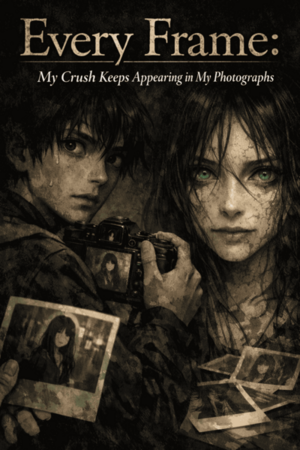
Every Frame: My Crush Keeps Appearing In My Photographs
The man who had saved him did not let go of the back of Makoto’s collar until Makoto was no longer trying to lunge forward.
It took a few seconds longer than it should have. Makoto was aware of the grip before he was aware of the voice, of the heat in the man’s hand, of the rough pull of fabric against his throat, of the awkward half step backward that turned into a stumble and then into balance again. The truck had already passed. The sound of it was still in the air somewhere, fading down the street with the same blunt indifference it had arrived with. People had begun to move again. A bicycle bell rang once. Somebody shouted at somebody else from somewhere behind a closed shopfront. The town, with its stupid patience, continued existing.
Makoto blinked hard and found himself staring at a pair of work-worn hands.
They were broad hands, the kind that had spent years opening drawers and lifting boxes. One thumb had a pale burn mark near the joint. The skin across the knuckles was sun-browned and dry. He followed the hands upward and found an older man crouched in front of him, breathing a little harder than he seemed willing to admit.
It was the old guy from the furniture shop.
Makoto swallowed and tasted dust.
“Hey,” the man said, still holding on. “You all right?”
Makoto tried to answer and discovered that his mouth was not as ready as his body had been to return.
Yuto was kneeling to one side, one hand braced on the pavement, the other hovering near Makoto’s arm without quite touching it. His breathing was uneven. He looked angry in the way he did when anger was the only thing standing between him and panic. He had the expression of someone who had been running not just from place to place but from the thought of what he might have arrived too late to stop.
“You idiot,” Reina said.
She was standing a short distance away, close enough to hear, far enough to look like she had placed herself there by force of will and irritation. Her hair had come a little loose at the temples. Her face was pale. There were tears gathered in her eyes that she had not let fall. She wiped at one of them with the heel of her hand and looked immediately annoyed that her own body had betrayed her.
Makoto looked at her and the sight of her made something in his chest tighten. Not relief. Not exactly. Something worse and softer than relief, something that made the memory of her voice at the shrine, the memory of her beside him at the bench, the memory of her saying his name in that calm, irritated, steady way, rush back into him all at once.
She was there. Right in front of his eyes. She was angry.
“What were you doing?” she said, and the edge in her voice cracked on the last word.
Makoto stared at her for a second too long. Then the old man who had caught him cleared his throat once, not unkindly, and looked from one face to the next with a patience that was beginning to thin in the corners.
“What is happening?” he asked. “Why would anyone jump at a road like that?”
Makoto opened his mouth.
Closed it.
He looked down at the pavement. The paint marking at the edge of the curb had peeled in one long strip. There was a crack in the asphalt near his shoe where weeds had begun to force their way through.
He had seen her.
He had seen the woman again, just for a second, and the second had been enough to pull everything else out from under him. The road, the light, the shape of the truck coming at him, all of it had stopped being part of the same world.
He could still feel the pull of that moment in his stomach.
He could still hear the sound of his own feet leaving the ground.
“We came here because of a photograph,” he said at last.
The old man stayed crouched, one hand still at Makoto’s collar. “A photograph?”
Makoto nodded once. It was easier to look at the pavement than at the faces waiting for him.
“Yeah,” he said.
The old man did not move. If anything, he became stiller.
Makoto continued, because once the sentence had started, he could not seem to stop it.
“We found it in an old archive. A photograph. A note. By someone. Pictures from this place. Of a woman. We were trying to find out who he was and what happened to her. We came because the trail led here.”
Yuto glanced at him, then at the old man, and made the smallest motion with his hand, as if he wanted to interrupt and could not decide whether doing so would help.
Reina folded her arms tightly across her chest. Her mouth had gone very thin. The tears remained in her eyes, bright and stubborn, as if she intended to keep them there out of spite.
The old man listened without changing expression. That was almost worse than surprise would have been. Surprise would have made him a person. This was the face of a man receiving information and placing it, quietly, into a box he had already prepared.
When Makoto finished, the silence that followed was uncomfortable in a way he could not immediately explain.
The street noise around them had returned to itself. A car rolled by. Somewhere a shutter rattled down. The town went on being ordinary. That ordinariness made the space between them feel larger.
Makoto became aware of how much the old man was still holding him. He lifted a hand to his collar, more to register that the fabric was still twisted there than to move it.
“Why were you there?” he asked suddenly.
The old man blinked once. “Hm?”
“Why did you come out?” Makoto heard the strain in his own voice and hated it. “You were in the shop.”
The man looked at him for a moment, then let go of the collar and rested back on his heels.
“I saw you,” he said.
He glanced toward the road, then back at Makoto. “Something felt wrong. Your eyes, mostly. There was a look in them that did not sit right. I have seen it before. Not often, but enough.” He paused. “You were moving like you had already left the street. I got curious. Then I saw you run.”
Curious.
The word landed strangely. Makoto looked at him more carefully now, at the way he stood, at the way he had answered, at the way he had not once asked who Reina was or why Yuto was there, as if all of that had already been accounted for.
The old man lifted one shoulder in a small shrug. “I had a bad feeling. So I ran.”
Makoto let that sit between them.
Then, because his mind refused to stop reaching for oddities, he heard the man’s words a second time and found the seam in them.
Something felt wrong. Your eyes.
As if he had known what to look for in a stranger’s face. As if he had been expecting it.
Yuto, who had been quiet for longer than usual, finally bowed his head deeply toward the old man.
“Thank you,” he said.
The words came out formal, a little stiff from the strain of having had to become proper in a hurry. He kept his head lowered for a moment longer than necessary, which made the gesture feel more sincere than polite. When he straightened, his face had settled into the determined calm he used when he was trying to keep the rest of them from falling apart.
He turned toward Makoto. “Can you stand?”
Makoto nodded before he had fully decided to.
He got his feet under him with Yuto’s help. The road lurched for a second, but he stayed upright. The old man watched him with that same measured attention, as if he were observing a fracture that might either hold or spread.
Reina came a step closer, then stopped. She looked like she wanted to say something sharp and failed to choose the shape of it. Her eyes were still wet. That seemed to make her angrier. The usual sharp Reina was hesitating to say her mind ever since they arrived at Natsume. And Makoto was aware that the reason was him.
“What were you thinking?” She said at last.
Makoto looked at her.
He did not know how to answer that.
He was saved from trying by the old man standing up.
He was taller than Makoto had expected. He dusted his palms against the front of his apron and glanced toward the road one more time, then back at them. The movement of it was practical, almost dismissive, but there was a slight tension in his shoulders now that had not been there when he had been crouched.
“All right,” he said. “You should leave, or something.”
Makoto stared at him.
“I can’t,” he said.
The old man regarded him with a neutral expression. “Why not?”
Makoto reached into the fold of his jacket without fully knowing he was going to. His fingers found the folded sheet he had kept there from the archive room, the copy they had made and handled too many times already. The edge had softened with use. He pulled it partway free and stopped, holding it against his palm.
“The Aiba sheet,” he said.
The old man’s eyes moved to the paper.
Then to Makoto’s face.
Then back to the paper again, with a concentration that was suddenly so intense it seemed to remove the air from the little gap between them.
“Aiba,” he repeated, as if trying the name against some private memory.
Makoto nodded once, uneasy now in a way that had nothing to do with the road.
“We found his name in the records,” he said. “We found the photograph. We came because he was the first link we could find.”
The old man did not answer immediately. His face had gone unreadable in the practical, unhelpful way some people’s faces did when the thing they had been carrying privately was finally touched by someone else. The look in his eyes was not fear, exactly. It was not surprise either. It was something older and less forgiving than either of those.
Yuto looked between them. Reina stopped pretending not to listen.
The old man took one step closer.
Then another.
When he was standing directly in front of Makoto, he reached out and took the paper from his hand. His fingers brushed Makoto’s for a second, and something in that touch was wrong enough to make Makoto’s skin prickle.
The old man looked at the sheet once, and then he smiled in a way that did not belong to his mouth alone. It was small and tired and not at all kind.
“I am Aiba,” he said.
Makoto did not understand.
Not at first.
The name sat in the air without meaning, then began to gather one around it by force of repetition. Aiba. The sheet. The old photograph. The old records. The photograph of a woman and the name at the edge of the frame. The town. The shop. The man who had saved him from the road.
He looked at the old man’s face again.
At the silver beard, the scarred hand, the sharp eyes.
At the way he was still holding the paper.
And just as Makoto tried to make the shape of the thing fit, the old man folded the sheet once, very carefully, and tucked it under his arm.
“Now,” he said, as if the conversation had only just begun, “you can tell me what exactly you think you found.”








Please sign in to leave a comment.