Chapter 22:
What Was Always There
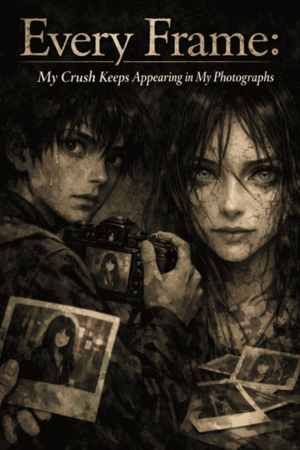
Every Frame: My Crush Keeps Appearing In My Photographs
The room was very quiet.
Makoto thought of frame seven.
He thought of the contact sheet from the laundromat. Room C. The reflected enlarger glass. The puddle on the walk out of the cemetery, and the fourth shape in it, always behind him, always closest to him.
He thought of himself running into traffic in the street of a small town.
“Mamiya’s figure,” Shinohara said. “It was not Sayo. I know that now. It had Sayo’s shape because Sayo’s shape was what I had described to him, over years of evasion and careful misdirection, as the figure others had seen. He borrowed her face for his own grief. The camera obliged.”
Makoto felt something settle in him.
Not comfort.
Understanding.
The cold specific clarity of a mechanism revealed.
“The camera,” Shinohara said, “does not haunt. It does not hold the dead. It holds the living. It holds what the living are looking for. And when the living cannot stop looking, the camera cannot stop finding.”
He looked at Makoto steadily.
“You were looking for someone,” he said.
Makoto did not answer.
He did not need to.
Shinohara glanced at the camera around Makoto’s neck.
“The figure in your frames,” he said. “In frame seven. In the laundromat print. In Natsume. She was not Sayo. She was not your mother. She was the shape the camera made when you needed her to still be somewhere and you could not find her anywhere else.”
The room held that.
Makoto thought about the figure in the lower left corner of frame seven. Dark hair. Facing the camera. The stillness that did not belong to interruption but to placement. The posture that had stopped him at three in the morning with his face too close to the tray.
She looked placed.
He had written that.
She was placed.
He had placed her there.
Not consciously. Not with malice. With grief that had learned, from a long time of having no other outlet, to speak through a camera.
Aiba spoke for the first time since Shinohara had begun.
He did not step forward.
He spoke from the wall, quietly, as if the words were not meant for the room but he was allowing the room to hear them anyway.
“She told me once,” he said, “that the only honest photographs were the ones where the photographer did not know what they were trying to say.”
He looked at the floor.
“She said the photographs where you knew exactly what you meant were always slightly false. Because knowing what you mean is a kind of control. And photographs that are controlled tell you what to see instead of showing you what is there.”
He paused.
“She said the best frames were the ones where the camera understood something the photographer was not ready to understand.”
He looked up.
Not at Makoto.
At the wall.
“I think about that,” he said. “When I look at the photographs I took of her. The ones where she is at the edge. I did not know, when I took them, what I was trying to say. I only knew I wanted her in the frame. I wanted her to exist in a frame that I had made, in a world I had chosen, in light I had decided was right.”
He stopped.
“She disappeared,” he said. “And I understood. The photographs were not about her. They were about me. About what I could not hold. The camera had known before I did.”
The silence after that was different from the silences before it.
It was the silence of something that had been said for the first time.
Not because Aiba had not known it.
Because knowing and saying were different, and he had needed thirty years and a room full of the right people before saying became possible.
Makoto looked at the camera around his neck.
He thought about the assignment.
Negative Space. One roll. No corrections after the fact. Find what absence does to a place.
He had thought it was an assignment about emptiness.
He understood now it was an assignment about the opposite.
Shinohara had not given it to him to teach him about photographic technique.
He had given it to him because he had looked at Makoto in the first week of semester, at the careful notebooks and the empty frames and the method built to keep the world at a specific distance, and he had seen what was underneath it. He had seen a photographer whose camera was looking for something the photographer had forbidden himself to name.
He had given him a roll of film and pointed him toward the city and waited to see what the camera found.
The camera had found her.
The camera had found her in the first roll, in the first month after she died, and Makoto had stood in his darkroom and watched her appear in the developer tray and called it a mystery.
It was not a mystery.
It was the most honest photograph he had ever taken without knowing he was taking it.
He looked at Shinohara.
“You knew from frame seven,” he said.
Shinohara nodded.
“Why did you not stop it?”
Shinohara was quiet for a moment.
“Because I stopped it with Mamiya,” he said. “I intervened. I managed it academically. I gave it a name it could not survive being given. And Mamiya broke before he could understand what he was looking for.”
He looked at Makoto.
“I thought,” he said, “that if I let you follow it, if I gave you the Aiba sheet, if I arranged for you to come here, if I let the investigation find its own ending, you might arrive at the answer before it became impossible to receive.”
“And if I had not?”
Shinohara held his gaze.
“Then I would have failed again,” he said.
The plainness of it.
No self protection in it.
Just the fact.
Makoto looked at him for a moment.
He thought about Mamiya in a facility hours away from Tokyo. He thought about the records and the darkroom logs and the entry that said review printing written in the same handwriting six times in two weeks. He thought about a student who had gotten close and broken before he arrived.
He thought about running into a road in Natsume.
He thought about how close it had been.
“The figure,” he said. “In Mamiya’s photographs. Who was he looking for?”
Shinohara shook his head.
“I never knew,” he said. “He never told me. And then he could not tell me.”
The unresolvability of that.
Some things did not get answered.
Some people broke before the answer arrived.
He looked at the camera.
He thought about what Aiba had said. The photographs where you knew exactly what you meant were always slightly false.
He thought about frame seven.
He had not known what he meant when he shot it.
He had not known what he meant when he stood in the northern section of the cemetery on an April afternoon with the assignment sheet in his notebook and the city outside the walls going about its ordinary business. He had known about negative space and the weight of absence and the way an empty frame could carry a subject more honestly than a full one.
He had not known that the camera would find her.
He had not known she was what he was looking for.
The camera had known.
The camera had found her in the lower left corner of frame seven and it had found her again in the reflected glass of an enlarger in Room C and in a puddle on the walk out of a cemetery and in the streets of a town he had traveled to looking for a different answer.
The camera had been trying to show him something from the first frame of the first roll.
He had called it a mystery.
He had built an investigation around it.
He had followed it through records and archives and other people’s grief and close calls and old buildings in small towns.
And here was the room the investigation had always been heading toward.
Here was what the camera had kept.
Not a ghost.
Not a haunting.
Not a woman who appeared at the edges of frames because something supernatural had pressed her there.
Just a photographer who could not let someone go.
And a camera that would not stop looking until the photographer could.
He reached up and put his hand on the camera body.
He stood in the old building in Natsume in the full dark of the evening and he held the camera and he let himself understand what it had been trying to show him.
Not Sayo.
Not the figure in the frames, not the girl in the lower left corner of frame seven, not the shape that appeared in reflected surfaces and moved through streets just ahead of him and stood still in shrine courtyards and laughed, once, in a cemetery at dusk.
Not any of those things.
His mother.
The camera had been looking for his mother since April.
Since the first roll. Since the assignment. Since he stood in the northern section of the cemetery on an afternoon that smelled of damp stone and distant traffic and pointed the lens at a composition he had metered and checked and cleared and the camera had found her anyway. In the lower left corner. Where he had not put her. Where he never would have put her. Where the camera put her because the camera knew what the eye was searching for even when the eye refused to know.
He had photographed her dying.
He had stood in that room with the language she had given him, a camera is the only honest way I know to say I love something, and he had used it in the moment he had nothing else left to use. He had said goodbye in the only language he had. And then he had sealed the language. He had built a method that forbade it. He had turned the camera away from every face for years because the last face he had photographed was hers.
And the camera had not accepted the prohibition.
The camera had kept looking.
Every empty frame was a frame she was not in. Every checked edge was a sweep she was not at the border of. Every cemetery, every doorway, every strip of pale sky between stone and branch, the camera had gone to every place she might have stood and found her not there and found her not there and found her not there.
Until frame seven.
Where the grief had finally accumulated enough that the camera pulled something from the available materials, a shape, a stillness, a quality of presence, and produced it in the lower left corner of a frame he had cleared.
Not a ghost.
Not a haunting.
Not Sayo.
His mother.
Refracted through the years and the camera and the method and the investigation until she was unrecognizable. Until she was a mystery. Until she was something to chase through archives and small towns and the reflections of enlarger glass.
He had been looking for her the whole time.
He had called it negative space.
He had called it an investigation.
He had called it many things.
The camera had been trying to tell him what it was since April.
He looked at the camera in his hands.
His mother’s hands had held this camera.
His mother’s eye had looked through this glass.
She had stood in the kitchen with the strap around her neck and laughed at his lists and told him that the day was a room he could prepare before entering and she had been right and she had been wrong and she had been gone for long enough now that both things had settled into something he could carry.
He had not been carrying it.
He had been photographing around it.
And now, standing there with the old camera warm in his hands, he understood that he had not been put back at the beginning by this realization. The beginning had been in him already. It had been in the way he looked. In the way he waited. In the way he trusted a frame more than a face. In the way he knew how to stand at the edge of something and not enter it unless the light made permission.
He felt the shape of that knowledge change in him.
Not disappear.
Change.
It did not ask to be put down entirely, not yet. Maybe not ever. But it was something he could now carry without pretending it was anything other than what it was.
A way of looking.
A way of missing.
A way of saying, I see you, to the person who had taught him how to see in the first place.
And somewhere behind the first wound, farther back than he had known to look until now, was the girl in the frames, the mystery, the town, the investigation, all of it, and they were not erased by this truth. They were only recast by it. The shape had changed. The center had moved. The frame was the same, but what it held had become clear.
His mother had been the beginning.
That was what the camera had been trying to tell him.
That was what he had finally heard.









Please sign in to leave a comment.