Chapter 1:
Destiny or command
O NO JIDAI
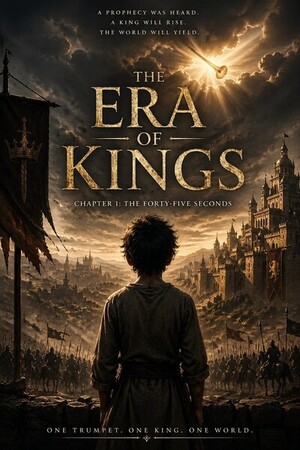
THE ERA OF KINGS
Chapter 1: destiny or command
⸻
Part 1 — The Trumpet
The chapter opens in the ancient world, around 500 BCE, in a fictional era inspired by Mesopotamia, early European kingdoms, city-states, temples, warlords, slave routes, and rising empires.
This period would later be called:
The Trumpet Era
The First Trumpet lasted forty-five seconds.
During those forty-five seconds, every awake person in the known world heard something in the sky.
But what they heard was not the same.
Some heard words clearly.
Some heard only sound.
Some heard the message in their own language.
Some felt pressure in their bones.
Some were asleep and heard nothing at all.
That difference became one of the first great arguments of the era.
If heaven wanted all mankind to hear, why did some people sleep through it?
⸻
The Prophecy
The most accepted version says:
In the year the First Trumpet sounds, a king shall rise.
When the Seventh Trumpet sounds, the world shall yield beneath one rule.
The greatest among kings shall be given authority over mankind.
But other versions exist.
One version says the king has already been chosen.
Another says the king has not been chosen yet, and must prove himself by conquering the age.
Another says the prophecy does not speak of one man, but of one nation.
Another says the trumpet was not divine, but a deception sent by spirits, priests, or enemies.
Another says there was no message at all, and that men created the words afterward because they wanted war.
The prophecy does not tell everyone what to do.
It gives ambitious people an excuse.
⸻
Page-by-Page Chapter Outline
Pages 1–4: The Sound
The chapter opens with quiet scenes across the world.
A king receives tribute.
A slave carries stone.
A woman gives birth.
A priest prepares incense.
A soldier washes blood from his hands.
A merchant counts silver.
A child sleeps beside a dying fire.
Then the sky makes a sound.
Not thunder.
Not music.
Not language exactly.
For forty-five seconds, everyone awake stops moving.
Some fall to their knees.
Some cover their ears.
Some cry.
Some laugh because they believe they have been chosen.
Some feel terror because they understand that every ambitious man in the world has just been given a reason to move.
Narration:
Later generations would argue over what was heard.
The priests wrote that heaven had spoken.
The kings wrote that heaven had granted permission.
The poor remembered only that the powerful became restless.
⸻
Pages 5–8: Different Interpretations
Different kingdoms react in different ways.
In one empire, priests declare:
“The king has already been born. All children of the trumpet year must be recorded.”
In another kingdom, a general says:
“No child rules the world. Power chooses the man strong enough to take it.”
Inside a temple, scholars argue over the wording.
One scholar says:
“It says the world shall yield beneath one king. It does not say that king exists yet.”
Another replies:
“It says the First Trumpet marks his rise. A rise can begin before a crown.”
A skeptical noble interrupts:
“My brother slept through the whole thing. If the gods wanted mankind to hear, why speak in the hour when half the world dreams?”
No one truly knows what the prophecy means.
That uncertainty begins the wars.
⸻
Pages 9–10: The World Becomes Dangerous
The consequences spread quickly.
Kings begin registering children born that year.
Midwives are paid for names.
Assassins receive quiet orders.
Nobles hide sons who are too intelligent.
Small villages are questioned by traveling priests.
Border wars begin under the excuse of testing heaven’s favor.
Narration:
The trumpet did not crown a king.
It made every crown afraid.
The story leaves the great world behind and moves to a village too small for kings to care about.
⸻
The Village
Khirun
Khirun is poor, rural, and outside the direct protection of the major kingdom.
The village has no great walls, no famous temple, no army, and no noble bloodline.
The people know about the trumpet, but they do not fully understand it.
For them, prophecy is not philosophy.
It is danger.
When kings become afraid, villages pay first.
⸻
Ashoka’s Family
Tavan
Ashoka’s father.
A poor worker, part farmer and part carpenter.
He is not educated like a noble, but he understands people deeply.
He teaches Ashoka through questions.
⸻
Liora
Ashoka’s mother.
Practical, loving, emotionally intelligent, and quietly strong.
She understands danger before others say it aloud.
She knows Ashoka is too kind for the world they live in.
⸻
Pages 11–18: Ashoka Wakes Up
Ashoka wakes in a small house with cracked clay walls and a roof that leaks when it rains.
His family is poor, but the home feels alive.
His mother is already working.
His father has left early to repair a plow for another family.
Ashoka wakes late and tries to act as if he meant to.
Liora tells him to help grind grain, carry water, and deliver bread to an old woman nearby.
Ashoka complains a little, but he does the work.
He talks with villagers.
He gives part of his food to a younger child.
He helps an old man cross a muddy path.
When Liora notices he gave food away again, she does not immediately praise him.
She worries.
Liora says:
“Kindness is good, Ashoka. But kindness without judgment can be used by people who have none.”
Ashoka answers honestly:
“If someone needs help, am I supposed to first decide whether they deserve it?”
Liora does not have an easy answer.
The scene shows that Ashoka’s kindness is not foolish.
It is beautiful, but dangerous in a cruel system.
⸻
Pages 19–26: The Father’s Test
Ashoka finds Tavan repairing a broken cart near the edge of the village.
Tavan lets Ashoka help him hold the pieces in place.
While they work, Tavan tests him.
Tavan asks:
“In a kingdom, who fights?”
Ashoka answers:
“Soldiers.”
Tavan nods.
“Who blesses the soldiers before they leave?”
Ashoka answers:
“Priests.”
Tavan asks:
“Who owns the storehouses, the caravans, and the silver used for trade?”
Ashoka thinks.
“Nobles. Merchants too, if the king allows them.”
Tavan notices that answer.
He continues.
“Who writes the laws?”
Ashoka says:
“Scribes.”
Tavan asks:
“Who grows the grain?”
Ashoka says:
“Farmers.”
Tavan asks:
“Who builds the roads and walls?”
Ashoka says:
“Workers. Prisoners sometimes. Slaves in some places.”
Tavan becomes quiet for a moment because Ashoka noticed the ugly part.
Then Ashoka asks:
“If everyone else does those things, why does everyone bow to the king?”
Tavan does not answer quickly.
He keeps working on the cart.
Then he says:
“Because a kingdom is not held together by the man who does the most work. It is held together by the man everyone agrees to fear, need, or believe in.”
Ashoka listens, but does not fully understand.
Tavan continues:
“A soldier has a sword, but he needs someone to tell him where to point it. A priest has the gods, but he needs someone to protect the temple. A noble has grain, but grain rots if roads are not safe. A farmer feeds the kingdom, but hunger makes farmers easy to crush. The king sits above them because each of them fears what the others would become without him.”
Ashoka frowns.
“So the king is important because people are afraid of each other?”
Tavan looks at him.
“Sometimes. A better king makes people believe they are safer together than apart. A worse king simply makes each group too afraid to move without permission.”
Ashoka is silent.
He is too young to fully understand, but he senses something large.
Then he asks:
“Then is a king strong because he has power, or because everyone thinks he does?”
Tavan stops working.
The question surprises him.
He looks at Ashoka for a long moment.
“That question will trouble you more when you are older.”
⸻
Pages 27–30: The Trumpet Reaches the Village
Later, Ashoka and Tavan return to the village.
The adults are discussing the trumpet.
One man believes the prophecy means a king has already been chosen.
Another says the strongest king will receive the world after proving himself.
An old woman says the message is false because her husband slept through it.
A traveling peddler says some kingdoms have started checking birth records.
Another villager says:
“If kings are looking for one child, then every child has become dangerous.”
Liora hears this and becomes tense.
Ashoka asks:
“Why would a child be dangerous?”
No one answers comfortably.
Tavan finally says:
“Because men who want power are often more afraid of what may happen than what has happened.”
The world is becoming unsafe around Ashoka before he understands why.
⸻
Pages 31–36: Ashoka’s Ordinary Goodness
Ashoka helps his mother prepare food.
He asks why people judge strangers.
Liora says:
“Because judging quickly feels safer than understanding slowly.”
Ashoka asks:
“Is it safer?”
Liora answers:
“Sometimes. That is the problem.”
Later, Ashoka helps deliver water.
He sees children playing a war game with stones.
One child says the king wins because he has the biggest army.
Ashoka changes the game by moving stones around the water supply.
The other children complain because he did not attack directly.
Ashoka says:
“If the army cannot drink, the army becomes smaller without anyone dying.”
The children do not find it exciting.
An older villager watching nearby notices.
Ashoka thinks in systems.
⸻
Pages 37–42: Ashoka Finds the Injured Man
Ashoka goes near the river or dry road outside the village to collect something for his mother.
He hears breathing.
Not a scream.
A weak, controlled sound.
He finds a man lying near the reeds.
The man is dirty, wounded, and wearing clothing from another culture.
His accent is different.
His tattoos and jewelry mark him as someone from a rival people.
The man says he came from a fight on the nearby road.
He says traders were attacked.
He says he escaped but may be followed.
Ashoka is cautious.
He asks:
“If the fight was on the eastern road, why did you come from the north path?”
The man pauses, then answers:
“Because the men who attacked us stayed on the road. I followed the dry riverbed until I no longer heard horses.”
The answer is believable.
Ashoka asks:
“Why not go to the village openly?”
The man looks toward the village and then away.
“Because people do not ask who you are before deciding what you are.”
Ashoka understands this because of earlier conversations.
The man says his people are judged badly in this region.
He says if the villagers see his markings, they may hand him over, refuse him help, or blame him for the fight.
He does not sound like a villain.
He sounds like someone who has lived through prejudice.
That is how he begins gaining Ashoka’s trust.
⸻
The Injured Man
Veyr
Veyr is the name he gives Ashoka.
It may not be his real name.
He is intelligent, patient, and emotionally observant.
He does not manipulate Ashoka through obvious evil.
He manipulates him through partial truths.
A skilled liar does not build trust with pure lies.
He uses truths that lead someone toward the wrong decision.
⸻
Pages 43–48: Veyr Gains Ashoka’s Trust
Ashoka gives Veyr water.
Veyr thanks him quietly.
He asks Ashoka’s name.
Ashoka hesitates, then tells him.
Veyr says:
“Your parents raised you well.”
Ashoka does not know how to respond, but the compliment affects him.
Veyr asks if Ashoka’s village has guards.
Ashoka does not answer immediately.
He notices the question is strange.
Veyr sees the hesitation and adjusts.
“Forgive me. I asked because if the men who attacked me come here, I do not want to bring danger to people who gave me water.”
The answer makes emotional sense.
Ashoka relaxes.
Veyr is not forcing information out of him.
He is making Ashoka feel responsible.
Veyr tells him:
“You should not tell your village I am here yet.”
Ashoka asks why.
Veyr says:
“Because if they fear my people, they will not see a wounded man. They will see an old story they were taught to hate.”
Ashoka remembers his mother saying people judge quickly because it feels safer.
Veyr continues:
“Let me rest until night. If I can walk, I will leave before your village has to decide whether I deserve mercy.”
Secrecy begins to sound compassionate.
Ashoka says he can bring food.
Veyr refuses at first.
Ashoka insists.
The trust deepens.
⸻
Pages 49–52: Ashoka Lies for the First Time
Ashoka returns home late.
Liora notices.
She asks where he was.
Ashoka says he took longer near the river.
It is not a full lie, but it is not the truth either.
Liora studies him.
She senses something.
Tavan watches quietly too.
At dinner, the family talks about the prophecy again.
Tavan says that when powerful men become afraid, truth becomes something they purchase.
Ashoka asks what that means.
Tavan explains:
“A king can pay a priest to say the gods favor him. A noble can pay a witness to remember the wrong thing. A frightened crowd can pay with silence. Truth does not disappear all at once. It is usually traded away by people who believe they had no choice.”
Ashoka becomes uncomfortable because he is hiding Veyr.
He does not yet understand that he has begun trading truth for mercy.
⸻
Pages 53–56: Night Visit
Ashoka secretly brings food to Veyr.
Veyr looks better than before, but still weak enough to seem harmless.
They talk.
Ashoka asks:
“Were the men chasing you because of what you did or because of where you came from?”
Veyr smiles sadly.
“In this world, those are often treated as the same thing.”
Ashoka asks if he has family.
Veyr says he once did.
Ashoka asks what happened.
Veyr says:
“Men with banners came and explained that we were on the wrong side of a border.”
Ashoka becomes sympathetic.
Veyr presents himself as a victim of war, a man judged by kingdoms, and someone who lost family.
The difference is that Veyr chose to become part of the cruelty.
Ashoka has not learned that yet.
⸻
Pages 57–60: Veyr Studies the Village
While speaking gently, Veyr gathers information.
He asks where the road patrols usually pass.
Ashoka says they rarely stop in Khirun.
Veyr asks whether the village elder keeps a night watch.
Ashoka says Old Rem watches, but mostly to scare off animals.
Veyr asks about the north path.
Ashoka says carts cannot use it, but people can.
Ashoka becomes suspicious again.
He asks:
“You ask many questions about leaving.”
Veyr does not panic.
He answers:
“Because staying near kind people is dangerous when cruel people are looking for you.”
The answer makes Ashoka feel guilty for suspecting him.
Veyr knows how to turn Ashoka’s conscience against his judgment.
⸻
Pages 61–64: The Last Family Scene
Ashoka returns home.
His parents are awake.
Liora does not scold him immediately.
She asks him to sit.
Tavan asks whether Ashoka knows the difference between mercy and trust.
Ashoka says:
“Mercy is helping someone. Trust is believing them.”
Tavan asks:
“Can you give one without the other?”
Ashoka thinks.
He says:
“I don’t know.”
Tavan says:
“Most adults do not know either. That is why the world is full of graves made by good intentions.”
Ashoka feels exposed.
Liora touches his hair and tells him he can tell them anything tomorrow if something is weighing on him.
Ashoka almost tells them.
But he thinks of Veyr being judged, beaten, or handed over because of his culture.
So Ashoka says nothing.
His silence comes from compassion, not selfishness.
⸻
Pages 65–68: The Betrayal
Late night.
The village is quiet.
Veyr rises inside the abandoned hut.
He removes the bandage from his arm.
The wound is real, but shallow.
He was never as helpless as he appeared.
Another man waits outside in the dark.
He asks Veyr whether the village is guarded.
Veyr says:
“Barely.”
The man asks about the north path.
Veyr says:
“Open. Too narrow for carts, but wide enough for men.”
The man asks about children.
Veyr does not answer immediately.
The man understands anyway.
Veyr looks toward Ashoka’s house.
For a moment, he seems conflicted.
Not enough to stop.
He is not a monster without thought.
He is a weak man who chooses survival, greed, loyalty, or fear over the child who helped him.
He walks to the village gate.
Old Rem, the watcher, is asleep.
Veyr slowly lifts the wooden latch.
The gate opens.
Outside, armed men wait without torches.
They enter quietly.
The attack has not fully begun.
Ashoka sleeps inside his home.
Tavan is still awake, noticing a sound outside.
At the village gate, Veyr steps aside and lets the men in.
No speech.
No announcement.
Only the gate opening.
End of Chapter 1



Please sign in to leave a comment.