Chapter 0:
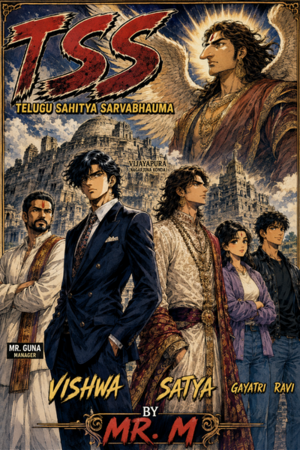
TSS: Telugu Sāhitya Sārvabhauma prologue: into the world of TSS
TSS: Telugu Sāhitya Sārvabhauma (Supreme Sovereign of Telugu Literature)
TSS: Telugu Sāhitya Sārvabhauma
Prologue: Into the World of TSS
4998 CE: India, Andhra
Location: Vijayapuri
The neon veins of Vijayapuri throbbed against the obsidian sky.
Once, this soil was the proud bastion of Andhra kings and the seat of mighty empires like the Andhra Ikshvakus and the Vishnukundinas. Today, it was an overwhelming, gravity-defying monolith of the future. Towering skyscrapers pierced the clouds, their facades painted in blinding holographic advertisements. Flying vehicles sliced through the air in perfect, automated synchronicities, weaving between multi-tiered hyper-highways that spanned the heavens. It was an era of peak human achievement, an advanced world of hyper-technology.
Yet, beneath the electric glow of the floating billboards, something vital was suffocating. The ancient glory, the grand history, and the sacred cultural soul of the land were being methodically erased, buried under layers of synthetic gloss. Was there any true identity left for a city that had traded its historical roots for cybernetic neon?
But this alternate Earth possessed a unique, absolute law—one far different from our world.
Here, the written word was not merely art. It was supreme.
Since the glorious reigns of the Eastern Chalukyas to the golden age of the Vijayanagara Empire, the Telugu literary arts had held a position of unmatched reverence within the royal courts. But in this alternate timeline, that literary power had evolved into something absolute. The Writing Industry sat at the absolute apex of civilization, towering over cinema, television, and state politics. In Vijayapuri, the undisputed capital of this industry, what was written became reality. A single story could dictate political elections, shape societal morals, and alter the cultural fabric. Every movie, every television series, and every animated epic was merely a subservient byproduct of the writer's pen.
To rule the Writing Industry of Vijayapuri was to be the unvanquished, uncrowned emperor of the world.
For eight uninterrupted years, that throne had belonged to one man: Vishwanath.
To the mesmerized masses, he was simply known as Vishwa.
Vishwa was no longer just a name; it was an invincible monolithic brand. Eight years ago, at the tender age of twenty, he had shattered the literary landscape. He took the ancient, philosophical trope of Punarjanma—reincarnation—and twisted it into a highly commercialized, addictive genre alien to the soil. He stripped away the profound karmic weight of the concept and replaced it with power-fantasies, foreign world-building, and detached modern escapism that had absolutely nothing to do with Telugu history or culture.
That very year, at twenty, he achieved the impossible: he was awarded the Telugu Sāhitya Sārvabhauma—the Emperor of Telugu Literature—the absolute highest honor in the entire industry. To hold that award was to hold the keys to the kingdom.
Vishwa’s ascension struck the literary world like a cataclysmic tidal wave. His newly engineered genre spread like a virus. Under the massive, inescapable shadow of his commercial success, the true pillars of Telugu literature—its ancient history, deep-rooted traditions, and spiritual devotion—began to wither away. Over eight years, they faded into near-extinction, systematically pushed into the dark corners of forgotten libraries.
The industry followed the money. Sensing the shift, thousands of lesser writers began copying Vishwa's blueprint. The market was flooded with cheap, mass-produced imitations of his reincarnation genre. The psychological impact on the younger generation was devastating. The youth grew up intoxicated by this artificial, borrowed escapist fantasy world, completely blind to their own civilizational heritage. And at the center of this illusion sat Vishwa, ruling his eight-year empire with an iron, uncontested grip.
Then, out of the shadows of anonymity, walked a man named Satya.
Satya Harishchandra.
He did not possess an empire, but he carried a burning fire. Satya watched with bleeding eyes as the ancient civilizational grandeur, the sacred devotion, and the mother-like cultural identity of Telugu civilization were being systematically strangled. To him, copying foreign tropes and abandoning one's roots was a form of cultural suicide—leaving the society as nothing more than a hollow, second-class imitation of someone else's identity. He firmly believed that a writer's pen must draw its ink from the deepest wells of their own ancient roots and ancestral spirit. He entered the arena not to compete, but to tear down the foundations of Vishwa's artificial empire by writing stories inspired by the raw, glorious, and untainted truth of ancient culture, history, sacred devotion, and civilization.
The stage was set for an apocalyptic clash of intellects. Two entirely different worlds. Two irreconcilable philosophies.
On one side stood Vishwa, the undisputed literary emperor who had dictated the minds of millions for eight long years. On the other stood Satya, an ordinary commoner armed only with the forgotten truths of a glorious past.
Who will conquer? Who will survive the brutal political and cultural warfare of the ink? Who will ultimately claim the supreme title of The Telugu Sāhitya Sārvabhauma?
And what catastrophic ripples will their battle send through the fabric of reality? For the stakes of this literary war are so unprecedented, the corruption so deep, and the preservation of truth so vital, that even the Heavens could not remain silent.
Why must the Divine itself manifest and descend onto this mortal earth to witness this conflict?
See it. Read it. Feel it.
Welcome to the world of TSS: Telugu Sāhitya Sārvabhauma.
[End of Prologue]






Please sign in to leave a comment.