Chapter 1:
The Telling
The Seventh Researcher
The old woman's name was Esther.
She was ninety-three years old. She'd been Branded for sixty-seven of those years. Her Brand was minor—she could calm people with a touch, ease their fear, slow their heartbeats. The Registry had never bothered with her. She was too small. Too insignificant. Too useful to the neighbors who came to her when their children had nightmares or their spouses were dying.
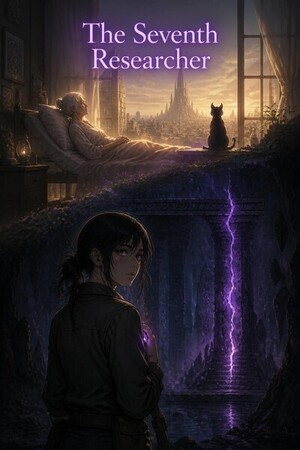
She lived in a small apartment in Sector 4 with a one-eared cat and a window that looked out over the Stacks. The cat was named Misfortune. Esther had found her in an alley twenty years back, half-dead and missing an ear, and had nursed her back to health with the same steady patience she brought to everything. The cat repaid her by ignoring her completely during the day and sleeping on her chest at night, a warm weight that reminded Esther she was still alive.
She was dying now. She'd known it for weeks. The doctor had used words like "progression" and "comfort measures" and "time." Esther had nodded along, asked no questions, and gone home to her cat and her window and the slow, quiet work of leaving.
Her granddaughter, Lena, sat beside her bed. Lena was twenty-six. Un-Branded. She'd spent her whole life waiting for a mark that never came, half-relieved and half-disappointed. She held her grandmother's hand and tried not to cry.
"Don't do that," Esther said. Her voice was thin. Papery. "You'll make me feel guilty. I've got enough of that already."
"Guilt for what?"
Esther closed her eyes. For a long moment Lena thought she'd fallen asleep. Then she spoke.
"There were seven of us."
---
Sixty-seven years earlier, Esther was twenty-six.
She was the youngest of the seven scientists brought together by a discovery that didn't fit any of their disciplines. The facility was a converted mining outpost in the foothills, three hours from the city by dirt road. It had been abandoned for decades before Dr. Haas found it—or rather, before he found what was beneath it. He'd been following a trail of Indigenous legends that predated colonization, stories about a door in the mountain. The stories were folklore, as far as the team was concerned. Interesting context. Nothing more.
The others were older, more established. Voss led the team—tall, pale-eyed, with a voice that carried. Chen was the geologist, quiet and exact. Okonkwo was the physicist, the one who asked the questions no one else thought to ask. Morrow was the linguist. Patel, the biologist. Haas was the archaeologist who had found the site in the first place, and he still wore the find like a medal.
And Esther was the anthropologist. The one who was supposed to understand the cultural context of what they'd found. The one who argued, from the very beginning, that they should study the site from a distance.
"It's a door," Haas said on the first day, standing at the edge of the cavern, hands on his hips. The chamber was vast—a natural formation, limestone and granite, worn smooth by centuries of underground rivers long since dried. The gate stood at its center, rising from the stone floor. Two pillars. A crossbeam. A pool of dark water at its base. "It's been sealed for thousands of years. Look at the craftsmanship. Look at the inscriptions. This is the discovery of a lifetime."
"The inscriptions don't match any known language," Esther said. "We don't know what this structure is or why it was built. We should proceed carefully."
"Of course we should. We're scientists." Haas turned to her with a smile. "We follow the evidence."
---
The gate was made of stone that didn't match any local geology.
Esther had spent her career studying ancient structures. She'd excavated temples in Peru, burial mounds in Siberia, cave systems in the Sahara. She knew what old things looked like. She knew how they felt when you touched them.
The gate was different. The left pillar was solid, carved with symbols that repeated in patterns. The right pillar was cracked down the center, and the crack seemed old—not damage, but design. The crossbeam was intact. Beneath the gate, pooled in a depression in the stone, was water. Dark water. Still water.
"The water isn't evaporating," Chen said on the third day. "The humidity in this cavern should have dried it out centuries ago. But it's still here. Same level. Same volume."
"Maybe an underground source is feeding it," Patel said.
"There's no source. I checked. It's just sitting there."
Esther stood at the edge of the pool and looked down. Her reflection was faint, distorted by the dark of the water. The symbols on the pillars reflected on the surface, their shapes wavering with the ripples from her breath.
"We should document everything," she said. "Take samples. Run tests. But we shouldn't touch the structure itself until we understand more."
"That's the plan," Voss said. "We study first. We act later."
---
They studied the gate for two years.
They took samples. They ran tests. They catalogued the symbols on the pillars and cross-referenced them with every known writing system. They found nothing that matched. The stone wasn't local. The water wasn't stagnant. The symbols weren't language—not pictographic, not ideographic, not syllabic, not alphabetic. They were something else. A sequence. A pattern.
Morrow was consumed. She stopped sleeping. She stopped eating. She'd sit in front of the pillars for hours, sketching the carvings, muttering to herself. "It's repeating," she said one night, her eyes bloodshot. "The sequence. It's the same on both pillars. Over and over. Like a key. Like a combination."
"A combination for what?" Esther asked.
"I don't know. But the pattern is there. I can prove it."
Esther felt it at the back of her teeth—a pressure, a wrongness she couldn't name. A sense that the gate was more than a structure. That the symbols were more than decoration. She had no evidence. No data. Just a feeling that grew stronger the longer they stayed.
She tried to raise it. She pulled Okonkwo aside one evening.
"We've been here two years," Esther said. "We've documented everything. We've taken samples. We've run every test the equipment allows. I think we should publish our findings and request additional resources."
"Voss won't agree to that," Okonkwo said. "He wants results. The funding isn't indefinite."
"The results are that we've found an unprecedented archaeological site. That's worth publishing."
"It's worth publishing if we can explain what it is. We can't. Not yet." Okonkwo rubbed her forehead. "Morrow's sequence is compelling. If she's right—if the symbols really are some kind of combination—we might be able to open it."
"We don't know that it's meant to open."
"Then what's it for? Why build a door that doesn't open?"
"I don't know. But I know we're not ready to answer that question."
Okonkwo was quiet a moment. "I understand your caution. But Voss will push for a vote. And I don't think you'll win."
---
The vote happened on a Thursday.
They were gathered in the facility's common area, around a table cluttered with notes and photographs and half-empty coffee cups. Voss stood at the head of the table. Morrow sat beside him, her sketches spread across it.
"I've completed the analysis," Morrow said. Her voice was hoarse. "The symbols correspond to specific tones. Frequencies. If we generate those frequencies in the correct order, the structure may respond. The pattern repeats on both pillars. The correlation is strong."
"May respond," Esther said. "Not will."
"The methodology is sound. I've documented every step."
"You're proposing we activate an unknown structure based on a translation of symbols we've never encountered. We don't know what they mean. We don't know what the sequence is meant to do."
"That's the point," Voss said. "That's why we proceed. The only way to test the hypothesis is to attempt it."
Esther looked at the others. Chen wouldn't meet her eyes. Patel was nodding slowly. Haas was already pulling out his notes. Morrow stared at the table. Okonkwo looked uncertain, but she didn't speak.
"We take a vote," Voss said. "All in favor of proceeding with the activation attempt."
Six hands went up. Esther kept hers in her lap.
"Then it's settled. Tomorrow morning." Voss began gathering the notes. "We attempt activation."
Esther didn't move. Her hands stayed folded in her lap, her eyes fixed on the table. She'd known for weeks. But somewhere in the back of her mind, she'd believed—childishly—that someone would listen. That someone would look at the data and see what she saw. That someone would choose patience.
No one had. No one would.
She stood and walked out of the common area without speaking. No one called after her. She walked through the dark, past the barracks, past the supply tents, to the edge of the treeline where the foothills began their slow rise toward the mountain. The stars were out. The air was cold.
'They're going to do it,' she thought. 'They're going to activate a structure we don't understand, and we have no idea what will happen.'
She didn't know how right she was. She didn't know what would come through the gate the next morning. She didn't know she'd carry a mark from that day for the rest of her life, or keep its secret for sixty-seven years, watching the world change in ways no one could have predicted.
She didn't know any of that. She just stood at the edge of the treeline, alone in the dark, and waited for the morning.
---
"I voted no," Esther said. Her voice was barely a whisper now. "I was the only one. And I still couldn't stop it."
Lena squeezed her grandmother's hand. Her skin was thin as paper. The Brand on her sternum—the small circle with the line through it, the mark she'd carried for sixty-seven years—was faint now, almost invisible. "What happened? When they activated it?"
Esther closed her eyes. Her breathing was shallow. The cat jumped off the bed and padded across the room, curling up in the window with her one good ear pointed toward the night.
"Tomorrow," Esther said. Her grip tightened, just slightly, just for a moment. "I'll tell you the rest tomorrow. I'm so tired, Lena. I'm so tired."
"Then sleep. I'll be here."
"Don't go. Please don't go."
"I'm not going anywhere. I promise."
Esther's grip loosened. Her breathing slowed. The cat watched from the windowsill, her amber eyes reflecting the distant lights of the Stacks. Lena sat in the quiet, holding her grandmother's hand, thinking about gates and scientists and secrets buried longer than she'd been alive.
She didn't know if she believed any of it. Her grandmother was ninety-three. Her mind had been fading for years. This could be delirium. This could be a story she'd invented to make sense of a world she'd helped break.
But Esther's hand had been steady when she spoke. Her eyes had been clear. And Lena had never seen her grandmother look so afraid.
Outside, the city hummed its endless hum. The cat watched from the windowsill, amber eyes on the dark. The apartment was quiet. The secret sat between them like a living thing, waiting to be told.
Lena held her grandmother's hand and waited for the dawn.








Please sign in to leave a comment.