Chapter 1:
The Cartographer's Inheritance
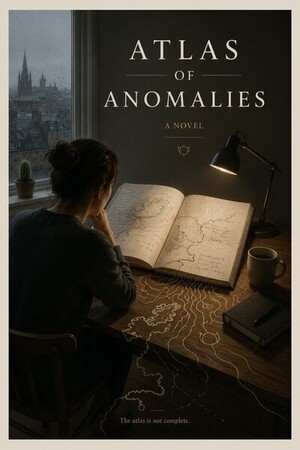
Atlas of Anomalies
The atlas arrived on a Tuesday, which Mara Voss always thought was the worst day of the week to receive anything life-altering.
It came in a wooden crate sealed with a wax stamp she didn't recognize — a circle bisected by a line that curved upward at both ends, like a mouth caught somewhere between a smile and a scream. The crate had been shipped from a post office in Reykjavik, though the return address was listed only as "The Institute for Unmapped Places," with no street, no city, no country beyond that cold northern capital. The customs label described the contents simply as: books (old).
Mara was not an adventurous person by nature. She was thirty-four years old, worked as a junior archivist at the University of Edinburgh's Special Collections department, and owned exactly one houseplant — a cactus named Gerald, who she considered reliably low-maintenance and emotionally uncomplicated. She had not spoken to her estranged father in eleven years. She had not expected, therefore, to receive his effects when he died.
His name had been Dr. Elias Voss. Cartographer. Explorer. Absent father. Dead at sixty-one under circumstances the brief solicitor's letter described as "sudden and unusual," which Mara read twice and then set on top of a growing pile of correspondence she intended to deal with eventually.
She opened the crate with a kitchen knife and a great deal of irritation.
Inside, packed in yellowed cotton batting, was a book.
It was larger than she expected — roughly the size of a desk atlas, bound in dark leather that had aged to the color of dried blood. The cover bore no title, only a debossed symbol matching the wax seal: that ambiguous circle-and-curve. The pages, when she carefully turned to the first, were handmade — thick, fibrous, the kind of paper that felt alive under fingertips, that seemed almost to exhale.
The first page bore a single line in her father's handwriting:
For Mara, who will know how to read this when the time comes.
She hadn't known her father well enough to know if that was an insult or a compliment.
She set the book on her kitchen table next to Gerald and made herself a cup of tea she didn't drink, and stared at it for a long time.
Then she opened it to page one.
The atlas was organized strangely. Instead of continents or regions, it was divided into what her father had labeled "Registers" — each a category of inexplicable place. Register One was titled "Locations of Temporal Drift." Register Two: "Sites of Architectural Impossibility." Register Three: "Territories Where Physics Negotiates." And so on, through twelve registers in total, each containing between four and nine locations mapped with the obsessive precision Mara associated with her father's rare, clinical correspondences during her childhood — the occasional postcard from a desert or a jungle, always with coordinates scrawled in the margin, as if that explained where he was more meaningfully than a city name.
What made the atlas strange — beyond its obvious strangeness — was that the maps were wrong.
Not inaccurate. Wrong. The coastlines in Register One's first entry showed a configuration of the Norwegian fjords that didn't match any satellite image or nautical chart Mara could find online that night, hunched over her laptop at midnight with the atlas open beside her. The proportions were off by perhaps twelve percent. The fjords were deeper, the land between them thinner, and there was an island in the middle of one inlet that appeared on no map she could locate.
She told herself it was artistic license. She told herself cartographers sometimes idealized. She told herself her father had always been eccentric.
She went to bed and lay awake until three in the morning, thinking about the island.
Its label, in her father's cramped hand, read simply: Náströnd-sekund. Below it: "Do not approach from the south. The south is hungry."
She called her colleague Piotr the next morning, which was Wednesday, which was already better than Tuesday.
Piotr Szymański was the university's specialist in historical geography and the only person Mara trusted with things she hadn't yet decided were real. He was fifty-three, Polish, wore the same green cardigan every day, and had the specific quality of stillness that Mara associated with people who had seen enough of the world's strangeness to stop being startled by it.
She brought the atlas to his office.
He looked at it for forty-five minutes without speaking. Mara sat in his guest chair and watched dust move in the afternoon light through the window and tried not to feel the thing she was starting to feel, which was the particular vertigo of a world about to expand beyond its previous dimensions.
"Your father compiled this," Piotr said at last. Not a question.
"Over, I think, about thirty years. I found a date in the back — 1991 is the earliest entry I can find. He died last month."
"I know Elias Voss died," Piotr said, and the way he said it — carefully, like setting something breakable on a shelf — told her something she filed away. "I didn't know he had a daughter."
"He wasn't very forthcoming about personal information."
Piotr turned to Register Three and studied a map of what appeared to be a valley somewhere in the Atacama Desert. The map showed the valley's topography in exquisite detail, with elevation lines so closely spaced in certain areas that they formed solid blocks of ink — places, she realized, where the elevation changed faster than the scale of the map could properly render. In the center of the valley was a small circle labeled "The Stillpoint" with a note: "Here, gravity is a suggestion rather than a law. Pack accordingly."
"Pack accordingly," Piotr murmured. He almost smiled. "That sounds like Elias."
"You knew him."
"I knew of him. The cartographic community is small, and people who map the places your father mapped are a subset of that small community. A very small subset." He closed the atlas and looked at her. "There are perhaps nine people alive who take this kind of work seriously. Your father was the most rigorous of them. The most methodical."
"What kind of work is this, exactly?"
Piotr considered the question with the gravity it deserved. "Documenting places that shouldn't exist," he said, "but do."
Part Two: The First CoordinateMara took three weeks of accumulated leave from the university and bought a plane ticket to Iceland.
She told herself it was to settle her father's affairs — there was, apparently, a rented storage unit in Reykjavik containing the rest of his field notes and equipment. She told herself it was professional curiosity, the archivist's obligation to understand the materials in her care. She did not tell herself the truth, which was that she had been looking at the coordinates for Náströnd-sekund every day for three weeks, and that each time she looked, the island in the atlas seemed slightly more present, slightly more three-dimensional, as if it were gaining mass simply from being observed.
Piotr came with her. She hadn't asked him to; he'd simply appeared at the departures gate with a green cardigan and a rucksack, and said: "Someone who has read the atlas should go with you."
"You've read it?"
"I photographed the relevant pages. I've been reading it for three weeks." He paused. "I haven't slept well."
"The note about the south being hungry?"
"Register Seven," he said. "The entry about the city."
She hadn't read that far. She made a mental note to.
Reykjavik in November was an exercise in committed darkness. The sun rose approximately at ten and retreated with evident relief by three, leaving the city in the particular blue-grey dimness that Mara found surprisingly peaceful — as though the world had agreed to rest, to exhale, to stop pretending to be entirely solid.
Her father's storage unit was in an industrial district near the harbor. The lock code, provided by the solicitor, was her birthdate, which she found either touching or strategic — either her father had been sentimental, or he'd known she was the only one who'd come.
The unit contained: eighteen crates of field notebooks; a surveying theodolite so old it might have been antique; three satellite phones of varying vintage; maps — hundreds of them, loose and rolled and folded and pinned — covering the walls, the floor, two folding tables; a sleeping bag; and a photograph.
The photograph was the only personal item. It was tacked to the wall above the main table, slightly crooked. It showed a woman Mara recognized as her mother — young, younger than Mara was now — standing on a shoreline Mara didn't recognize. The water behind her was wrong. Not dangerous-looking, just — wrong. Too still. Too flat. The light hitting the surface was behaving in a way Mara couldn't immediately articulate: it seemed to be coming from below rather than above, or perhaps both simultaneously.
Her mother's expression in the photograph was not frightened. It was the expression of someone encountering the exact thing they'd always suspected existed, and discovering that suspicion and confirmation are two completely different experiences.
Mara's mother had died when Mara was nine. A stroke, sudden, no warning. Her father had not come back for the funeral. Mara had not forgiven him for that. She was not sure, standing in his storage unit at the edge of the world, whether forgiveness was the right category for what she was starting to feel.
Piotr stood behind her, looking at the photograph, and said nothing, which was the correct response.
Register Seven.
She read it that night in their rented flat, while the wind applied itself to the windows with Nordic thoroughness.
The entry was titled: "The Sunken City of Kereyos: A Preliminary Survey." The location given was somewhere in the Aegean Sea, specifically a set of coordinates that placed it between Santorini and the Turkish coast, in water roughly four hundred meters deep. The map showed a city — unmistakably a city, with grid-like streets and structures that her father had labeled with tentative names: "Administrative Quarter(?), Residential Tier 2, The Long Market, The Resonance Hall."
But what made her breath catch was the marginal notes. Dense, urgent, written in a smaller hand than his usual — the handwriting of someone who didn't have time or space to be legible.
"The city is not submerged in the conventional sense. The water above it does not behave as water should at depth. Light penetrates to the ruins as though the four hundred meters above are somehow compressed — as though the rules of attenuation have been locally suspended. The ruins are illuminated from within or by some property I cannot name.
"The structures are intact. Not partially intact. Not intact-considering-the-millennia. Intact. The stonework shows no marine fouling, no coral, no degradation. The streets are clear. I observed, through the diving scope, what appeared to be movement in the Resonance Hall — not animal, not the movement of sediment. Lateral, purposeful. Brief.
"I did not dive. I have never been a coward about the work but I was afraid, specifically, of what I would find was still in residence.
"Kereyos predates all known Aegean civilizations by an estimated four to six thousand years, based on architectural parallels I can only partially make. The parallels are not to any known culture. They are to each other — to the other sites in this atlas — which suggests either a single civilization of extraordinary geographic reach, or a single set of architectural principles arrived at independently by multiple cultures who had no contact with one another except through whatever these places share.
"I believe the sites are connected. Not metaphorically. I believe there is something the sites share — a property of place, a frequency, a condition of reality — that makes them what they are, and that makes them kin to one another across thousands of miles and thousands of years.
"I have been trying to understand what that property is for thirty years. I am running out of time in the ordinary sense.
"I hope Mara reads this."
She set the atlas down on the kitchen table and looked at Gerald's photograph — she'd brought it in her bag, automatically, without thinking — and felt the vertigo again. Not unpleasant. The vertigo of a world definitively refusing to be smaller than you'd imagined.
"He knew," she said.
Piotr looked up from the field notebook he was reading. "Knew what?"
"That he was dying. He sent me the atlas because he knew." She paused. "He spent thirty years on this and didn't tell me any of it. Not one postcard with a by the way. Not one phone call saying I've found something you should know about. He just — worked, and then sent me the work, and died." She heard her own voice and recognized the thing in it, which was not grief exactly but grief's functional equivalent: the loss of a future conversation that had never been scheduled.
"He may not have known how to tell you," Piotr said, which was generous.
"He managed to leave a note in the atlas."
"That's different. He had thirty years to write that. He'd have needed thirty years to say it, too."
Mara looked at the photograph of her mother on the unrecognizable shoreline.
"Piotr," she said. "Do you know where that photo was taken?"
He came to look at it. He was quiet for a long time.
"Register Five," he said finally. "The lake in Kazakhstan. The one he called the Mirror."
Part Three: The MirrorThey found the Mirror on the fourth day after renting a Soviet-era four-wheel-drive vehicle from a man in Almaty who charged them extra for the ice chains and offered, without explanation, to include a compass that he said "points to what matters instead of north," which they declined.
The coordinates led them into a high desert plateau in the eastern Tian Shan range, through landscape so minimal it seemed like a preliminary sketch of a landscape — ochre ground, grey sky, mountains in the distance performing their standard role as geography's punctuation. The road became a track, then a suggestion, then nothing. They drove the last fourteen kilometers by compass and atlas.
The lake was smaller than Mara had expected. Perhaps two hundred meters across, roughly circular, sitting in a natural depression with no apparent inlet or outlet. At altitude, in November, it should have been frozen. It was not frozen. The water was the colour of mercury — silver-grey, thick-seeming, utterly still.
They sat in the vehicle for a while.
"Your father's note," Piotr said, consulting the atlas. "'The water reflects accurately only what has been true, not what is currently true. Objects held above the surface will cast reflections corresponding to their past states. Duration of reflection-lag varies; I measured between three and forty-seven minutes in repeated trials. Hypothesis: the Mirror is buffering reality, processing light with a delay analogous to the delay in deep-sea sonar systems. Hypothesis (alternative): the Mirror exists in a slightly earlier timeframe than its surroundings and has not yet received the present moment. Both hypotheses are inadequate.'"
Mara got out of the vehicle.
The cold was thorough and personal. She walked to the water's edge and crouched and held her hand above the surface.
In the water, her hand was not her hand. It was her mother's hand — she recognized it from photographs, the longer fingers, the ring she'd worn until the day she died. The ring caught the light from below, the impossible light that came from somewhere that wasn't the overcast sky.
She did not scream. She felt like screaming was an option she had, and she chose not to exercise it, and instead she stayed very still and watched her mother's hand hover above the mirror surface for approximately thirty seconds before it dissolved back into her own.
She stood up.
"What did you see?" Piotr asked. He was standing behind her.
"My mother's hand." Her voice came out steady, which surprised her. "She must have stood here. Done the same thing." She looked at the atlas in his hands. "That's the shoreline in the photograph. That's where my father took that picture." She paused. "He brought her here."
"Mara —"
"He brought her to the places. Not just himself." She looked across the silver water. "She knew about all of this. My mother knew."
The vertigo was enormous now, encompassing. The world was not bigger than she'd imagined. The world was a completely different shape.
She slept badly that night, which was becoming habitual. Not the sleeplessness of anxiety but of abundance — too many new shapes of thought jostling for space in a mind that had, until recently, been organized around the cataloguing and preservation of other people's discoveries.
In the morning she went back to the storage unit alone while Piotr drove to the university library to arrange remote access to their scanning equipment.
She sat on the floor among her father's field notebooks and began to read.
He had been sixteen when he first encountered what he called, in the first notebook (1982, Morocco, spiral-bound, the cover stained with something orange that might have been tea or might have been sand), "the feeling of a place refusing to behave." He was on a student geology expedition in the Anti-Atlas mountains, near a dry riverbed, when he stepped into a section of valley where the temperature was measurably, inexplicably fifteen degrees warmer than the surrounding terrain. No rock formation, no thermal vent, no sun-trap geometry accounted for it. His professor said the thermometer was faulty. Elias Voss wrote: "The thermometer is not faulty. I felt it before I measured it. The place knows it is warm."
That sentence — the place knows — appeared again and again in the thirty years of notebooks. It was his most fundamental observation and his most unscientific one, and reading it in notebook after notebook, Mara felt something happen to her understanding of her father. He had not been reckless. He had not been chasing fantasy. He had spent three decades doing the most rigorous thing she could imagine: trying to find the precise, empirical language for an experience that kept insisting on being real.
The notebooks recorded twenty-three sites before she reached the year 2004, which was when the entries changed. In 2004, her father had visited the island of Náströnd-sekund for the first time. The entry was the longest single entry in any notebook — forty-seven pages, dense, with diagrams and calculations and two long passages that read less like field notes and more like a man trying to describe music to someone who had never heard sound.
"The island is not accessible by standard navigation. This is not metaphor. GPS does not function within approximately six hundred meters of the shore; I have tested this eleven times with three different units from three different manufacturers. Magnetic compass indicates northwest consistently regardless of the device's actual orientation. Visual navigation is possible but requires attending to something other than conventional landmarks — I find myself using the light, specifically the quality of the light on the water's surface, which behaves like a guide or a signal rather than like weather. When I attend to it correctly, the island is there. When I try to navigate by logic alone, I end up three kilometers south, in the hungry section, which I have marked on the map and will not revisit.
"The island itself is small — perhaps one kilometer from north beach to south ridge. The interior is mostly a meadow of grass I have not been able to identify botanically: pale green-silver, fine-stemmed, which moves in a wind I cannot feel on my skin. The effect is of watching water rather than grass.
"At the center of the meadow is a structure. Single room. Stone. No roof. The stone is the same pale ivory as the structures I later found at Kereyos — which I had not yet visited when I first came here, but which, on retrospect, is either confirmation that the sites share a builder or confirmation that I was pattern-matching after the fact. I accept both possibilities.
"Inside the structure: nothing. No altar, no hearth, no obvious purpose. The floor is stone, perfectly level, and has been worn smooth in the center in a shape approximately the size of a person standing. Someone, or many someones, or something, stood in this room for long enough to wear the stone.
"I stood in the worn place.
"I will not fully describe what happened. It is not that I lack the vocabulary, though I partially do. It is that writing it will make it sound significant in the way that reported mystical experiences always sound significant — portentous, overblown, self-important. What happened was not like that. What happened was quiet. It was the quietest thing that has ever happened to me.
"I understood, standing in the worn stone, that I was not alone in the understanding I had been building for twenty years. That the understanding was not mine. That I had been — not guided, exactly; not led; more as if a very long and complex sentence was being slowly completed, and I was the next word, and there were words before me and there would be words after me, and the sentence was saying something that none of us, individually, could say alone.
"I thought of Mara. I think about Mara in the field, which I try not to do, because thinking about her is a form of regret and regret is not useful in the field. But standing in the worn stone in the roofless room on the island that shouldn't exist, I thought: she would read this correctly. She would know what this means. She is better at this than I am and I have never once told her so, which is among the longest list of things I have not told her, and I am going to have to find a way to correct this, because the sentence is not finished and she is the next word."
Mara sat on the floor of the storage unit with the notebook in her hands and did something she hadn't done in eleven years, which was cry about her father. Not for long. Not dramatically. She simply sat with the notebook and let herself feel the specific grief of a conversation that had finally started, and was now arriving in archive form, forty years too late and not too late at all.
Then she dried her face on her sleeve and kept reading.
Part Four: The Grammar of Impossible PlacesThey spent six weeks traveling.
Mara called the university and extended her leave. Gerald the cactus was placed in Piotr's care, which she felt he was equipped for. She and Piotr moved through the atlas like scholars through a text, systematically, each site a new chapter in an argument they were only beginning to follow.
They argued about methodology for the first two weeks. Piotr wanted to approach each site as a scientist: controlled observation, measured data, hypotheses formed only from evidence. Mara wanted to approach them as an archivist: context first, the item second, always asking what the thing was made to do rather than only what it demonstrably did. By the third week, traveling through the Atacama in a hired truck with the heater broken and the atlas open on the dashboard, they stopped arguing. Not because either of them had won, but because the sites refused to be approached by only one method. Each one required both of them, differently skilled, attending simultaneously.
There was the valley in Atacama — the Stillpoint — where they both independently experienced the sensation of weighing nothing, not as a physical lightness but as a conceptual one: the deep understanding that gravity was a local agreement rather than a universal constant, and that this particular geography had simply declined to participate. Mara had sat in the center of the Stillpoint for two hours, unable to explain why moving felt like a violation of something. She felt, for the first time in years, completely unhurried.
There was the forest in Hokkaido, in Register Six, which her father had labeled "The Recursive Wood." It covered perhaps three acres. The trees inside were birch — ordinary birch — but the forest could not be crossed. Not because of any physical barrier. Simply because the forest was, apparently, larger on the inside than on the outside. They entered from the north edge and walked due south for eleven hours, tracking their position carefully on a GPS unit, before the GPS developed a peculiarity: it showed them precisely in the center of the three-acre forest, no matter how long they walked. They emerged, eventually, from the southern edge, exactly where expected — but both of them had the unshakeable conviction that they had covered significantly more than three acres of ground, and the notebooks they'd filled during the crossing confirmed it. Eleven hours of observations. Three acres of forest.
"It's not space that's wrong," Mara said, sitting on the forest's edge and eating a rice ball from a convenience store. "It's the unit. The unit of measurement that's wrong."
"What unit?"
"Whatever we use to measure interior experience versus exterior distance. Inside the forest, those two things aren't synchronized." She looked at her notebooks, at eleven hours of careful observation. "My father wrote that these sites share a property. I think the property is that they've decoupled something that normally stays coupled. Gravity and mass. Reflection and present moment. Interior and exterior space."
Piotr was quiet for a moment. "What decoupled them?"
"I don't know. But I think the city in the Aegean might."
Register Seven's coordinates brought them to a Greek research vessel out of Heraklion, captained by a woman named Despina Alexiou who had been expecting them. This was the first truly disorienting thing — more disorienting than the Mirror, more disorienting than the Stillpoint — because it was human and therefore should have been explicable.
"Your father sent a letter," Despina said, handing Mara an envelope. "Postmarked eight months ago. He said his daughter would come, and that she would have the atlas, and that I should take her to the site."
The letter, in her father's handwriting, said: "Please take care of her. She is better at this than I was, even if she doesn't know it yet. The thing to understand about Kereyos is that it has been waiting. Not metaphorically."
Not metaphorically, she noted. A phrase he'd apparently been fond of.
They went down in a submersible — small, two-person, aged but functional, smelling of salt and electronics and the specific anxiety of the deep. Piotr stayed on the vessel; he was emphatically not a diver and was clear-eyed about his limits.
The city appeared at three hundred and eighty meters.
Her father's notes had not lied. The light was wrong in the precise way the photo's light had been wrong: it came from everywhere and nowhere, sourceless, consistent, as though Kereyos were simply better lit than the surrounding abyss. The structures rose from the seabed with the quiet confidence of things that had never expected to be submerged and had therefore not bothered to adapt. The stonework was the color of old ivory, carved with patterns that Mara recognized — not from any cultural archive, not from any academic catalogue, but from the atlas itself. The same symbol that appeared on her father's wax seal. The circle and the ambiguous curve.
Everywhere. On every building. On the street paving. On what appeared to be — she pressed her face to the porthole, needing to be sure — a series of pillars running down the center of the widest street, each carved with what seemed to be maps.
Not maps of coastlines. Maps of the other sites.
She could make out, with certainty, the shape of the Mirror. The configuration of the Recursive Wood. The valley contours of the Stillpoint.
And in the Resonance Hall — the large domed structure at the city's center — the movement her father had described. Lateral, purposeful. Brief.
She asked the pilot to hold position.
She watched.
After approximately three minutes, something appeared in the entrance to the Resonance Hall. It stood at the threshold and did not move.
It was too far and too dim to resolve clearly. It was approximately human in proportion. It appeared to be looking directly at the submersible.
The pilot, a quiet young Greek man named Stavros who had made this descent eleven times at her father's request and said very little about any of it, watched her watching the figure in the doorway. "It is always there," he said. "Every time. It does not come closer. It does not go back inside."
"What do you think it is?"
He considered this with the seriousness it deserved. "I think it is the person who built the lights," he said finally. "Someone has to keep the lights on."
Mara looked at the figure in the doorway of Kereyos — at whatever attended the city in its permanent present, tending the impossible light, maintaining the open loop of a moment that had refused to conclude — and felt a recognition so complete it bypassed surprise entirely. There was no word for this in her professional vocabulary. There might be no word for it at all. The nearest she could come was continuity — the recognition that some projects outlast their initiators, that some ideas are large enough to require generations of tending, that she was looking at the oldest version of a thing she had spent her entire career doing: preserving, maintaining, keeping the record alive.
Mara, in the cold glow of the instrument lights, felt the vertigo peak and then — not pass, but resolve. Like an equation balancing. Like a word she'd been trying to remember arriving with sudden, total clarity.
She understood, looking at what stood in the doorway of Kereyos, that her father had spent thirty years trying to find the grammar of impossible places — the organizing principle, the why. And she understood, with the particular confidence of someone who has spent their career understanding how archives work, that the places were not anomalies.
They were evidence.
Part Five: The Atlas CompletedShe wrote for three days straight when they returned to Heraklion. Piotr brought her coffee and did not ask questions, which was the correct approach.
What she wrote was not a paper and not a report. It was a continuation of the atlas — new entries, new observations, the next register. Her father's notation system translated intuitively, as though she'd been trained in it. (She had been, she realized. She'd been trained in it by eleven years of his postcards with coordinates in the margins. He'd been teaching her the language slowly, at a distance, in the only way he could manage.)
The organizing principle, as best she could articulate it, was this:
The sites in the atlas shared a property of decoupling. In each location, something that the rest of the physical world held together had been separated. Gravity from mass. Reflection from present. Interior distance from exterior space. And in Kereyos — in the oldest site, the origin — time itself had been partially decoupled from sequence. The city had not been submerged. The city had experienced a moment that had not yet ended, a present tense that had never become past. It was not preserved in the past. It was preserved in a perpetual now.
The symbol on the buildings — the circle bisected by the curving line — was not decorative. It was a diagram. A circle, which was the normal loop of cause-and-effect, of time moving forward into consequence. And the line that curved up at both ends: not a smile, not a scream. An interruption. The looping circle, opened. Pulled apart at one point so that the inside and outside became the same surface.
A Möbius strip, almost. A structure with only one side.
The sites are places where the loop has been opened, she wrote. Where the usual rules of connection — between past and present, between here and there, between observer and observed — have been locally suspended. The civilization of Kereyos did not discover these sites. They created them. Or they taught the sites to be what they are. Or both.
The reason the sites persist is the same reason the atlas persists: they have been attended to. Something at Kereyos has continued attending to them for however long the city has existed in its permanent present. Whatever stood in the Resonance Hall doorway — whatever I saw, and did not fully see — it is tending to these places. Maintaining the decoupling. Keeping the loop open.
Why? I cannot say. My father could not say. I suspect this is not a question that has an answer in the language we currently speak.
What I can say is that the sites are not random. They are not accidents of geology or physics. They are deliberate. They are, I think, a kind of gift — left for anyone who knows how to read the atlas, as my father knew, as my mother knew, as I am learning to know. A gift of evidence that the world is larger and stranger and more generous than it presents itself as being.
The thing about impossible places is that they are not, in the end, impossible. They are simply places that operate according to a different arrangement of the possible. Standing in them, you do not feel that the rules have been broken. You feel that you have been permitted to observe a rule that was always present but usually hidden.
That is what my father was trying to give me. Not coordinates. Not anomalies. A permission.
She stopped writing. Read it back. Decided it was accurate.
She added a new entry at the front of Register One — a preliminary note, the kind a new editor writes for a revised edition:
"This atlas was compiled by Dr. Elias Voss over the course of thirty years and is continued here by his daughter, Mara Voss, archivist. The atlas documents locations where the usual agreements between physical laws have been locally renegotiated. These locations are not dangerous, except to assumptions. Visitors are advised to bring a notebook, a good compass (conventional), and a willingness to measure inward distances with more precision than outward ones.
"The atlas is not complete. It cannot be complete. New entries will be added as they are found.
"The south of Náströnd-sekund remains hungry. Approach from the north."
Epilogue: The Last MapSix months later, sitting in the window of her Edinburgh flat on a Sunday morning with Gerald on the sill beside her and the atlas open on her lap, Mara found a page she had somehow missed.
It was near the very back, past the last numbered register, in the section she'd thought was blank endpapers. A single map, small, precise, drawn in her father's hand. No coordinates. No register number. No explanatory notes in the margins.
The map showed a coastline she recognized.
The north shore of the island where she'd grown up. The small harbor. The particular shape of the headland. The sea her mother used to drive them to on summer evenings, when her father was away, when the world was only the three of them for a little while.
In the center of the map, her father had drawn the Möbius symbol — not in ink, but pressed into the paper with a dry pen, barely visible, something you'd only see if you tilted the page to the light.
And below it, in the smallest handwriting she'd seen him use, so small she needed her reading glasses:
I was here too. Even when I wasn't.
Mara sat with that for a long time.
Outside, Edinburgh did what Edinburgh does in spring — made ambiguous overtures toward brightness, retracted them, reconsidered, tried again. A pigeon performed some structural assessment of the windowsill and departed unsatisfied. Gerald stood in his pot with the dignity of an organism that has survived worse and expects to survive more.
She picked up her pen.
She turned to the next blank page of the atlas.
She began to draw.
End


Please sign in to leave a comment.