Chapter 1:
Truck-Kun Finds a Teenager with Poor Situational Awareness
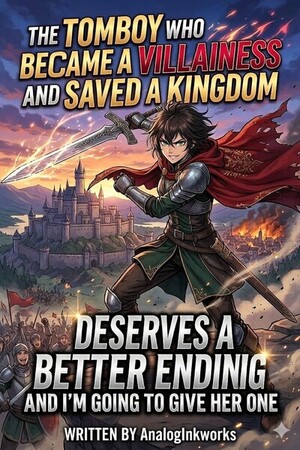
The Tomboy Who Became a Villainess and Saved a Kingdom Deserves a Better Ending and I'm Going to Give Her One
The finale aired on a Thursday.
Kaito Mori watched it alone with the lights off and a convenience store coffee going cold on the table beside him along with some half-eaten snacks. In retrospect, this was appropriately symbolic of what turned out to be some of the most personally unsatisfactory forty-three minutes so far of his short seventeen years of life.
I Became the Villainess and Rewrote the Ending — the anime adaptation of the light novel he had read twice since middle school and once again last spring when the adaptation announcement dropped — had in its final episode delivered exactly the ending the source material promised. The kingdom was saved. The prince made his choice and confessed his love. The credits rolled over a montage of happy faces and swelling strings.
Kaito sat with this for a long moment before making his way to the entryway.
Then he picked up his keys, put on his shoes, and went for a walk, because the apartment had suddenly become too small to contain what he was feeling. He could not name it precisely but something caught in the back of his throat before pressing uncomfortably on his chest.
He was aware that having this reaction to an anime finale was not, strictly speaking, a proportionate response.
He was having it anyway.
---
The streets of Shinjuku at eleven on a Thursday were quiet enough that a seventeen year old in a school jacket could walk fast without navigating around anyone. Kaito had his hands in his pockets and his eyes on the pavement, which was not ideal but was where they needed to be, because he was in the middle of working something out.
The working out was not going well.
He had loved this story. That was the uncomplicated part — he had found it on a recommendation thread in his second year of middle school, read it in three days, and felt that it had been written for him. Not because anything in it resembled his life. Because Suzuki Hana — the girl at the center of it, the one who had woken up inside a fictional fantasy otome game, The Triumph of Lady Seraphine, as its villain, Elara Voss, and proceeded to change the world with her bare hands — was the most alive character he had ever encountered in fiction. She was funny and energetic and occasionally wrong in interesting ways and she moved through every situation with boundless energy and optimism. Like a golden retriever powered by a nuclear reactor.
He had read I Became the Villainess and Rewrote the Ending twice more after that. He had been genuinely excited about the anime.
And then the finale had aired, and something in it had settled in his chest like a stone, and he was walking through Shinjuku at 11 PM on a school night trying to understand what it was and why it wouldn't move.
The thing was — and this was the part he kept circling without landing on — it wasn't as though anything had gone wrong, exactly. The story had ended the way it was always going to end. He had known that. He'd read the novel. He had known going in what the finale would contain.
He just hadn't expected it would feel like this. Now that he was a little older, something in his feelings had changed without Kaito realizing it.
He thought about the last episode. About the final scene. About the specific way it had looked, in the animation, with the light and the music and the careful framing — all of it arranged to tell him that what he was seeing was a happy ending.
He thought about Suzuki as Elara in that final scene, and something in his chest pressed harder, and he still couldn't name what it was, only that he felt an inkling of the same feeling he'd had closing the novel for the first time in middle school, sitting on his bedroom floor at two in the morning.
He was so occupied with not being able to articulate it that he forgot to look where he was going.
The light was green.
He stepped off the curb.
Later, in the dim and floating way he would have of remembering things that happened in the next two seconds, he would recall: the sound first, very large, very close, coming from his left. Then the light, very bright. Then a sensation that he would have described as being made briefly and completely aware of every part of his body simultaneously, followed immediately by not being aware of anything at all.
The last thing he thought, which was not a profound thing but was honest, was: oh.
I should have been paying attention.
---
He did not die.
Or: he did, and then something happened that meant death didn't take.
He was not sure which framing was accurate and in the hours that followed he did not have the cognitive bandwidth to determine it, because he was occupied with other things. Chief among them: breathing. His lungs were doing something unfamiliar, expanding into a chest that was larger than his had been, and the process required monitoring. He lay still and monitored it.
Ceiling.
Stone. Vaulted. Cold morning light pressing in from somewhere to his right, where a gap in heavy curtains admitted a thin grey bar of it across the floor.
He stared at the ceiling. This seemed like the reasonable thing to do while the rest of his brain came back online. There was a lot of ceiling. It was very old. He catalogued the small imperfections in the stone the way you catalogued neutral things when your mind needed the foreground occupied while the background ran its processes.
He became aware, gradually, that something was wrong with his hands.
He lifted them. Held them above his face.
They were his hands in the sense that they were attached to his arms and responded to his intentions. They were not his hands in the sense that they were larger than they should have been, longer in the fingers, with a vaguely familiar geography of calluses — a ridge along the base of the right index finger, a thickening at the heel of the right palm.
He looked at them for a while.
Hm, he thought.
He sat up slowly, testing. No pain — or rather, the even distributed ache of a body that had been through something, spread so uniformly it almost read as ordinary. He was taller than he should have been. Broader. He swung his legs off the bed and when his feet met the cold stone floor he was sitting further from the ground than expected.
He stood. Took in the room.
Stone walls. Two windows. A writing desk against the far wall, papers on it, a candle burned to a stub in its holder. A wardrobe of dark wood. And above the fireplace, mounted on brackets, a sword — not ceremonial, the scabbard worn smooth at the grip in the way of something used regularly, the mounting practical rather than decorative.
Someone lived here. Someone who trained.
He crossed to the writing desk because papers were information, and looked at what was there.
The script was not Japanese.
He could read it anyway.
He stood for a moment with a letter in his hands, reading it without difficulty in a language he had never studied, and felt the particular quality of wrongness that came with doing something your brain was certain should be impossible. The letter was addressed to Lord Ren and concerned a trade matter between the Aldric family holdings and those of a neighboring duchy. It was signed off at the bottom in handwriting that was apparently his own, a few lines of reply, closing with *R. Aldric.*
He set the letter down carefully.
He opened the desk drawer. Found a seal bearing a crest he didn't recognize, blank paper, a wax stick, and a small leather-bound journal. He opened the journal and flipped through it slowly — entries in the same handwriting, sporadic, the record of someone who wrote when something was worth noting rather than daily. A young man. References to a father and an older brother. References to the academy he would be attending in the spring. And then, about two thirds of the way through, an entry that made him stop:
Almost accessed it today. Third time this month. Brother says it took him two full years. Eight months for me. I don't know what this means yet.
He read it twice.
He looked up from the journal. Looked at the sword above the fireplace. Looked at his own hands.
The calluses were an archer's. The ridge at the base of the right finger, the heel of the palm — he understood, suddenly, exactly what had formed them. Hours of it. Months. A bow, drawn and released, drawn and released, until the body stopped thinking about it.
Eight months, the journal said. Almost accessed it.
Something was moving at the back of his mind. A feeling like a word at the edge of his reach. He had read something — he had read a great deal, and somewhere in what he had read was something that matched the shape of what he was currently standing in, and the solution was getting closer with every detail he noticed.
He set the journal down and went to the window.
The view was countryside — rolling hills going gold in the early morning light, a treeline to the north, and directly below, visible through the glass, a yard of packed earth with practice posts and a weapons rack at one edge. Training grounds, maintained and well-used. The architecture around him was old stone, built for permanence.
No roads he recognized. No powerlines. No convenience stores.
He stood at the window.
Where am I? he thought, without being entirely sure who he was thinking it at.
He turned back to the desk. Read the letter again, more carefully this time. The trade matter it described concerned the border between the Aldric holdings and those of the neighboring family to the east.
He looked at the name of that family.
He read it twice.
Voss.
The word landed with a weight that was disproportionate to its size, and he stood very still while his brain did something rapid and involuntary — cross-referencing, assembling, running the accumulated details of the past twenty minutes against something he had carried in his memory for three years. A novel. A story about a girl who had woken up in a world with a map in her head and used it to change everything. A neighboring duchy. A border. An academy in the spring.
He looked at his hands again. The archer's calluses. The journal entry about something he had been close to accessing for eight months.
He thought about a character who did not appear in that novel by name. Whose family was mentioned in passing a few times, in half a sentence here or there, as a minor western duchy with no significant political role.
He looked at the crest on the seal in the drawer.
He sat down on the edge of the bed, because the next thought needed to arrive at its own pace, the way large things did.
He had watched an anime finale a few hours ago. He had walked into a street in front of a speeding truck, and had woken up here, in a stone room in a body that wasn't his with a sword on the wall and an archer's hands and a letter from the Voss duchy on the desk.
He thought about the last scene of the finale. The light and the music. The careful framing.
He thought about what he had been feeling, walking through Shinjuku, that he still couldn't quite name.
His heart skipped a beat as he thought: she's here.
Not in this room. Not in this building. But somewhere — maybe one hour's ride east, though he had no sense yet how far one can ride a horse in an hour — in a bedroom he had never been in but had read about, there was a girl who had woken up in a body that wasn't hers, and she was going to take inventory, and she was going to make a decision about her hair, and she was going to spend the next four years executing the most ambitious plan he had ever read.
And he was here. He was in it. He was a character so minor that the novel had dismissed his entire family in a few scattered sentences, and he was the only person in this world who had read it. He had actually isekaied into his favorite isekai novel! That thought was exciting but it also made his head hurt a bit.
He looked at his reflection in the dark glass of the window. A face he didn't know yet. Young and unremarkable and, to anyone who wasn't looking for it, entirely invisible.
I'm not Kaito anymore, he thought. From now on I'm Ren Aldric.
He thought about the finale. About what he hadn't been able to name. About the stone in his chest that still hadn't moved.
I know how this story, he thought. Elara's a real person now, but she only knows the Otome game she played obsessively. I'm the only one who knows how this ends.
He looked at the training grounds below. At the weapons rack. At the pale gold light coming up over the eastern hills, in the direction of the Voss duchy, where she might be waking up right now.
Not this time, he thought.
He clapped his hands together with a slight smile on his face. The outline of a plan started forming in his mind.
---
## Author's Notes
Kaito Mori was struck by truck-kun at 11:14 PM on a Thursday in Shinjuku. He had been walking without looking where he was going. Truck-kun is an internet meme about how isekai novels start with a truck killing the main character with such frequency that the truck has been personified.
He had been thinking about an anime and the light novel, I Became the Villainess and Rewrote the Ending, and specifically the main character, Suzuki Hana — the girl at the center of it, the one who had woken up inside a fictional (from Kaito's perspective) fantasy otome game, The Triumph of Lady Seraphine, as the villainess, Elana Voss.
In case it isn't obvious, Suzuki Hana is a fictional character in Kaito Mori's original world, she wasn't isekaied into the same story. The otome game likewise only exists in the fictional work, I Became the Villainess and Rewrote the Ending. In other words, Kaito isekaied into a world that itself was a fictional isekai story about Suzuki Hana / Elara Voss.



Please sign in to leave a comment.