Chapter 1:
The Land Before the Lion
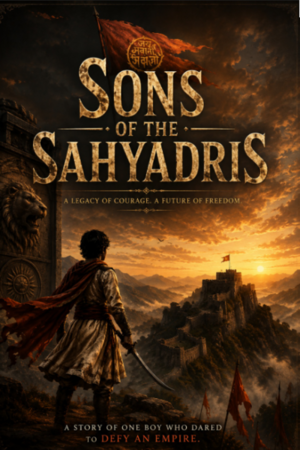
Sons of the Sahyadris
Before there was a hero, there was only pain.
The Deccan was beautiful. Anyone who saw its green hills in the monsoon, or its golden fields before harvest, would call it that. But beauty does not feed a man whose crops are taken. Beauty does not protect a village whose daughters are dragged away in the night. And beauty never once stopped the Sultans from ruling this land like it was theirs to crush.
For years, the people here lived under foreign kings. Kings who did not speak their language. Kings who did not pray to their gods. Kings who taxed starving farmers and called it justice.
The local chiefs — proud, stubborn hill people — fought when they could. Bled when they had to. And mostly, they waited.
Waited for something to change.
Nobody knew the change was about to be born in a small hill fort, on a night when the sky itself seemed to be holding its breath.
The fort was called Torangad. Built high on a rocky hill, not for comfort, but for survival. Thick stone walls. One narrow gate. The kind of place where a handful of stubborn men could hold off an army ten times their size.
That night, the air inside felt heavy. Too heavy.
A woman named Mainabai sat in a small stone room, her face pale, her breath sharp and short. She was the wife of a Maratha commander — a man respected by some, envied by others, feared by all who knew what he was capable of.
He was far away that night, fighting in someone else's war, serving a Sultan he did not love but could not yet defy.
So Mainabai faced this alone. Almost alone.
An old midwife knelt beside her, wiping the sweat from her forehead, lips moving in a quiet prayer. Outside, the wind had picked up enough to rattle the shutters, and somewhere below the fort, a dog had started howling and would not stop.
"Push," the midwife said. "Just a little more."
Mainabai gritted her teeth. Outside, thunder rolled low across the hills — like something far away was waking up.
Then, finally — a cry. Small. Furious. Alive.
"A son," the midwife breathed, lifting the baby for the mother to see. "You have a son."
Mainabai looked down at the small, red-faced child in her arms, and for one moment, all the fear in her chest turned into something else. Something fierce.
She did not know what this child would grow up to do. She could not know that men would one day write his name into history — that kings far away would hear it and feel afraid. That an empire would rise from nothing, fort by fort, battle by battle, because of the boy she now held against her chest.
All she knew was this: he was hers. And she would not let this land break him the way it had broken everyone else.
"I will not raise you to bow," she whispered, so quietly even the midwife didn't hear it. "I will raise you to stand."
She named him Rudra.
His father was almost never home.
Rudra was five the first time he really understood that. He stood at the fort gate, waiting, the way he always waited when word came that his father's men were riding back. The gates creaked open. Tired horses. Tired soldiers.
No father among them.
"He stayed behind to settle accounts with the Sultan's officers," one soldier told him, not unkindly, ruffling the boy's hair as he passed. "Next time, little one."
Rudra didn't cry. He had already learned that crying changed nothing.
It was his mother who raised him — and she raised him like a blacksmith shapes iron. Slowly. With fire. With patience that looked, from the outside, almost like cruelty.
She did not tell him stories about princes who married princesses. She told him about kings who had ruled this land before the Sultans came. About gods who fought demons not because it was easy, but because somebody had to.
"Why did those kings lose their land?" Rudra asked her once, maybe seven years old, sitting cross-legged by a small fire while she mended a torn shawl.
"Because they trusted the wrong men," Mainabai said, not looking up from her stitching. "And because they waited too long to act when the danger was small enough to kill."
"What do you do when the danger gets too big to kill?"
Now she did look up.
"Then you run," she said simply. "Or you die proving you should have killed it sooner."
Rudra thought about that for a long time. Long enough that his mother noticed, and almost smiled, though she didn't let him see it.
When Rudra turned eight, his mother decided he was old enough to start learning the sword.
She hired an old soldier named Yesaji to train him — a man who had lost two fingers on his left hand and never explained how, and who did not believe in going easy on children just because they were children.
The first lesson lasted less than a minute. Yesaji knocked the wooden practice sword out of Rudra's grip with a single, almost lazy swing, and the boy landed hard on his back in the dirt of the training yard.
"Again," Yesaji said.
Rudra got up. Picked up the sword. Lasted four seconds longer the second time.
"Again."
By the twentieth fall, Rudra's palms were raw and his pride was bruised worse than his body. He sat in the dirt, glaring up at the old soldier, breathing hard.
"You're not even trying to teach me," he said. "You're just knocking me down."
"Good," Yesaji said. "You noticed. Most boys your age just cry." He crouched down to Rudra's level, his scarred face unreadable. "Here is your first real lesson, little commander's son. Nobody is going to teach you how to win. The Sultan's men will not pause a battle to explain your mistakes to you. You learn by falling. You get good by falling enough times that you finally understand which mistake keeps putting you on the ground."
"That's a terrible way to teach someone."
"It's the only way that's ever worked," Yesaji said. "Again."
Rudra picked up the sword. He did not win that day. He did not win for many days after that. But something in him had shifted — a kind of stubbornness that refused to treat falling as the end of anything.
By the time he was twelve, he had stopped losing to Yesaji within the first ten seconds.
By fourteen, their matches sometimes lasted long enough that the old soldier was sweating too.
His father returned home properly for the first time in nearly a year when Rudra was eleven — not for a brief visit this time, but for a full season, summoned back by politics Rudra didn't yet understand.
He was a tall, broad-shouldered man named Shahji, with a voice that filled a room before he even finished a sentence. He looked at his son the way a builder looks at a half-finished wall — assessing, calculating, already imagining what more could be added.
"Your mother tells me you ask too many questions," Shahji said, the first real conversation they had in years, sitting across from each other in the fort's main hall.
"Is that bad?"
"It depends entirely on the questions." Shahji studied him. "Ask me one. Right now. Something that's been sitting in that head of yours."
Rudra didn't hesitate. "Why do you serve a Sultan who doesn't respect you?"
The hall went quiet. A servant near the doorway froze mid-step, suddenly very interested in the floor.
Shahji didn't get angry. He leaned back instead, considering the question the way he might consider an opponent's opening move on a battlefield.
"Because right now," he said slowly, "serving him keeps this family alive, keeps this fort standing, and keeps me close enough to the Sultan's court to know things other men don't. A sword swung too early breaks before it ever reaches the enemy's neck." He leaned forward. "But you didn't ask if I respect him. You asked why I serve him. Those are different questions, Rudra. Learn to tell them apart, and you'll go further than most men in this kingdom ever will."
Rudra said nothing for a long moment. Then: "And if the day comes when serving him no longer keeps us safe?"
For the first time, something flickered across his father's face — not anger, not pride, but something more careful. More guarded.
"Then we will see what kind of man you've grown into by then," Shahji said. "Won't we."
It wasn't really an answer. Rudra understood, even then, that it wasn't supposed to be.
By twelve, Rudra had stopped asking his mother these kinds of questions and started asking the world instead.
He watched the Sultan's tax collectors ride into nearby villages each season — grim men with armed escorts, who weighed grain sacks with rigged scales and took twice what was owed. He watched farmers hand over food their own children needed, because refusing meant worse than hunger.
One such afternoon, he stood at the edge of a village watching this happen, fists curled so tight his nails left marks in his palms.
An old farmer noticed the boy watching. Recognized him — the commander's son, dressed plainly, standing among them instead of above them.
"Best not to stare, young master," the farmer said quietly. "Staring doesn't fill an empty stomach. It just gets you noticed by the wrong men."
"Why does no one fight back?" Rudra asked.
The farmer let out a tired laugh, the kind with no humor left in it. "Fight back with what? Hoes? Bare hands? Against men with swords and the Sultan's name behind them?"
Rudra didn't answer. But he didn't forget the question either. It followed him home that night, and stayed with him for years after — quiet, patient, waiting for an answer he didn't yet have.
He started visiting that village again, and others like it, more and more often as he grew older. Not as the commander's son arriving to inspect anything. Just as a boy who sat with farmers' sons, who learned to herd goats badly and laughed when he fell in the mud doing it, who slowly stopped being "young master" to them and started being something closer to one of their own.
His mother noticed, of course. She noticed everything.
"You're building something," she said to him once, watching him return from the hills, dust on his clothes and a strange, quiet satisfaction on his face.
"I'm just making friends."
"You're the son of a commander," Mainabai said. "Commanders do not have friends. They have men who will or will not die for them one day. You should know which one you're making, before you need the answer."
Rudra looked at her for a long time after that. He did not have a clever response ready. For once, he simply nodded, and let the words settle somewhere deep, where he kept the things that mattered most.
He found the beginning of his answer not in the fort, not among nobles, but in the hills — among shepherds, blacksmiths, and farmers' sons who had nothing to lose and, as it turned out, everything to gain.
By the time he was sixteen, Rudra had a small circle of friends nobody at court would have approved of. A blacksmith's apprentice named Suryaji, quick-handed and quicker-tempered. A quiet, sharp-eyed hill boy named Kanhoji, who noticed things other people missed. A handful of others, sons of nobody important, who had grown up the same way Rudra had — watching their land get taken from people who had no power to stop it.
One evening, the five of them sat around a small fire on a hillside, far enough from the fort that no one would overhear. Kanhoji finally asked the question that had been sitting unspoken in everyone's chest for months.
"What is it you actually want, Rudra?" he asked. "All this talk about forts. About the hills not belonging to the Sultan. What are you building toward?"
The fire crackled between them. The others went still, waiting.
Rudra looked around the small circle. Farmers' sons. A blacksmith's apprentice. Boys with no titles, no land, no real power — and yet the only people who had ever really listened when he talked, the only ones who had never once called him "young master" with that careful distance in their voice.
"A kingdom," he said simply. "Not theirs. Ours."
Nobody laughed. Strangely, nobody said it was impossible either.
"With what army?" Suryaji asked — not mocking, just genuinely unsure how five boys and some borrowed swords were supposed to become anything close to that.
Rudra stared into the fire a long moment before answering.
"We don't need an army yet," he said. "We need one fort. Taken quietly. Taken smart, before the Sultan's men even realize it's gone. After that, we need people to hear about it. Because once people believe something is possible, they stop waiting for someone else to do it for them."
Kanhoji studied him across the flames, his sharp eyes narrowing.
"You're talking about stealing a fort from the Sultan's own garrison," he said slowly. "That's not a plan, Rudra. That's a death sentence."
"Maybe," Rudra said. "Or maybe it's the first page of something nobody in this land has dared to write yet."
The fire popped and hissed. Somewhere out in the dark hills, an owl shrieked, sudden and sharp, and every boy at that fire flinched — except Rudra.
He just smiled, like the dark itself was something he had already decided not to fear.
None of them knew it yet. Not Kanhoji, not Suryaji, not even Rudra himself, not fully.
But the spark had already been lit.
And sparks, in dry country, in dry times — they do not stay small for long.
End of Chapter 1.







Please sign in to leave a comment.