Chapter 5:
Interlude 1: Un Petit Chevalet
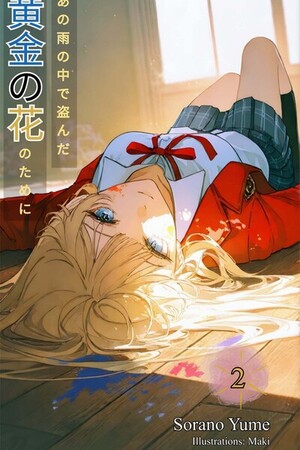
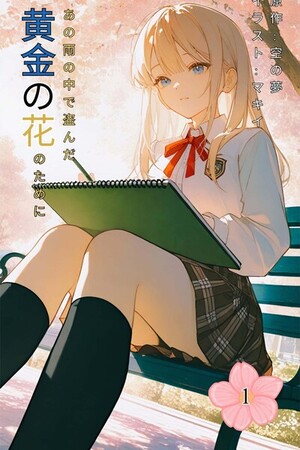
Kogane no Hana (Golden Flower), Volume 2
"Aino-san, I believe you're destined for greatness. And your son, too, is an art savant."
"Is he really?"
"I can see it right in his eyes. Did you know that Da Vinci also spent his childhood that way? He kept wandering, and was never satisfied with the skim of things. Look at your child observing your artworks, Aino-san. Sooner or later, he'll paint not from copying from somebody, but from translating what he sees."
I was just six years old when I first heard those phrases from a classy-toned old man with a Hungarian mustache in an art museum. I was too young back then to understand what he meant by art savant or why he was telling my mother that at all, so I merely nodded my head and smiled in acknowledgement of the words being said to me.
Besides, I thought that the 'Da Vinci' was just another word of whispers passed between adults. I never knew back then that the surname was a sheer statement of potential… and expectation.
“He’s just drawing what he feels.” my mother had responded.
“That’s what makes him dangerous—in the best way.”
One would think that it's just a straight-up coincidence from two people who accidentally stepped on an art museum, a mother trying to please her son's impulsive cravings through outings, but that's not the case. This wasn't just a random visit. We were here because yet again, another art of my mother would be hung up on the display cases. It was an oil painting of Hirosaki Castle at Aomori, and for me, as a six year old with an unmatched energy and elation for such a spectacle, it meant everything.
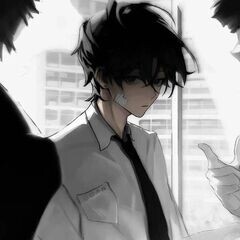
Everybody knows me, Shimizu Itsuki, as the quiet kid at the back of the class. A seventeen year old boy who crashed head-on in the world of adults with nothing more than a pair of old rubber shoes and a face stiff as stone. A dango seller who doesn't involve himself outside of business, and a ghost that floats past people.
Before though, I was something else entirely. I was your average child, a bit of an observant, a laid-back kid who loved watching the summer skies, thinking that the clouds were colossal cotton candies drifting languidly against the pastel blue. I always captured the scent of green breeze more than often, somehow thought it carried the dreams of others just like the currents in Sumiyoshi River.
Yes, I was a child full of dreams, just like you. A boy that wanted to impress the world, to leave memories and impressions, to walk freely, maybe a red balloon in hand, and let my cheeks feel the warmth of summer, and to paint the lights of spring.
More than that, I'm a person that wants to follow in his parents' footsteps.
I was seven years old when my first watercolor landscape hung in a downtown gallery, through the help of my mother. It gathered a crowd of ten, and I was confused why their eyes seemed to shine brighter while looking at the colors I painted. For my mother and that man, it was a good start.
Two years later, at nine, I sold my first oil painting, a portrait requested by a middle-class couple to display for their marriage ceremony. The money I earned there was enough to renovate our kitchen and to buy me more materials, and I was called Japanese 'Duerer' thereafter.
At ten, I didn't understand why people started scrambling for a glimpse of my sketchbook or why the air seemed to hum when I walked past. Why did adults begin kneeling in front of me, asking questions I didn’t know how to answer? For me, I wasn't doing anything special. I was just filling out the whites of the canvas based on what I'm seeing and feeling, and yet, names like Monet and Vermeer were being called.
I only wanted to be addressed as 'cute', or 'pesky', like other normal children do, and never that.
"You're a generational talent, Itsuki-chan! You're already making a name for yourself!"
"A miracle of a child indeed!"
Again and again. I thought back then that children never lie and adults understood things said once, but that kind of persistence remained as the situation allowed. I already told them that I was just Shimizu Aino's child. A starry-eyed follower to my own hero, a bright burning supernova.
That's before she became the woman who locked herself in the bathroom with the lights off for hours. Before the cigarette butts and empty cases of beer piled up on the kitchen counter, and before the nights she began staring out the window with no light reflecting in her once dedicated eyes.
Mama reached for the stars before becoming a black dwarf.
She was a force of nature in the Kobe art circles. She was known for soft, rural-inspired impressionist works that looked like they had been dipped in sunlight. A remnant of Camille Pissarro they said, she had once aimed for the Louvre, a dream she carried like a torch. But after I was born, that torch changed hands. She stopped pursuing her own career, dedicating every waking moment to teaching me.
"For you, my little masterpiece."
Her masterpiece, that's what she called me. I could see myself reflecting artistically right before her hazel eyes, which I solemnly inherited.
In her hands, were her final signed painting—a soft landscape of a flower pot—as a gift. It was a baton being passed.
She taught me how to hold a brush before I learned to tie my shoes, how to feel the texture of canvas with my palm, and how to blend color with my fingertips. She helped me develop my ability to capture emotion with the lines of a brush. That's where artists excel—seeing things beyond the surface, towards what is imperceptible.
My first piece was an abstract, a messy mix of colors as if someone painted something with eyes closed.
"Mama, it's ugly!"
"That's why you shouldn't erase it, Itsuki-chan."
"But Mama..."
"The first artwork of an artist, whether ugly or not, is the only time they are honest. It’s the birth of your soul on paper, Itsuki-chan. If you erase the 'ugly' beginnings, you erase the person you were before the fear of being perfect. Promise me… promise me you’ll never try to delete your journey, okay? For now, let me keep it."
So she provided me with another canvas with a smile.
"Remember, my dearest," her voice was a melodic whisper, "treat painting like a river flowing naturally. At times, you shouldn't be the person standing before it, you must be one of the fishes swimming in it. Make sure you always consider the five senses when painting. Can you tell me what they are again?"
"Sight, hearing, smell, taste and… and..."
"Touch," she finished. "close enough, my good boy."
My mother didn't correct my clumsy attempts or chide my impatience. Instead, she leaned in, her gentle smile reflecting in my wide eyes. "Now, what does the sea need?" she asked, her gaze encouraging.
I hesitated, then pointed to a deeper shade of blue. Mama nodded, her eyes twinkling with satisfaction. Together, we swirled the colors, creating a horizon that was uniquely ours—a bit wobbly, perhaps, but filled with the boundless dreams of a child and the unwavering love of a mother.
In the following months, pieces finally took form. I began my journey to bring art to life as if I poured myself into the canvas.
It became my identity, and as soon as my star rose, hers flickered. The broken system of the outside world decided to intervene.
It only started by a whiff of a different atmosphere when we visited the galleries. People would immediately rush to me, ignoring everybody, even the children with the same dreams as mine, which I treated as friends. The opportunities of forming relationships with people became scarce, and I was just left entertaining them all.
As time passed, even though I am always around people, I felt more alone than ever. But I kept pushing through it, painting masterpiece by masterpiece, because all I wanted was to satisfy this innate desire to make my parents proud.
Magazines, tabloids and newspapers, there wasn't a day where my face wouldn't be plastered on the cover. I had more time traveling across the country than I had in a classroom.
I was too young back then that attention equated to competition. Too naive to know the meaning of pride. Too innocent to know the consequences of being admired. It corrupted the purest parts of those who looked up to me, and envy crawled not just to my friends, but also to the sole reason why I'm here in the first place.
My mother.
It started with warm praises, such as 'You must be proud,' and 'This prodigy inherited your talent!'. Now that they've seen the heights of my ceiling, it was time to turn to criticism from other places.
"Itsuki is already light-years better than Aino-san, don't you think?"
"Hmm… should we replace her artwork here?"
"I thought that Aino-san had this spark that would bring Kobe fine arts to greatness, but alas, it was the son."
Mama would smile outwardly, her pride masking a fracturing heart. Their claps in the gallery when my works were shown became less and less sincere. Sometimes, I would catch Papa whispering something to her that would make her frown.
Soon enough, the vibrant, sun-drenched studio we shared began to grow cold. The easels were slowly moved to the basement, replaced by heavy, leather-bound collegiate volumes of philosophy, history, and logic introduced by my father, Shimizu Kentaro.
He was a professor at a university he also founded. Originally, he was consistently away for long periods of time, and now, his presence bothered me even more when it came down to him teaching me theorems that had no way of fitting a child's head.
I often looked out the window every single night. Seeing the parents next door read their children bedtime stories to sleep, I always wondered what went wrong in making my own proud that they imposed this kind of treatment upon me.
Naturally, my curiosity somehow found their way to navigate the books and theses like how I approached a new tube of paint. I sketched the portraits of Nietzsche, Kant and Dostoevsky while reading their writings. In a sense, I understood how far humanity has gone in their research of the mind and society.
"Imagination is a luxury for those who don't understand the world," my father would say, sliding another book over my sketches.
"Imagination is a reminder of those who understood. Look closely. The beautiful may be small..." I whispered right as he left.
Even though every book he gave me spoke of consequences, control of imagination, and stealing spotlights like a math equation, I still left a tiny window for myself, a dreamer, to remind myself that the greatest minds of the past used imagination to actually grasp truth, rather than escape it. It was just words from people that only see grey.
I just realized everything years later.
Those books weren't given to cultivate me, but to dilute me and strip my creativity. It made me question everything around me. The worse, it steered me somewhere quieter, more clinical, further from the smell of paint and turpentine. He wanted to replace the 'freeflow' with a 'system'.
And yet, I couldn't stop. I painted in secret, under my covers, in the corners of my mind. I didn't do it for the galleries or the critics who called me a "savant." I did it because it was the only thing that felt truthful. Words could be twisted, people could leave, and logic could be used to justify cruelty—but a brush never lied. Art was the only way I knew how to create meaning from nothing—to express the things that those books told me didn't exist.
The end of our family didn't start with a scream; it started with a heartbeat. When I was ten, my mother became pregnant. I remember her quiet, careful movements—the way she cradled her stomach with a tenderness she had long since stopped showing my paintings. By then, the "miracle child" was no longer a joy to her; I was a constant reminder of the career she had sacrificed and the talent she couldn't match.
She stopped watching me paint. She stopped praising the work. Instead, the house filled with the sharp scent of alcohol and the stale haze of cigarette smoke. She would lock herself away for hours, leaving the studio dark and cold. I always reminded her that it's a risk for her already sensitive situation. But by then, our relationship was already irreparable.
But then I recalled the question, "What does the sea need?"
Without colors, a sea is just a large crevasse of void. If my mother had become an empty shell, I would fix it. If I showed her the "color" again, she would come back to me.
I spent weeks secretly painting a portrait of her. I didn't paint the woman who drank and smoked in the dark; I painted my mother who used to smile in the sunlight and when she saw me blending colors. When I finally showed it to her, I expected a hug. I expected a return to the way things were.
Instead, I got terror.
"Why did you do this?!" she hissed, her voice slurred and trembling. "Art is a lie, Itsuki! It's frivolous! It's unrealistic!" She looked at the beautiful image of herself as if it were a monster. "The world isn't made of colors—it’s made of hierarchy and judgment! And you… you’re just a freak who doesn't understand that!"
"Mama... I'm not a—”
"THAT'S WHAT YOU ARE! A FREAK AND A CURSE! I WOULD'VE ACHIEVED MY DREAMS IF IT WASN'T FOR YOU!"
I could only remember getting stunned and wide-eyed back then. The scent of her alcoholic breath was as sharp as the words she just said. I never realized that the victory of someone is always at the expense of others. If there was a winner, there would always be a loser left behind. And by that day, it was my mother.
"I just… I just wanted you to smile again, Mama… my hero..."
Tears blurred the image of my mother, and for a moment, I perceived that she was wiping tears of her own. I swore I heard her whisper 'I’m sorry, my dear masterpiece', as if she was mourning the version of herself she hadn't seen in years. Yet it swirled once more in that unadulterated envy and resentment she had on my talent.
"NO!!! YOU'RE THE ONE WHO STOLE MY HAPPINESS!" she rasped with all of her might. In a drunken, sobbing fit, she grabbed the canvas and tore it in half. The sound of that fabric ripping was the first time my world ended.
It was far from what she used to believe, I wanted to say. And the uncomfortable question in my head swirled like a broken player.
Do your dreams disappear when you become an adult?
Does everyone lose hope when they realize that the world is cruel?
Not long after, the horror escalated. She collapsed, bleeding heavily. Papa had gone back to Tokyo for his work—and I was just a boy with a ruined painting. Adrenaline seized me, and with tears dampening my face, I picked up the telephone and called whatever number I remembered seeing at the backpages of the books my father gave me.
The publishing company brought the paramedics, and I could only watch them take her away, unable to do anything but stare at the blood on the floor.
She lost the baby, my brother.
In the weeks that followed, the silence in the house became a weapon. My parents didn't need to yell; they blamed me with their eyes and fists. Every cold expression, every missed meal, every thorough beating told me the same thing: I was defective. My "gift" had caused this mess. My existence had killed the only thing they actually wanted. Three books about nonverbal communication was enough to make me comprehend.
We were already strangers living under the same roof.
"If you truly loved your mother," my father told me one night, his voice devoid of any emotion, "you would have stopped painting a long time ago."
And the final nail in the coffin, their quiet divorce.
One morning, I was told by my father about a scheduled 'checkup'. It was a tough winter day back then, so I believed him when he said that I became 'pale'. I haven't heard of the word malnourishment until lately, so it made sense.
The process was swift and precise. I didn't question the nurse despite how odd looking the syringe was. I only felt wrong when it pricked my skin, and the ceiling blurred immediately. My eyelids became heavy, and as I held on to the last of my consciousness, I could only make out the words 'Let's make the migration quick' before everything went black.
One morning, I woke up to a half-empty house. I looked at the clock ticking at the wall, two days have already passed. My father and mother were gone, including their clothes, documents, cash and jewelry. But looking at the studio, everything was still intact. The paintings and materials covered in linen were still there.
Everything valuable had been taken, leaving 'dangerous' things behind. That included me.
On the floor was an address pointing me at Sannomiya, and even though I initially hoped to find them there, what I found was only an empty apartment room, where I was tasked to move everything there. If not for Mikoto-san, I wouldn't have survived the first waves of having nothing.
From there on, I figured everything out. I survived on leftovers and the small stash of cash I found, never telling a soul. I was terrified that if the authorities found out, I’d lose the only things I had left—the canvases they had abandoned along with me.
I vowed never to paint again. Art hadn't just failed me—it had systematically stripped me of my family, my mother’s love, and my future.
When people ask me why I sell dango, I laugh. But the truth is, I chose dango because it’s the opposite of a masterpiece. It’s round, it’s simple, and it disappears the moment it’s consumed. It doesn't require putting your five senses to work. It doesn't summon ghosts from the past. It doesn't overshadow others and makes the world envious. It was a simple give and take transaction.
Now, when I see colors, I don't think about beauty anymore. I don't imagine myself as a dreamer, a child running on riverside creek, dragging a red balloon, thinking that the breeze carries the dreams of others.
I always think about my own grieving.
Every time I see a vivid sunset or a bright blue eye, I’m reminded of the boy, sitting in front of an easel too big for him, who tried so desperately to buy his mother’s love with a brush, only to realize he was the one paying the price.
He didn’t know.
He didn’t know that the more beautiful the painting, the more it shattered the people he wanted to keep.
And maybe that’s why he buried it.
Because even now, he still wonders—
If he had been ordinary, would they have stayed?




Please sign in to leave a comment.