Chapter 1:
Chapter 1: The Silence of Granite
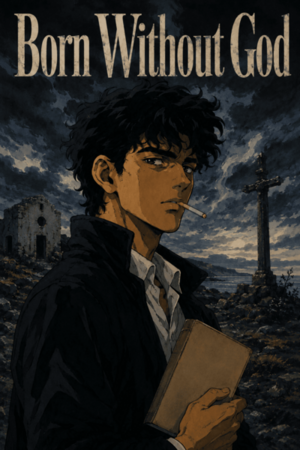
BORN WITHOUT GOD
In Nivàra, silence is not the absence of sound. It is a weight that settles on your shoulders, cold and rough like the granite of the mountains that hold the village in a fist of stone.
Leone Aresu knew that silence better than anyone. People often spoke when they wanted to hide something, and the truth tended to gather in the pauses between words—in the way a man looked away or clenched his teeth to keep his lips from trembling.
That night, the silence had been shattered by a metallic roar, a scream of twisted steel that had echoed all the way down to the bottom of the ravine below the old road to the coast.
When Leone reached the bottom of the gorge, his shoes soaked with mud and wet grass scratching at his ankles, his father’s gray Alfa Romeo lay overturned on its side, wedged between two massive boulders. Smoke rose from the engine with a hoarse hiss. The smell of gasoline and burnt oil made the air almost impossible to breathe.
Leone did not scream or cry. He was twenty years old and, faced with what he saw, clung to the only thing he knew how to do: observe.
He approached the shattered driver-side window. The headlights, still on, cast faint blades of light against the rock wall and caught the heavy rain falling around him.
His father, Pietro, was slumped over the steering wheel, motionless. His face was calm, almost unnaturally so for a man whose life had just ended against a block of granite. In the passenger seat, his mother, Ester, rested against the backrest with her eyes half-closed and glassy.
Leone reached a trembling hand into the cabin and touched his father’s neck. Nothing.
Only the previous Sunday, Pietro had complained that Leone was holding the oil bottle incorrectly while they cleaned his old hunting rifle on the kitchen table. Without interrupting the complaint, he had pushed the better chair toward his son with his foot. Ester had scolded them both for staining the tablecloth and, ten minutes later, brought them coffee while still muttering under her breath.
The memory arrived whole—his father’s rough fingers, his mother’s irritated voice, the chipped cups— and vanished before Leone could hold on to it.
He turned toward Ester. Her wrist was cold.
As the realization that he was alone in the world began to work its way through him, Leone noticed her right hand. It was not lying open at her side. Her fingers were clenched into a stiff fist, and something dark and dull gleamed between them.
It was not the gold of her wedding ring.
Breathing hard, Leone used both hands to pry open his mother’s fingers. When her grip finally loosened, an object fell into his palm.
It was a heavy ring of black steel without a single precious stone. A geometric symbol had been cut deep into its smooth surface: a five-pointed crown, broken down the middle by a diagonal line.
Leone closed his fist around it. The cold metal bit into his skin.
His father worked at the land registry office. His mother took care of the house and tended the vegetable garden. Pietro drank his morning coffee standing beside the sink, no matter how many times Ester told him to sit down. Ester spoke to the tomato plants when she thought no one was listening and denied it whenever Leone caught her.
In Nivàra, they were people no one had any reason to watch. Their lives seemed to consist of simple habits repeated year after year.
That ring did not belong to that life.
The headlights of a patrol car lit the edge of the ravine from above, cutting through the darkness with flashes of blue. Sirens, late as always, began to wail in the distance. Leone slipped the ring into the inner pocket of his jacket and exhaled slowly, forcing back the tears.
Whatever his life had been that morning was gone.
The following morning, the Carabinieri station in Nivàra smelled of burnt coffee and old paper.
Marshal Corrias, a man in his fifties with a mustache yellowed by nicotine and a belly pressing against the buttons of his uniform, watched Leone from the other side of a metal desk. He held the accident report between both hands.
“It was a fatality, Leone,” Corrias said. His voice was low, carefully measured. “The bend on the old road to the coast is treacherous when it rains. Your father must have lost control. Maybe he nodded off.
There were no skid marks.”
Leone stared at him, ignoring the uniform and the documents beneath his hands.
Corrias’s pupils were slightly dilated. As he spoke, he kept drumming his left index finger against the medical report in a quick, nervous rhythm. Fatigue could have caused it. Discomfort, perhaps too much coffee. Yet the corner of his mouth twitched each time he pronounced the word fatality.
He’s afraid of that word, Leone thought.
Whether the fear came from guilt or something else, he could not know.
Leone leaned forward slightly. His tone remained calm, almost submissive, and he allowed Corrias to see only a young man bowed by grief.
“Marshal, my father didn’t suffer from sudden bouts of sleep. He knew that road curve by curve. He’d been driving it for thirty years. He took that route every Tuesday.”
Corrias stopped drumming his finger and folded his arms across his chest.
“Leone, I understand your pain. But the dynamics are clear. The investigation confirmed the impact. It was a tragic accident. The village stands with you. You were…” He cleared his throat. “I mean, your parents were good people. Quiet people.”
He lingered on the final words.
Leone could not tell whether they were meant to reassure him or warn him. “Of course,” he said, lowering his gaze. “Thank you, Marshal.”
“What will you do now?”
The question came before Leone had fully begun to stand. There was an urgency in Corrias’s voice that had not been there when he spoke about the bodies.
Leone wondered whether the Marshal was measuring his intentions.
He pulled his jacket closer around himself. Through the fabric, he could feel the outline of the black ring against his chest.
“I don’t know,” he replied. “I think I’ll sell the house. I have to pay off the debts my father took on to repair the roof. There’s no reason for me to stay here.”
The tension in Corrias’s shoulders eased. A quiet breath escaped him.
“That’s the best choice, lad. Cagliari offers more opportunities. Nivàra…” He glanced toward the window. “Nivàra is a place for old men.”
Leone left the office without saying goodbye.
As he walked down the corridor, he began assembling what little he truly knew. The possibility of his remaining in Nivàra had unsettled Corrias; the prospect of his departure had brought visible relief. Whatever lay behind the crash, the Marshal appeared to fear it.
Fear in a man of the State was information.
Outside, the pale sun of a Sardinian autumn hung over an almost empty square. A few old men sitting on the steps of the Church of San Costantino watched Leone pass. Their gazes carried the same silence he had spent his life trying to decipher.
Some of it may have been compassion. Some was the involuntary relief of those who see misfortune strike a neighbor’s house and thank heaven it passed over their own.
Among them, Leone noticed an unfamiliar figure.
A man in his thirties, wearing a tailored dark coat far too elegant for the dusty streets of Nivàra, leaned against a black sedan parked beneath a holm oak. His posture was relaxed, but his eyes, hidden behind dark lenses, followed Leone across the square.
Leone kept walking toward the empty house.
Inside his pocket, the black ring seemed suddenly hot against his chest.
If someone truly stood behind his parents’ deaths, that person might not be interested only in hiding a secret. The man beside the sedan appeared to be waiting to see what the last of the Aresu would do.
At the front door, Leone slipped the key into the lock and glanced back toward the square.
The sedan remained beneath the holm oak, out of place among the pale stone and weathered façades. Leone’s lips moved in the faintest smile.
They wanted to see what he would do.
They would find out soon enough—but not on their terms.




Please sign in to leave a comment.