Chapter 6:
Chapter 6: The Blind Spot
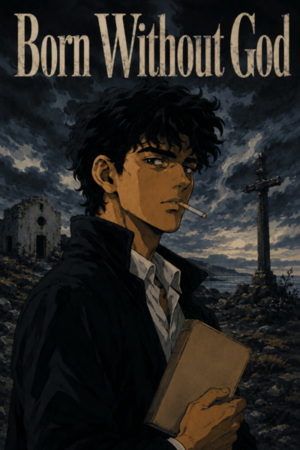
BORN WITHOUT GOD
The air at the port tasted of salt and rust. It cooled Leone’s face, but every step along the western quay sent pain through his swollen left eye.
He kept the injured arm close to his chest. Blood and fluid from the wound had dampened the fabric of his shirt. Mira walked beside him with her head buried in the hood of her sweatshirt, the canvas backpack striking her hip.
Neither spoke.
Mira’s jaw remained tight. Leone did not ask whether she blamed him for what had happened in the attic.
“Up there,” she said, turning behind a row of Tirrenia containers rusted by salt. “Between the old grain silos. The harbor patrol never passes after four in the morning.”
Leone caught his foot on a steel mooring cable and fell to his knees. He stayed in the mud for several seconds before bracing his good hand against a container and dragging himself upright.
Mira watched without offering help.
“The great analyst from the mountains,” she said.
“You guessed that Raimondo’s chain wasn’t his, but you didn’t understand that a man with a noose around his neck might hit you before you finished talking. Do people in Nivàra always talk that much?”
“I looked at the wrong details.”
“You looked at them like an academic.” Mira began walking again. “Out here, the truth isn’t a secret people reward you for finding. It’s something they pick up and hit you with.”
She glanced back.
“Remember that if you make it to tomorrow.”
Her refuge was an abandoned electrical control booth wedged between the base of a concrete silo and the pier where barges had once berthed. Faded spray paint covered its walls. Inside, a gutted valve switchboard occupied most of the cold room, its copper stripped away years before.
Mira checked the pier and removed the brass key from her hoodie.
She crouched beside the switchboard, inserted it into a narrow slit between the severed cables and turned it halfway. A metal panel opened with a dull click.
Someone had modified the machine to create a hiding place. Leone could not tell whether Mira had done the work herself.
She reached inside and removed a green ammunition box. From it, she took a sealed glass ampoule and a syringe still wrapped in plastic.
“Broad-spectrum antibiotic,” she said. “Stolen from a pharmaceutical shipment three months ago. It won’t fix that arm, but it might slow things down until you reach a doctor.”
Leone looked at the syringe. “You know what you’re doing?”
“I’ve watched it done.” Mira snapped the neck of the ampoule and drew the liquid into the syringe. “Hold still and try not to make me regret this.”
While she worked, Leone looked inside the ammunition box.
Bundles of fifty-euro notes were bound with office rubber bands beside three blank blue passports. Among them lay a small piece of black sealing wax, broken in two.
Part of an engraving remained visible on its smooth surface: three diagonal lines converging toward a point.
A fragment of the broken crown.
It matched the symbol on the ring hidden inside Leone’s jacket. He reached toward the wax, but Mira kicked the lid shut.
“Don’t touch things you don’t understand.” “That sealing wax—does it come from Trieste?”
Mira went still, the needle suspended between them. Outside, seawater struck the pillars beneath the pier.
She caught Leone’s left arm, pushed up the sleeve and drove the needle into the muscle without answering. The cold liquid spread beneath his skin.
“In Cagliari, questions about the North are expensive,” she said, pressing cotton against the injection site. “Sardara has family in Civitavecchia and Monfalcone. Say the wrong place name near him and he starts shooting before anyone explains.”
Leone leaned against the concrete wall.
He possessed only fragments. His father had watched Ester on Don Basilio’s behalf. His mother had belonged to the Silent Crown in Trieste. Mira now hid sealing wax carrying the same symbol in Cagliari.
The pieces did not prove how those lives connected, but the repetition was difficult to dismiss. The Crown’s reach might extend much farther than Nivàra and Trieste.
“Does Sardara know about this place?”
Mira sat on the ammunition box with her knees drawn to her chest.
“Sardara hears about everything from the Sabaudo pier to the Marina. Raimondo is a dog, but he’s his dog. By noon, they’ll clean out my room. By evening, they’ll be asking Corrias about you.”
“Corrias?”
“He calls Sardara when strangers from the interior start asking for roads to the coast.” Leone remembered the movement at the corner of the Marshal’s mouth.
Cagliari offers more opportunities.
Perhaps Corrias had wanted more than to remove him from Nivàra. He might have expected someone in Cagliari to hear that Leone was coming.
“We should move.”
His arm still hurt and the fever remained, but sitting in the cold room had steadied him enough to think. Mira raised one hand.
Footsteps sounded on the iron gangway outside.
Two people moved slowly toward the silos, pausing every few meters.
A yellow beam passed through the cracks in the wooden door and slid across the floor until it reached Leone’s muddy shoes.
Someone with a flashlight was searching around the booth.






Please sign in to leave a comment.