Chapter 2:
CHAPTER ONE: THE QUEEN WHO RETURNED
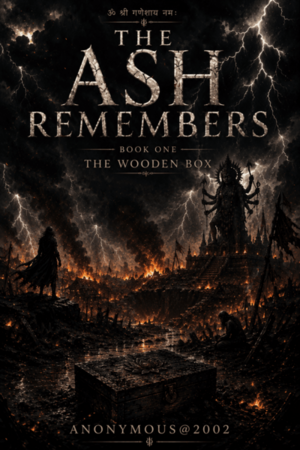
The Ash Remembers
Book One: The Wooden Box
---
CHAPTER ONE: THE QUEEN WHO RETURNED
---
The Royal Palace, Amaravati
Three Hundred and Sixty-Three Years After the Massacre of Raksha-Kuti
The king was dying.
The palace had known this for years—his body worn thin by centuries, his face now that of a man near ninety, though his true age stretched toward nine hundred. The court had long since learned to speak around such things. Words like succession and legacy appeared in careful conversations, in council sessions that stretched into evening, in the letters that passed between noble houses with seals of ancient wax. The king's slow decay was simply the stage upon which ambition performed its quiet rituals.
No one said what everyone knew: Sahastranetra had no heir. The line of Indrayani ended with him.
The question was who would sit on the throne of storms when he no longer did. And that question, after centuries of silence, had drawn the queen back to Amaravati.
---
The council chamber was obsidian and shadow—built for strategy, not ceremony. A long table of dark stone dominated its center, inlaid with a map of the known territories. Around it, the lords had gathered.
At the head sat Brihaspati, the ancient sage—so old that his eyes had paled to the color of winter sky, his face a landscape of creases. To his right, General Vajranakha, broad and scarred, his voice a low rumble. To his left sat Vyomgami of House Nabho-Dhara, adopted son of the old Lord Sahastrabahu, now bearing the title of Lord of Gravity. Where his predecessor had been immovable and patient as tectonic plates, Vyomgami was something else: sharp-eyed, quick of speech, his fingers constantly moving as if counting invisible coins.
Representatives of the elemental lords sat scattered along the table: a heat-haze for Agni, a woman whose hair moved like water for Ganga, a square-jawed man of earth for Bhumi. Lesser lords and provincial governors filled the remaining seats—Vasushena of the northern territories, still too young to hide his ambition; Adityavarma, old and bitter, a holdover from a previous reign; others whose names and loyalties shifted like sand.
The argument had been circling for hours.
"The Daitya border requires attention," Vajranakha said, his thick finger on the map's eastern edge. "Vritrasura the Fourth gathers his strength. He watches. He waits."
"Vritrasura has waited for centuries," Vyomgami said. His voice was lighter than Sahastrabahu's had been—almost reedy, but with a careful edge. "The Daityas measure time in stone. Their patience is not strategy. It is nature."
"Patience becomes strategy when the throne sits empty," Vasushena cut in. "Every day without a named heir—"
"The succession," Brihaspati said, his voice mild but carrying, "is a matter that requires care. The king has no heir. The line of Indrayani ends with him."
A pause. Eyes shifted around the table. No one spoke the obvious—no one ever spoke it directly. The line of Indrayani had ended long before the king's body began failing. Everyone in this room knew it. No one would say how.
"We must choose," Brihaspati continued. "The question is the basis."
"Blood," said Vyomgami, though his tone suggested he was testing the word rather than committing to it. "The noble houses have governed since the first Indra. Continuity is stability."
"Merit," said Vajranakha. "Blood produces softness. The border wars produce leaders."
"Divine recognition," said Brihaspati. "The Vajra chooses. And the Vajra, at present, recognizes only one will."
The silence that followed was heavier than the Lord of Gravity's presence had ever been.
"She is not here," Adityavarma said.
"She has not been here for three hundred and fifty years."
"She abandoned—"
"She has the Vajra," Brihaspati said.
And the room fell still.
---
The doors opened.
She entered without announcement. She needed none.
Sachi walked into the council chamber and the assembled lords rose—some from respect, some from fear, some because the weapon at her hip had begun a low, steady hum that was difficult to ignore.
She was not what most of them remembered.
Three and a half centuries in the wilderness had stripped away the queen. What remained was leaner. Her gray hair was cropped short. Her body was wiry, hardened, dressed in rough wool patched at the elbows and belted with rope. Her feet were bare and calloused. Her face was a record of weather and silence, the face of a woman nearing ninety, though her true years reached far deeper.
But her eyes had not changed. Storm-gray. Direct. The eyes of someone who had spent centuries in the wastes and had not wasted a moment.
Vyomgami, who had risen with the others, sat down a fraction later than everyone else, his fingers stilling on the table. He had never met Sachi in person, but he had grown up on stories of her—the Vajra's chosen, the Senapati who had commanded armies, the queen who had walked away from a throne and survived. The stories had not mentioned the way her presence seemed to fill a room, or the way the Vajra's hum vibrated in the chest like a second heartbeat. He was afraid of her. He was clever enough to hide it, but not clever enough to stop feeling it.
Sachi reached the table. She did not sit.
"Continue," she said.
Brihaspati inclined his head. "My lady. We were discussing the succession. Candidates have been proposed."
"Names."
"Lord Vyomgami's cousin, Gravasena. A soldier from the border campaigns. Others."
"But no decision."
"No, my lady. The matter remains... unresolved."
Sachi's gaze moved across the faces around the table. No one met her eyes for long.
"The last time this council faced an unresolved succession," she said, "a king was crowned whose name this court now struggles to speak." She let the silence stretch. "I will not see that happen again."
Vyomgami cleared his throat. "With respect, Lady Sachi, the noble houses have governed their territories for millennia. A king chosen by the council, with the support of the houses—"
"A king chosen by political convenience is no king at all. He is a compromise. And compromises do not hold when the Daityas come." Her hand rested on the leather sheath at her hip. "The next Indra will not be chosen by convenience. Only by worth."
"And if no one meets your standard?" Vasushena asked.
"Then the throne waits. And we learn to govern without a king."
---
The session ended without resolution. The lords departed in clusters, voices low and urgent, glances backward frequent. Vyomgami lingered a moment longer than the others, as if calculating whether to speak, then thought better of it and slipped away.
Sachi remained at the window, watching evening spread across the golden towers of Amaravati.
Brihaspati approached her. "You did not come to negotiate."
"No."
"You came to draw a line."
"I came to ensure that what happened once does not happen again. The court sees the throne as a prize. They forget what it cost."
The old sage was silent for a moment. "You are not the woman who left this palace."
"No," she said. "That woman died a long time ago. What remains is something else."
"You've changed."
"I had to."
"Have you found peace?"
"No. Only acceptance."
Brihaspati studied her face, searching for something in the lines that three hundred years had carved there.
"And what have you accepted?"
Sachi turned from the window. Her storm-gray eyes met his.
"That the past cannot be undone."
She walked toward the door.
"I am going to see my husband."
---
The royal bedchamber was a monument to neglect.
Once it had been the heart of the palace—gold leaf on the walls, tapestries depicting triumphs, an altar that burned with perpetual flame. Now the gold was tarnished. The tapestries were gray with dust. The altar was cold. The great bed of carved sandalwood dominated the room like a sarcophagus, and on it, a shape barely disturbed the sheets.
Sachi approached. The man on the bed was a husk. His skin was parchment stretched over bone, the face of a man who looked near ninety, though he had worn that face for decades. His breathing was shallow—each inhale a small negotiation with the dark. One hand lay on his chest. The left hand. The right arm ended at a stump, the flesh around it still raw, still angry, as if the wound had been made yesterday.
His eyes were open, clouded, fixed on the cracked ceiling.
"Sachi." The voice was a rasp, dragged from somewhere deep. "I felt you enter the city."
She said nothing. She stood at the foot of his bed.
"The council. My replacement. Who?"
"Not decided."
A sound that might have been a laugh. "Of course not. They've been arguing for years. They will argue for years more."
He turned his head on the pillow. The movement cost him—she saw it in the tightening of his jaw, the flicker of something behind the clouded eyes.
"You abandoned me." The words came raw, scraped from somewhere deep. "Three hundred and fifty years. You walked out while I slept. No word. Nothing. You simply… disappeared."
"Yes."
"You were my wife." His voice cracked on the word.
"I was your contract. You needed the Vajra's recognition. I wanted influence. The arrangement served its purpose."
"I gave you a throne." The words came harder now, the old heat surfacing. "I gave you power. I gave you—"
"You gave me nothing." Her voice was flat. "I took what I needed from the arrangement. As did you. There was nothing else between us."
"There was the child."
The air in the room changed. Sachi's hand found the Vajra. She did not draw it. But her knuckles went pale against the leather.
"He was mine," Sahastranetra said. The rasp had become something sharper. "My heir. My blood. You carried him. You were supposed to—"
"Supposed to what?"
"Protect him." The words came out like a blade. "You were supposed to give me a legacy. Instead you let him—"
The Vajra flared. White-gold light erupted through the chamber, hurling shadows against the walls. The altar shook. Dust rained from the cracked ceiling. Sahastranetra pressed back into the mattress. For a moment—just a moment—something flickered across his ruined face that might have been fear.
Sachi's voice was ice. "I carried our child. I felt him move inside me. I sang to him when I could not sleep. And then one night I felt him stop."
She moved around the bed. Her bare feet made no sound on the cold stone.
"I delivered his body alone. In this room. While you were in the eastern territories."
She stopped at his bedside. Looked down at him.
"Do you know what killed him?"
She leaned closer. Her voice dropped to barely a whisper.
"Your hands."
A long silence. The only sound was Sahastranetra's ragged breathing.
"My silence."
The words hung in the air between them, heavy as stone.
Sahastranetra stared at her. His breath came in ragged wet gasps. The stump of his right arm twitched against the sheets.
"You think I should feel guilt," he said. "You think I should regret what I did. But I don't. I did what had to be done. For the kingdom. For the throne. For everything I was supposed to be."
His voice rose. The old heat was returning.
"I was the son of Indrayani. I was raised for this. Trained for this. Every day of my life, I was told what I would become. And then—" He laughed, a wet, ugly sound. "And then the Vajra chose you. A soldier's daughter. A nobody. And they all looked at me like I was nothing."
Sachi did not flinch.
"I know."
Her voice was quiet. Cold.
"I did what I had to do too. We both did. And now we're both paying for it."
She turned toward the door.
"Sachi."
She stopped. She did not turn.
"You came back." His voice was different now—quieter. Almost puzzled. "After all this time. You came back."
"Someone had to."
She paused at the threshold. Her hand rested on the doorframe.
"I will ensure that the next one is not like us."
She walked out.
---
The door closed. The chamber was silent.
In the corridor, Sachi leaned against the cold stone. The Vajra hummed against her hip. Her breath came uneven, her chest tight.
For a moment—just a moment—her hand drifted toward her abdomen. She stopped it. Let it fall.
She pushed herself off the wall and walked. There was work to do.
---
In the bedchamber, Sahastranetra lay alone.
The ceiling was cracked. The altar was dark. Dust drifted in the fading light.
He closed his eyes. In the darkness behind his eyelids, faces waited. An old woman standing in fire. A young woman standing at an altar. A face transforming—skin darkening, eyes igniting, blood on the lips. The same dark eyes. Across all the years. Watching.
He opened his eyes. The faces remained.
They never left.
---
Far from the palace, a girl walked through a forest.
She was young—perhaps fifteen in appearance, though her true age was harder to read. Her feet were bare. Her clothes were rough, patched and faded. Two small horns—barely the length of a fingernail—pushed through her dark hair.
Across her back, she carried a wooden box.
It was old, charred at the edges, carved with the figure of a dancing woman. The strap was worn smooth where it had rubbed against her shoulder for years. She did not know how long she had carried it. She did not remember a time before it.
She did not know who she was. She did not know where she was going. She knew only the dream that came every night: darkness, a small space, a face above her, a word spoken again and again.
Survive.
She adjusted the strap across her shoulder and continued walking.
Somewhere behind her, an old king closed his eyes.
Somewhere ahead of her, a story waited to be remembered.
The forest watched. The box was silent. The girl walked on.
---
END OF CHAPTER ONE






Please sign in to leave a comment.