Chapter 0:
Prologue
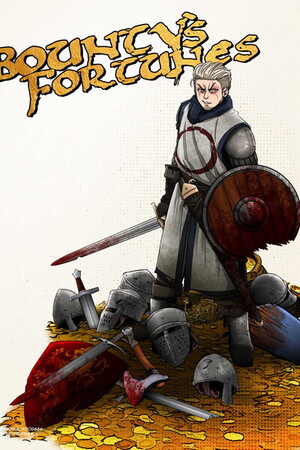
Bounty's Fortunes
Every war did not end cleanly.
They end in the mud, in the silence after the last war of the last campaign. They end with men standing in fields that were green before and are not green now, trying to remember what they were supposed to be doing with their lives.
The Great War ended all at once, lasted only eleven years, and it left almost nothing behind that had not been dug up, burned, or drowned in that same mud.
The trenches came in the second year, when someone noticed the ground was soft and the arrows could be avoided. Both sides dug themselves into the earth across every contested region in the known world, and the mud between the lines took weapons, boots, and men who stepped too deep.
It did not give them back.
In the seventh year, the Mirthalas Empire entered the war. The Dark Elves sent no heralds and they brought a weapon nobody could describe accurately, not then and not in the years after, when veterans tried and found the words simply did not exist yet.
It ended the war in the ninth month of the eleventh year.
The Mirthalas did not just take the Midlands. They took all of it, and having taken it, declined to rule it as one thing. The conquered territory was carved along old river lines into two crowns under a single black and red dragon's head banner, with the western court held by the Dragomyrth royal family, and an eastern command held by the Irovatos clan. Both answered, at least in theory, to the same empire. In practice, everyone from the Midlands to the Mirthalas homeland understood that Dragomyrth sat at the head of the table, and Irovatos sat where it was told to sit.
Dragomyrth ruled like a spider, tending its web. Treaties written to unravel favorably years after signing, arranged marriages, governors who smiled and kept ledgers that would later be produced in evidence. Irovatos ruled the way a hammer hit a nail. Where Dragomyrth wanted obedience, it purchased loyalty at a discount and let ambition do the rest. Where Irovatos wanted obedience, it burned three villages and displayed the fourth as a lesson to the fifth.
Beneath both crowns, the old kingdoms that had once fielded armies against each other now existed as puppet states, their thrones occupied by men and women who still kept their titles, but lost everything. Local courts still convened, taxes still bore old names, and the banners of long dead royal houses still flew over gates that Mirthalas soldiers now guarded. It cost the Empire almost nothing to let a defeated king keep his chair, so long as the chair reported upward and the treasury flowed the same direction. Slavery, meanwhile, thrived. Debtors, prisoners, and the simply unlucky moved along routes the Empire had no interest in closing, since closing them would have meant closing a market both courts drew considerable profit from. The West, loudly and proudly, denies it.
The Mirthalas empires now controlled the entire Midlands trade routes and collected their tolls with ease, while the surviving free kingdoms in Easterlandys and Weswards had debts and institutional paper, none of which fed anyone.
Soon, the treasuries were gone.
Every sword, every shield, every week of pay across thirty fronts had been converted from gold into something the war used up and left in the mud. They inflated, and inflated badly. A gold crown that had once purchased a horse, a month of provisions, and left change, became within eighteen months a coin nobody wanted to be the last one holding. The kingdoms answered the only way panicked treasuries know how, by making more, and the half-crown was born in that panic, a smaller coin meant to make the collapse feel orderly.
The worst of it passed, eventually.
Half-crowns are now steadied into something that no longer loses its value by the week. But it never recovered what the crown had once been, and the arithmetic of the collapse stayed baked into the coin long after the collapse itself was history. A laborer's daily wage now came as a fistful of half-crowns thick enough to need its own pouch, not because the wage was generous, but because the coin itself had been diminished so thoroughly, so long ago. A loaf of bread cost more half-crowns than a grandparent's whole month of provisions once had, and everyone understood this was not the same as being poor.
Against the Mirthalas standard, the half-crown kept sliding. Merchants who traded across the river into occupied territory watched the exchange worsen season after season, until a purse that had bought a wagon of grain from an eastern trader two years back bought half a wagon now, and everyone on the free side of the border understood exactly whose coin was gaining and whose was not. The exchequers raised their lending rates twice in a single year trying to hold the line, tightening credit at home in the hope of making the half-crown worth defending abroad. It slowed the bleeding without stopping it. Word went out to merchant houses inside the Empire itself, offering concessions, reduced tolls, land grants, anything that might draw Mirthalas coin back across the border and prop the exchange rate up from the outside, since the kingdoms had proven they could no longer do it from within. The bankers took the concessions gladly, and every concession accepted was one more thread of the free kingdoms' economy sewn quietly into the Empire's hand, a fact the exchequers did not advertise and the taverns discussed anyway, at length, over coin that bought less than it should have.
Craftsmen reopened workshops and found materials had tripled in cost while customers had halved in number. Farmers went back to fields that had not been worked in a decade, to soil that had forgotten what grain was. The work that needed doing was real. The wage a rebuilding kingdom could actually pay was not enough, and shrank further each season as the half-crown kept revising downward what enough meant.
Then the soldiers came home.
The men that spent eleven years at war were not straightforwardly convertible into other things. The skills were specific, the instincts calibrated to circumstances that no longer applied, and whatever savings they had set aside were denominated in a coin that had moved the goalposts while they were away. They stood in market squares and did arithmetic. The arithmetic did not produce livable answers.
For a season there was work. The farms needed labor, the cities needed rebuilding, and the returned men needed wages and the kingdoms needed them occupied. But the rebuilding ran out of things to rebuild. The men were still there, with the same hands and the same habits, and the job market had already decided it had absorbed what it could.
Some found footing through stubbornness or connection. The rest looked at the skills they had, and the roads that needed watching, and the merchant caravans moving through increasingly dangerous countries, and made a different calculation.
Banditry required little startup capital. The equipment was already owned, the experience recent and comprehensive. Most of the men who arrived at it could explain, with reasonable accuracy, the sequence of events that had brought them there. They did this in the tone of someone explaining something embarrassing, which was honest. The slave trade grew beside it, feeding the same routes the Empire had already decided not to police. The legal systems supposed to address both were still reassembling themselves after a decade of wartime suspension.
The kingdoms passed laws. They posted notices, organizing a task force that produced excellent reports and the roads kept getting worse.
The Bondsmen system emerged from a single ledger entry written by a city administrator, who had watched three merchant families robbed, two residents taken, and one council meeting produce nothing actionable. He wrote next to the names of the responsible parties a number: what he would pay to have them brought in. He shared the ledger. Other administrators added their own entries. Within three years the system operated across most major towns, paying former soldiers to chase warrants the kingdoms could not chase themselves.
The rates were set by administrators working with post-war budgets, which meant they were insufficient. The bounty hunters said so at considerable length, and then went out anyway, because the alternative was the job market they had already tried and the job market had already answered.
They were not a glorious institution. The money was thin, the work was hard, and the roads they walked were the same roads that had produced the warrants in the first place. But they were what the world had, in the space between a legal system that could not move fast enough and a criminal economy that had found its footing.
So, the hunters went out.
And in Aldeburgh, in a tavern called the Arch of Jay, someone sat with a warm tankard and once a job had arrived, he picked up his battered shield and his rusted sword and walked out into the wet night anyway.
The money would probably not cover his rent. It usually did not.
The rest was a matter of who was left standing.



Please sign in to leave a comment.