Chapter 4:
What the Island Gave Him
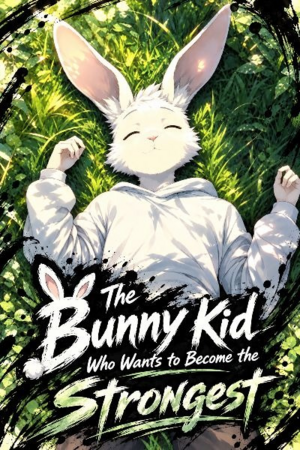
The Bunny Kid Who Wants To Become The Strongest
Kuma's sky ship had been gone for a few day's before anyone thought to measure the time that way. On Pork Island, Day's, Months, weren't counted so much as accumulated — one Festival folding into the next, one carrot harvest answering the last, a boy getting taller in increments nobody noticed until his sandals stopped fitting. What follows isn't a single morning. It's what those four years left behind, the way silt is what a river leaves when nobody's looking.
---
## I. THE SMELL (Age 8)
There was a game the children of Pork Island played without ever naming it.
It went like this: you closed your eyes somewhere on the island — the docks, the jungle path, the southern beach, anywhere — and you tried to locate yourself by smell alone.
Wood smoke first, always, because the cooking fires never fully went out.
Then the specific layering underneath: pork fat and jungle humidity, and if you were near the Plateau, the green-dark musk of the oldest trees.
Sea salt from the west.
River cold from the center.
The sweetness of the Carrot Flats in the east, when the wind was right.
Every child on Pork Island could place themselves within fifty meters with their eyes shut. It was not taught. It was absorbed, the way the whole island absorbed things — root-deep, without ceremony, simply by being raised inside it.
Eleo had never thought about any of this until the morning a trade ship came in from World 1's eastern routes and a merchant stepped off the gangplank, looked around, and said, loudly, to his companion:
*"Gods, what is that smell."*
Not in wonder. In offense.
Eleo was eight, sitting on the dock with his feet in the water, eating a carrot.
He looked at the merchant. The merchant didn't look back — he was covering his nose with a cloth, the way salt-foot traders sometimes did when the Smokeline's welcome-smoke hit them for the first time and they mistook a gift for a nuisance.
"That's breakfast," Eleo said.
The merchant glanced at him. Then away. The particular glance that meant: *you don't count.*
Eleo sat with that for a moment. Then he took another bite of his carrot, looked out at the water, and decided the merchant was wrong about everything and didn't know it yet.
This felt correct in a way he couldn't have articulated. The island smelled like life happening. Like people doing real things for real reasons. You'd have to be missing something important to find that offensive.
He didn't forget the merchant. But he also didn't carry him. The island had taught him that before he had words for it.
That same evening, he asked Leader Oran about it.
Oran was not easy to describe to someone who hadn't met him. He was a large man — a wild boar, broad through the shoulders and chest, with a face that seemed to be perpetually in the middle of some private amusement. He was somewhere past sixty and carried it the way the oldest trees carried theirs — not as a burden, but as accumulated fact. He'd been leading Pork Island for thirty years and intended, he said often, to keep at it until someone more patient turned up, which he suspected would take a while.
He was also, at this particular moment, sitting in the dirt outside the community hall attempting to fix a broken chair with what appeared to be the wrong tools, chosen deliberately.
"Wrong tools on purpose," he explained, when Eleo arrived and stared. "Keeps the hands busy but not the mind. Best thinking conditions." He squinted at a joint. "What's on you, boy?"
Eleo sat down across from him in the dirt without asking. He'd been doing this since he was small enough that Oran could hold him in one hand.
He told him about the merchant and the cloth over the nose and the particular glance.
Oran listened without interrupting, which was one of his most disarming qualities. He had the kind of attention that made your words feel like they were landing somewhere solid, not just passing through.
When Eleo finished, Oran was quiet for a moment, turning a chair leg in his hands.
"You know what they used to say about us?" he asked. "Not this island. I mean us. Our people, back before this place existed."
Eleo shook his head.
"They said we were animals." He held up a hand before Eleo could speak. "I know. We *are* animals. That's the joke that wasn't a joke. They meant it as something other than what we are. They meant we were lesser. Dirtier."
He set down the chair leg.
"You know how you answer that?"
"Punch them?"
Oran looked at him for a long, serious moment. Then he laughed — deep and unhurried, the kind of laugh that came from somewhere below the ribs.
"Boy," he said, "you are your grandfather's grandson, I'll give you that." He wiped his eye. "No. Not punch them. Though—" another small laugh "—it's not the worst idea I've ever heard.
"You answer it by being completely, undeniably, magnificently what you are. You cook your food and you let the smell go out to sea as a welcome, and you let anyone who wants to be offended by it go ahead and be offended." He picked up the chair leg again. "Their offense is information about *them*, not about you. File it there."
Eleo thought about this. "What if they have power?"
Oran was quiet for a moment. Then: "That's a better question than most adults would ask." He looked at the boy across from him — small, big-eared, carrot still in hand, eyes serious in the way they went serious when something actually mattered.
"Power and rightness are different things. A man can have every power in the world and still be wrong about what you are. Don't let him teach you about yourself." He tapped his own chest. "You know what's in here. Don't outsource that. Be what you are. Don't accept diminishment. That's the whole doctrine, boy — the rest is just decoration."
Eleo looked at him. "Did someone try to teach you wrong about yourself?"
Oran's expression shifted — not closing, exactly, but deepening. Something that had been in the room all along becoming briefly visible.
"Yes," he said. Simply.
"What did you do?"
He picked up the wrong tool, applied it to the wrong joint, and thought about it.
"I came here," he said. "And I cooked something. And I let the smell go out."
## II. THE FESTIVAL (Age 9)
The Festival came every year and lasted a month, which was correct, because one day could not hold everything.
At nine, Eleo was old enough to enter the jungle obstacle course for the first time and young enough to be completely destroyed by it.
The course ran through half a kilometer of interior jungle, over roots and through low branches and across two sections of the Cold One, and it was designed specifically for children — which on Pork Island meant it was designed specifically to be chaotic and exhausting and almost certainly humbling.
He made it through in a time that was apparently record-setting in the wrong direction, which Abby wrote down in her small notebook with what he felt was unnecessary precision.
"Fourteen minutes and thirty-two seconds," she said.
"The log moved."
"Logs don't move, Eleo."
"This one moved."
She wrote something else in her notebook. He didn't ask what.
The Festival had a different quality each day. The early mornings — the ones closest to the spring turn, when the light came in at that particular gold angle the island only got a few days a year — were quieter than the rest, a private hour before the noise started, when a few of the older islanders stood alone near the shore and said nothing to anyone. Nobody called it anything. It simply happened, every year, right before the first race, and every child grew up assuming that was just what dawn on the first Festival morning felt like.
Then came the races: foot races along the beach, boat races in the bay, cooking races that produced meals ranging from extraordinary to genuinely dangerous. The rules changed mid-race without warning, which was tradition and also, Eleo suspected, how the adults kept things interesting for themselves.
In the middle stretch came the eating contests. Eleo had been preparing for this since approximately the moment he understood eating contests existed. He had trained. He had studied. He had eaten prodigious quantities of everything put in front of him for most of his living memory.
He came in third.
He sat with this for a while.
"Third is respectable," Abby said.
"Third is not first."
"It's also not last."
"Abby."
"Eleo."
He ate another bowl of whatever was in front of him and resolved to come back next year, a genuine bread-breaker's effort undone by one particularly committed farmhand twice his size.
But the Festival's real weight came at the end. Remembrance Night.
He'd been to it every year of his life, but this was the first year he understood what he was seeing.
The whole island gathered at the shore — every family, every elder, every fishing boat pulled up out of the water and turned into seating. Fires along the beach. The smell of the meal that had been cooking communally all day, distributed freely, eaten together.
Then the speaking began.
One by one, people stood and talked about the dead. About the founders who hadn't lived to see what they'd built. About parents and friends and the people who had held things together before they couldn't anymore.
The rule — and it was a genuine rule, held seriously — was this: if you could make someone laugh about someone they lost, you had honored them. Not mocked. Not diminished. Honored.
An old woman stood up and talked about her husband, who had been stubborn in exactly one area of life: the correct way to peel a carrot. He had opinions. Strong ones. He had been wrong. She had never told him while he was alive because watching him peel carrots with enormous misplaced confidence was among her favorite things in the world.
The beach laughed. Not in relief. In recognition.
A man stood up and talked about his mother, who had been afraid of birds her whole life despite living on an island with approximately ten thousand of them. He described her complicated relationship with a particular gull that had nested outside her window for six years. The gull had outlived her. He fed it now. He didn't know why. It seemed right.
Eleo laughed at this and also felt something large and unnameable move through his chest, and he looked sideways at Abby, who was watching the speaker with bright eyes and very still hands.
He didn't say anything. Neither did she.
Near the end, Oran stood. He was always the last, or nearly the last. It wasn't a rule. It just worked out that way.
He was quiet for a moment, looking at the fire. The beach was quiet with him.
"I had a daughter," he said.
The beach already knew this. Everyone on the island knew this. But Oran said it every year because, he had explained once, privately, to Eleo's grandfather: *some things you say not because they're new information, but because the saying keeps them real. She lived. She deserves to be real.*
"Her name was Mira."
He let that sit.
"She was eleven when she died. She was, in my completely objective assessment as her father, the funniest person I have ever known in my life." He paused. "She also had the most catastrophic relationship with door frames of anyone I have encountered before or since."
He looked up.
"She walked into the same door frame in our house approximately four hundred times. We counted. She kept a tally. She thought it was hilarious."
The beach laughed.
"Every morning I walk past that door frame," he said, and the laughter hadn't fully faded yet, "and I say good morning. Because that's where she is. She's in the wood. She's in the dent she left."
The laughter and the ache lived in the same breath, and everyone on the beach breathed both at once.
Eleo sat very still. Something had settled in him, heavy and clarifying.
He looked at Oran — this large, worn, patient man standing at the edge of the firelight — and understood, for the first time, that wisdom wasn't the absence of grief. It was what happened when grief was refused the chance to make you smaller.
He tucked this away, in the same pocket as the folded paper with the stick figures.
## III. THE SECOND LEADER (Age 10)
The Second Leader was not spoken about.
Eleo had known this his whole life the way children know things on small islands — not told, but absorbed. The name was not said. The period was not referred to. When the island's history came up, in passing, in stories told during the Festival, in Elder Miro's occasional lectures that no one had technically asked for — that era was a gap. A held breath. What the newer, half-joking phrase for it called *Second Leader quiet.*
At ten, he asked Oran about it directly.
They were in the community fields. The carrot harvest was two weeks out and the plants were at that late stage where they needed attention but not labor — walking the rows slowly, checking, being present. Oran did this most mornings. Eleo had started joining him the previous year without it ever being arranged.
He asked. Simply. Straight.
Oran was quiet for three rows.
"It involved children," he said finally.
Eleo waited.
"He had authority. He used it the way people use authority when they've forgotten what it's for." Oran crouched, examined a plant, pressed the soil gently around its base, stood. "He told himself it was for the good of the island. They always tell themselves that."
He moved to the next plant.
"He was removed. It wasn't quick enough. That's the part we carry."
"Who removed him?"
"The community. Together." He kept walking. "That's the only authority that counts, in the end. The island deciding what it will and won't hold."
Eleo walked beside him. "Is that why you don't have — like — guards? Or enforcers?"
Oran looked at him sideways with an expression that was complicated and fond.
"That's exactly why," he said. "Power that enforces itself is power that's afraid. We don't want that kind." He paused at a plant that needed more attention and knelt. "We want the kind that only exists as long as it's genuinely needed and then steps aside. Power as service. Power as temporary. Power that's always asking: am I still the right answer to this problem?"
Eleo watched him work the soil. "Do you ask yourself that?"
"Every morning." Oran didn't look up. "Every single morning, boy. If I ever stop asking, that's the morning someone should replace me."
Eleo thought about this for the rest of the row. Then: "What happened to the children? The ones he—"
"They're still here," Oran said quietly. "Some of them. They're adults now. They're farmers and fishers and parents." He stood and brushed the soil from his knees. "The island held them. The way it's supposed to."
He looked at the rows of plants, green and growing, fed by the same soil that had held everything else.
"That's what a community is for. Not for things going right. For being there when they go wrong."
He put a hand briefly on Eleo's shoulder. The weight of it was familiar — not Gou's weight, not Kuma's weight. Something different. Something patient. The specific weight of someone who had decided, a long time ago, that other people's pain was his responsibility to take seriously.
"The silence isn't shame," Oran said. "It's respect. For the ones who were hurt. They get to decide what's said about it. Not us."
They finished the row. The carrots grew the way they always had, in the deep dark soil of a place that had decided, once and for long ago, what it was going to be.
## IV. THE LION BEYOND THE ISLAND (Age 11)
The pilgrim arrived on a supply ship in the wet season, which was its own kind of strange, because pilgrims did not, as a rule, come to Pork Island. Traders came. The occasional wandering scholar came, drawn by rumor of the old growth on the Plateau. But a pilgrim — robed, sun-worn, carrying nothing but a satchel and a very specific kind of hope on his face — was new.
He said his name was Corvin. He said he had crossed two seas to see the Roaring Stone.
Ferrens, who ran the archive room and possessed the specific quality of knowing things before you finished asking, was the one who ended up walking him up through the Green Break, mostly because nobody else particularly wanted to, and Eleo — eleven, curious, unable to resist a stranger with an unusual reason for being somewhere — tagged along at a distance that fooled no one.
"You'll want to lower your expectations," Ferrens told the pilgrim, not unkindly. "Whatever you've heard, it's smaller."
"I've heard a great deal," Corvin said. He had the careful, over-formal way of speaking that mainlanders sometimes had when they'd learned about a place from books instead of from living in it. "The Roaring Stone. Where the Lion God first spoke to mortals. Site of the First Roar."
"It's a rock," Ferrens said. "In a grove. Nobody's put a fence around it."
Corvin looked faintly wounded, the way people do when a thing they've built up for years is threatened by the possibility of being ordinary.
They reached the grove by afternoon. Eleo watched from the treeline as the pilgrim went still the way everyone went still, the first time — that particular quiet that wasn't silence but felt like the space was listening. Then Corvin walked to the flat, unshaped stone at the grove's center, knelt, and began reciting something long and formal, a prayer with real structure to it, verses Eleo had never heard, invoking the Voice of the Lion, the Claw-Bearers, the Roar-Tenders who'd apparently devoted their whole lives to teaching self-worth to strangers.
Eleo leaned toward Ferrens. "What's he doing?"
"Praying," Ferrens said. "Properly, by his standards."
"We don't do it like that."
"No." Ferrens watched the pilgrim with an expression that wasn't quite amusement and wasn't quite pity. "We say something before we eat. We speak to him when things are hard. That's the whole of it. Out there—" he tipped his head vaguely toward the sea, toward World 1 "—it grew into something else."
Later, back at the archive room, over tea Corvin drank like a man determined to be gracious about everything, Ferrens filled in the rest, half for the pilgrim's benefit and half, Eleo suspected, for his own — the particular pleasure of a man who loved cataloguing things being handed something genuinely new to catalogue.
There was, apparently, a whole religion out there. Temples. A City of Beasts, built somewhere on the mainland, that called itself the holiest place of Zarukhan's worship despite — as far as anyone on the island could tell — never having hosted so much as a whisper from him. Clergy called Roar-Tenders, who taught self-worth the way a schoolteacher taught letters. A high priest called the Voice of the Lion, chosen — Corvin said, with the particular certainty of someone repeating doctrine rather than describing fact — directly by Zarukhan himself. Warriors called Claw-Bearers, sworn to defend the holy sites, of which the island's own grove was apparently the first and, by Corvin's account, the only real one.
"There's a war," Corvin said, at one point, quietly, like it embarrassed him to say it in a place this untouched by it. "The War of Existence. Zarukhan's faith against a god called Morte, somewhere in the eastern provinces. It's been going a long time. Nobody agrees on when it started."
"And you fight in that?" Eleo asked.
"I pray in that," Corvin said. "There's a difference, and I've made my peace with which one I am."
There was a saint, too — Saint Bram the Roarer, some two hundred and fifty years back by mainland reckoning, who was said to have stood in the middle of the old Animal Kingdom itself and roared at it, literally, in front of everyone, refusing every threat they made against him until they simply stopped trying to make him small. Nobody on the island had ever heard the name. Ferrens wrote it down anyway, in his careful cataloguer's hand, in the margin of a page that already held two other handwriting styles from a hundred years back.
"Funny," Ferrens said, mostly to himself. "We had a whole crossing full of people who did exactly that. Just none of them got a title for it."
Corvin didn't understand the comment. Eleo thought he understood it completely, and said nothing, which felt like the correct amount to say.
There were relics, too — a cloak called the Golden Mane, said to be woven from Zarukhan's own fur, kept somewhere in a cathedral called the Temple of the Claw; an artifact called the Claw of Existence, said to defend its bearer from diminishment itself. There were festivals — the Day of Roaring, held at the spring equinox, when the faithful gathered at dawn and roared, together, as loud as they could, to mark the day the Lion God first spoke.
"We do that," Eleo said, surprised. "Sort of. First morning of the Festival. People go quiet down by the shore before the races start. Nobody roars, though."
"Perhaps," Corvin said carefully, "it doesn't need to be loud, here. Perhaps here it never had to be proven."
That landed somewhere Eleo didn't have words for yet, and he carried it without examining it too closely, the way he'd learned to carry things that mattered before he understood exactly why.
Before Corvin left — three days later, on the next ship out, having gotten what he came for and considerably more than he expected — he asked Ferrens one final question, standing at the edge of the grove with the ordinary, unfenced, unadorned stone behind him.
"Doesn't it bother you? That there's nothing here. No priesthood. No order. Anyone could walk in and claim to speak for him and there'd be no authority to stop them."
Ferrens considered this for longer than the question probably deserved.
"That's the point," he said finally. "He doesn't need speaking for. That's the whole doctrine. A god who tells you to trust your own read on things doesn't lend himself to middlemen." He looked at the stone. "You built temples because you needed somewhere to put your certainty. We didn't need that. We already knew what we were. That's why we left, in the first place."
Corvin didn't have an answer for that. He simply bowed, the way pilgrims did, and walked back down toward the docks, carrying two hundred and fifty years of doctrine toward a rock that had never asked for any of it.
Eleo watched him go.
"Was he wrong?" he asked Ferrens. "About it being ours. The real one."
"No," Ferrens said. "He was right about that part. It's just that being *first* isn't the same as being *more.* We just got here before anyone decided it needed decorating."
---
## V. THE MUSHROOM PEOPLE (Age 11)
The Mushroom People had been gone for twenty years before Eleo was born, but their presence was everywhere if you knew how to look.
The trade bond between them and the island's founders was the reason the island had survived its first decade. That was simply true. The founders had arrived with tools and seeds and knowledge and not enough of anything. The Mushroom People — who had been living in World 1's interior for generations, who understood soil chemistry and water management, who could read an ecosystem the way some people read text — had seen what was being attempted and helped.
Not because they were asked. Because they understood that what was being built mattered.
They had eventually moved to World 3, following something Eleo's lore books described only as *a deeper understanding of their own nature*, which he found vague and fascinating in roughly equal measure. They'd left behind trade agreements that had remained honored on the island's end even after there was no one left on the other end to honor them with. Because that was what agreements were.
Eleo learned this at eleven from Ferrens, who possessed the specific quality of not particularly caring whether you were interested in what he was teaching, because he knew it was important, and he was going to teach it regardless.
They were in the archive room, which was less a room and more a large closet that had achieved awareness of itself. Ferrens ran it alone. Had done for thirty years. And had opinions about organization that he was happy to share at length.
"The first trade was seeds," he said. He was not looking at Eleo. He was cataloguing. "We gave them dried pork. They gave us root varieties that couldn't grow on this island without assistance. They showed us how to assist." He placed a scroll in its slot with the precision of someone who knew exactly where it belonged.
"That's what a real trade is. Not just goods. Knowledge. How to continue."
Eleo was sitting on the floor — the chairs were occupied by stacks of documents — with a large illustrated record across his knees. Hand-drawn maps of the island in its first years. Annotated in two different handwriting styles. The founders' cramped, urgent script. Another hand, broader and more patient. The Mushroom People's contributions marked in the margins.
"They were fungi-based," Ferrens said. "Biologically. Interconnected in ways our bodies aren't. They experienced time differently. Community differently." He paused. "They saw the founders the way they saw everything — as part of a larger system. Something that, if it survived, would change the balance of what was possible in this region."
He finally looked at Eleo.
"They weren't being generous. They were being accurate."
Eleo looked up from the map. "They thought the island would matter."
"They knew it would." Ferrens sat down — creating a small avalanche of papers, which he did not acknowledge. "And they were right. You're World 1's free ground. There are people who've been living here for twenty years who came with nothing. There are children who've grown up speaking three languages and knowing how to farm and fight and hold a community together."
He looked at Eleo over the stack of documents.
"That started with fungi who saw a group of animals escaping with seeds and tools and decided: this should work."
Eleo looked at the two handwriting styles running alongside each other through the margins of the old map. Two completely different kinds of minds, thinking in completely different ways, working toward the same thing.
"I want to be like that," he said softly. Not really to Ferrens.
Ferrens, who had been teaching long enough to recognize when a student was saying something real, didn't comment. He just continued cataloguing. Which was its own kind of answer.
---
That evening, Eleo found Lucy in the kitchen at the end of service. Doing the last cleaning in the way she did everything — methodical, present, no wasted movement. The Iron Fang was quiet. Abby was upstairs. The fire was banked.
He sat on the counter — she'd given up telling him not to, years ago — and told her what he'd learned.
She listened while she worked.
"Mom used to do that," she said eventually. She wasn't looking at him. "The Mushroom People thing. Seeing."
She wrung out the cloth.
"She said some people look at you and see what you are. And some people look at you and see what you could make possible." She hung the cloth. "The second kind are the rarest thing in the world."
"What kind are you?"
She looked at him then. The particular look she had — that filing-away look — except this time he recognized what she was filing. Not information. Recognition.
"I'm trying to be the second kind," she said. "Every day."
He sat with that. "Is that why you make breakfast for everyone?"
She laughed. Short and genuine. A sound she didn't make carelessly.
"The founders' first meal was pork. They'd made it off a ship with nothing and found this island. The first thing they did when they had fire was cook. And eat together." She looked at him. "Sharing food is how this island said: we're real. We're here. We're going to continue."
She smiled.
"That's all I'm doing every morning, Eleo. Saying we're here. We're going to continue."
He was quiet. Then: "Abby told me once that you came from somewhere bad."
Lucy was still. Then she nodded once.
"The food thing — that's taking something they used to hurt you and making it into something that holds people. Right?"
Lucy looked at him for a long moment.
"Yeah," she said softly. "That's exactly what it is."
She turned back to the counter. The kitchen was clean.
"You're going to be something, Eleo. I hope you already know that."
He didn't have an answer. He sat on the counter in the quiet kitchen and felt the warmth of the banked fire and the particular peace of a place that had decided what it was and kept being it, every day, on purpose.
## VI. THE YEAR BEFORE (Age 11, Turning 12)
The year Eleo turned twelve, Oran's health began to slow.
Not dramatically. Not suddenly. Just the specific slowing of a body that had carried considerable weight for a long time and was beginning to set some of it down.
He still walked the carrot rows every morning. He still sat outside the community hall with wrong tools and wrong joints, thinking. He still stood at Remembrance Night and said: *"Her name was Mira."*
But he rested more. And the community, quietly, without comment, arranged itself around that fact. This was how Pork Island handled things.
One evening near the end of the dry season, Eleo found him sitting on the dock at the southern bay, watching the water go gold in the last light. Oran had a piece of dried pork in one hand and appeared to be in the middle of a thought he'd been having for a while.
Eleo sat beside him without asking. They were quiet for a long time — the comfortable quiet of people who had talked enough to trust the silences.
"Can I ask you something serious?" Eleo said.
"You usually do."
"Do you miss her? Like — constantly?"
Oran looked at the water. "Constantly." He paused. "But it's changed what it feels like.
"When it first happened, missing her was like standing in a fire. Everything hurt. Everything reminded me, and the reminding hurt all over again." He was quiet. "Now it's more like weather. She's always present. Some days the weather is very hard. Most days I can feel it and still go about my life."
He looked at the dried pork. "She liked this. The sweet-cured kind. She ate it constantly." He took a bite. "So I eat it and think about her. And it's just weather. Mine. That I carry."
Eleo looked at the water. "Is that healing?"
Oran smiled faintly. "I think healing is a misleading word." He thought for a moment. "Like healing means it goes away. It doesn't. You just get bigger than it." He tapped his chest. "The loss stays the same size forever. You get bigger."
He looked at Eleo.
"That's why you have to keep growing. Not away from things. Into them. Through them." He tapped his chest again. "Everything you love and lose stays here. You just keep making room."
---
## VII. THE HARVEST (Age 12)
The morning of Eleo's twelfth birthday, he was in the carrot fields before anyone else.
Not because anyone had asked him to be. Just because he'd woken up early with the specific energy of a significant day. His body had taken him there before his mind had decided where to go.
The field was cool in the pre-dawn. The plants caught the first grey light. The soil was dark and damp from the previous day's watering.
He walked the rows the way Oran walked them — slowly, crouching occasionally, pressing the soil, being present. He didn't have Oran's knowledge. He was just here. Paying attention.
He thought about the Mushroom People walking these same rows in the island's first years, reading the soil, teaching someone to read it with them. He thought about the seeds carried across water on a boat that had no guarantee of arriving. He thought about a first meal cooked on a fire lit by hands that had never been allowed to light one freely before. He thought about a stone in a grove that a pilgrim had crossed two seas to see, and about Ferrens saying: *being first isn't the same as being more.*
He thought about Oran saying: *it doesn't divide. It multiplies.*
He pulled a carrot from the ground. It came up clean, dense, sweet-smelling — exactly what it was.
He brushed the soil from it.
Abby found him there at sunrise. She stood at the row's end and looked at him with the expression she had when deciding whether to say the thing she was actually thinking.
"Hey," she said.
"Hey."
She walked down the row and stood beside him. She looked at the carrot in his hand, then at the field, then at the sky, which was doing something complicated with color at the horizon.
"You're leaving," she said. Not a question.
Eleo looked at the carrot. "Not today."
"But soon."
"...Yeah." He looked at her. "I have to, Abby."
"I know," she said flatly. Not cold — just said. The way she said things when she'd already done the work of processing them. "I know you do. I'm not asking you not to."
"Then what are you asking?"
She was quiet for a moment.
"I'm coming with you," she said. "Eventually. Not now — I'm not ready yet. But I will be." She looked at him with the directness she had when she'd decided something. "So don't you dare become someone I don't recognize before I get there."
Eleo held her gaze. "Never," he said.
She nodded once. Then she turned and walked back toward the Iron Fang, the sunrise behind her, her shadow long on the carrot field.
He stood there for another moment. He thought about everything this island had put into him — the smell of cooking fires going out to sea, the warmth of bark under his palm, the flat stone with its offerings that a stranger had once crossed two seas just to kneel in front of, the specific sound of Oran's laugh when something caught him off guard, Lucy's hands moving through a clean kitchen saying *we're here, we're continuing,* the Festival and grief and laughter living in the same breath, the two handwriting styles in the margins of an old map, existence itself, offered without apology, needing no temple to make it true.
He tucked all of it into the same pocket as the folded paper.
Then he turned toward the sound of Lucy beginning breakfast — the smells already finding him across the field: wood smoke and pork fat and the particular warmth of a kitchen that had always meant *come in, there's enough.*
And he walked back through the carrot rows toward the Iron Fang.
Twelve years old. Ready, and not ready, the way you always are.
The island knew. It had always known. It understood the difference between gone and not yet back.




Please sign in to leave a comment.