Chapter 1:
Road to nowhere
The Iron Hearth
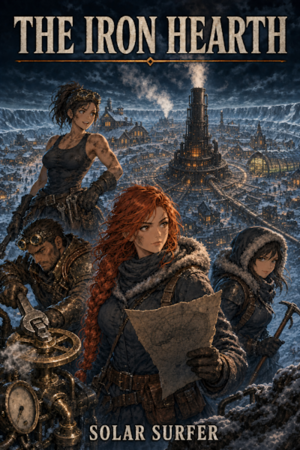
The occupants climbed down and examined their situation.Mara found the iron signpost next to her boot. It lay beneath a thin layer of fresh snow, pointing east.Behind her, eighty-seven sledges ground to a halt in a crooked line. Six hundred people stood beside them, wrapped in patched wool and hide. No one complained. The dogs had stopped barking two days ago, and even the children understood that silence conserved strength.
Commander Saye pushed through the scouts gathered around the marker. His black beard was silvered by frost and age.
"Why have we stopped?"
Mara carefully unfolded the survey map over her knee. The map had been drawn long before she was born, and the paper had split along every crease. She marked the fallen signpost's position and followed the old imperial road east with one gloved finger.
The map showed a valley.
The world showed a wall of ice.
It rose through the blowing snow, blue and smooth, burying the road beneath a glacier tall enough to swallow a watchtower. The map did not show it because the winter was new."The shelf moved south,"
Mara said. "Four miles at least."
Saye stared at the glacier, his expression caught between anger and hope.
"There will be a passage along its edge."
"Perhaps."
"Perhaps?"
"We don't know whether we can cross the northern foothills. Those mountains are treacherous even for the rangers. The southern end reaches the ravine. Our sledges will sink in the frozen quagmire."
"Then we go north."
Mara looked toward the pale disc of the sun. It hung behind the Veil of clouds like a red-hot coin beneath frosted glass. They had three to five hours of light left, not that it mattered. The light did little to warm their bodies, let alone their souls."If the ice shelf continues all the way to the foothills, we lose a day finding out,"Mara argued.
"We lose more by standing here,"
Saye countered.
A harness bell sounded behind them.One of the lead dogs collapsed into the snow.The driver dropped beside it and worked at the buckles with stiff fingers. The animal did not move. After a moment, the driver removed its blanket and carried it toward the forest.Nobody watched for long.
Saye lowered his voice.
"How much food do we have?"
Mara thought for a moment.
"Five days at the present ration."
"You told me seven."
"Two sledges broke through the river ice yesterday.We recovered the flour, but it was soaked."
"And fuel?"
"Three days. Not counting the ardent chamber."
Saye glanced back at the caravan. Canvas had been stretched over the largest sledges to shelter those too sick to walk. Small puffs of vapour escaped whenever someone coughed beneath it.
"Then we find the road. We must find the road,"
he said.
Mara folded the map.
The first roads had been built when winter was still only a season. Their surveyors had measured gentle rivers and green valleys beneath an open sky. They had not accounted for glaciers that walked across the world in a winter that lasted far longer than any before.
"We should camp here," she said.
"Send scouts north without the sledges."
"Three days of fuel, and you want to burn one of them waiting?"
"I want to know where we're going before six hundred people follow us."
Saye's jaw tightened. He had commanded the caravan since they abandoned their homes in Blackharbor; every mile had brought hunger closer to starvation and made every disagreement resemble disobedience. He took a deep breath and tried to remember the old days, when he had been considered a man of patience and tact. Those days seemed so far away now.
A figure approached from the nearest supply sledge. Tomas Rell wore a red leather engineer's jacket reinforced with mismatched plates and fur. A coil of copper tubing hung over one shoulder.
"The axle housing is cracked again," he said.
"If we unload the machine parts, I can brace it."
"What's an axle housing?" Mara asked.
"It houses the axle! You know, the thing beneath the sledge that holds it together." Tomas was not a very patient man.
"We are not unloading anything," Saye said.
"Then the sledge stays here."
"Make it move."Tomas retorted,
"Will the glacier move if you give it orders?"
Saye turned and took one step toward him.Mara moved between them before tension rose and the two men chose fists over words.
"How long?" she asked.
"Half an hour if Jessa gives me two machinists. Longer if we have to defrost the bolts."
"You have twenty minutes."
"I will inform the bolts." Tomas returned to the sledge.
Saye watched him go. "That is the third delay his scrap has caused."
"That scrap includes two pressure pumps, a flywheel governor, and the last ardent chamber from Blackharbor."
"It also weighs as much as thirty days of food."
"We did not have thirty days of food to carry."
They both knew why the machinery remained. It would help them establish a new home and build a new city. In skilled hands, the ardent chamber could power a few districts at least. Without Tomas and the rest of the engineering division, building a new home would be impossible. Saye pulled his scarf over his mouth.
"Go north, Surveyor. Take three scouts with you," he said.
"One hour. If there is a passage, shoot a green flare. Otherwise, turn back."
"Back to what?"
His eyes hardened above the scarf. "One hour, Surveyor."
Mara gathered Sana Quill and two other scouts. They left their packs with the sledges and followed the glacier north, driving iron poles into the snow before each step. The snow eventually reached their knees, as if trying to swallow them whole.
The freezing cold seeped through their leggings, attacking their nerves with painful pins and needles.And yet, the ice wall continued without a break.After half a mile, the old valley narrowed. The glacier filled it from ridge to ridge.Sana struck the ice with the head of her axe. "Could climb it.""With ropes and daylight, perhaps," Mara said."With fewer children and no elderly people, perhaps."They went farther.The wind strengthened as the sun slipped toward the horizon. It swept across the valley floor, bringing with it long white whips of snow that erased their footprints almost as quickly as they made them.Mara climbed a ridge of shattered stone and looked north.The glacier continued all the way to the foothills.
No passage.
No road.
Nothing but blue ice and the bones of telegraph poles protruding from it.Sana joined her.
"How far to the southern route?"
"Eleven days in good weather."
"And in this?"Mara did not answer.
They turned around.
"Let's give him the news."
They walked back to the caravan. Lamps were lit one by one as people settled in for the night. The sun finally sank below the horizon, and the clouds ensured that no starlight broke through.Eighty-seven weak flames in a dark country without roads.Mara took out her map again.Northwest of their position, beyond an area the imperial surveyors had left nearly blank, a thin circle marked an ancient impact basin. Beside it, in faded red ink, someone had written two words:
'Geothermal crater.'
The notation made no sense whatsoever. A geothermal crater? In this part of the country? Why wasn't it properly marked and annotated in black ink?
Mara stared at it until the snow began to cover the page.







Please sign in to leave a comment.