Chapter 1:
Chapter 1 - The Hollow Daughter
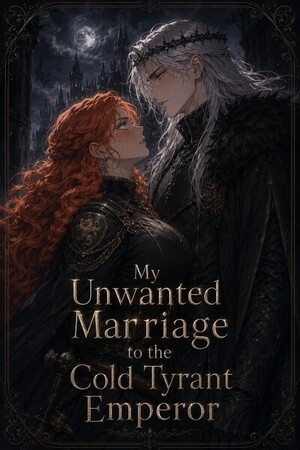
My Unwanted Marriage to the Cold Tyrant Emperor
My mother falls asleep still holding my hand.
It is the only kindness the night offers either of us, so I do not pull away. Not when my fingers go numb from the cold, not when the candle burns low enough that the shadows begin to wander. I sit still. It is something I have always been good at.
Being still, watching, and observing. It is one of the few things the court has never found a way to punish me for.
I count her breaths. The slow rise and fall of her chest, and the longer pause after. Each breath costs her something now. The medicine keeps her breathing steady, but the medicine is not easily come by, and everyone in this tower knows it, even if no one says so where she might hear.
The vial waits on the table by her bed. Three fingers of it left, pale gold, like something pressed from sunlight and sunflowers. When it empties, another will come, carried up by a physician who will not meet my eyes, sent down by the king who does not think of us at all except as a burden.
My father keeps my mother alive. I have known this the way I know my own name. He is the only one able to obtain the medicine she so desperately needs. I try not to dwell on it. Accepting what I cannot change, trying to live with the reality of it. One wrong step, one wrong move, and her access to life-saving care is denied.
When the candle's steady glow begins to fade, I know that it is very late, and I slowly ease my hand from hers, one finger at a time, before I slip away.
The eastern tower stairs turn down and down like the inside of a shell. I know every step by the sound it makes, and I recognize every shadow cast among the candles and the lanterns filled with alchemized Nibheis ore; I can walk this hall blind. I see a few servants pass in the dark. They do not bow as they go, which is fine by me. I do not bother to meet their gaze. Here in this hall I do not have to arrange my face.
That is the great secret no one tells you about a face. Expressions are work, and holding one steady in the way other people want costs something. Apparently they are also avenues for information, but I have yet to fully figure it out. Every day, everyone in court watches everyone else's face. I know smiles can be weapons, and that not everyone means what they say. It is something I still struggle to identify.
By daylight, I wear the face they expect. The dull, calm one. I have learned to stare at their noses, not quite meeting their eyes, but just enough to pass for it. The court speaks a language made almost wholly of things left unsaid, and I have never been fluent in the unsaid. I say true things instead, plainly, and often at the wrong moments.
I watch them land like dropped plates.
Long ago I decided this was not a flaw worth curing. The people who matter to me have never needed me to speak in riddles, and the people who do not matter, I have stopped trying to please.
They call me hollow.
They are not wrong.
Magic comes to the true born early. By four most often. By three, if the blood runs strong and the house is lucky. By five at the very latest, when an anxious family has all but stopped pretending not to worry. A child who turns six with no spark in them is named a hollow, a person without magic, the lowest of the low a noble can be.
I turned six, and the spring came and went, and nothing woke in me. I have been hollow ever since. I have had time to make my peace with it. Time, too, to learn the second half of the sentence they never say to my face: that I am a bastard as well, and broad where the court prizes narrow. I am plus-sized, and I take up space no one wants to give or acknowledge.
I have counted the ways I disappoint them. It is a long list. I keep that information and catalogue it the way I categorize everything, because it helps me make sense of the world.
There is a sudden chill to the air as I make my way down the hall and into the sanctuary that is my room. Idly, I fiddle with the crystal in my pocket. I always keep it close, out of habit, and rub it against my finger the way other people touch a charm or a scar.
The king gave it to me himself.
That is the part I cannot make small, no matter how hard I try. Not a servant, not a steward, but my father, the warrior king. He is a man who has killed more men and beasts than the court poets have written songs. He knelt to my height on my fifth birthday, which I have not seen him do since, and put the crystal into my hands. He told me it would let me see far-off things. I was his only child, then. His only heir. He still had hope for me at five. You can give a great deal to a child you still have hope for.
At six the hope closed like a door, and a year after that he married Lady Eliza, whose blood runs cold, just like her magic. She can turn any water to ice. Not long after the marriage, the twins were born. Two doors shutting in a single short season. A reminder that I was once his heir, and am now nothing more than his mistake.
The twins are fifteen now, golden-haired like their mother and quick, and the court adores them the way it adores anything that shines. Mikli holds the lightning; Mealla holds the thunder and the storm that comes behind it. Between the two of them they carry the same magic my father carries alone. The sky's whole temper, split down the middle, half passed to each.
Sometimes I hear the whispers about it. How the magic has thinned, and thins still, among the noble houses. That a king who commands the entire storm has sired children who each hold only a piece of it. But they never speak of it directly. I do not blame them; my father is a vindictive man. Still, I keep track of the information I come across. I close the doors to my room, clutching the crystal in my hand, as I drift off to sleep.
- -
I am reading to my mother the next day when the head of a young boy appears near the door. A palace servant, by the way he is dressed.
“Lady Bree?” he asks.
“I am she,” I respond as he approaches. He cannot be more than ten years old when he presents me with a dark blue envelope, the color of my father's house, a silver phoenix ringed with storm clouds engraved on the back. He waits patiently for me to open it. My mother speaks after a cough.
“Go on. What does it say, dear?”
Silently, I read the letter.
Lady Bree, I am summoning you to the great hall to discuss important matters concerning the Empire. You will join me at the dais at the tenth hour. Consider this a part of your duty; should you arrive late, or fail to appear, there will be consequences. The page in training will await your reading of this note to ensure your verbal reply and cooperation.
I pause.
Blinking.
I read it again.
“The King has summoned me,” I say to my mother. She gives me a worried look, one that contrasts against the page boy, who is eager for my response.
“You had better go, my dear. But I am here. No matter what.”
“I know.”
I turn toward the young page. “I accept my summons and will be there shortly.”
“Very good, my Lady,” he says as he leaves, and begins to descend the steps of the tower. I stay with my mother a little longer before I follow the same path he took.
My heart races with dread.
I am never summoned. Not unless I have made a mistake. I know something has changed, because kings do not send for hollow daughters on a whim.
The hall's architecture takes its inspiration from my family's crest. The stained-glass windows are symmetrical, all undulating curves; lightning, fire, the sky, and birds are carved into the glass in greys, blues, silvers, and purples. Polished granite and silver trim run alongside strong marble columns that lead up to the main dais.
I make my way carefully down the marble. The hall is built long, to draw the eye to the dais, which sits raised several feet up a few additional steps. I can feel the many eyes on me as I walk. But I do not focus on that. Instead I make sure to step with purpose, without seeming to hurry. Hurrying looks like fear. I keep my gaze to the floor, count my steps, and kneel before him as I arrive.
My father does not rise, and he looks at me with the particular attention he gives a tool he is deciding whether to use.
“You will go south,” he says, without greeting. “And you will marry the Adrastos boy.”
I blink.
Then again.
I am confused. For a moment I do not understand, because the sentence fits no shape I have prepared for. I have prepared for many things, but this conversation was not one of them. Then it settles, and the cold of the room finds its way under my skin.
“Emperor Theron,” I ask. “Of Skiagreth?” Hesitantly, I look up.
“You know him?” my father says, cold and firm.
I hold back a scoff.
“Of course I know of him. Everyone does.” I choose the true words, because someone should say a true thing in this room, even if it is only me. “They call him a tyrant. They say he took the whole of the central continent by storm. They say he killed his own brother and father for the crown.”
Something moves at the edge of the court. A rustle, an in drawn breath, a few whispers. I glance over and see a knot of ladies murmuring to one another. I realize my tone may have been too direct. Improper for one of my status. I can tell, because I have learned the small sounds people make when someone says a thing that should have been left quiet.
Hesitantly, I turn my gaze up. My father's stare is cold and unwavering, a scowl etched into his features.
“Then you understand the honor,” he says, dry as birch wood in the summer heat, “of being offered to him.”
“But—” Before I can finish, my father interrupts.
“This is for the Empire of Eloria. I have already sent letters to Emperor Theron discussing this match. It is not up for negotiation, and you are to head south tomorrow morning.”
“Tomorrow morning?” I cannot help but blurt it out.
It is happening so fast.
I do not understand.
My father has never had much interest in my future. I know that, for now, Skiagreth has not expanded further north, held back by the Pass of Arryndale. A narrow corridor between two sets of fjords that blocks the path from the central continent to the north. Even so, skirmishes have broken out along the pass more than once.
“Yes. Your items are being packed as we speak,” King Canute says, with finality.
My heart races. My thoughts scramble, trying to predict what will happen to me once I am sent to Skiagreth. Then it clicks. No one sends a daughter they value to a man they call a tyrant.
“And if he refuses, once I arrive? What then?” I ask, my heart hammering in my chest.
My father smirks. His gaze is cold, his tone firm.
“Then you would have fulfilled your duty,” he says. He leans forward, and the storm-light that swirls within his blue eyes stirs faintly to grey, the way the air changes before weather.
“If he does not refuse,” he says, “you will make yourself useful. You will listen. You will learn the shape of his court and the weaknesses of his house, and you will send what you learn north, to me. You will be my eyes inside the tyrant's walls.”
Panic bubbles in my chest.
“But my mother? Who will—” I ask, but before I can finish he holds up a hand, cutting me off.
“She will be taken care of. Her medicine comes from the south now,” he says, and I tune in. In all my time in this castle, my father and the physicians have not once spoken to me about her medicine, nor the name of her sickness. I have checked books, made guesses but this is crucial information.
“The war has seen to that. Your task is simple. Relay information that pleases me, and it will keep finding its way to her. Fail me, or run, and it will not.” For the first time, my father smiles. It is a small thing, and it does not reach his eyes, and I would give a great deal never to see it again.
“Yes. Of course, Your Majesty.” I curtsy. “I will not fail you.”
He chuckles then. “For her sake, you had better. You are dismissed.”
- -
The rest of the day I am rushing to prepare.
One day.
I have one day, and it is not enough. Not nearly enough time. As I am rushing about, my younger half-sister Mealla finds me speaking with several servants.
“So they're sending you to the monster,” she says. She has our father's habit of skipping the parts of a conversation she finds beneath her. “Everyone's talking about it.”
“Yes,” I say. “I'm to be married to him…”
“Or you'll be executed on the spot,” she counters.
I grimace as she studies me. I avert my gaze. She is not wrong. I am not sure what she expects me to say, so I keep quiet.
“You'll likely embarrass us,” she says. “You'll say something strange and his whole court will laugh and mock you….. or something worse.”
“Probably,” I agree.
She goes quiet again as I check my box of books. Then she lifts her chin and sweeps past me in a rush of skirts, and only when she is nearly to the door does she pause.
“Don't die,” she whispers, to the wall, not to me. And then she is gone before I can decide whether she meant it.
Not long after Mealla stops by, Mikli enters my room too. They are rarely far apart, so this does not surprise me. He stands quietly at my door, and it reminds me of the way he used to when he was small and could not sleep, his hands in his pockets. He still has the same habit.
“Remember when I had the shaking fever?” he says as he comes in.
“I do. Everyone was afraid of catching it. Mealla threw a fit because she wasn't allowed near you.”
He nods. “I remember you coming into my room with a cloth around your face. You stayed up the whole night, telling me the names of things until I fell asleep.”
I hum in response. He had the attention span of a peanut and could not follow stories well, so I thought naming a great many facts about plants might bore him enough to sleep. I also changed the cooling cloth on his face, since everyone else was too afraid of getting sick to be near him and help.
“What about it?” I ask.
He looks at me for a long moment. Mikli is quick. Quicker than the court gives him credit for, because he hides it beneath all that mischief and boyish charm. I see the same grey flash that lives in my father's eyes, there in his.
“Why you?” he asks at last, quietly, so the guards in the corridor will not hear. “Of everyone. Why would he send you?”
It is not the right question, or rather, it is the one no one else has bothered to ask, because to them I am the obvious answer. I frown. Tears fill my eyes, but I take a deep breath, wanting to be strong for him.
“Because I cost him nothing,” I say. It is the true answer, and I give it to him because he has earned a true answer from me.
He does not like it. His jaw sets, and for a moment the air smells of coming rain. His gift, stirring with his temper. “That's not a reason,” he says. “It isn't right.”
“It is to him,” I say, as he hands me something. I look at it. A dagger, with a jeweled handle and a silver sheen. Small enough to conceal, but just as deadly for it. Sapphires are set into the hilt.
“Thank you, Mikli.”
“Don't thank me,” he responds, before rushing out of the room.
After making sure everything is nearly packed, I save the hardest goodbye for last.
My mother is awake when I come to her just after dusk. Someone has already told her, I do not know who, because when I arrive she is already crying. I cannot stop my own tears from coming at the sight.
I run to her and hug her tightly. She holds me close, squeezing me. The smell of her envelops me in a familiar warmth as she speaks.
“He can't,” she gasps. “He can't send you there. You're—” She stops. She has never once called me hollow. In twenty-two years she has never let the word into this room. “I can't lose you,” she finishes. “You're all I have.”
“I'll be all right,” I tell her, even as I cry. It is a lie, and she knows it is a lie, but I tell it to her anyway. Sometimes the true thing is not the kind thing, and I have learned, slowly, from her, only ever from her, to tell the difference.
“I promise to write to you. And the medicine will keep coming,” I say, which is the only comfort I can think to offer. “As long as I do what he wants, it will keep coming. You'll be here when I come home.”
If I come home.
I do not say that part out loud. I have gotten better, over the years, at knowing which true things to swallow.
She holds my face in her two thin hands and looks at me as though she is trying to memorize me by heart, and something in my chest pulls so hard and so suddenly that for one strange breath it feels warm. The tears come and I cannot stop them. I do not bother hiding it. Not in front of her.
I am scared. I am so very scared.
But then, for a moment, I feel a heat blooming just under my skin, where there has only ever been the cold ache of the fear of losing her.
Then it is gone. As quickly as it came, before I can even turn to look at it.
I press my hand flat to my breastbone. There is nothing there. There is never anything there. I am hollow; I always have been.
My mother kisses my forehead then.
“Come back to me,” she says, and I nod.
“I will,” I say, and sniffle.
“And no matter what happens, stay alive,” she whispers. “Endure.”
I nod. That night I slept in her bed, as if I were a child again. But the next morning, guards arrive outside her room. They have come to deliver me and all my possessions to the carriages that wait for the road south. The road will be long. I am being sent to the tyrant who is meant to send me back… or kill me.
I do not expect to survive him.
I am so rarely wrong about the things I expect.






Please sign in to leave a comment.