Chapter 3:
Half for the Sea
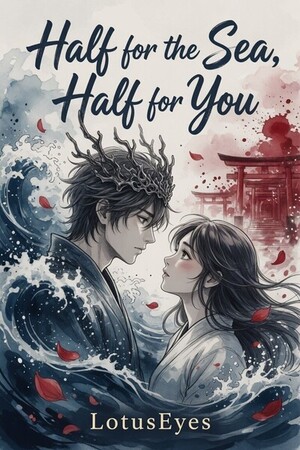
Half for the Sea, Half for You
They went up the hill in the dark, four hundred of them on a lantern-lit path, villagers in white walking the edges of the column the way farmers walk a herd.
The shrine at the summit was old wood and older stone, its courtyard swept and ringed with torches, and the great shimenawa rope had been taken down from the gate and lay coiled by the altar.
Itsuki stared at that coil, and his body recognized something his head hadn't caught up to yet.
The old families waited in white, Mr. Sakaki at their center with the ledger. Behind the workers, the shrine gates swung shut.
"Friends," Sakaki said, warm as ever, like a year-end bonus speech. "You came here because your luck ran out, and the island took you in. Now the island asks its price, as it has every tenth year for a thousand years."
The ledger opened, and the company warmth came off his voice. "Be honored. Most lives are spent on nothing. Our lord came to us ten years ago, on the tide, in the shape of a child, as the promise said. We kept the larder stocked, as our grandfathers did. Now the lamp burns low, and it is time to serve the meal."
The crowd made no sound for several moments. Then, like an animal realizing the smell of a slaughterhouse, they rushed the gates. But the wood didn't budge. Chiyo's hand found Itsuki's and crushed it in panic.
Then the flame of every torch in the courtyard leaned—together, without a breath of wind—toward one spot in the crowd.
"Lord Watatsu," Sakaki said. "Master of the deep current. Keeper of the drowned. Forgive us that we let you hunger. Wake, and eat."
He laid himself face-down on the stones, and a thousand years of old families went down behind him like a white wave collapsing.
"This is ridiculous," Chiyo said. It came out as a horrible little laugh, a mind in denial. "He guts fish. He came on the boat with me. He's not a god—"
She spun to Itsuki, desperate for him to agree. He didn't answer, because for the first time in ten years, he was hearing his own true name.
Then Sakaki rose, gathered the great coiled rope into his arms, and fed it to the torches.
"The door is open, lord," he said. "Come through."
The rope burned the way a thousand years burns: all at once. And Itsuki went out of the world like a light.
Suddenly, Itsuki was hanging in a place with no floor and watching the island through a distant lens as if it were a pebble in grey water. The other islands were a scatter of crumbs around it. The whole turning Earth was a blue drop on a black table, and time was lying flat around it like a chart he could read in any direction.
And he remembered, the way you remember your own hands. He had himself cut the trench this island stood on. He had been old when the water first learned to hold salt.
He needed nothing: not food, not sleep, not company, not the little blue drop called Earth. He was timeless, and deathless, and that was the whole problem.
A thing that needs nothing holds nothing. From out here, love did not show through the lens at all. He had watched it for an age, mortals spending their whole hearts on things already gone, and the spending was invisible from above, like heat.
So the ancient men had woven him a door. Prayer, twisted into rope. Worship was never decoration; it was engineering.
And the law of the door was simple: a god who wants hands must be fed by the hands he wants. Every tenth year, the meal was served. Four hundred humans. That was the price of standing on soil, of being seen, of touching anything at all.
Ten years ago, he had poured one speck of himself through that door, to find out what spending a heart felt like. The speck washed up on a temple step with salt in its hair. So that was what the sea had taken from him.
The speck had been very happy.
But the cycle was over, and the lamp was dry now. Below him, on the pebble called Oborijima, the door stood open and the meal of four hundred souls had been served. The hunger of ten starved years reached up and put him on like a glove.
***
On the hill, the people saw the boy stop being a boy.
What stood up out of him, nobody ever managed to comprehend.
A mountain of black tide in a rough shape. Rope-scars glowing down its sides like lightning. A crown of drowned masts. Gills the size of temple doors, and everywhere across it, opening and closing, eyes like moons surfacing.
It turned toward the four hundred penned against the gates, and its hunger arrived ahead of it, like weather.
"Eat, lord," Sakaki wept into the stones, jubilant. "Eat, and stay with us."
The god of Oborojima reached for the meal.
"ITSUKI."
One voice. Tiny and furious, cracking down the middle and refusing to stop.
Chiyo stood alone in the open courtyard, between the god and his meal, feet planted sailor-wide, looking up into a face made of moons.
"You still owe me," she said. "Half a mandarin. You ate it. You never gave anything back. So you come down here and settle up, Itsuki, because I am not walking off this hill without you."
And the oldest law there is—older than the rope, older than the door, older than worship—took hold of the mountain of tide.
Because worship binds a god's power. The old families had always known that; it was the trick their door was built on.
But a gift binds the god. What is handed to a god unasked, unafraid, with no bow or ritual anywhere near it, is not an offering. It is a debt. And no god, in all the black water of eternity, may devour the hand he owes.
He had eaten as her guest. A guest does not eat the house.
The moons closed, all of them, slowly, like a man shutting his eyes.
Then the god of Oborojima folded himself away, down and down, all that dark packing itself with visible care back into a shape with wind-chapped cheeks, until a young man stood swaying in the burnt-torch light, and the world could breathe again.
"THE TITHE IS ENDED," he said, and it was the boy's mouth but the tide's voice. "THE FOG IS OPEN. GO HOME."
Then he looked at the shrine, and the sea came up the hill.
It came quietly, one great black hand of water out of the strait, and it cleared the summit the way you clear a table: gate, altar, stones, the smoking remnant of the rope, lifted and carried down into the deep.
It touched no one. When it drew back, there was nothing on the hilltop but clean wet grass, as if a thousand years had never bothered the island.
"There is no door left," Itsuki said, in his own voice, to the old families face-down in the dark. "Don't build another."
Out over the strait the fog tore open, and far off, small and impossible, they could see a lighthouse: the mainland.
The workers ran, stumbling, carrying each other down toward the boats, and the sea lay flat for them. Sakaki alone stayed kneeling on the bare hilltop, weeping like a man who has lost everything.
Chiyo hadn't moved.
Itsuki came to her across the wet grass, human-sized, and human-warm. The first light of dawn was showing through him, like the sun through a worn-thin shirt.
"You're dying," she said, her lips trembling.
"I'm not dying, Chiyo. The sea doesn't die. It just stops being able to hold anything."
"You can eat me and stay." She said it, her eyes streaming.
"You already fed me," he said. "A thousand years of tithes couldn't buy what half a mandarin did. Everything since that boat, I've been living on your debt."
"I don't want to be a lesson," she wept. "I wanted to be your life."
"You are. Look how much of it you got. All of it."
He put his arms around her. She held on the way you hold a boat's rail in bad weather.
There was no moment she could point to afterward. Nothing broke; nothing fell. The arms around her were arms, and then they became sunlight, and the smell of salt and winter mandarins.
Then, she was holding her own shoulders on a bare hilltop in the sunrise.
***
People say the sea around Oborojima has been calm ever since. Take that for what it's worth; fishermen say a lot of things. But it's true nobody has drowned there since.
It's true the nets come up empty sometimes. And it's true there is nothing on the hill anymore but grass.
Just, every winter, down on the breakwater, there's an offering left by a woman who kept coming back on the steamer long after her father got well, long after her hair went grey.
A mandarin. Peeled. Split in half.
Half for the sea.
Call it what you like. A habit. A superstition. Or a debt, honored once a year, by the one person a god still owes.
The old canteen auntie, last of the old families, lived to nearly a hundred, which she said was her punishment. She used to swear that if you sat on the breakwater on a cold winter morning, ate your half slowly, and didn't ask the water for a single thing—
Sometimes, faint, like a word from a language you'd forgotten you knew, the tide would say it back.
Half for you.









Please sign in to leave a comment.