Chapter 4:
Chapter 4 - The Tyrant
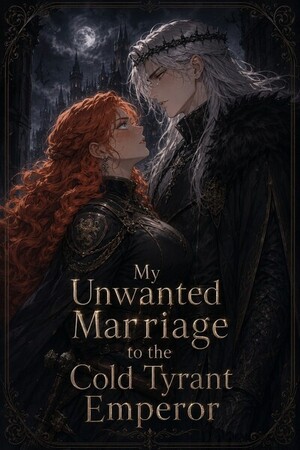
My Unwanted Marriage to the Cold Tyrant Emperor
We pass beneath the shadow-rimmed arches of the emperor's fortress, and the cool dark of it closes over us like water. Somewhere behind us a woman in the emperor's livery steps forward and gently takes Iona in hand, murmuring about baths and warm quarters and rest, and leads her off to join the other maids before either of us can think to object.
Lykos walks me to a set of doors twice the height of a man, and stops.
“Last piece of advice,” he says, low, just for me. “Whatever they say in there, don't let it show. They'll be watching your reactions and looking for weakness.”
“I am very good at masking my face,” I say.
He looks down at me, and something in the red of his eyes goes almost soft. “Yeah,” he says. “I bet you are.”
Then the doors open.
The hall is full of the most powerful people in the south, and every one of them turns to look at Master Torsten and me.
Tightly, I clutch my dress; it gives my hands something to do besides shake. Quietly, I count the nobles gathered beneath the long columns. Perhaps sixty of them, in silks the colors of jewels and old blood, ranged down a floor that runs a hundred feet to a dais at the far end.
And it is not the crowd my eyes are drawn to. It is the throne.
It sits alone at the top of the dais, carved of obsidian and ivory, black stone and white bone married into a single seat.
And in it sits the tyrant.
I have built him wrong in my head. I built him broad, like his reputation, like Lykos. The man on the throne is tall, a shade under Lykos and half his breadth, all clean hard lines and a stillness that costs him nothing to hold. His hair is white. Not an old man's white; a pure, strange, snowfall white I know at once he was born with, because it is the white the songs give his murdered father. His eyes are gold, and the songs say those were given to him by his mother. His face is impassive and unreadable.
He does not lean forward to see me better. He is already seeing me, in a way I feel along my skin like a change in the weather, and I understand, before he has said a single word, that of everyone who has looked at me today, he is the first who is actually looking. The whole hundred feet between us pulls taut, and for a moment there is no one else in the room at all, only the two of us at the ends of it.
It is Master Torsten who breaks the tension and silence. “Your Imperial Majesty. With the compliments of Emperor Canute of Eloria, I bring you his daughter, the Lady Bree, offered to you in marriage, as a pledge of peace between the southern empire and the north.”
He speaks well. He always speaks well. He paints the offer as generosity itself, a hand held out across a hard border, and never once looks at me while he does it.
“Peace.” A lord in deep red pushes to the front of the crowd before the emperor can so much as breathe. He is dark-haired and furious and looks as though he has been waiting his whole life to be furious about precisely this. “Majesty, forgive me, but let us call the thing what it is. Canute does not send us peace. He sends us his shame. A baseborn girl he could not even trouble himself to make a true princess of, and he calls it an honor and expects us to bow.”
“Lord Varro,” someone murmurs, a warning, but Varro is not a man to be stopped once he has begun.
“Refuse her,” he says. “Refuse her, and take the north the way we took everything else. We are three campaigns from the Pass. Why marry the door when we can break it?”
A rumble of agreement rolls through the lords around him, the ones with sons in the army and grievances older than I am. Others say nothing at all, and their silence is its own kind of vote; there are men here who want neither the war nor the wedding, and they watch the argument the way a hawk scouts for prey.
Master Torsten inclines his head, smooth as poured oil. “My lords, if I may. To refuse a marriage freely offered is no small insult, and insults have a way of growing into wars whether anyone wishes them or not. My emperor extends his own blood in good faith. It would be a great pity to answer good faith with steel.” It is a lie so well made that I almost admire it. My father has not extended anything in good faith in his entire life.
Lord Varro scoffs. “And why should we accept this atrocious offer?”
“Because, my lord, we have been three campaigns from the Pass for five years.” A woman in purple steps forward and speaks now, calm where Varro is hot, her hands folded before her. Her hair is a pale blonde, her eyes a honey brown. “And every one of those campaigns has cost us a generation of sons, bought back to us in boxes.”
“Lady Sabina,” Varro drawls. “What you suggest would mean their sacrifice was in vain.”
The woman, Lady Sabina, speaks firmly. “A marriage costs us nothing but a ring and our pride. I have always found pride the cheaper thing to spend.”
“Easy to spend, when it is not your house being insulted,” Varro snaps, orange eyes hot.
“Every house in this room has spent sons,” Sabina says, unmoved. “I would gladly spend my pride to stop spending those. Not to mention the constant dark beast attacks.”
Several more murmurs move through the court, yet Emperor Theron remains cold and composed as it all goes on around me.
It is an odd thing to listen to, and I feel my anger build as they argue about me, as though I am a parcel someone has set on the floor for the room to fight over. I keep my eyes down. The noise of everyone arguing is a cacophony that begins to merge the chattering nobles into a static that makes my skin crawl.
I take a fold of my skirt in one hand and clench it, and let it go, and clench it again, the blue silk crushing and smoothing under my fingers, a small private rhythm to hold while the voices climb and climb and the hall grows too bright and too loud and too full of teeth. I make myself very still, quiet, and wait for the sounds to pass.
A loud voice startles me, and I look up. At the foot of the dais stands a man I had not marked before, the only one in the hall not dressed for a court: black leather, black hair cropped close, skin tanned dark, eyes the deep brown of river stones. He holds a spear in hand, and when he speaks, the whole room hushes for him in a way it did not hush for Lord Varro or Lady Sabina. Immediately, I know he is going to be a problem.
“You are all arguing about the wrong thing,” he says, before giving me a harsh look with those dark brown eyes. “A war we can win or lose. A pride we can keep or spend. But this,” and he tips the spear a finger's width toward me, “is a gift from a man who has spent five years trying to put a knife in the emperor. Forgive me if I do not much care why she was sent here. I care what she was sent here for.” He looks up at the throne. “Send her back, Your Majesty. Or give her to me, and let me keep her somewhere with a lock on it. But do not put your enemy's daughter in your own house and call her a wife.”
It is the most sensible thing anyone has said, and it is aimed at my throat, and the worst of it, is that he is right. I am for something. He simply does not know what yet.
But Master Torsten did not cross a continent to watch his purpose thrown into a cell, and he steps forward now with the oil back in his voice and steel underneath it.
“You go too far, Captain Cassius.” So the spear-man has a name. I fold it away with everything else I am learning about this room. “Lady Bree is the trueborn blood of an emperor, offered in good faith. You would have her locked away like a common spy? Is this how the Empire greets an honored guest!?!?”
“I would have her put where she cannot bleed us.” Cassius does not so much as glance at him. “Honored guests do not come from the house of a man who has spent five years trying to gut my emperor.”
Master Torsten scowls. “She is a bride, not an assassin.”
“She is her father's daughter. That is enough for me.”
“You insult Emperor Canute,” Torsten says firmly, “and throw away the peace he extends.” Several more nobles begin to shout.
Suddenly, they are all talking at once. Lord Varro's voice climbs back in, along with Lady Sabina's, and a dozen others I cannot pull apart, over one another and over me, the way water runs over a stone, until the words stop being words and become only noise, and the noise has edges, and the edges are in my skull.
It is too much.
It is all, suddenly, far too much.
The hall is too bright. The voices come from too many directions and I cannot sort them, and my skirt is crushed to nothing in my fist. A high thin sound is building behind my eyes like a kettle left on the stove too long, and my skin has gone tight and wrong, and I want, more than I have wanted anything since my mother's room, to press my hands flat over my ears and fold myself down into the smallest shape a person can make and stay there until the world goes quiet.
But in my twenty-two years of life, I have learned that acting on that impulse is costly. Too costly to do in front of a tyrant while his court decides whether I am to be killed or imprisoned. But I am close to a meltdown, closer than I have been in a very long time. I try to steady my breath, my eyes fixed on the floor and losing their grip on it. My eyes water, but I blink back the tears. Refusing to cry and show weakness to a den of vipers.
“Enough!”
The word is loud and firm. It drops into the middle of all that noise and the noise dies around it at once, and I do not understand yet why the quiet comes at the exact moment I need it. It is the first time I have heard Emperor Theron speak.
“You are all very certain of what she is,” he says, “and not one of you has asked her.” He lifts two fingers off the arm of the throne.
I do not look up to meet his gaze. I am too overstimulated for that. But I can feel it on me, and I bite my lip, my knuckles white with how hard I am clenching my dress.
“Leave us,” he says.
For a moment sixty of the most important people in the south are not sure they have heard him correctly.
“Your Majesty,” Lord Varro says, “this is not how such matters are decided.”
“Leave us. Or I will have your tongues nailed to the wall.” He does not raise his voice the second time. And the court goes, in a tide of silk and swallowed fury, until the great doors boom shut and take all their eyes out with them.
The worst of the weight is gone.
Sixty stares lifted from me all at once, and for the first time since the doors open I can pull air back into my lungs. Relief floods my system. That the crowd was a hand closing slowly around my throat, and I have stood here for the last quarter of an hour drowning very quietly and very politely, the way I have drowned in every crowded room my entire life. But he dismissed them.
I take a few more steadying breaths and look around. Emperor Theron has kept only three souls in the emptied hall: the spear-man named Cassius, black-eyed and plainly unhappy about it; Lykos, at my shoulder, a warm and silent wall; and Master Torsten, who would sooner stop breathing than leave me unwatched. The emperor leans back in his chair of black stone and ivory. He regards me with those impossible gold eyes, and when he speaks, it is in a voice pitched lower than before, plainer, stripped of all the court's music:
“You do not have to look at me, if it is easier not to. I can see that it costs you something. Speak to the floor, if you would rather. I will hear you just the same.”
I have spent my whole life learning to perform and to mask in rooms like this one. No one has ever, not once, told me I could stop.
I look at the floor. It is a kindness so unexpected that for one dangerous moment my eyes sting, and I have to count the veins in the marble floor to keep myself from breaking.
“Better,” he says, as though he can see that too. “Now. Without an audience, and without your father's script. Why has he sent you to me, Lady Bree? And do not say peace. We are both far too clever for that.”
I wonder if I should tell him the truth.
I am scared.
Scared of being locked away, or killed. But the truth is the only language I have ever been good at.
I take a deep breath before I speak.
“He has sent me because I am someone he can afford to lose,” I say with finality. “He does not expect you to accept. He expects you to be insulted. I am a bastard, and I am hollow, and I am not the kind of woman a conqueror keeps” I say.
I know my father has offered myself and dressed it as a gift, and I’m sure Emperor Theron knows this too. There is no point in lying now.
“When you reject this offer of peace, it will give him more of a reason to call you a tyrant. I am not a bride, Your Majesty. I am a sacrifice, and a justification for war. That is my honest answer.”
There is one thing I do not say. One thread I keep behind my teeth even now, because it runs all the way north to a sickroom and a vial of pale gold, and I will burn my own honesty to ash before I tell him everything. I have just laid the other important pieces at his feet.
I close my eyes. I expect anger, yelling, anything but silence.
I have said too much. I always say too much, and this time I have said it in front of Torsten, who will send every word of it back to my father. The mistake settles over me like cold water.
Master Torsten recovers first, and fastest. “Your Majesty.” His voice is smooth again, but there is a thread of steel beneath it now, and it is pointed at me. “You must forgive Lady Bree. She is an odd girl. She was raised apart, and she has never learned the shape of a room, nor when a thing is better left unsaid. She does not mean half of what she says. Pay her strange manner no mind, I beg you. The offer is generous, and it stands.”
The emperor does not look at him. He does not so much as glance his way. He looks at me, and when he speaks, it is as though Master Torsten has not made a sound at all.
“Cassius,” he says.
“Majesty.”
“You wished to know whether she would lie to me.” A pause, and he motions toward me with one hand. “It appears she does not know how.”
“That,” says Cassius, flat as a blade laid on a table, “or she is very, very good.”
“No.” The emperor says firmly. “That is not what this is.”
He is quiet for a moment. Then, softly, almost to himself: “Hollow.”
He says the word slowly, turning it over, the way I turn a thing I mean to take apart later. And for the space of a breath those gold eyes rest on me with an attention that has nothing to do with marriages or thrones or the north at all, an attention that passes through me the way a hand passes through water, and I have the deeply unwelcome sensation of being seen all the way to the bottom. Then just as quickly as it appears, it is gone.
“Here is what will happen,” he says, and now it is not to me, and not to Cassius. It is to the room, to the empire, to the shape of the years ahead, in the voice of a man who has never once in his life been argued out of a thing he has decided. “I will marry her.”
The words drop into the quiet like stones into a well.
“Majesty.” Cassius's voice is low with warning.
“I have heard the council.” The emperor rises. He is very tall when he rises, and the shadow-light from the high windows runs off his white hair like pale moonlight. “I have heard my lords, who want a war they will not have to bleed in. And I have heard the lady.” Something moves at the corner of his mouth that is not quite a smile. “She is the only person in this hall who has told me the truth today. Her father has staked his whole gambit on my pride. He is certain I will refuse her. I have never been fond of doing the thing my enemies are certain of.”
He comes down the steps of the dais slowly. Every movement he makes is deliberate and disciplined. My heart races with uncertainty as he stops in front of me, close enough that the edge of his shadow seems to reach my shoes.
“Lady Bree.” Quiet again. Only for me. “Look at me. Once. You do not have to keep it.”
I look up.
Gold, all the way down. There is something behind his eyes that I cannot read. It frightens me. But underneath the fear, absurdly, is the first thing I have felt since I left my mother's room that is not despair. It is curiosity.
“You expected to be sent home,” he says.
“Yes.”
“You will not be.” A pause, and something almost like the ghost of amusement crosses that disciplined face. “I find I would rather keep the one honest thing the north has ever sent south. We will be married within the week.”
Somewhere behind me, Lykos lets out a low breath that might be a laugh. Somewhere to my left, Cassius says nothing at all, which is worse.
In a moment the doors will open. The court will pour back in with its contracts and its outrage and Varro's fury, and Torsten's cold satisfaction as he sits down to compose his first letter north, to tell my father that the clever trap has closed on empty air, that the daughter he threw away has been caught, kept, and set aside to one of the most dangerous men in the world.
But that is a moment away. For now there is only the emperor, and his terrible gold eyes, and the wreckage of every plan that has ever been made for me lying in pieces across his beautiful marble floor.
I came here to be refused.
I have been chosen instead, and I do not yet know whether that is my rescue or the beginning of something far worse.






Please sign in to leave a comment.