Chapter 0:
Spawn of Darkness
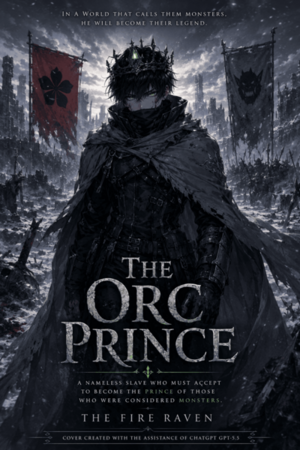
The Orc Prince
With his wrists bound by a pair of iron rings attached to a long chain, the opposite end of which was held in an armored fist, and with the point of a sharp blade pricking his back, the condemned man marched toward his death.
The soldiers at the head of the escort pushed back the crowd that flooded the square with shouts and shoves, while on either side of the formation, four horsemen advanced with shields strapped to their forearms and swords drawn, ready to punish the audacity of anyone who dared attack their unit.
Leading the march, mounted on the back of a chestnut-maned steed, Captain Massio Carole of the First Company of the Red Blade armies advanced at a steady, measured gallop. A chain wrapped around his wrist kept his “escort” moving.
“Advance!” Massio ordered, pulling on the chain. “Moving at a snail’s pace does you no good. It won’t change your fate; it only delays the inevitable. You’ll only become more anxious, and perhaps that will lead you to commit some reckless act. Resign yourself, Lord of the Night, and accept death with dignity!”
The pronouncement was a subtle gesture of mockery, sharper than the edge of a newly forged sword. After all, that decrepit old man, skin and bones, with a greasy gray beard so long that it dragged along the ground, trapping dust and dirt in its silvery strands, was no longer worthy of enjoying the glory and fear that the mere utterance of that name had once inspired.
A title, first stained with blood, then defiled by degeneration, and finally reduced to nothing by his defeat and humiliation—a title that had once represented the dream of the most ambitious masters of the arcane arts.
“Cursed is his title, cursed is his name, cursed is his legacy.”
So the gods had decreed.
“Man of war,” the condemned man called the captain, “honored and proud, you show courtesy to those beneath you, but that is nothing more than a deceptive fog of false virtue that you use to conceal your most shameful emotions: contempt, hatred, disgust. You are a repugnant being!”
His throat could not withstand the intensity with which he spoke, and he began to cough.
“I can smell the stench of your rotten soul.”
He spat on the ground.
Massio clenched his fist with such force that he twisted the links of the chain. The fire in his gaze burned like the sun, and yet the condemned man remained unfazed, smiling arrogantly as he silently awaited the captain’s reply.
Despite the fact that Massio’s fury bubbled in his chest like hot oil, he managed to maintain his composure. He had been warned about the venomous tongue of that snake, and he wasn’t going to allow himself to be swayed by words.
He was tempted to respond, but he refrained because, although his ego suggested otherwise, he knew he wasn’t a man of words, as the condemned man had said. He was a man of war, and he always resolved—or attempted to resolve—all problems with violence, which he venerated with religious devotion.
Violence had brought him to the privileged position he held; violence had provided him with honor and wealth. Thanks to his blessed, bestial strength and talent for inflicting death, pain, and terror, there was never a lack of bread on his table, honor to his name, or abundance for his family.
That was why, when he was limited in his ability to use it, he felt as defenseless as a child. Every time he tried to respond to verbal aggression with another insult or engage in debate with an ideological opponent, it always resulted in his own shame.
The condemned man let out a triumphant chuckle.
The hatred that permeated the air was palpable. Curses roared from every direction as the crowd hurled rotten vegetables and spat phlegm, none of which reached their target, blocked by the soldiers’ shields.
The plaza floor was soaked with tears, sweat, saliva, and snot flowing from the mass hysteria, which was as scorching as the summer sun and just as intense, causing headaches and fainting spells.
“Damn you, Monster!” a man shouted, throwing a rotten tomato at the condemned man.
The stinking projectile missed its target, falling to the ground and being crushed beneath Massio’s horse’s hooves.
“Kill him! Don’t wait any longer! Kill him!”
“I beg you, an old woman, a sister of the Temple of the God of Light—your existence is a sin!”
“Wipe this plague from the face of the earth!” whimpered a woman with half her face charred, foam dripping from her mouth. “Your beasts reduced my village to ashes and stole my children!”
Had a man not held her back, she would have thrown herself at the guards.
“Death to the Lord of the Night!”
Even the knights were not immune to hatred. They fulfilled their duty to escort the condemned man, yet deep down, they were tempted to comply with the demands of the people.
The riders’ hands trembled as they gripped their swords, resisting the urge to wield them against the monster who had been responsible for the deaths of hundreds of their comrades.
The lancer felt the same hatred. He struggled with all his willpower not to lose his mind and run the old man through from back to chest with his lance every time he pricked him.
Even Captain Massio, renowned throughout the kingdom for his unwavering integrity, battled the inner horrors that lurked deep within his soul. Despite having advised the old man to resign himself to his fate, he secretly fantasized, with the feverish anticipation of a child and the sadism of a demon, that the man would actually dare to resist.
Nothing would have pleased him more than to see him succumb to despair and try to flee, his trousers wet, his face red, and tears streaming down his cheeks like a child—not only for the morbid pleasure of witnessing such humiliation, but because then, and only then, according to his king’s orders, would he have the privilege of ending the monster’s life.
Finally, the condemned man stood before the steps of the scaffold.
He raised his head, and his eyes met those of the executioner, who gripped his axe with both hands so tightly that the wooden handle creaked, revealing the ecstasy he felt at having to take a life for the first time.
It was as if the mere presence of that man awakened the darkness within the souls of everyone present.
Captain Massio dismounted his horse and dragged the condemned man down the steps to the block, where he seized him by the shoulders and, with a kick to the ankle, forced him to his knees.
“Stay down where you belong!” he ordered. “If you move even a little…”
“Let me guess… you’ll kill me, won’t you?” the condemned man replied boldly, maintaining the smile that so irritated Massio.
The captain barely managed to control his rising anger and stepped away from the loudmouth. He untangled the chain from his wrist and attached it to a slot in the middle of the platform.
“Captain,” said a soft voice to Massio’s left.
It was a young man, tanned and freckled, with a thick mane of golden curls. He was dressed in a very colorful way—too colorful for a man, the captain thought.
He couldn’t help but grimace in displeasure. To his eyes, it looked as if scraps of fabric had been taken from a pile of clothes and sewn together into a shirt and pants.
Despite his initial impression, it was undeniable that the young man looked elegant and neat.
“My name is Rinlo Thafius,” he introduced himself with an elegant bow.
“And you’re the new jester?”
In response, the young man burst into laughter, certain that the remark had been sarcastic.
It wasn’t.
“You certainly have a good sense of humor, sir. Due to your estrangement from the kingdom because of the war, you haven’t heard of me. Her Majesty has taken me under her wing, and I currently work as a scribe in the service of the crown.”
Rinlo rummaged through one of his pockets and pulled out a parchment, which he immediately handed to the captain.
“What is this?”
“Official Charges and Sentence, by order of the king and the Court of the Five Races, for the people of Clover. If you have trouble with any of the words, I would be happy to assist you…”
“Do I look like an idiot to you?” Massio interrupted suddenly.
“What?” Rinlo asked, confused.
“Do… I… look… like… an… idiot to you?” he repeated, emphasizing each syllable and making long, awkward pauses between words as he brought his face close to the scribe’s. “And woe betide you if you try to make me repeat it a third time.”
“What?” Rinlo asked, confused. “I-I’m sorry, m-my sir.”
He stammered and bowed his head in humility before the aggressive knight.
“It wasn’t my intention to offend you, I just…”
“You’d better not. It’s not my problem if your little speech is completely incomprehensible because you’re trying to play the poet with that pompous prose that effeminate brats like you use, but I’m not going to embarrass myself because of you, so let’s take a look.”
The captain opened the roll of paper, exposing his inexperienced eyes to elaborate and complex calligraphy worthy of a nobleman, written in bluish-black ink that formed words and sentences he had never read, along with others whose meaning he only vaguely understood.
This frustrated him so much that he was tempted to turn the brat’s face toward him and shout at him, but he restrained himself, for that would have meant admitting his ignorance.
“I fear this is too refined for common ears, which comprise the majority of the public. As an amateur writer, this shortcoming is forgivable, but with the position you hold, I find it disappointing that you would stoop to something so basic,” he declared, elegant and haughty.
“Perhaps I am not well-versed in the written arts, but even I know that a good writer should always know their audience and adapt to them.”
He handed the manuscript to the young scribe.
“Correct it. Use more common words for ordinary people.”
Resigned and offering no more protest than a slight sigh, Rinlo took his quill and inkwell from their case.
While the captain and the scribe exchanged words, crossing out and rewriting portions of the paper, the condemned man admired the view from the top of the scaffold.
He reveled in the stench of negative emotions that permeated the air, and the fire in the eyes of those present burned him like the summer sun until he began to sweat.
He could feel the flow of negative energy coursing through the atmosphere. If he could still use his magic, it would have been a very good harvest of corrupted souls.
That thought stirred a melancholic nostalgia in the deepest recesses of his being, reminding him that he had once been human.
Long ago, change, the future, and death had ceased to mean anything to him. He had been eternal—a force of nature, death incarnate.
But now, he was nothing more than a pathetic old man taking his last breaths before his head was taken in retaliation for his sins.
The condemned man experienced things whose names he had forgotten: sadness, fear, anguish.
The mortality he had thought lost forever had returned.
He didn’t want to die, but he was going to die.
He still had so many plans, so many lands to plunge into darkness, so many innocent souls he would never get to torture, so many horrors he couldn’t bring to fruition.
How terrible it was to die with remorse.
Yet this was no time for lamentations.
Before drawing his last breath, he would make the world tremble one last time.
A carriage as white as clouds, drawn by two horses and guarded by a dozen soldiers, made its way through the plaza amid the cheers of the commoners who celebrated its arrival.
“Make way for the king and queen!” ordered the knight who led the guard.
A long scarlet carpet was unfurled by a group of ladies dressed in white, starting from the steps and ascending to the platform at the fountain near the northern entrance of the plaza, where the carriage stopped.
Two soldiers bowed and opened the carriage doors.
A mature man with tanned skin and a long, flowing black beard emerged, spiraling from his face to his chest. Behind him came a young woman with snow-white skin and rosy cheeks.
Her long red hair was woven into intricate braids that reached her waist, keeping it from dragging along the ground. Flowers of every color and precious gems adorned the knots of her curls.
The man offered his hand to help the lady down, and she accepted with a warm smile.
The people of Clover welcomed their king and queen with jubilation, applauding and shouting praises.
“Long live King Gigon and Queen Silved!”
A dozen musicians accompanied the couple’s walk until they reached the top of the scaffold, where they received the bows of everyone present, with Captain Massio at their head.
“My king, my queen,” he said, bowing to each of them. “You look radiant and glorious,” he praised. “Everything is ready.”
“Excellent.”
“Let’s not wait any longer. It’s time to quell Clover’s thirst for vengeance and put an end to this dark episode in my reign.”
The captain nodded, stood, and approached the edge of the scaffold.
He surveyed his surroundings: the crowd, the bustle, the euphoric emotions.
This was, without a doubt, a historic moment for all of Clover, and he would play an important part in it. This made him feel both honored and anxious.
He took a deep breath, opened the scroll of paper, and began to move his lips.
“Under the light of the Supreme God and the glory of the Divine Court of the Five Founding Gods, today, by sentence of the Court of Justice of the kingdom, the Senate of the United Kingdoms of Clover, and Their Majesties, King Gigon Muphervask V and Queen Silved Otriz I, Mogarraz Thradelyntz, for his crimes against not only humanity but against all living beings that inhabit Clover, which include, but are not limited to:
“Treason against the elven kingdom of Ballyan, his own homeland;
“Conspiracy to destroy the Ardamin royal family;
“The assassination of Hyuvall Ardamin, King of the Elves and predecessor to the current one;
“Practicing black magic, including necromancy;
“Creating artificial life through immoral magical rituals that depended on the desecration of corpses and experimentation on living beings;
“The destruction of temples, libraries, and schools throughout the five kingdoms;
“The burning of priceless texts, including grimoires and prophecies;
“The forced magical terraforming of the Great Valley of Gaethia;
“And, last but not least, organizing and leading a genocidal campaign against the Giant Race, causing their extinction.
“For these and other atrocious crimes, Mogarraz Thradelyntz, known as the Lord of the Night, will pay with his life!
“He will not be granted a proper burial, and his remains will be thrown into the depths of the ocean, leaving his flesh at the mercy of the creatures of the sea!”
The crowd raised their voices in excitement.
“Before we proceed, the king will speak,” Massio announced.
The king bid farewell to his wife with a smiling glance and went to the captain to address the public.
“My subjects, peoples of the five kingdoms, I can feel your thirst for justice, and I swear by the gods that it will be quenched. This is only the beginning.
“First, we will cut off the head of your Dark King, and finally, we will exterminate every last Orc, as well as the other monsters created by his dark magic.
“The fallen will be avenged, and Clover will be purified of evil!”
The condemned man suddenly erupted into loud laughter mixed with groans and a phlegmy cough. The aberrant sound made more than one child cry, dogs bark, cats scatter, and even several of those present, including the queen and Rinlo, recoil.
“What’s so funny?” the king asked.
“Silence, you trash!” Massio scolded, moving toward Mogarraz, intending to silence him by force.
The king stopped the captain, clutching his shoulder.
“If you have something to say, go ahead,” the king conceded to Mogarraz, stepping aside and pushing the captain away, clearing his view of the audience, who watched intently, eager to hear what the villain had to say.
“Claim your right to a few last words.”
Mogarraz stifled his laughter, but the twisted grin stretched across his face from ear to ear, revealing his crooked, sharp teeth glistening with foamy saliva.
“Look at your faces. See the colors of your souls. The chaos I’ve awakened within you is the work of my life, a life dedicated to exalting my art.
“I unleashed the most terrible evils upon this earth, brought abominations never before seen into the world, committed the unspeakable, transcended the limits of my brushstrokes, and redefined evil in the collective understanding—an impact never before witnessed.
“I feel so, so, so proud right now.
“Thank you for letting me appreciate the fruits of my labor one last time.
“I’m sorry, my beloved toys, but I must go. But don’t worry. I’ve planted one last seed that will soon germinate and keep my legacy alive.
“My life is over, but my essence will remain in this world!
“Chaos will emerge again!”
The captain, tired of listening, grabbed Mogarraz by the neck and threw him onto his back. He drew his sword and pressed the blade against his victim’s neck.
“Where is he?! Where is your damned spawn?!”
“Release him!” ordered the king.
“But, Your Majesty!” replied Massio.
“Release him!” he repeated.
“I can make him talk, Your Majesty. Just give me some time. We can postpone the execution and…”
Massio insisted, gripping the hilt of his sword fiercely, his hand throbbing and his wrist tensing.
The king shook his head.
“It’s time to end this.”
He placed his hand on Massio’s, trying to calm the soldier’s nerves.
“I grant you the honor. Take revenge for everything and everyone he stole from us.”
Massio wanted to protest, but his thirst for revenge overwhelmed him. This golden opportunity was impossible to refuse, and he bowed his head.
“As you command, Your Majesty.”
The captain went to Mogarraz with a stoic expression, but his eyes burned with sadistic passion.
He grabbed his victim by the arm and, with a powerful jerk, threw him onto the scaffold.
He raised his sword toward the sky. Sunlight bathed the blade, turning it white. With a swift and precise movement, like a flash of light, he ended the condemned man’s life.
There was applause. There were shouts of celebration. But it all felt rather bland.
The captain had satiated his vengeance, but it tasted like earth, for he knew there was still another monster to destroy, hidden somewhere.
The captain’s dissatisfaction was shared by much of the crowd. No one could savor the taste of justice, for their palates were tainted by the uncertainty and fear instilled by Mogarraz Thradelyntz’s words.
The day of the execution marked a turning point in the history of the unified kingdoms of Clover.
The darkness unleashed by the Lord of the Night claimed the sanity and dignity of hundreds of souls who succumbed to despair and paranoia, all because of the supposed existence of an unborn child.
This madness infected even the king himself, who, mercilessly, committed a sin so atrocious that the disgusted gods abandoned the five kingdoms, returning to the stars from whence they came and leaving mortals to their fate.
Without divine protection, terrible times ravaged Clover one after another, like storms that slowly stripped away every last glimmer of glory and hope, until finally, the worst of all these storms—the Empire—swept everything away.
The unified kingdoms of Clover were reduced to a memory, and the last words of the Lord of the Night became nothing more than a legend…
At least until that child, born in darkness and bound in chains in the depths of the earth, finally emerged into the light to turn the world upside down.






Please sign in to leave a comment.