Chapter 8:
Chapter 8 - Paid in Flesh
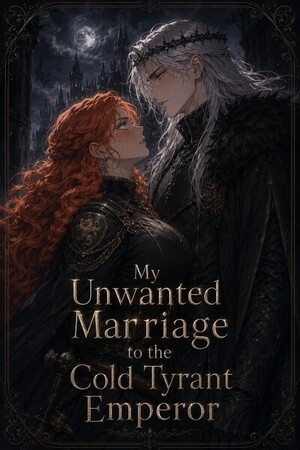
My Unwanted Marriage to the Cold Tyrant Emperor
The emperor's bedchamber is large, all black marble, with a vast bed draped in silver silk beneath a canopy of dark wood carved with wolves. It is the most luxurious room I have ever seen, and it makes me feel small.
Theron closes the door behind us with a finality. The noise of the wedding is gone. It is only the two of us now, and a fire burning low in the hearth, and a bed I cannot look directly at, and the knowledge sitting cold in my stomach of what comes next.
In law, in coin, and in flesh. That is what the officiant, the servant of the Lord of Shadows, had said. This marriage is meant to be consummated as part of the contract. I know this, and have known this, yet I still feel nervous.
“You are shaking again,” Theron says.
“I am aware.” I press my hands flat against my skirts to still them. “I cannot always make it stop.”
“I did not say you needed to stop.” He crosses the room without hurry and stops an arm's length from me, close enough that I have to tip my head back to hold his gold eyes, and I make myself hold them. Normally I hate looking others directly in the eye, but I do not want to be seen as weak in this moment.
“You're scared?”
“I am,” I say bluntly.
“I see.” He takes my hands in his, holding them gently.
“I will only say this once.” His voice drops into that low even register he used at the altar, the one that quiets the roar in my head.
“There is a contract. It says what it says. But I have never in my life taken a thing that was not freely given, and I do not intend to begin tonight. If you do not want this, you have only to say so. The contract can wait. It can wait a week, a month, until you are ready, or until never, and I will hold the whole of the south off your father’s door in the meantime. No one will know but us.” He pauses. “So. Tell me the truth. Do you want this, or do you only mean to endure it?”
It is such a strange question to be asked. No one has ever asked me what I want. Not once, in twenty-two years. My father did not ask, and the court did not ask, and I had not thought a man like this, a conqueror, a tyrant, would ever think to ask either.
I turn the question over in my head the way I turn everything over, honestly, all the way to the bottom.
“I am frightened,” I say slowly. “That part remains true. But it is not you I am frightened of. I have only done this once before, and not this far, and I do not know how, and I do not like not knowing how to do things.” I pause. “Because not knowing how to do them means I cannot prevent mistakes or errors from happening.”
“Your innocence is not a mistake.” He chuckles. “I find it amusing, actually, because it means I will be your first and your last.”
I do not know why, but the possessive way he speaks grates against me somewhere.
“There is nothing amusing about this. Not to me,” I decide to say.
“No, I suppose not. But my question remains. Do you want to go through with this?”
“Yes,” I say, with a shaky breath. “I am sure. Originally I wasn't, but after thinking about it I have decided that I do. I want it. I want this. And I want you.” I pause, and look down at our hands. “I am only afraid because it is new, and the two things are living in me at once.”
He lifts our hands to his lips and kisses them. I watch as something shifts behind his eyes, that same unreadable attention from the throne room, the one that goes through me like a hand through water.
“Two things can live together and be true at once,” he says. “They have lived together in me my whole life.”
And then he pulls me close, his hands holding mine. He slides one up my arm in a sensual gesture, slowly, giving me every moment to move away from it, but I do not. He slides his hand up until his palm rests against the side of my face, and I still do not move away from it. My own hand moves up to rest over it.
“Tell me to stop,” he whispers, in a husky yet firm tone, “and I stop. At any moment. Say the word and it is over, and there is no price. Do you understand me?”
“I understand.”
“Say you understand that you may stop this.”
“I understand that I may stop this at any moment,” I say, and my voice only shakes a little, “but I do not want it to stop.”
I return the gesture, hesitantly. I mirror his actions, moving my hand over his, and hesitantly I cradle his face. He is so beautiful, his face long and sharp with high cheekbones. The gold of his eyes reminds me of sunflower petals.
“I want you to kiss me properly this time. Not the way you did in the hall, for the witnesses. The other way.”
The corner of his mouth moves, not quite a smile, never quite a smile, but the nearest thing to one I have seen from him.
“As my empress commands,” he says, and he kisses me.
It is nothing like the altar.
He kisses me deeply, slowly, unhurried in the way of a man who does everything with terrible control, and when his mouth opens against mine I make a sound I did not plan to make. I feel him go still for half a breath, checking, always checking, before he gathers me in closer. His hand slides from my jaw to gather my thick red curls, pulling back gently, forcing my head back so he can deepen the kiss. I feel his tongue tangle with mine as his other hand settles at the small of my back and draws me against him.
I have spent my whole life drowning in too much sensation, in rooms too loud, where lights are too bright and too many people are staring. I did not know it could be like this, that there could be a flood of sensation I wanted to go under. That I wanted to choose to drown in until the noise in my head is gone.
For the first time in as long as I can remember there is only one thing to feel instead of a hundred, only his mouth, his hands, and the heat building deep below my abdomen, and I press up into it, greedy for the quiet of it, greedy for him.
“Bree,” he says against my mouth, with a rasp.
“Don't stop.”
“I am not going to stop.” His voice has gone rough at the edges, the control fraying, and knowing that I did that, that I put that crack in his terrible stillness, does something to me I have no name for. “Unless you tell me to.”
“I won't,” I breathe. “Keep going. Make me feel good,” I say breathlessly, as he lifts me up onto the bed. I gasp at first, surprised, as I am a heavy girl, but he quickly swallows the sound. This time I kiss back, clumsy yet eager.
“I will. Tell me what you want, what you need,” he says, in a way so utterly needy that my own toes curl.
“I want you. I need you,” I say as he settles over me on the bed. I fumble with his clothes as he reaches under and undoes the laces of my dress. His tongue invades my mouth again. I feel his breath and his lips against my jaw, my throat, and his hands slide up with a certainty that leaves me aching where he touches.
“Like this?” he asks. Yet I am already drowning in sensation.
“Yes. Show me how to touch you, and make me feel good too,” I say as my own breath hitches. Tears slip from the corners of my eyes, but they are not from fear at all. They are from the sheer overwhelming tenderness of being, and for once in my life, I feel wanted. I feel desired, and asked for, and answered.
“Stay with me,” he murmurs against my thighs, and I do.
- -
The next morning, I wake up alone.
That is the first thing I know, before I know the light or the hour or the ache in my body: I am alone in the enormous bed, and the sheets beside me are cold, and have been cold for some time.
I sit up slowly. The room is gray with early morning, the fire burned to nothing in the grate, and there is no sign of Theron anywhere, no coat thrown over a chair, no boots by the door, nothing to say a second person slept here at all except the dent in the pillow beside mine, which I reach out and touch and find is as cold as the rest.
I do not understand.
An ache begins to build again in my chest.
Last night he asked me, several times, whether I wanted him. Last night he whispered my name like it meant something. And now he is gone so early and so completely that if a stranger walked in right now they would think I spent the night alone. The only proof I have of what happened is the marks on my skin, and the fact that I am still undressed from last night, because I did not feel like cleaning up afterward. I lie in the wreck of the bed and feel the warmth of the night curdle slowly into something cold and familiar.
Of course. Of course he is gone.
The contract required a wedding night, and we have had one, and the marriage is a marriage now in law, in coin, and in flesh. There was never anything in it for him but that. I let myself believe, for a handful of hours in the dark, that the tenderness was real. That the checking and the asking and the way he said “stay” meant he wanted me, and not merely as the seal for a treaty.
How stupid.
You are so horribly stupid to even think that it could have meant something.
Tears prickle my eyes at the thought. It is the exact kind of stupid the whole court expects of me.
I press my hand flat to my chest, where it aches, and as the tears fall I think back to why I was even sent here. My mother. My family.
I take a deep breath. Crying will not get me out of this situation, and while it hurts, it is not forever. He got what the contract required, and left. This is the best time for me to search the room and see if I can find anything out too. I would do well to remember that this is what I am here for.
As I am getting ready, Iona finds me closing a nearby drawer as she enters. I am dressed for the day, but she takes one look at my face and does not ask about my tears.
“I see you have already dressed,” she says gently. “I brought you bread, and there is,” she hesitates, “there is a letter, my lady. It came up with the northern post. From Master Torsten.”
My stomach drops before I have even taken it from her hand.
It is short. It is all business, with no warmth. The man does not waste ink on a person he considers an odd girl. I read it once, and then again, to be sure I have understood everything that is being asked of me.
“What does it say?” Iona asks. “You have gone the color of the sheets.”
I wonder, for a second, if it is safe to tell even Iona about this. But she was there in the carriage on the way down south, with me and Torsten. I sigh.
“He wants to know about the Pass,” I say. “The Pass of Arryndale. How many soldiers Skiagreth keeps there, and where, and under which commanders.” I set the letter down. My hand is steady, which surprises me. “My father is asking how well the southern door is guarded.”
Iona is quiet for a moment. She is only a maid, and there are things she cannot say aloud in a palace full of the emperor's ears, but she has known me long enough to know that this is about my mother.
“And will you?” she asks, very low. “Tell him?”
“I must. It is the only way to ensure my mother gets her medicine,” I say, which is the first thing all morning that has nothing to do with Theron. “I just don't know how,” I mumble, as Iona comes over and begins to help me with my hair.
“That will be rather difficult to find out without seeming suspicious.”
I nod in agreement. “You're right.” I sigh again. “Once you have finished with my hair, I think I will take a walk. I find I think better when I am moving.”
Iona finishes with my hair, and I go, because I meant what I said about thinking better on the move, and because a walk will take me past the things I need to see.
I walk slowly down through the corridors, and no one stops me. I am surprised by this, but it turns out an empress may go wherever she likes, and never in my life have I been permitted to go where I liked, so I go everywhere. I find courtyards in the middle of the palace that are open to the golden southern sky, and colonnades where clerks hurry with armfuls of paper, and a great hall where petitioners wait on benches to be heard.
Here I notice ordinary people, farmers and merchants, and a woman with a sick child on her hip, waiting for the tyrant's justice as though they expect to receive some. It is not what I was told the south would be. In the north they say Theron Adrastos rules by the sword. Here I watch a steward take down a miller's complaint about a flooded field with great care, and I do not know what to do with that.
It is in the eastern courtyard that I see someone I recognize from before. She has long, straight black hair and dark eyes, and brown skin. It is Lady Melina, the kind woman from the reception at my wedding. She wears all black, and there are others with her, and an older woman beside her seems to sob.
Something is off, but I cannot tell what yet. I walk along the sidelines, because I do not want to be spotted just yet. It is then that I notice several more figures in the same black garb, a noble house by the looks of it, gathered around a boy. They stand around him the way one stands around a grave.
The boy is young. Fifteen, perhaps, no older than my own younger brother Mikli, with the soft unfinished look of a child who has not yet grown into his own hands, and he is dressed not in a noble's silks but in the plain gray of a soldier, and he is trying very hard to look brave and not managing it at all.
Melina clutches his face in both her hands as she whispers something to him.
This is not the same woman I met at the wedding. She was laughing and warm then, but now there is nothing bright left in her.
She is memorizing her brother the way my mother memorized me the night before I left, and beside them stands a tall, hard-faced man of perhaps twenty-five, in the gray uniform the royal knights wear, waiting, patient and unwanted. He looks down at the boy with pity and a kind of protectiveness, and yet no one looks up at him. It makes me wonder whether he does not fully belong to them.
I should not intrude. I know that. But Melina lifts her head and sees me, and instead of the court mask I expect, her face simply crumples, and so I go to her.
“They are taking Elio,” she says, before I can speak. “My brother. He is fifteen. He turned fifteen eleven days ago.”
“Where are they taking him?”
“The front.” She laughs, despite her crying, and it is a terrible sound. “The Pass. Where else? To fight the beasts, like every second child of every blooded house in this empire, from fifteen until nineteen, if they live to nineteen.” Her voice cracks. “We thought we were spared. Do you understand? We already gave. Kadmos there,” she tips her head at the hard-faced man, and I understand now the bitterness in it, “Kadmos is my mother's, but he is a bastard, and my father spent him gladly, sent him off at fifteen to pay the house's price so his true children would be safe. And it worked, for a while. One child per house, that was the levy. We thought Elio was safe.”
“What changed?”
“The beasts got worse,” she says simply. “So the emperor has changed the price.”
The tall man, Kadmos, says nothing. He only waits, and I look at him and see a bastard sent to collect the trueborn brother his own sacrifice was supposed to protect, and I feel the strange cold recognition of it settle into me, one discarded child has come for another, and a great unfairness and grief fill me. This is not right.
“We should go, Lady Melina,” Kadmos says, not unkindly. “The column leaves at midday. It is a long road, and easier to begin now than at night.”
Melina turns to me then, desperate. “Please. I don't know if you can change it, but talk with the emperor. Perhaps you can change this?”
I see the tears in her eyes, and my heart breaks. “I don't know if I can, but I will try. I will talk to,” I pause, “my husband.” Calling the emperor my husband feels foreign and odd.
Melina sniffles and nods. “Thank you. That's all I ask.”
She turns to her brother and gives him a hug. Elio hugs her back tightly before he lets go and meets my eyes over her shoulder. This child, in a soldier's clothes, does the bravest and most heartbreaking thing I have ever seen: he smiles at me, and inclines his head, because I am the empress, and even now, even here, he remembers his manners.
I think of Mikli, who is fifteen, who gave me a jeweled dagger and told me not to thank him, who would be doing the exact same thing if he had been born a second son in the south instead of a prince in the north. I think I might be sick.
I watch them lead Elio away.
I do not decide to go to him so much as find that my feet have already chosen.
The whole way through the palace I rehearse it, the way I rehearse everything, planning the words in careful rows so they will not come out wrong. I will ask him to spare Elio, because I promised Melina I would try. I will ask, while I am there, about the Pass, because somewhere far to the north a woman is dying by inches and I am the only thread of medicine she has, and I will ask about this blood price Melina had mentioned. Three tasks. I line them up like coins on a table, but in my head instead.
By the time the guards admit me to his study, my hands are already knuckle white from gripping my skirts so tightly.
Theron is at a long black table spread with maps and dispatches, and he does not rise when I enter, and he does not look up for a moment that stretches just long enough to tell me that him not looking is a deliberate choice. When he does lift those gold eyes to me, they are nothing at all like the eyes from last night.
“Empress,” he says. “You are meant to be resting.”
“I could not rest.” It is true, but my next words come out more rushed than I would like. “I came to ask you something.”
“So I gathered. People rarely seek me out to ask nothing.” He sets down the paper in his hand. “Ask.”
I have planned the words, so I say them. “There is a boy being sent to the front today. Elio, of House Corvus. He is fifteen. His family had already given a son to the knights, years ago, and they believed that their family had already paid their price. I am asking you to let this one stay.”
“No.”
Just that. No pause to consider it, no softening, no reaching for a reason. The word lands hard as stone, and he has already picked the dispatch back up as though the matter is closed, and something in me, some northern part that has been managed and dismissed my whole life, refuses to let it be.
“You did not even think about it.”
“I thought about it a long time ago,” he says, not looking up, “and arrived at the answer you have just been given. The house owes a child. The child goes. If I make an exception for a boy because his sister wept prettily at your wedding, I make it for every house with a grievance and a daughter who can cry, and then there is no army, and then there is no line at the Pass, or to defend against the dark beasts, and then there is no empire for you to be empress of. Was there anything else.”
It is not a question. It is a door closing.
And it is cold, brutal in his honesty, and his gaze looks almost annoyed. More annoyed than any of the nobles who mocked me, because they at least wanted something from me, and this man wants nothing, has decided the conversation is beneath him and finished, and I feel the old familiar heat climb my neck. The heat of being the stupid one, the lesser one, the one not worth the whole of a person's attention. He got what the contract required from me in the dark last night, and now in the daylight he will not spare me three full sentences. I understand, I think. I understand exactly what I am to him.
But I have two more coins on the table, and I am my father's daughter whether I like it or not, so I pick up the next one.
“Then tell me about the Pass itself,” I say, and I keep my voice even. “If boys like Elio are to die there, I would understand what for. How many hold it? Is it so hard-pressed that it needs children? Where do the beasts come through, and how many men does it take to hold the line?”
The room changes.
It is nothing I can point to. He does not move, does not straighten, does not reach for a blade. But the temperature of him drops another degree, and he sets the dispatch down again, slowly this time, deliberately, and he looks at me with his full attention for the first time since I entered, and he glares.
“What an interesting question,” he says softly, “for a bride to bring me the morning after her wedding.”
My heart stops.
“I only meant—”
“The disposition of my armies.” He says it over me, interrupting with a harsh tone. “The strength of the Pass, where the line is thin, and how many men it takes to hold the northern door.” He tilts his head, and the gold eyes do not blink. “Those are not a frightened girl's questions, Bree. Those are a general's questions. Or a spy's. Tell me, which am I speaking to.”
I cannot lie. It is the one thing I have never been able to do, and now, when my whole life and my mother's depend on it, I feel the truth straining at my teeth like a dog at a rope, and I do the only thing I can, which is to hand him a smaller true thing to cover the larger one.
“A frightened girl,” I say, “who watched a child my brother's age be led off to die this morning and I just wanted to understand why. That is all. I am sorry if my asking offends you. I did not know curiosity was a crime in the south.”
It is true, all of it, and he hears that it is true, I can see him hearing it, and it does not matter at all. Because a true thing and a whole thing are not the same, and he is far too clever not to know the difference.
“Curiosity is not a crime,” he says. “It is a habit. And habits, in a wife who came to me from the hand of a man who has spent five years trying to gut me, are things I will watch very closely.” He lets that sit. Then, quieter, and this is the cruelest part, because it is almost gentle: “Go back to your rooms, Empress. Ask your maid about the beasts, if you are curious. Ask the kitchens. Ask anyone in this palace but me, about anything but my armies. Do you understand?”
“I understand.”
“Good.” He picks up the dispatch. The door is closed again, and I am on the wrong side of it. “You may go.”
I go.
I make it out of the study and three turns down the corridor before I have to stop and put my hand against the cold stone and breathe, and the thing sitting hardest in my chest is not the fear, though the fear is there, sharp and new, he knows, or he half-knows, and I have made everything more dangerous. The thing sitting hardest is the humiliation.
My eyes begin to water from the memory of it. He looked at me the way you look at a problem, not a person. He would not answer me because he thinks I'm beneath answering, because he used me and left me and now cannot be troubled to grant me the truth about the boys his empire buries. I press the heel of my hand to my eyes. I will not cry in this corridor. I have cried enough in this place.
“That bad, is it.”
I had not heard Lykos come. He is leaning against the wall a little way down, arms folded, and there is none of his usual brightness, only a careful, watchful kindness that is somehow worse.
“How much did you hear?” I ask.
“Just enough, and you bursting out of his majesty's office something fierce." He pushes off the wall. “Come. You look like a woman who needs to keep moving, and I am told the two of us have that in common.”
I fall in beside him because I do not have the strength to do anything else, and for a while he simply lets me walk. I sniffle, wiping my eyes quietly. He does not fill the silence, which I am grateful for, until my breathing has steadied.
“He will not spare the boy,” I say finally.
“No,” Lykos agrees. “He won't. And you are standing there hating him for it, I can see it, and I am going to spoil your hate, because you deserve the truth even if he will not give it to you.” He glances at me. “What do they teach you, up north, about how we fight the beasts?”
“With blades. With magic channeled through the ore just like we do,” I think of the crystal in my pocket. “A majority of our knights blades are made of Nibheis ore, from our mountains. Even those who cannot use magic can use it.”
“There.” He points at me as though I have proven something. “Nibheis. Your northern ore. It is stable. It holds a charge for years. A child could use a crystal and it would last for a lifetime.” He nods at the shadow-dark dagger at his hip, and for a moment the shadows along the colonnade lean toward him the way they did at the gate. “We do not have that. Southern ore is brittle. It cracks, it burns out. A worked piece might last a season if you are lucky, and then it is dust. You saw the seamstress's clasp snap in her hand, I would wager.”
“I saw it.”
“That is the whole of the south in one broken clasp. Our ore will not hold, so we cannot arm a farmer with a crystal and send him to hold a wall the way the north can. Our ore takes constant working, whole houses of laborers, forges burning day and night, just to keep one garrison supplied for a month. We cannot make the war a matter of tools.” He says it without any softness at all. “So we make it a matter of people. Blooded people. Magic in the blood is the one weapon we have that does not crack, and it runs strongest in the noble houses, which is why the houses pay in children and the hollow-born and the common folk do not. First-born stays, to keep the house standing. The second, the third, whoever the blood runs hot in, they go. Seven when the training starts. Fifteen to the front. Four years, they serve.”
“And the price changed,” I say. “Melina said they had already given a son. That the knights only took one child per house, and now it is more.”
“One per house held for a long time,” Lykos says. “Then the beasts stopped keeping to the deep forest. More of them, and bolder, and coming further every season. A garrison that held with two hundred needs three now. So the price went up. One child per generation, blood willing.”
He is quiet for a moment. “It is not cruelty, whatever it looked like from where you were standing in that study. It is arithmetic. There are only so many blooded bodies in the empire and only so much wall to hold, and the man doing the sums does not get to be kind. He only gets to be right, or to watch it fall.”
I walk beside him and say nothing, because there is a great deal to file, and because the shape of the thing is turning over in my head and coming to rest somewhere I did not expect.
“He could have told me that,” I say at last. “In there. He could have simply told me why.”
“He could have.” Lykos stops walking, and looks at me, and his red eyes are serious in a way I am not used to from him. “But you asked him about the strength of his armies literally the morning after he married the daughter of his enemy. Put yourself in his boots and ask whether you would have explained your weakest wall to that woman, or watched her very carefully instead.” He lets that land. “He was not looking at you and seeing someone stupid, Empress. Whatever you decided in there, you decided wrong. He was looking at you and seeing someone dangerous. Those are not the same, and if you cannot yet tell them apart yet, learn to, quickly, because your life here may depend on the difference.”
And there it is, laid at my feet. The thing I was so certain of. The contempt, the being-seen-as-less, tipped over and shown to be its own opposite. Not beneath his notice. Squarely inside it.
I do not know what to do with that. It should be a comfort but it is not, because dangerous is a worse thing to be to a man like Theron than stupid ever was, and because underneath all of it the other wound is still bleeding quietly, that he asked me three times in the dark if I wanted him and then could not stay till morning, and no arithmetic of ore and beasts explains that one away.
“Thank you,” I tell Lykos, and mean it. “For spoiling my hate.”
“Anytime.” The brightness comes back into him, like a lamp turned up. “It is my very favorite thing to spoil. Now go, Empress, and do whatever thing you were going to do next. Just no more tears, alright?.”
He says it lightly, a joke, and I make myself smile as though it is one. But I can’t smile back. I just nod. If Theron will not tell me the information I will need a way to find it on my own. Because even if he must make the noble houses send their blood to protect, I also have someone I must protect.
- -
I meet Master Torsten in the lower gardens at the changing of the guard, because it is the one hour I have worked out, in three days of watching before the wedding, when the corridors are thin and the eyes are fewest.
It is not enough.
I know it is not enough.
Somewhere in this palace is a man named Cassius who told me to my face that he would read every letter I sent and watch every window I stood beside, and I have no doubt that there are people here whose sole purpose is to notice exactly what I am about to do.
My heart is racing hard.
I have tucked myself into the shadow of a hedge grown wild, and I keep my voice low, and I do not look at Torsten while I speak, because two people talking look far more like conspiracy than one person alone.
“You took your time,” Torsten says. He is pretending to admire a stand of southern roses. “Your father does not like to be kept waiting.”
“I have been married for one day,” I say. “It has barely been a full day and I’m not a miracle worker.”
“The Pass, girl. Do you have the information, or do you not?”
I do have it. That is the terrible thing.
I have spent the afternoon since Lykos left me doing the very thing I was sent here to do, listening at the right doors, reading the duty rosters left out in the clerks' hall, and counting the banners in the muster yard.
I have it. Or at least a close estimate. Six hundred at the Pass itself, and the name of two forts behind it, and the name of one commander, and the shape of it all sits in my head, complete and damning.
And I think of Elio, fifteen and eleven days, walking north in a column toward that exact place. I think that the numbers in my mouth are boys like him, holding a wall against the dark, and that if I say them aloud they will travel to my father, who does not care about the beasts at all. A man who only wants to know how thin the door is so he can decide whether to break it, and put more boys like Elio in the ground from the other side.
I think of all of that.
And then I think of my mother, in a cold tower a thousand miles away, breathing only as long as a vial of pale gold keeps coming, and the vial keeps coming only as long as I am useful. I take a shaky breath. I have to be useful.
“Six hundred at the Pass,” I say quietly. “Two supporting forts to the south of it, perhaps two hundred in each, but I can’t be sure. The northern forts are held lighter than the Pass itself. That is what I have.”
Torsten's mouth curves. It is the first time I have seen him look at me with anything like approval, and it makes me feel unclean.
“There,” he says. “Was that so hard? Your father will be pleased. I will see this information reaches him.”
“There is one more thing.” I take the second letter from my sleeve, the one I wrote this morning with a shaking hand, and I hold it out between the bushes, and I hate that my fingers do not want to let it go. “This is for my mother. Not for my father. For my mother, directly, into her own hands. You will send it with the rest.”
Torsten looks at the letter and does not take it. “That is not the arrangement.”
“It is the arrangement now.” I keep my hand out. I keep my voice level. “I have just given you information on the southern door. I will keep giving you what you ask for, all of it, for as long as my mother is alive to receive letters. But she will receive them. That is the price of my usefulness, and you will find, Master Torsten, that I can be very useless if I decide the price is not being paid.”
For a long moment he says nothing, and I do not know if I have made a terrible mistake, threatening the one man who holds the thread to everything I love. My heart is slamming. Somewhere behind me a bird sings, ordinary and unbothered, and it is only a bird, and still my whole body flinches toward the sound out of an old habit I do not understand.
Then Torsten takes the letter.
“You are a stranger girl than your father knows,” he says, tucking it away. “He thinks you are simple. I am beginning to think he is wrong, and I am not certain that is good news for anyone.” He steps back, the roses forgotten. “The usual hour, the usual way. Do not keep me waiting so long again.”
And then he is gone up the garden path, and I am alone with a bird singing somewhere I cannot see it, and the knowledge that I have just handed my father a list of children to be measured against his ambitions, and that I would do it again, tomorrow, and the day after, for the length of one pale gold vial.
I did not know, before today, that a person could do a monstrous thing for love and feel the whole weight of it land and go through with it anyway.
I am learning a great many things I did not know.
I press my hand to my chest, where it aches, where it has ached since I woke up alone, and I walk back up toward the palace of the man I cannot decide is a monster, carrying my small monstrousness beside his, and I do not feel like an empress at all.
I feel like my father's daughter.
And that, of everything this long day has taught me, is what hurts the most. That I am no different or any better.






Please sign in to leave a comment.