Chapter 9:
The Lost Memories of a Goddess
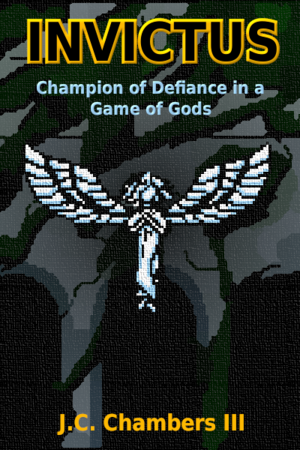
Invictus: Champion of Defiance in a Game of Gods
They crossed wilderness with alacrity. While their rest in the cave could hardly be counted as pleasant, it had been enough for Leo to traverse the distance with little trouble. The addition of boots made the journey far more bearable.
Fia did her best to keep up, but it was clear she’d never had to move long-distance across the wilderness before, as she quickly began to flag.
Eventually, Leo decided it would be faster to carry Fia, much to her chagrin. With arms and back strengthened by years of rowing at sea, it was a trivial matter to princess-carry the goddess.
It took them the better part of the day to circumnavigate the enormous cliff face, finding a narrow pass to ascend to the highlands.
The sun was setting by the time they began the steep uphill trek, and even with his conditioning as an oarsman, he doubted he could make the journey while carrying Fia.
So despite his fervent desire to carry on, he found a crevice in the wall of the canyon and secreted himself with Fia.
This crevice bore more in common with an actual cave, giving Leo a clear view of anyone who might approach while also concealing them well. Even if they started a fire, the light would not be visible unless a traveler were practically upon them already.
Unfortunately, Leo lacked any of the tools necessary to make a fire, so they were forced to camp in the cold once more.
By now, however, their blanket had dried, so Leo gathered some fallen pine boughs from the night’s storm and made a very rough pine mattress. He dumped out the clothes they’d gathered and laid them atop the pine boughs to hopefully be less pokey, then laid the blanket on top of them.
Then, he carried Fia and laid down with her on their improvised mattress, folding the blanket around them to keep warm.
Like the night before, Leo was dead tired. But this time, he needed some answers.
He held Fia close, his hand cradling her head, as he said, “We need to talk.”
“O-okay,” she stuttered, whether from nerves or the cold, he couldn’t tell.
“Please, uh, forgive me my impertinence, but just what kind of god are you?”
She frowned up at him, her teeth still chattering. “What’s that supposed to mean?”
“As a god, aren’t you supposed to be really old and wise?”
Her frown turned to a scowl. “Do I look old to you?”
“Gods are immortal. You’ll look young for millennia.”
Fia looked like she wanted to snap at him with a retort, but perhaps because she was so tired, she just sighed and leaned her forehead on his chest.
That was unexpected. Leo was sure he was going to piss her off. Gods in the old stories were notoriously capricious and petty.
“Before I try to answer your questions,” she said, her voice just audible over the wind outside their cave, “I first need to ask: what do you know about the Game of Gods?”
Leo frowned. He’d heard the term before, but he’d never given it much thought. His education as a youth had revolved around martial prowess and civics, not backward religious theories.
“Every thousand years,” said Fia, interpreting his silence as ignorance, “the gods begin arriving in the mortal plane to seek out and pick champions for their game. The better that each god’s champion performs, the better rank they attain in the pantheon for the next thousand years.
“With that rank, they obtain greater power over manipulating the different realms. Heaven, hell, the mortal plane. Minor gods could become near-omnipotent, and major gods could be cast down to being little more than wandering spirits—in theory, anyway.”
“Let me guess,” said Leo, “in practice, there’s a group of assholes at the top who rig the game from the beginning, so they get to maintain power for the next thousand years.”
Fia nodded, squeezing his shirt. “You aren’t required to participate, of course. But with few exceptions, if you don’t play the Game of Gods, you’re stuck with whatever the winners decide on. If you wonder why slavery is so prevalent in this age, it’s because Pulgus, God of Slavery, placed very well a thousand years ago.”
“So how do you place well, then?”
“You kill people,” said Fia, her voice growing small. “For every person you kill, you gain their faith in the gods as tokens that you can use to improve the powers granted by your champion’s mark.”
“Holy shit,” Leo breathed. “What’s to stop champions from going and massacring a church?”
“Hopefully, another champion,” said Fia, “but even then… a thousand years ago, there were cults dedicated to a goddess where, when she selected a champion, the cultists all allowed the champion to kill them so that he could become incredibly powerful very fast.”
Leo didn’t have anything to say to that. So far, everything he heard about this game was messed up beyond belief.
“The worst part is that it worked,” Fia breathed, disgust drenching every word. “Corpula’s champion took first place in the game.”
“So, that’s it? I’m expected to just go murder a thousand people, or you’re screwed?”
Fia shook her head. “There is another way to accumulate faith tokens. If you kill another champion, you take on all the tokens that they’d gained, and you gain access to their branches of power.”
“Wait a second.” Leo flexed his free hand. “You’re saying I can throw ice spears now?”
“Not yet, but eventually,” she said. “There’s a lot of complicated rules, and we’re running out of word count, so I’ll have to explain that part later.”
“Word count?”
“Don’t worry about it. For now, the key is that we don’t have to murder innocent people to win. We just have to defeat other champions.”
“Okay,” said Leo, looking down at her. From this angle, he could see the part in her silvery hair in the moonlight. Without thinking, he gently began caressing Fia’s head, running his fingers from the top all the way the nape of her neck.
She stiffened, and he stopped.
“D-don’t stop,” she muttered.
“A-all right,” he answered, suddenly flustered.
Looking to get past the awkwardness, he returned to the next most pressing topic. He did, however, continue stroking her head.
“So, all of this doesn’t explain something that’s been bothering me. How come you seem to know so little?”
At this, Fia shrank a little. But when Leo stopped petting her head again, she physically reached up and put his hand back on her crown.
He chuckled despite himself but continued running his hand over her hair while he awaited an answer.
Finally, Fia whispered, “There is a… cost to coming over. The barrier between our worlds is a river of energy. If they’re careless, a god could be swept away to parts unknown, lost to the passing of the ages, doomed to wander the cosmos for all eternity.
“I am a young goddess. Whenever a god dies, its mantle will eventually form around another entity. I only attained godhood within the past few years. Before that, I wandered the plane of gods as… something else. I can’t remember what I was, who I was. But when I obtained this mantle, I knew that I had to participate in the Game of Gods.”
“Does obtaining the mantle of godhood rob you of those memories?” asked Leo.
“No,” Fia shook her head. “Rather, that knowledge was part of the price I paid to cross the River of Souls. As a new god with no worshippers, I had almost nothing to offer Kherty. So he took who I used to be, along with everything I knew because of it. So from the time I became a goddess onward, I can still recall clearly. But much of the wisdom and experience that allowed me to earn my mantle in the first place was stripped from me.”
“What would the Boatman of the River of Souls want with your memories?”
“I… don’t know for certain,” said Fia, “and not because he took my memories. He is one of the few gods who never participates in the Game. But he always exacts a toll.”
“What will he take of you if you die here, then? Your godhood altogether?”
Fia shook her head and shuddered. “When a god dies during the Game, nobody knows what happens to them. They never appear on the River Styx. They just… vanish. The elder gods say they used to know once, but that was the first toll Kherty ever took.”
Leo could feel the very real terror in Fia’s trembling frame. Coming here had been a tremendous risk for her, with very little chance of reward or success.
“Why even come here, if it’s so dangerous?”
“Because people need me,” Fia said, resolve firming up her voice. “Because no matter how they are spat upon, kicked, beaten, humiliated, and even killed, people in this world have faith which can never be conquered. And as long as the fire of defiance burns in them, there is hope. And so, Leo, you are that hope. You are my hope.
“My hope to change this cruel world.”





Please sign in to leave a comment.