Chapter 1:
EPISODE 1 — "The teenager Who Learned to Smile at Nothing"
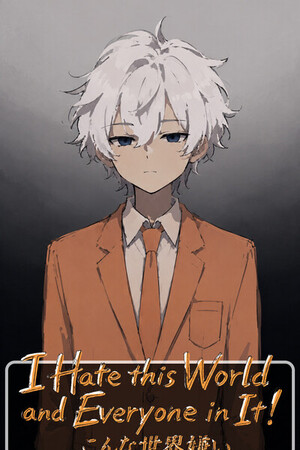
I Hate this World and Everyone in It! — こんな世界嫌い
[NARRATOR: There is a kind of smile that costs nothing to give and everything to hold. Not the smile of a happy human. Not the smile that follows laughter. This is the other kind — the kind built brick by brick out of every door that was ever slammed, every silence that followed a question no one wanted to answer, until the smile becomes a wall with a face painted on it. This is not a story about a divorce that ended, or a childhood that was stolen cleanly, in one motion, like a bandage ripped away. This is a story about what's left standing after both of those things happen slowly, over years, in a house where no one bothered to raise their voice because no one cared enough to. His name is Kibaro Nanashi. The world does not know it owes him anything. He has made very sure of that.]
PART ONE: SHIROYAMA HIGH SCHOOL — MORNING, FIRST DAY
The gate to Shiroyama High stood open the way gates always stand open on the first day — inviting, indifferent, swallowing students two and three at a time into a courtyard buzzing with reunions and nervous laughter. Kibaro Nanashi stood just outside it, hands in his pockets, watching the mechanism of teenage happiness operate itself without him.
[KIBARO'S INTERNAL MONOLOGUE: Three hundred and sixty-one days since I last had to do this. New building, same performance. Smile by the second exchange. Laugh, but only once, and only if someone else laughs first. Don't let them see how much you'd rather be anywhere else. It's not hard. I've had practice.]
A cluster of students swept past him, already trading stories about their summer, and one of them glanced his way — the automatic, harmless glance people give a stranger — before turning back to her friends without a second thought. Kibaro noted it the way he noted everything now: filed, catalogued, discarded.
"You're new too, right?" a voice said beside him. He turned, and the mask arranged itself before he'd even decided to wear it — eyes soft, mouth curved just enough, shoulders loose like a human with nothing to hide. "First year, yeah," Kibaro said, and the words came out warm, easy, practiced smooth as river stone. "Guess we're both figuring this place out."
The teenager who'd spoken — tall, energetic, the kind of open-faced kid who'd probably had four best friends by lunchtime in every school he'd ever attended — grinned like he'd found something. "I'm Souta," he said. "Souta Ide. You want to walk in together? Better than standing here looking lost."
[KIBARO'S INTERNAL MONOLOGUE: Here it comes. The part where I decide how much of myself to hand over before you decide it isn't enough and go find someone easier to like.]
"Sure," Kibaro said, smiling wider, letting the word land soft and welcoming. "I'm Kibaro." They walked in together. Kibaro laughed twice at things Souta said that weren't especially funny, nodded three times more than the conversation required, and by the time they reached the shoe lockers, Souta was already talking about lunch, about clubs, about finding him again after homeroom.
"Sounds good," Kibaro said, and meant none of it, and felt nothing about meaning none of it, because feeling had stopped being a currency he could afford to spend a long time ago.
PART TWO: HOMEROOM — LATE MORNING
The classroom filled with the particular chaos of thirty strangers pretending not to be nervous. Kibaro took a seat near the window — not the back, which drew attention, not the front, which drew more — and arranged his face into something pleasant and unremarkable before the homeroom teacher even entered.
"Good morning, everyone," the teacher said, setting a folder down on the desk. She was younger than most of the staff photos Kibaro had glimpsed on the school website, with tired eyes that suggested she'd already had a long summer of paperwork behind her. "My name is Ms. Fumiko Sena. I'll be your homeroom teacher this year, and if any of you need anything — anything at all — my door is open."
[NARRATOR: She said it the way teachers say it every year, to every classroom, a sentence worn smooth from overuse until it means almost nothing. She did not yet know that for one kid in the third row, it would end up meaning almost everything.]
Kibaro clapped along with the polite applause that followed and thought nothing of it. Roll call moved through the room in alphabetical order, names rising and falling like a tide — Fujimori, Hattori, Ide, Kaneko — until it reached him. "Nanashi, Kibaro," Ms. Sena said, glancing up from the folder. "Here," Kibaro said, raising a hand just high enough to be seen, voice pitched into something bright and unbothered.
She paused for half a second longer than the name required — the kind of pause that comes from having glanced at a student file before class, seen a line or two about a legal guardian's address, an emergency contact that wasn't a parent — and then moved on, professional, careful not to let the pause become a spotlight.
[KIBARO'S INTERNAL MONOLOGUE: She read the file. Of course she did. They always read the file. And now there's a shape in her head where I used to be a name — poor student, rough situation, handle with care. I could tell her it doesn't matter. I could tell her I stopped needing careful handling around the same time I stopped needing anyone at all.]
He kept smiling. It was, by now, less an expression than a posture — something his face did automatically, the way a hand pulls back from a stove without needing to be told twice. At lunch, Souta found him exactly as promised, dragging over two other boys from class — Renji, loud and easily amused, and Daiki, quiet and watchful in a way Kibaro clocked immediately as someone who noticed more than he said.
"So where'd you go to middle school?" Renji asked, mouth half full. "Different district," Kibaro said, waving a hand like the details were too boring to bother with. "Moved around a bit before that too. Nothing interesting."
"Moved around how much?" Daiki asked, and there was nothing accusing in it, just a quiet, genuine curiosity that made Kibaro's heart tighten for exactly one second before he smoothed it back down. "Family stuff," Kibaro said, and let the smile do the work the words wouldn't. "You know how it is."
Daiki didn't, in fact, know how it was. Neither did Souta or Renji, who both nodded along like the answer had actually explained something, because it was the kind of answer built specifically to sound like an ending rather than a locked door.
[KIBARO'S INTERNAL MONOLOGUE: You know how it is. Four words, and none of them true, and none of them false either. That's the trick. Never lie outright. Just give them a shape small enough that they stop asking what's inside it.]
PART THREE: THE WALK HOME — LATE AFTERNOON
The walk back to the house he lived in — he never called it home, not even in his own head, the word simply refused to attach itself to that address — took him past a park where younger kids were still playing, their laughter sharp and uncomplicated in the cooling air. Kibaro slowed without meaning to, watching a father lift a small child onto his shoulders while she shrieked with delight, and something in his stomach folded in on itself, quiet and old and thoroughly familiar.
[KIBARO'S INTERNAL MONOLOGUE: I used to be that young. I used to be lifted like that's what I was for. I don't remember when it stopped. I just remember that one day it had, and nobody told me why, and I decided somewhere in there that asking why was the surest way to get hurt worse.]
He didn't stop walking. He never stopped walking, near scenes like that. Stopping meant looking too long, and looking too long meant feeling something he had spent years training himself not to feel in public, where anyone might see his face slip and mistake the crack in it for an invitation.
The house came into view — plain, beige, indistinguishable from the others on the street, containing inside it two adults who had taken him in three years ago not out of love but out of the dull calculus of family obligation, and who had made sure, in a hundred small unspoken ways, that he understood exactly how much of a burden he was.
He let himself in through the side door, the one that didn't creak, and moved through the house on old, practiced instinct — quiet steps, minimal presence, a kid who had learned that the safest amount of space to take up in a room was none at all. "You're late," a voice said from the kitchen. Not a question. Not concerned. Just a fact laid down like a weight.
"Sorry," Kibaro said, voice automatically softening into the register he used only in this house — smaller, more careful, stripped of the warmth he'd worn all day like a costume he could finally take off. "First day ran long." No response came. None was expected. He climbed the stairs to the small room that was technically his and closed the door with the particular silence of someone who had learned, a long time ago, exactly how loud a door was allowed to be.
PART FOUR: KIBARO'S ROOM — NIGHT
The room held almost nothing that suggested a person lived in it — a bed, a desk, a single shelf with no decorations, curtains that were always kept half-closed. Kibaro sat on the edge of the bed and let the smile fall off his face for the first time since he'd left the house that morning, and underneath it there was nothing dramatic, no tears, no shaking — just a flat, hollowed stillness, like a held breath that had forgotten it was ever supposed to be released.
[NARRATOR: This was the only performance Kibaro Nanashi never gave — the moment, alone, when there was no one left to perform for, and the mask came off not because he wanted to be seen, but because there was, in that room, at that hour, no one there to see him at all.]
"Renji. Souta. Daiki," he said quietly, to the dark, testing the names the way you might test ice before stepping onto it. "Ms. Sena." He almost laughed, a small, humorless breath of air. "All of you, smiling at me today. Like I was worth smiling at."
He thought, briefly, unwillingly, of his parents — not the divorce itself, which had happened slowly enough to be almost boring in its cruelty, but the year before it, when his mother still sometimes hummed while she cooked and his father still occasionally asked about his day like the answer mattered. He thought of the last time either of them had looked at him like he was something other than a problem to be solved or handed off.
He thought, then, of the letter that had come near the end of his last year of middle school — official, dry, informing him in language too clean for what it was describing that both of them were gone, and that there would be no funeral he was expected to attend, because by then there had been no one left who considered him family enough to invite.
[KIBARO'S INTERNAL MONOLOGUE: I used to think I hated the world because it took everything from me. It's taken me a long time to understand that's not quite right. I hate the world because somewhere in all of it, there has to be a reason I was so easy to leave. And if the world can't tell me what it is, then hating all of it, all at once, is easier than hating just myself for not knowing.]
Outside his window, the first stars had begun to show themselves over the rooftops, faint and indifferent, the same stars that had hung over every house he'd ever lived in and never once cared which one he was locked inside of. "Tomorrow," Kibaro said softly, to no one, to the room, to the version of himself that still, somewhere underneath all of it, wanted badly to be found, "I'll smile again. It's easier that way."
[NARRATOR: Tomorrow, there would be a classmate named Souta who wouldn't stop trying, and a teacher named Ms. Sena whose door really would stay open, whether Kibaro believed her or not. Tomorrow, the mask would go back on exactly the way it always did — smooth, practiced, convincing. But tonight there was only this: a teenager, a dark room, a house that had never once felt like his, and the quiet, unbearable weight of hating a world that had simply never given him a reason not to.]
He lay down without turning on the light, closed his eyes, and let the silence hold him the way nothing else in that house ever had.
TO BE CONTINUED...







Please sign in to leave a comment.