Chapter 19:
My Game Begins Episode 3/Chapter 3: Arrival of the Shadow Lord—battle begins Part 5: Is He Really Our Ren?
My Game Begins! Season 1 part 1
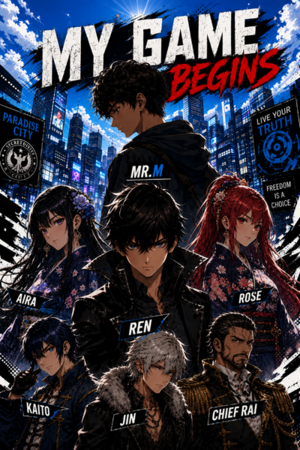
My Game Begins
Episode 3/Chapter 3: Arrival of the Shadow Lord—battle begins
Part 5: Is He Really Our Ren?
"Alright, everyone," Mr. Kazuki announced, tapping his textbook against the podium.
"Please open to Lesson Number Six: The Sengoku Jidai."
The moment those words left the teacher's mouth, Srinivasulu—in Ren's form—launched straight up out of his bench, his eyes sparkling with absolute raw enthusiasm.
"Super, Sensei! Absolutely magnificent!" Srinivasulu blurted out, gesturing animatedly.
"This is my absolute favorite part of history! Larger-than-life figures, their epic battles, and tactical brilliance! Looking at them always reminds me of the Telugu confederacy—or the Nayaka confederacy back home!
After Orugallu (Warangal) fell to the Delhi Sultanate, those seventy-five brave leaders didn't bow down. They rose from the ashes, fought fiercely against all odds, and drove the Sultanate forces right back, took Orugallu (Warangal) back and establish a sovereign Telugu confederacy!
Honestly, the relentless resistance put up by 75 Nayakas was one of the major catalysts behind the eventual decline of the Delhi Sultanate itself!"
Mr. Kazuki, Aira, Rose, Kaito, Jin, and the entire classroom froze, staring at Srinivasulu in absolute stunned silence.
Recovering his composure, Mr. Kazuki blinked in pure astonishment.
"Wow, Ren... It looks like you don't just understand our history and culture, but you have a remarkably deep grasp of global historical frameworks as well."
Srinivasulu offered a smooth, confident nod, rubbing the back of his neck with a grin.
"Well, Sensei, I wouldn't say I know everything, but I do have a solid foundational understanding of global traditions—especially when it comes to cultural parallels with Telugu culture."
He stepped slightly out from behind his desk, holding up a finger to make his point.
"Take traditional display festivals, for instance," Srinivasulu continued, his voice dropping into an engaging lecture tone.
"Look at Japan's Hina Matsuri and South India's festival traditions. In Tamil culture, it is called Bommai Golu; in Kannada culture, Bombe Habba; and in Telugu culture, Bommala Koluvu.
"On the surface, they share some fascinating structural similarities, but the differences are what truly make them distinct."
Walking a step down the aisle, he began counting off the details on his fingers.
"First, the timing.
"Hina Matsuri is traditionally celebrated on March 3. Bommala Koluvu, on the other hand, is primarily celebrated during Sharad Navratri around September and October.
"However, in Telugu culture, it is also celebrated during Sankranti as Sankranti Bommala Koluvu, and also occasionally during the Telugu New Year, Ugadi, around March and April!"
The classroom hung onto every word, completely transfixed.
"Second, look at the structural design," Srinivasulu pointed out, sweeping his hand through the air.
"Hina Matsuri has a highly structured traditional arrangement. The classic full display consists of 7 tiers, with 15 principal dolls representing the Imperial Court and various miniature furnishings and accessories arranged according to their traditional positions."
"Bommala Koluvu, by contrast, uses an odd number of steps—3, 5, 7, 9, or 11, depending on the household and regional practice.
"There is no fixed rule on exactly how many dolls must fit onto a step. If a family buys ten new dolls, they simply squeeze them onto the existing steps or add a new tier.
"The display expands organically!"
Srinivasulu didn't stop there.
He began pacing slowly between the rows of desks, bringing the imagery to life.
"And look at how the displays are often arranged in Bommala Koluvu:
The Top Tiers (Steps 1 to 3 - The Gods):
Traditionally, the upper tiers are often for the Supreme Deities.
You find—Lord Venkateshwara, Lord Vishnu, Lord Brahma, Lord Shiva—and Goddesses like Durga, Lakshmi, and Saraswati.
The Middle Tiers (Steps 4 to 6 - Demigods, Saints, and Heroes):
These bridge the divine and human worlds.
You see avatars like Lord Rama or Lord Krishna, revered saints, and historical icons often laying out epic scenes from the Ramayana or Mahabharata.
The Lower Tiers (Steps 7 to 9 - Human Life and Commerce):
These depict the bustling, secular human world.
Featuring shopkeeper dolls surrounded by miniature bags of grains and lentils—alongside figurines of teachers, musicians, weavers, farmers, children playing cricket, and domestic animals.
The Ground Floor (Nature):
The floor right beneath the steps is transformed into a miniature countryside using real mud, sprouted mustard seeds for grass, and small mirrors to mimic lakes."
He paused, pivoting sharply to contrast it with the Japanese tradition.
"Now, look at Hina Matsuri, whose traditional dolls are arranged in a hierarchy inspired by the Imperial Court of the Heian period:
Tier 1:
Just two dolls—the Emperor (Odairi-sama) and the Empress (Ohina-sama) sitting before a gold folding screen (Byobu).
Tier 2:
Three court ladies (Sannin Kanjo) serving sake.
Tier 3:
Five young musicians (Gonin Bayashi) holding traditional instruments or a fan.
Tier 4:
Two court ministers (Zuishin) equipped with bows and arrows to protect the Emperor.
Tier 5:
Three helpers (Sannin Jogo), traditionally depicted with expressive faces associated with anger, sadness, and joy, holding traditional cleaning implements.
Tiers 6 and 7:
No dolls at all—instead displaying exquisite miniature tools, lacquerware furniture, household objects, and carriages."
Srinivasulu swept his hands wide, bringing his argument to a grand conclusion.
"When you examine how many similarities and yet stark differences exist across cultures, it honestly leaves professional historians baffled!
"How two completely different cultures developed such parallel yet distinct traditions is incredible.
"And as far as I know, festivals like Sankranti, Ugadi, and Navratri date all the way back to the Andhra Satavahana era around the 1st century BCE—or even the late 3rd century BCE around the exact time Emperor Simuka established the mighty Andhra Satavahana Empire in Kotilingala!
"This makes me wonder whether traditions like Bommala Koluvu, Bommai Golu, and Bombe Habba may have much older roots in South India, perhaps even reaching back to ancient times. What do you think, Sensei?"
For a moment, absolute silence hung in the room.
Then, Mr. Kazuki burst into applause, a wide grin spreading across his face.
"Wow, Ren!" Mr. Kazuki laughed, clapping heartily.
"That is precisely why I say you are my favorite student for a reason!"
He stepped out from behind his desk.
"I completely agree with your depth of knowledge.
"But as you pointed out, history isn't just about battles and entertainment. As you just showed us through culture, history is a mirror.
"Just like a coin has two sides, studying history teaches us both the good and the bad so we can learn from it.
"Let's give Ren a round of applause and go to our lesson!"
Spurred by the teacher, the entire classroom erupted into applause.
Srinivasulu bowed slightly, flashing a modest grin.
"Thank you, Sensei. Thank you, everyone. I just shared a bit of what I knew, that's all," he said, before finally taking a seat back at his desk.
Meanwhile, Aira, Rose, Kaito, and Jin exchanged bewildered looks.
Leaning forward across the aisle, Kaito muttered under his breath to Jin,
"Bro... our Ren used to struggle to string two sentences together when speaking just to the four of us.
"Now he's standing up and delivering full-blown cultural history lectures?"
Jin narrowed his eyes, staring back at Srinivasulu.
"You said it, man... Is that really still our Ren?"
Behind them, Rose and Aira sat in stunned silence, their eyes locked onto Srinivasulu, who was sitting right in the middle of them.
Neither of them could process the bizarre transformation unfolding right before their eyes.
(End of Episode 3/Chapter 3 — Part 5)





Please sign in to leave a comment.