Chapter 2:
Class E
Kuroyuri
The dormitory wing was quieter than the classroom building, which surprised him. He'd expected the opposite — expected somewhere twenty traumatized teenagers would be housed to hum with the same tension as Room 401 had, all night. Instead the halls smelled like fresh paint and floor wax, and his room, when he found it, had his name already printed on a card slotted into the door.
KIRISAKI, SOUTA — 1-E — RM 214
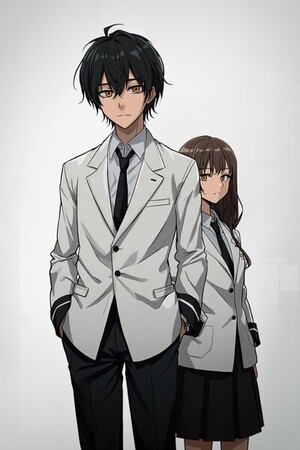
Inside: a bed, a desk, a narrow closet, a window that looked out over the same courtyard he'd glimpse properly the next morning. A duffel bag sat on the bed that he hadn't packed and hadn't been told to expect — uniforms, folded with a precision that read as machine rather than human, a handful of textbooks, toiletries. Everything a person needed to disappear into a new life without having to ask anyone for it.
He didn't sleep well. He hadn't expected to.
Homeroom was at nine. The room had a number on the door — 1-E — and twenty desks arranged in four rows of five. Souta counted them once, sitting down, and didn't need to count them twice.
The others came in around him, quiet, none of them sitting near anyone they recognized from the night before if they could help it. A boy near the window kept his eyes on his own hands. The girl with the empty bag from orientation took the seat by the door and watched it like she still expected something to come through.
Sae sat two rows ahead, off to the side. Not next to him. He understood without needing it explained — whatever had happened in that closet belonged to the dark, and daylight hadn't yet agreed on terms for crossing back into.
At nine exactly, their homeroom teacher walked in.
He was younger than Souta expected, maybe thirty, with a face built for being forgotten in a crowd. He set a slim folder on the podium.
"My name is Instructor Domon. I'll be your homeroom teacher for as long as you're in this class. That might be three years. It might be considerably less, depending on how quickly you learn the difference between the two things this school actually asks of you."
He let it sit a moment.
"Surviving, and ranking. You've already proven you can do the first. That won't be tested in quite the same way again — orientation is the worst night you'll have here, by design. Ranking, though, never stops being tested. Not for three years."
The boy by the window raised his hand. "What happens if we don't rank well?"
"Field division," Domon said. "It sounds like an opportunity. In practice it means operations the school considers acceptable losses. Some students come back from it. Most come back different. Some don't come back, and the school sends a short letter to whoever's listed on the enrollment form."
Nobody had a follow-up. The answer had closed rather than opened something.
"There are five homerooms," Domon went on. "E through A. Rank is reassessed monthly — academics, tactical evaluation, field simulation. Rank determines resources. A-class gets current equipment and instructors who used to run real operations. You get me, and gear that's a generation behind everything upstairs."
He said it like a budget line, but Souta caught something under it anyway. Not quite sympathy. Something adjacent.
"You should know Class E has a reputation," Domon added. "Every year, the twenty who make it through orientation by the most — inventive — methods end up here. Officially it isn't a punishment placement. Unofficially, the rest of the school already assumes you did whatever it took, and they'll treat you like it. Some of them will be afraid of you. Most will underestimate you. Both are useful, if you're careful which one you let people keep believing."
The gear came out on two carts, wheeled in by upperclassmen who didn't introduce themselves and left the moment the crates were down.
"Standard field kit," Domon said, opening one. A fixed-blade knife, matte black, no longer than a hand. A coil of dark cord. A case that looked like ordinary first aid until he showed them the false bottom underneath.
"You're each issued one. You don't lose it, you don't lend it, and it doesn't leave your locker during breaks. Check the lock obsessively — someone in this room will eventually try someone else's, just to see what happens."
A dry ripple of something not quite laughter moved through a few desks. Domon didn't discourage it.
"This isn't equipment for anything that matters yet. It's equipment for learning how equipment works. You train on last-generation kit until you've proven you won't hurt yourselves with it. A-class trains with gear some of you won't touch until second year — if you're good enough to be moved up by then."
If you're good enough to be moved up. Souta turned the phrase over as the kits made their way down the rows. Rank wasn't a scoreboard. It was a door.
The tone that passed for a bell sounded at the end of the period. Domon closed the folder, tucked it under his arm, and paused at the door.
"You survived the worst night this school has for you. That's not nothing. But orientation only tells the school what you're capable of with no choice in front of you. The next three years are going to ask a harder question, over and over: what you're capable of when you do have a choice, and nobody's forcing your hand."
He didn't look at anyone specific when he added, "Some of you already have opinions about the person near you. Whether they're someone to trust, or watch, or avoid. That's normal, given last night. I'd just say — don't decide too fast. Twenty desks, three years, whether you like each other or not. The people you write off in week one have a way of mattering later."
The door closed.Nobody spoke for a moment. Then the boy by the window turned around, blunt, like the question had been sitting in his throat since morning. "So is anyone going to talk about last night, or are we just doing this forever?"
A beat. Then the girl by the door , introduced herself as Hana Origuchi laughed, short and startled, like the question had punctured something she hadn't realized was holding pressure.
"Forever," she said. "Obviously forever. Did you miss the part where they told us to sit next to each other for three years?"
It wasn't resolution. It wasn't the twenty separate reckonings this room owed itself. But it was the first real sentence anyone in Class E had said to each other in daylight, and Souta, watching from his desk, understood it would have to be enough to start on.







Please sign in to leave a comment.