Chapter 16:
The Room She Kept (Chiyo, before)
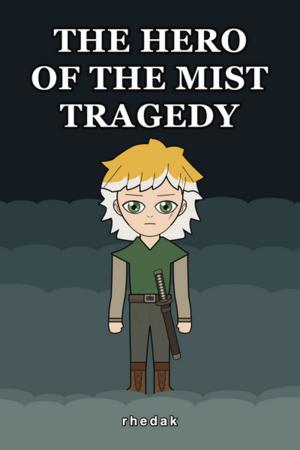
The Hero of the Mist Tragedy
Chiyo, before
The priest ran out of things to say before Chiyo ran out of tears. At least that meant nobody had to listen to him keep trying.
Two graves, dug side by side in ground still soft enough to work without breaking a spade, held the whole of what she had left of Jiro. Sora’s mother knelt at the second one, her husband’s hand heavy and useless on her shoulder. Some part of Chiyo reached across the gap between the two mounds on its own, until she was holding a stranger’s hand over freshly turned earth, because there was nowhere else for either of their hands to go.
The walk back to the inn was gone from her memory. Only that her knees had given out once, twice. Someone, she never learned who, had gotten an arm under hers both times before she reached the ground.
***
A man from the district office caught her at the inn’s door, heavyset, ink still drying on the cuff of his sleeve from whatever list he had been drawing up all morning. Later she decided it was no accident. A man who kept lists like that one didn’t lose track of which day was which.
“I know what today cost you,” he said, “and I am sorry for it, truly. But the column coming up from the capital road grows by forty, fifty souls a day, and this inn has eleven empty rooms and one woman running it alone.”
He asked, in the gentle voice men used right before asking her to give something up, whether she wanted to hand the running of it to someone else for a while. Someone the district could send, just until she was back on her feet.
“Do you want to take the one last thing I have as well?” Her voice came out louder than she had meant it to, cracking somewhere past “last,” and she did not care. Her husband had gone into the ground six years before this one, a beam that gave way on an ordinary afternoon. She had run this inn alone every day since, without once being asked whether she still wanted to.
The man had the sense to look ashamed and the worse sense to keep talking anyway, something about beds and blankets and how grateful the district would be.
She stopped listening somewhere in the middle of it and went inside to start banking the morning’s fire, because the fire did not care what day it was. She was not about to either.
She scrubbed the same table three times before noon. She restocked shelves that were not empty. By evening her hands ached in a way that had nothing to do with grief and everything to do with an honest day’s work. She had kept that bargain with herself since the beam fell six years ago.
***
The camp at the district’s edge had grown again overnight, canvas and cart-tarps strung between wagon wheels in rows that had stopped pretending to be orderly around the fourth day. Chiyo went out with bread and a spare blanket or two, as half the village did by now. She was tying off a guyline for a family with three children under it when she noticed the boy.
He was sitting apart from the others, at the edge of a row rather than inside it, knees drawn up, unsteady even sitting still.
Chiyo had seen that unsteadiness before, on the worst of the road-weary. Grime, or something like it, had worked its way deep into his hair, a dull yellowish cast to it that Chiyo took for road dust and nothing more.
A raw, unhealed burn traced his jaw, the kind that wanted a poultice and had gotten none, and nobody nearby seemed to have looked at him closely enough to offer one. Nobody was sitting with him. Nobody seemed to be looking for him either.
Chiyo could not have said, afterward, how long she stood there with the guyline still in her hand.
She could not look away. The reason was plain and stupid, and beside the point. The boy was the same age Jiro had been.
Nineteen, near enough, judging only by the way he held himself: too old to be led anywhere, and too young to have anyone left to lead him.
Chiyo spent the rest of the morning exactly as she had spent every morning that week, hauling the worst of the new arrivals back to the inn’s spare rooms. An old man whose cough had gone wet and dangerous. A mother with a baby too quiet for its own good.
Eleven empty rooms had stopped being an argument the district office needed to win. They had started being the only thing she still knew how to do with her hands.
The boy was not among the worst off, not by the only measure that was supposed to matter. Chiyo took him anyway, on her way past, before she could talk herself out of it.
“Up,” she said. “This is no place for moping, we need every hand we can get. If you want to sleep in a bed tonight, you’d better be ready to work in the morning.”
The boy looked at her a long moment before he got to his feet, something in his face that was not quite gratitude and not quite suspicion either. He said nothing at all, which suited Chiyo fine.
She had not said any of it to be thanked for.
They walked back to the inn together, not speaking, past a column still growing at the district’s edge and a valley that had not yet settled on what it wanted to take from any of them.
The boy’s name came only at the door.
“Satoshi,” he said.
Not much of a life to offer anyone, one exhausted woman, eleven rooms, and a debt to the dead that would never come fully paid. Chiyo held the door open anyway, and let him in.









Please sign in to leave a comment.