Chapter 4:
Not on the syllabus
Kuroyuri
The first full week established a rhythm, and the rhythm was the strangest part.
Mornings were ordinary in a way that felt almost aggressive in its ordinariness — mathematics, foreign language, a block called simply Analysis that turned out to be statistics dressed up in a different name. Souta sat through forty minutes of quadratic equations on Tuesday morning with a knife in a locked locker two floors down and could not decide, staring at the board, whether the normalcy was a mercy or its own kind of cruelty.
It was the afternoons that told the truth about where he was.
Applied Tactics :met in a room with no desks, just mats and a wall of equipment cages, taught by an instructor who introduced herself only as Sensei Kurahashi and spent the first session not teaching anything at all — just walking the rows, watching the first-years try to fall correctly, correcting elbows and footwork with a bored efficiency that made it clear she'd done this exact walk for a lot of first weeks before this one.
"Most of you are going to want to know why we're starting with falling," she said, halfway through, to nobody in particular, the way teachers talk when they've had the same conversation with enough classes that it's stopped being a conversation and become a recitation. "It's because the first time most of you get hurt for real, it won't be a fight. It'll be a fall you didn't know how to take. Fights you can usually see coming. Falls, you can't."
Souta filed that next to bring nothing and the count doesn't say how — another sentence that meant more than its surface, if you let it sit long enough.
Fieldcraft :was smaller, twelve students split off from the larger cohort based on some evaluation nobody had told them they'd taken, and Souta found himself in it alongside Sae for the first time since homeroom — not seated near her, the room didn't work that way, everyone at individual stations with a locked case in front of them, but close enough to see, across the room, the particular economy of her movements when the instructor set them to disassembling and reassembling a comm unit blind, timed.
She finished first. She didn't look up to see if anyone had noticed.
He noticed.
It was Kaito who brought it up, three days in, in the low-ceilinged common room on the second floor of the dorm wing where Class E had started gravitating in the evenings without any of them quite agreeing to it out loud — a shared television nobody watched, a table where homework accumulated and got done in the particular silence of people who'd rather be quietly working near others than alone in a room with their own thoughts.
"Renji Asou talked to you," Kaito said. Not a question. He said most things that way, Souta was learning — statements offered gently enough that you could correct them if they were wrong, but delivered with enough certainty that they usually weren't.
"You know him?"
"Everyone in class- E knows him by the second week. He does this every year — finds whoever in the new cohort looks like they're paying the closest attention, and talks to them once, and then leaves them alone to think about it." Kaito didn't look up from the book he was reading, or pretending to read. "My brother went here. Two years ahead of me. He mentioned an Asou once, before he stopped mentioning anyone from this place at all."
Something in the way he said stopped mentioning anyone from this place at all closed the subject before Souta could ask the obvious question, and he understood, the way he was learning to understand most things at Kuroyuri, that some doors got left shut on purpose and it wasn't his place to force them.
"What did he tell you?" Kaito asked instead.
"That not everyone makes it to second year with the same roster."
Kaito's jaw tightened, almost nothing, gone in a second. "That's true. It's not usually — dramatic, about it. People transfer out. Family stuff. Some people wash out of field simulations badly enough the school reassigns them somewhere quieter, admin track, support roles, off the killing side of things entirely. It's not always the worst version of what he's implying."
"But sometimes it is."
"Sometimes it is," Kaito agreed, and went back to his book, and Souta understood that this, too, was a door being closed gently rather than slammed.
Across the room, Hana was sprawled sideways across an armchair with her feet over one arm, watching the two of them with the specific alertness of someone who'd been listening the whole time without appearing to.
"You two are so bad at this," she said. "Just say the thing. Everyone in this room already knows the thing. We watched twenty people not make it out of a classroom four days ago. Renji Asou being dramatic about attrition rates is not the scariest information anyone's shared with us this week."
"Doesn't mean it's not worth being careful about," Kaito said.
"Being careful and being scared aren't the same thing." Hana swung her legs down, sat up properly, and looked at Souta with an expression that was doing something he hadn't quite catalogued yet — not flirtation, not exactly, something closer to genuine curiosity aimed directly at him, which he found he didn't entirely know what to do with. "You're the one he singled out, though. Out of twenty of us. Doesn't that make you want to know why?"
"I already know why," Souta said.
Both of them looked at him.
"He said it himself. He likes watching what the bottom rung does before the school finishes grinding the personality out of everyone. I didn't do anything to get noticed. I was just standing in a hallway at the wrong time, thinking, instead of talking to anyone." He shrugged, and meant it as dismissal, and understood — even as he said it — that it wasn't really dismissal at all, that some part of him had already decided Asou's attention was a data point worth keeping, filed next to everything else he was quietly collecting about how this place actually worked underneath what it told you it was.
Hana studied him a second longer than the moment strictly required. "Yeah," she said, finally, something wry creeping into it. "That tracks. You're exactly the kind of person who'd get noticed for standing very still and thinking about it."
He didn't know, yet, whether that was a compliment. He suspected, even then, that it would become one of several things about her he'd spend a long time not being sure how to read.
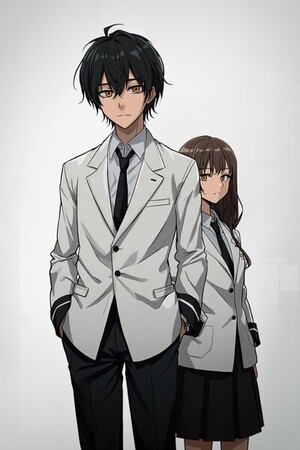
Sae found him on the stairwell between the third and fourth floors two nights later, later than curfew technically allowed, though nobody at Kuroyuri seemed especially rigorous about enforcing curfew for students who had reasons to be awake.
"You've been avoiding me," she said, without preamble, the stairwell light doing the same flat, unflattering thing to her face that the fluorescents the dorm room had done four nights ago, and he thought, absurdly, that it was strange how quickly four nights ago had already come to feel like a different lifetime.
"I wasn't avoiding you. We haven't had a reason to talk."
"That's the same thing, from where I'm standing." She came up two steps, stopped a respectful distance below him, close enough to talk quietly and far enough that it wouldn't have read as anything, to anyone who might have walked past. "I wanted to say — what happened that night. I'm not going to bring it up again after this. I just wanted it said once, out loud, so it's not just sitting between us unsaid forever."
"Okay."
"Thank you," she said. "For not making it harder than it had to be. Some people would have."
"You're the one who found the way out."
"You're the one who didn't take it and use it against me the second we were in daylight," she said, and there was something almost like a smile in it, small, careful, the first expression he'd seen on her that wasn't calculation. "That matters more than you probably think it does, here."
She left before he could decide what to say back, down the stairs and around the corner, gone the way she'd arrived — without any wasted motion, without looking back to see if he was watching.
He was.
He stood on the stairwell a while longer, alone, thinking about Renji Asou's warning and Kaito's careful evasions and Hana's blunt curiosity and the particular quiet of Sae's thank you, and understood, with the same clarity that had let him sit still in the dark four nights ago while everyone around him panicked and killed each other, that he had just been handed the first real shape of what the next three years were actually going to be about.
Not the knife in the locker. Not the rankings, or the field division, or even his grandfather's address, patient and waiting, somewhere in this building's records for whenever he was ready to go looking.
The other new first years, all of them just as unwilling to look away from each other as he was.






Please sign in to leave a comment.