Chapter 18:
Convenient Cowardice
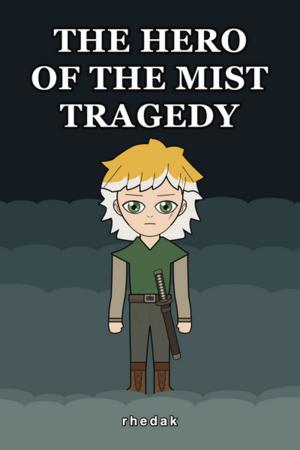
The Hero of the Mist Tragedy
The road passed through the old city wall before it reached the treasury district proper. Worked stone, older and more deliberate than anything the outer district had built, its gate’s iron long gone but the masonry around it still standing, scarred rather than fallen.
We found the first of it two streets further in, past a collapsed well-house: a stack of red cloth headbands, dozens of them, folded and bundled inside a rotted crate as though someone had meant to distribute them and never got the chance. Alongside the crate, propped against a wall gone soft with mist-residue, a pair of torn signboards, their painted characters too weathered to read whole.
Past both, spanning the mouth of what had once been a wide market street, a barricade of overturned carts and broken timber, built in a hurry and never fully taken down.
Nobody in the column said what it was. Nobody needed to, except two of them, who said it anyway, quietly, to each other and not to Reinhard.
“Red.” Kurogane said it without stopping to pick anything up, a merchant’s flat appraisal, not a courtier’s. “I remember when this district decided it needed a color of its own.”
“You were making a great deal of noise about it yourself, in the merchant halls, if my memory serves.” Kisaragi did not look at him either, his eyes on the barricade’s rough timber instead. “Everyone was, for a while. Easy to forget how loud a street can get, before it actually has to decide anything.”
“Loud enough to build a wall, apparently. I don’t imagine it ever got the chance to find out whether any of it was right.”
“Most of it never does.” Kisaragi’s voice stayed light, though its edges had gone thin. “It’s usually enough for a season, and rarely worth remembering past it.”
Grau, close enough to catch the tail end of it, crouched by the crate anyway and lifted one of the headbands free, turning it once in his hands, red dye gone dull and blotched with age. He set it back exactly where he’d found it, apparently satisfied that whatever the two of them were trading wasn’t anything his report needed translated.
Tenno had gone very still at the edge of my sight through all of it, and only because I had spent a year learning to watch people who did not want to be watched did I catch it.
A flicker crossed his face, there and gone, too fast to name. His hand tightened around the head of his cane hard enough to whiten the knuckles, then eased. He said nothing the whole time Kisaragi and Kurogane traded their reading of the street over his head, and looked at the crate no longer than anyone else had, which was itself the tell. Reinhard listened without joining in, filing the exchange with the patient attention he gave everything.
He moved the column on toward the district’s standing buildings once the two of them had run their course, though I noticed his glance return to Tenno before he let the moment go.
***
The treasury stood two blocks past the barricade.
On the way, a strip of blue-painted cloth caught on a fence post, faded almost past recognition, the same blue Tenno still wore at his throat every day of this expedition. Nobody else in the column paused long enough to place it beside the red they had just left behind. I did, and said nothing, and kept walking. The treasury was a squat, fire-scarred building, its records room’s roof half fallen in.
I knew where it would be before Reinhard’s maps confirmed it. The same unremarked certainty had told me, back at Tomohiro’s childhood village, exactly where its schoolhouse stood before anyone pointed me to it.
“This way.” I said it before he asked, already turning down a side street that hadn’t been cleared of rubble yet. I felt his glance land on the back of my head a half-second after I’d committed to the turn.
“You’ve read a survey map of this district, Satoshi.” He said it as a statement, not a question, an answer half-built for me to agree with.
“Enough ruins start to look alike, this deep in.” I let the answer stand, and did not offer the rest.
The records room’s strongbox had partly survived the building’s collapse, iron corners scorched but its lock still seated true. Inside, water-stained ledgers sat in neat rows. It was Reinhard, not a soldier sent ahead of him, who lifted the topmost intact volume free and worked through its pages one at a time, the way a man reads who expects to find something eventually and has no reason to rush.
He stopped on an entry near the middle, read it twice, and turned the ledger so I could see it without offering to explain what I was looking at. A formal refusal, dated, signed in a precise, unhesitating hand: Daizen Kurogane, merchant, declining in full and on record to contribute funds or materials to the crown’s research program, its reasons set down in two plain sentences. No coin for a program whose own architects could not yet say what it did.
“He likes things written down,” Reinhard said, mostly to himself, and set the ledger aside rather than closing it.
The letter turned up in the room’s far corner, half burned, tucked inside a locked drawer that had cracked open under the building’s weight.
Reinhard drew it out with two fingers, careful of the char at its edges, and held it to what daylight came in through the broken roof. A seal, House Kisaragi’s, pressed into wax gone brittle with age.
Beneath it, in a hand too fire-damaged to read whole, a few surviving words: a Wodensreich contact’s name, a phrase about “continued good faith.” There was no honest reading of it as anything but correspondence a Wodensreich office was never supposed to see.
“My lord.” Reinhard’s call carried easily across the ruined room when Kisaragi arrived to see what had been found. Kurogane’s voice was still audible through the doorway behind him, working through a stack of crates in the outer hall with one of Sturm’s soldiers.
Reinhard held the letter out instead of reading it aloud himself. Kisaragi took it, and for the first time since I had known him, did not have an answer ready before his eyes had finished the first line. He read it through twice, in silence, his glance flicking toward the doorway and the sound of Kurogane’s voice beyond it before it came back to the page.
I had decided, in a supply yard some weeks back, that whatever sat underneath the charm probably didn’t matter much either way. Watching him take a full breath to find the door in a room that had just caught fire around him, I was no longer sure the charm had ever been separate from whatever was underneath it at all. He settled a moment later, visibly: a man who had already chosen which of two rooms he would rather be caught standing in.
“It was never anything but the coat, Oberst-Researcher.” His voice had dropped, pitched for Reinhard alone, low enough that Kurogane’s talk through the doorway nearly covered it. “Every loyal word I have ever spoken to an Okiri ear, I spoke so I could go on being useful to yours. I have been exactly what your empire needed since before your empire knew to ask for it.”
Reinhard did not answer at once. His blink took a full breath longer than it should have, and when the eyes opened his face had decided to give nothing back.
“That is a great deal to offer a man holding a burned letter and nothing else.”
He set the letter down between them rather than handing it back. “I will remember that you offered it.”
“Then consider me informed, however you choose to remember it.” Kisaragi’s smile came back where it had been before he had said any of it. I understood, watching him, that he had decided the wager was worth more to him than the risk of Kurogane overhearing.
Tenno, Natsume, and Reika had been held near the treasury’s mouth until now, and were walked up in time to watch Kurogane, called over a moment later, get the same wordless handling Kisaragi had: the volume set open in front of him, no question attached. Twice inside one afternoon now, and I understood what he was doing.
He was not asking either man to confess to anything. He was only putting a fact where a face could not help but react to it, and reading whatever the reaction gave him for free.
Kurogane only glanced at the entry and shrugged, unbothered. “I refused. I said so, in writing, at the time, to anyone who asked. I don’t see what a fire-damaged room changes about a fact I never once tried to hide.”
“No.” Kisaragi’s voice came in cool and quiet from across the room, not quite loud enough to carry to Reinhard. “You never had to hide it. Refusing costs a man nothing, if he’s already decided he’d rather watch the rest of us drown than get his own hands wet.”
“I notice you’re not calling it a lie.” Kurogane didn’t turn to face him. “Only cowardice. I’ll take the lesser charge.”
“Convenient cowardice, at that.” Kisaragi finally turned to face him. “Every road your Shosha network built in these years runs straight through trade my house used to hold outright. You didn’t have to sabotage anything. You only had to sit still and let my family’s revenue starve while yours grew fat on it.”
“I built roads. You built a shrine to a king who’s spent this whole expedition fetching cups of tea for a foreign officer, and you still can’t say his name without lowering your voice a register, out of respect, I assume, for a throne that no longer exists.”
Kurogane finally looked at him. “Devotion, then. I only wonder some days which of you it’s actually for.”
Kisaragi’s smile thinned, and for once he did not answer, turning back toward the doorway and leaving it to sit unresolved between them the way the earlier not-answering in the street had.
Reika had been near enough for all of the argument, hearing it and saying nothing. She spoke once Kisaragi had passed her, in the register she kept for a funeral, not to him. “A lie told for a true enough reason is still a lie. A truth kept back to serve the same reason is the same lie, quieter. No one has ever found the ledger where it reads otherwise.” She walked out slower than she had come, and in all the road behind us it was the first time I had seen her do it. Kisaragi passed her without a flicker. Reinhard’s attention came up off the ledger for exactly as long as the line took to say, and went back down. One of Sturm’s soldiers glanced over, judged it more of the same, and went back to his crates.
For one breath I was certain she had aimed the whole of it at me. She was looking at the wall past Kisaragi’s shoulder, not at me, and had been the whole time. I kept my face where the room had already put its own, and let it go.
***
We fell back to camp inside the outer district’s cleared pocket that night, close enough to the ruins that the fallen Kirijuu’s mist-scent never fully left the air. I sat apart from the fire longer than I needed to, turning over the ease with which I’d known where a records room would stand in a city I had, by every account anyone here believed, never set foot in.
Reinhard did not come to ask me about it. He only watched the towers a while, in the direction the maps said we’d be walking come morning, and let the ruins keep their counsel one more night.
Tomorrow, the maps said, we would go deeper.








Please sign in to leave a comment.