Chapter 0:
Prologue- The Great Revolt
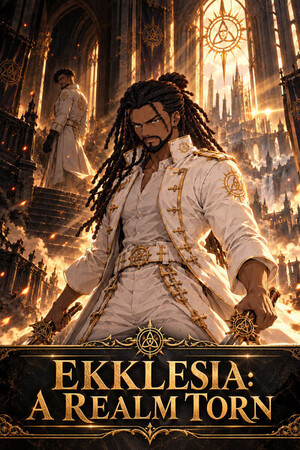
Ekklesia: A Realm Torn
The children were laughing.
Their voices carried across the open field beneath a cloudless sky, accompanied by the soft rustling of tall grass and the occasional shout whenever the small leather ball escaped someone's reach.
One boy kicked it too hard.
It sailed past the others, bounced twice, and rolled toward the edge of the field.
“I’ll get it!”
A younger child raced after it.
He was almost there when the ball stopped.
Then it moved.
Not forward.
It trembled.
The boy slowed.
A faint vibration traveled beneath his bare feet.
The ball shook again.
Once.
Twice.
Then the earth began to rumble.
The laughter behind him faded.
Beyond the distant ridge, something appeared against the horizon.
Banners.
Hundreds of them.
Then came the soldiers.
Rows upon rows marched across the distant earth, their armor catching the sunlight as spearheads rose above them like a forest of steel. Horses followed. Siege engines groaned behind them. What moments before had been a peaceful horizon slowly disappeared beneath marching feet and gathering dust.
The child abandoned the ball.
He ran.
From far above, a man watched him flee.
Meir stood silently upon the edge of the celestial overlook, his hands folded behind his back.
At roughly six-foot-two, he stood tall without being imposing through size alone. There was something refined about him—a lean, disciplined frame held with the effortless posture of a man accustomed to command. His immaculate white uniform followed that same discipline, its carefully tailored fabric accented by elegant lines of gold. The insignia upon his chest identified him as something far more consequential than a distant observer.
The General of Light.
Jet-black hair swept neatly across his head in a carefully maintained comb-over, sharply faded along the sides. His facial hair was equally deliberate, groomed precisely along his jaw and mouth. Against his warm, fair complexion, there seemed to be nothing disorderly about him.
Except his eyes.
They remained fixed upon the field below.
The first formation reached the village.
Then came the screaming.
Meir’s jaw tightened.
Fire climbed from the first rooftop.
Soldiers crashed through streets that, moments earlier, had been filled with merchants and families. Steel met steel. People fled between buildings. The peaceful field disappeared beneath boots, blood, and smoke.
And still Meir watched.
Not because he enjoyed it.
Because he had seen it before.
Different banners.
Different rulers.
Different excuses.
The same ending.
His fingers curled behind his back.
“How many times?”
The words escaped quietly.
Below, the abandoned ball rested in the grass.
A soldier’s boot crushed it beneath his heel.
Meir disappeared.
The halls of the Almighty were silent.
White stretched seemingly without end, untouched by stain or age. Great pillars rose toward ceilings lost in radiant light, their surfaces decorated with restrained veins of gold.
There was no excess in the place despite its magnificence.
Everything possessed an order that the world below seemed determined to reject.
Meir’s footsteps broke the silence.
He stopped before the presence of the Almighty.
For several moments, he said nothing.
Then—
“I don’t understand.”
The Almighty answered him patiently.
“What has you troubled, My child?”
Meir lifted his eyes.
“Why do You insist on protecting them?”
The question lingered between them.
“They do not learn.”
His voice remained respectful, but the restraint behind it was thinning.
“I watched children playing this morning. Laughing. Completely unaware of the hatred being carried toward them over a hill.”
He gestured toward the world beyond the palace.
“And by nightfall, how many of those children will still have homes?”
The Almighty allowed him to continue.
Meir stepped forward.
“They kill one another. They steal from one another. They deceive, conquer, enslave, destroy—and when the ashes settle, they mourn what they’ve done.”
His eyes hardened.
“Then their children do it again.”
“They are imperfect,” the Almighty answered. “And they have been given the freedom to choose.”
“And look at what they choose!”
Meir’s voice echoed through the chamber.
He immediately caught himself.
His jaw tightened.
But he continued.
“They have been given chance after chance. Mercy after mercy. How much suffering must be permitted before mercy becomes permission?”
“Mercy is not permission.”
“Then what is it?”
“An opportunity to choose differently.”
Meir stared upward.
“And how many opportunities will You give them?”
“As many as I deem just.”
Meir’s hands tightened.
“They have proven what they are.”
“They have proven what they are capable of choosing.”
“What difference does that make?”
“All the difference.”
Meir shook his head.
The Almighty continued.
“Humanity possesses the freedom to choose what is righteous. They also possess the freedom to reject it.”
“And everyone else simply suffers the consequences?”
“They are responsible for the choices they make.”
“Then take that choice away!”
The words echoed through the palace.
Meir froze.
For the first time, genuine concern entered the Almighty’s response.
“Is that truly what you are asking of Me?”
Meir’s breathing grew heavier.
“I am asking You to look at what they have done.”
“I have.”
“Then how can You allow it?”
“Because I see more than you do.”
Meir stared upward.
The answer did not satisfy him.
It angered him.
“You see their wars.”
“Yes.”
“Their cruelty.”
“Yes.”
“Their greed. Their hatred. Their endless desire to possess what belongs to someone else.”
“Yes.”
“And still You defend them.”
“I defend the freedom I gave them.”
Meir stepped forward.
“They abuse it.”
“And they will answer for what they choose to do with it.”
“When?”
The question came sharper than Meir intended.
“When will they answer?”
“That judgment belongs to Me.”
Meir went still.
The Almighty’s voice remained calm.
But something within it had changed.
“You came before Me seeking understanding.”
Meir said nothing.
“But you have begun demanding agreement.”
His eyes widened slightly.
“You look upon humanity’s pride with disgust, yet you now stand before Me convinced that your judgment should replace Mine.”
Meir’s jaw tightened.
“That is not what I—”
“Enough.”
Meir froze.
The single word carried more authority than any shout could have.
The chamber seemed to fall completely still.
“I have heard your grief.”
Meir lowered his head.
“I have heard your anger.”
His hands slowly clenched.
“And I have heard your judgment.”
A pause.
“My answer remains no.”
Meir’s expression hardened.
“Humanity will retain the freedom I have given them.”
“But—”
“Free will shall prevail.”
Silence.
Meir remained there for several seconds.
Then his fingers slowly relaxed.
The anger disappeared from his face.
Or seemed to.
“…I understand.”
He bowed.
“Forgive me.”
The Almighty said nothing.
Meir straightened.
“As You command.”
He turned and walked away.
His footsteps faded through the endless white halls.
At the threshold, however, he stopped.
He looked back.
Only for a moment.
His eyes narrowed.
Then he continued walking.
Wind tore at Meir’s white coat.
Far below him stretched another human city.
Thousands filled its streets, unaware of the figure suspended high above their walls.
Meir looked down upon them.
He could still hear the Almighty’s command.
His answer remains no.
Meir closed his eyes.
For a moment, he saw the children again.
The field.
The ball.
The soldiers.
The flames.
His eyes opened.
The hesitation was gone.
“If You will not pass judgment upon them…”
His white coat snapped violently in the wind.
“…then I will.”
For several seconds, nothing happened.
The city continued beneath him.
Merchants called from crowded streets. Wagons rolled through open gates. Children chased one another between buildings while guards stood lazily beneath the afternoon sun.
None of them looked up.
None of them knew that judgment had already arrived.
Meir slowly raised one hand.
His fingers spread.
A faint distortion appeared above his palm.
At first, it was no larger than a spark.
Then it grew.
Energy spiraled inward, twisting around itself as a dark sphere took shape within his grasp. The air surrounding it warped. Light bent unnaturally along its edges, and the wind that had been tearing at Meir’s coat suddenly pulled toward his hand.
The sphere continued to swell.
Meir stared at it.
For just a moment, his expression faltered.
He remembered the Almighty’s voice.
You look upon humanity’s pride with disgust, yet you now stand before Me convinced that your judgment should replace Mine.
His fingers trembled.
Below, a bell rang somewhere within the city.
Meir looked down.
He could stop.
Return.
Admit what had nearly taken root within him.
Then another memory surfaced.
The trembling ball.
The approaching banners.
The flames.
The screams.
Meir’s hand steadied.
“Ruin Orb.”
The sphere dropped.
There was no grand explosion when it struck.
For one terrible instant, there was silence.
Then the earth collapsed.
A violent surge of destructive energy erupted from the point of impact, ripping through stone streets and tearing buildings apart from their foundations. Walls buckled. Towers fractured. Windows shattered outward as a wave of force raced through the city.
The peaceful afternoon vanished beneath screams.
People ran.
Soldiers who had spent their lives preparing for attacks from beyond the city walls looked upward, searching desperately for an enemy they could fight.
They found only one man.
Hovering above them.
Dressed in white.
A child stood frozen in the street as frightened citizens rushed past him.
His mother seized his arm.
“Run!”
The second shockwave struck.
Dust swallowed them.
Meir watched from above.
His face remained hard.
This was necessary.
That was what he told himself.
Necessary.
The word became easier the second time.
People poured toward the city gates, trampling abandoned possessions beneath their feet. Guards shouted orders that disappeared beneath the panic. Somewhere below, a tower groaned before collapsing across a crowded avenue.
Meir’s eyes followed it down.
He had seen cities destroyed before.
He had despised humanity for doing exactly this.
And now—
He was doing it himself.
Meir’s breathing stopped.
For the briefest moment, horror crossed his face.
Then he buried it.
“No.”
His voice was barely audible beneath the destruction.
“This is different.”
He lowered himself toward the burning city.
“They destroy because they hate.”
His feet touched shattered stone.
Dust rolled around the pristine white of his boots.
Meir raised his head.
“I destroy so it can finally end.”
A group of soldiers emerged through the smoke.
They had been alerted that the Earth Realm was under attack.
Their weapons were drawn.
The first recognized him.
His sword slowly lowered.
“General…?”
Confusion replaced fear.
Meir knew that face.
Not his name.
But the uniform.
These men knew who he was.
They trusted what that uniform represented.
The soldier stared past Meir at the devastation.
Then back at him.
“What happened?”
Meir said nothing.
The soldier’s expression changed.
His eyes traveled upward toward the fading remnants of energy still twisting through the air.
Then toward Meir’s raised hand.
Understanding arrived slowly.
“No…”
Meir’s gaze hardened.
“Stand aside.”
“General, what did you—”
“I said stand aside.”
None of them moved.
The soldier’s grip tightened around his sword.
Not to attack.
Not yet.
“Those were civilians.”
Meir looked past him.
Through the smoke, people were still fleeing.
“Yes.”
The soldier stared at him.
That single answer frightened him more than the destruction had.
“Why?”
Meir was silent.
Then—
“Because someone had to make the choice He would not.”
The soldiers exchanged uncertain looks.
Meir stepped forward.
Several instinctively stepped backward.
But one remained.
“General Meir…”
The soldier raised his weapon.
His hands were shaking.
“…I can’t let you continue.”
Meir stopped.
For a moment, something almost resembling sadness entered his eyes.
Then it disappeared.
“Then you have made your choice.”
The soldier’s hesitation vanished.
With a shout, he lunged.
His sword flashed through the smoke, its edge cutting toward Meir before the others had time to react.
Meir did not move.
Steel struck steel.
CLANG!
The force of the impact sent the soldier stumbling backward.
A figure now stood between him and the General of Light.
One hand gripped the center of a long staff, a sword-like blade extending from either end. The weapon rested diagonally before her, its upper blade having caught the soldier’s sword before it could ever reach Meir.
For a moment, no one moved.
Then one of the soldiers recognized her.
His eyes widened.
“Vice Captain Ora…?”
Another soldier stared in disbelief.
“Vice Captain Ora of the Continentia Division?”
The title hung in the air.
Of all people, she should have been standing against Meir.
Continentia represented discipline. Restraint. Mastery over oneself even when emotion demanded otherwise. Its soldiers were expected to embody those principles, and as Vice Captain, Ora stood second only to her Captain in representing them.
Yet here she stood.
Between them and Meir.
Ora slowly pushed the soldier’s blade away with her staff.
Her stance remained composed, almost effortless. There had been no announcement of her arrival. No declaration of allegiance.
One moment, Meir had stood alone.
The next, she was beside him.
“What are you doing?” the soldier demanded.
Ora said nothing.
“You saw what he did!”
His voice rose as he gestured toward the burning city.
“Those people were defenseless!”
Smoke rolled between them.
“And you’re protecting him?”
Ora’s expression remained cold.
The soldier looked at her as though waiting for some explanation that would make what he was seeing reasonable.
None came.
His grip tightened around his sword.
“You would side with him?”
Ora finally answered.
“A soldier always follows their General.”
Silence.
Meir’s eyes shifted toward her.
Even he seemed to study her for a moment.
The soldiers exchanged uncertain glances.
Then—
BOOM!
Something struck the earth behind Meir.
Stone fractured beneath the impact. Dust erupted into the air, briefly obscuring another figure before a massive silhouette emerged through it.
Zohar.
He rose from the crater and straightened himself, seemingly more irritated by the soldiers surrounding them than concerned by the weapons pointed in his direction.
One of them took an involuntary step backward.
“Zohar…?”
Before anyone could react further, another presence descended from above.
This arrival was different.
No violent impact.
No shattered stone.
Yair landed several paces away and quietly rose to his feet.
His eyes traveled across the battlefield.
The soldiers.
The burning city.
Ora.
And finally, Meir.
He took his place beside them.
Three warriors now stood with the General of Light.
The soldiers who had moments earlier believed themselves to be confronting a single traitor were beginning to understand the magnitude of what was happening.
This was no longer one man’s betrayal.
The soldier nearest Ora looked from her to Zohar, then to Yair.
Disbelief slowly gave way to anger.
“You three…”
His sword trembled in his hand.
“You knew?”
No one answered.
They didn’t need to.
Ora’s weapon remained raised.
Zohar stood his ground.
Yair made no move to leave.
And Meir stood at the center of them all.
Their answer was clear.
The soldiers looked upon the four warriors they had once called allies, perhaps still hoping that someone would lower their weapon. That someone would laugh and reveal some terrible misunderstanding.
No one did.
The silence ended with the sound of steel.
One soldier attacked.
Then another.
Ora met the first.
Zohar met the second.
And within moments, the ruined streets erupted into battle.
What happened in that city would soon travel far beyond its broken walls.
At first, it spread as a rumor.
The General of Light had turned against the Almighty.
Then came another.
Ora, Vice Captain of the Continentia Division, had chosen to stand beside him.
Then came the names of Zohar and Yair.
By the time the truth reached the celestial realm, rumors had become warnings, warnings had become orders, and every soldier who heard them was eventually forced to confront the same question:
Where do you stand?
Some chose immediately.
Others refused to believe there was a choice to make at all.
But choices have a way of becoming unavoidable.
What began with four warriors standing together among the ruins of a human city would spread through barracks, divisions, command halls, and friendships that had endured for centuries.
By the time the first day ended, Meir’s act of defiance was no longer his alone.
The Great Revolt had begun.
The first two days were marked more by disbelief than hatred.
Meir was no ordinary soldier. He had served as the General of Light, respected and trusted by countless warriors who had fought beside him. To many, the idea that he had openly defied the Almighty seemed impossible.
Even those who witnessed the rebellion struggled to accept what they had seen.
But Meir was no longer standing alone.
Others began answering his call.
Some shared his anger toward humanity. They had watched mankind repeat the same cycles of violence and had quietly wondered the same things Meir had finally dared to say aloud.
Others cared little about humanity at all.
Their loyalty was simply to Meir.
If the General they had followed for centuries believed the Almighty’s command could no longer be obeyed, then they would follow their General.
Orders were ignored.
Posts were abandoned.
Soldiers disappeared from their barracks only to reappear among Meir’s forces hours later.
Divisions that had once stood united began fracturing from within.
Still, few truly wanted to fight.
Blades met only to be pulled away.
Warriors hesitated before striking people they had trained beside for centuries. Some called their opponents by name. Others pleaded with old friends to lower their weapons and come home.
There were even those who believed Meir himself could still be persuaded to surrender.
For two days, both sides clung to the belief that there was still time to undo what had happened.
They were wrong.
By the third day, hesitation had begun to die.
The conflict acquired everything a war required.
Battle lines.
Commanders.
Casualties.
And hatred.
Warriors who had once trained together now knew one another’s weaknesses well enough to exploit them.
Friends who had shared meals only days earlier crossed blades without lowering them.
The magnificent white halls that had once known peace echoed with the clash of steel.
Gold-trimmed pillars cracked beneath attacks.
Courtyards became battlefields.
Wounded soldiers lined halls that had never been built to receive them.
And at the center of the rebellion stood Meir.
The General of Light no longer pleaded for humanity to be judged.
He commanded.
Ora remained near him, her double-bladed staff turning aside anyone who managed to break through their formation. Zohar met advancing forces with overwhelming aggression, while Yair fought with frightening precision, wasting neither movement nor strength.
Together, they pushed forward.
And with every victory, more joined them.
But by the fourth day, something else had begun to change.
The longer the fighting continued, the less anyone seemed to remember what the first argument had even been about.
Humanity.
Free will.
Judgment.
Mercy.
Those words disappeared beneath simpler ones.
Traitor.
Loyalist.
Enemy.
Brother.
The celestial realm was no longer debating Meir’s rebellion.
It was bleeding because of it.
On the fifth day, the momentum shifted.
Meir’s forces had believed conviction would carry them forward.
It did not.
Those who remained loyal reorganized.
Positions Meir had taken were reclaimed. Routes his followers depended upon were severed. Forces that had spent the previous days advancing were suddenly forced to defend the very ground they had only recently conquered.
For the first time since the rebellion began, Meir was being pushed backward.
His followers looked to him for answers.
Meir gave them orders.
Retreat here.
Reinforce there.
Hold this position.
Abandon that one.
His voice remained composed.
His posture remained disciplined.
To those watching him, he still looked every bit like the General they had chosen to follow.
But when no one was watching, his hands tightened into fists.
This was not how it was supposed to happen.
Meir had believed that once others saw what he saw, they would understand.
He had believed righteousness would make the truth obvious.
Instead, they resisted him.
And slowly, almost imperceptibly, Meir began doing exactly what he had accused humanity of doing.
He blamed everyone else for refusing to understand.
By the sixth day, there was little glory left in the Great Revolt.
There was only exhaustion.
Broken weapons littered once-pristine floors.
White uniforms had turned gray beneath ash and dirt. Gold accents were scratched and stained. Warriors who had begun the rebellion standing proudly beside Meir now leaned against ruined walls simply to remain upright.
Ora still fought.
Zohar still fought.
Yair still fought.
And Meir refused to yield.
But their territory continued shrinking.
One position after another fell.
One group after another surrendered.
Others simply became too wounded to continue.
The rebellion that had threatened to tear apart everything they knew was collapsing beneath the weight of the very conflict it had created.
Yet Meir would not surrender.
Every casualty should have given him another reason to reconsider.
Instead, each became another reason he could not.
Too much had been sacrificed.
Too many had followed him.
Too many had fallen believing in his cause.
If he stopped now, then all of it had been for nothing.
And so, by the end of the sixth day, Meir and those who remained beside him had been driven to their final position.
Surrounded.
Exhausted.
Outnumbered.
The General of Light stood among the remnants of his rebellion and watched the opposing forces gather in the distance.
Behind him stood Ora, Zohar, Yair, and the few who still refused to abandon him.
Ahead stood warriors they had once called allies.
For six days, the celestial realm had torn itself apart.
On the seventh, judgment would finally come.
The Seventh DayThe battlefield had gone quiet.
Not peaceful.
Quiet.
There was a difference.
The silence that hung over the ruined ground was not the silence of a world at rest. It was the silence of exhaustion—the brief stillness that came when those still capable of fighting needed a moment simply to breathe.
Meir stood at the center of it.
What remained of the General of Light’s once-pristine uniform hung from his body in tatters.
The immaculate white fabric was scorched and torn. Gold trimming had been ripped away in places, and what remained was stained beneath ash, dirt, and blood. One sleeve had nearly separated from the shoulder. His carefully maintained appearance had disappeared somewhere during the seven days of fighting.
Yet he remained standing.
Barely.
Each breath came heavier than the last.
Around him stood the remnants of his rebellion.
Ora leaned against her double-bladed staff, using the weapon that had cut through countless opponents as support just to remain upright.
Zohar’s chest rose and fell violently.
Yair remained quieter than the others, but even his composure could no longer conceal the exhaustion written across his body.
Behind them stood those who still followed Meir.
Far fewer than before.
Ahead of them stretched a wall of soldiers.
The rebellion was over.
Everyone on the battlefield seemed to understand that.
Everyone except Meir.
One of the opposing soldiers stepped forward.
He lowered his weapon.
Not out of surrender.
Out of pity.
“Look at you.”
Meir raised his eyes.
The soldier gestured toward the battlefield.
“Look around you.”
Bodies.
Broken weapons.
Ruined structures.
Friends standing on opposite sides of a war that had not existed seven days earlier.
“This could have been avoided.”
Meir said nothing.
“You were the General of Light.”
The soldier’s voice softened.
“We followed you. We respected you.”
Meir’s expression remained unreadable.
“You could have stopped this at any moment.”
A pause.
“You still can.”
Meir slowly straightened.
Pain moved through his body, but he refused to show it.
“Stop?”
The soldier stared at him.
Meir looked beyond the army standing before him.
Beyond the battlefield.
As though somewhere far beneath them he could still see Earth.
“You think seven days have changed what I saw?”
“Meir—”
“You think because you have defeated me, humanity has somehow become worthy?”
His exhaustion disappeared beneath something sharper.
“I have watched them destroy one another for centuries.”
The soldier’s expression hardened.
“And look at what you have done in seven days.”
That struck him.
For just an instant, Meir had no answer.
The soldier stepped closer.
“You condemned them for war.”
His eyes moved across the battlefield.
“Then gave us one.”
Meir’s jaw tightened.
“You condemned them for killing their own.”
Another step.
“Then raised your weapon against your brothers.”
“Enough.”
“You called humanity prideful—”
“I said enough.”
“—yet you stood before the Almighty Himself and decided that your judgment was greater than His.”
“ENOUGH!”
Meir’s voice tore across the battlefield.
Silence followed.
His breathing became ragged.
Something inside him had finally broken.
“They are insignificant!”
The words escaped before Meir could restrain them.
Ora looked toward him.
Even some of Meir’s own followers did the same.
But he continued.
“They lie. They murder. They betray one another for land, wealth, power—for things that disappear almost as quickly as their pathetic lives!”
His fists clenched.
“And still He chooses them.”
There it was.
Not sorrow.
Not justice.
Something new.
“Again and again, He chooses them.”
Meir’s voice lowered.
“Over us.”
The soldier stared at him.
Meir’s eyes burned with something that had not been there when he first approached the Almighty.
Wrath.
“I served Him.”
His voice trembled.
“I defended His creation. I carried out His will. I stood against every creature that threatened what He made.”
His expression twisted.
“And when I asked Him to rid creation of the one thing that continues to corrupt it…”
Meir looked upward.
“…He chose them.”
No one answered.
“I will not.”
His voice became quiet.
“I will never accept it.”
The soldier’s expression changed.
Whatever hope remained that the General of Light might surrender disappeared.
Meir looked back toward Earth.
“If it takes another seven days…”
His eyes narrowed.
“Another thousand years…”
The wind moved through the remnants of his white coat.
“I will see humanity destroyed.”
Pain exploded through his body.
Meir screamed.
His knees struck the ground.
Ora immediately moved toward him.
“Meir!”
Then she stopped.
Pain ripped through her as well.
Her hand flew toward her lower back.
Zohar staggered.
His hands clutched his chest as something burned beneath his skin.
Yair collapsed to one knee, instinctively clutching his elbow.
All across the battlefield, those who had chosen Meir began to cry out.
Something was happening to their Marks.
Meir arched violently as heat spread across his back.
The symbol he had carried as one of the Almighty’s own began to change.
Not merely upon his flesh.
It felt deeper.
As though something that had always recognized what he was now recognized what he had become.
The old lines twisted.
Separated.
Reformed.
The pain was unbearable.
But beneath it, Meir understood.
This was not the beginning of his rebellion.
This was its conclusion.
He had been given opportunity after opportunity to turn back.
He had refused every one.
And now the choice he had made within his heart was being written upon his flesh.
When the pain finally subsided, Meir collapsed forward.
Smoke rose faintly from the remnants of his torn uniform.
Across his back stretched something new.
A Mark.
But not the one he had carried before.
The symbol was larger now, its once-familiar design twisted into something harsher and unfamiliar. Where his former Mark had represented his place beneath the Almighty, this one seemed almost like a brand—a permanent declaration that something within him had changed.
The others bore the same transformation.
Ora reached toward her lower back, her fingers trembling as she felt the unfamiliar Mark burned into her flesh.
Zohar looked down at his chest. The new symbol stretched broadly across both pectorals, impossible to conceal beneath what remained of his torn uniform.
Yair slowly raised his arm.
There, upon his elbow, the same transformation had occurred.
Different placements.
Different forms.
Yet something about the Marks unmistakably connected them.
The soldiers surrounding them stared in silence.
None had seen anything like them before.
How could they have?
Nothing like this had ever happened before.
Meir had been the first to openly turn against the Almighty.
And those who had chosen to follow him had crossed that boundary with him.
No one standing upon that battlefield yet had a name for what they were seeing.
They only understood what the old Marks had meant.
Those symbols had represented something greater than rank or military allegiance. They were outward reflections of the principles each warrior had once embodied—virtues written upon the flesh as naturally as their own features.
But these new Marks felt different.
Changed.
Corrupted.
As though the qualities they once represented had been twisted by the choices of those who carried them.
The complete meaning would not be understood for generations.
For now, only one truth mattered.
The warriors kneeling upon that battlefield were no longer what they had been seven days earlier.
Their rebellion had changed more than their allegiance.
It had changed them.
And for the first time, the celestial realm looked upon the symbols that would one day become synonymous with a single word.
Exsule.
The Great Revolt was over.
One by one, the defeated rebels were gathered and driven toward the passage that would become their prison.
The Forsaken Realm awaited them.
Meir walked at the head of those who remained, his torn white uniform hanging from his body and the newly formed Exsule Mark burning across his back.
Ora, Zohar, and Yair followed.
Behind them came the surviving rebels.
No one resisted.
There was nothing left to fight with.
One by one, they crossed the threshold, disappearing into the darkness beyond.
Meir stopped just before entering.
For a moment, he stood completely still.
Then—
“MASTER!”
The cry tore across the battlefield.
Meir froze.
Soldiers turned toward the voice.
A young warrior forced his way through their ranks, shoving past anyone standing between him and the passage.
Zaki.
“Wait!”
He stumbled forward.
His eyes were fixed upon the man standing at the threshold.
The man who had trained him.
Guided him.
The man he had trusted.
“Master, wait!”
Meir slowly turned.
Their eyes met.
Zaki stopped.
For the first time, he saw what remained of the mentor he had known.
The torn uniform.
The exhaustion.
The unfamiliar Mark burned across his back.
None of it made sense.
“Why?”
Zaki’s voice cracked through the silence.
“What happened?”
Meir stared at him.
Zaki took another step.
“Why are you doing this?”
For a moment, something shifted behind Meir’s eyes.
Recognition.
Perhaps even something deeper.
But it disappeared almost as quickly as it came.
“Master!”
The soldiers restrained Zaki before he could move any closer.
Meir said nothing.
His eyes traveled across the ruined battlefield.
The home he had defended.
The soldiers he had once commanded.
And finally—
His student.
His eyes narrowed.
There was no surrender in them.
No regret.
Only determination.
Zaki stared back at him, waiting for an answer that never came.
Meir turned away.
“MASTER!”
He stepped across the threshold.
“MEIR!”
And disappeared into the Forsaken Realm.
The passage closed behind him.
Zaki stood motionless.
Seven days.
That was all it had taken to divide a realm that had stood united for ages.
Those who followed Meir would be remembered by many names.
Traitors.
Rebels.
The Fallen.
But history would remember them by one name above all others.
Exsules.
And so ended the Great Revolt.
But for Zaki, the question it left behind had only begun.
Why?






Please sign in to leave a comment.