Chapter 4:
Chapter 4 Warm Hands
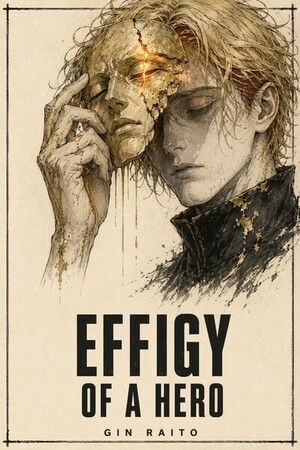
Effigy Of A Hero
⚜ ─── ✦ ─── ❮ ─── ✦ ─── ⚜
There were hours, in the grey before the bells, when no one came for him, and these were the hardest hours, though he would not have known to call them hard.
In the rites there were eyes, and the eyes held him together. A hand lifted because they watched it lift. A face arranged itself because there were faces to meet it. He was good at being watched. Being watched was the whole of what he was good at, and under it he was whole, he was a shape, he was the Hero, and the shape held.
Here there were no eyes.
He sat in the cold light of the chamber, and there was no one to be for, and without anyone to be for, the shape began to come loose at its edges. The stillness went down past the floor of itself, into the place with no bottom, and he went down with it. The hands lay in the lap. They were a man’s hands, pale, open, still, and he regarded them the way he might have regarded something left on a table by someone who had gone. Far off, the body breathed, in and out, doing the thing bodies did without being asked. Somewhere there was meant to be a person at the centre of it, sitting in the chair, feeling the cold come up through the stone, and he reached toward where the person should have been the way a hand reaches in the dark for a wall it knows is there.
And found no wall.
There was the chair, and the grey light, and the hands, and the breathing, and the cold. There was the reaching. But there was no one at the centre of it for the reaching to reach. No one home. Only a room with all its furniture in it and nobody living there. It should have frightened him, and somewhere far under the no-bottom it did, a thin animal alarm with nothing left to fasten itself to.
His hand found the chain.
His fingers closed on the worn iron before any decision reached them, the way they always did when the quiet got in, and the cold of the metal was a small hard certain thing. The something at the centre that had not been there a moment before crept toward the certainty of it like a cold creature toward warmth. He held on. The shape gathered itself again around the holding. He was a man holding a chain in a grey room, and it was enough to be going on with. He could not have said why the iron helped where the gold did not. The gold filled him and left nothing behind it; the iron was only cold, and only his, and somehow the only-his was the part that held. He did not ask. Asking was hunger. He held the chain until the bells rang, and when the day came to find him he let go, and rose, and the eyes of the world fell on him and held him together, and the Hero stood up out of the chair where, for a little while, there had been no one at all.
⚜ ─── ❖ ─── ⚜
There was an old woman who tended the lamps in the east passage.
He did not know her name. He had passed her ten thousand times, a small bent shape in grey wool, working her way along the brackets at the edge of his days with a taper in one hand and a rag in the other and had never once spoken to her, because the Hero did not speak to the women who tended lamps. She was older than anyone he could bring to mind. Her back had long since given up its argument with the years and folded her toward the floor, so that she did the low brackets easily and reached the high ones with a long brass snuffer she carried for the purpose.
This morning her hands had stopped working.
He saw it sidelong, without deciding to, the way he had seen the boy in the square. She stood at a wall-bracket with the taper shivering in her grip, and her hands had gone the blue-white of the dawn outside the windows, the knuckles swollen and stiff, and they shook too badly to hold the small flame steady to the wick. She tried. She missed. She tried again, with the flat patience of a person who has nowhere warmer to go and knows it. The cold had got down into the deep of her, into the bone, where a body cannot fetch it back out alone. He knew that kind of cold on sight. He could not have told you how.
Something in him moved toward her before the rest of him could account for it.
“Your hands,” he said.
She startled so hard the taper nearly went out, and turned, and saw who it was that had spoken to her, and what little colour she had left drained out of her face. “My lord. Forgive me, I’ll be done in a moment, I didn’t mean to be in your…”
“Give me your hands,” he said.
She gave them, because he was the Hero and you did not refuse the Hero, and her hands in his were like two cold birds, and he closed his own around them.
He did not reach for the iron stillness now. He reached for the other thing, the deep thing, the one with no name because a man does not name his own hands. There was no strike in it and no lifting, no blade, no enemy, no square full of faces. Only the drawing-up, quiet and close, through the palms, the most inward way of all, the one he had never been taught and had never needed teaching.
It came up out of somewhere under the ribs and broke over him all at once.
It did not hurt. Nothing that good could hurt. It poured up and out and filled him as it went, flooding every hollow place faster than he could have named them, and the grey morning went bright and the cold went far away and the bottomless quiet that had waited under everything was suddenly, gloriously, full. The static stopped. The watching stopped. For as long as it lasted there was no shape to hold together and no distance to manage and no one missing from the centre of him, because there was no centre now and no edges, only the roar of it in the blood and the unbearable brightness and the one clean moment in the whole grey day when he did not feel like a thing wearing the shape of a man but simply, finally, like someone. Like he was here. Like the chair in the empty room had a person in it after all.
The gold went out through his hands and into hers. He held the old woman’s frozen fingers and poured it into them, and he could have wept from the sheer relief of it, the relief of being, for a few seconds, somebody. The blue went out of her knuckles. The shaking stopped. Her hands came back to life inside his.
And then, the way it always did, it began to ebb. It always began to ebb. And the only thing in all the world that could call it back was to spend more.
He felt the loss of it like a door drawing shut somewhere inside him. He looked at her face to find the warmth he had given reflected back in it.
Her face was white.
She was staring at their joined hands, her mouth fallen open, her eyes wet, and she had stopped breathing, and she was looking at him the way you look at a thing that should not be, the way the boy in the square had looked up into the falling roar. She had burned once herself, fifty years gone, on the worst night of her life, when the fever took her firstborn and the physician folded his hands and gave up. She had gathered the child against her and burned for him, not knowing how, knowing only that she would give anything she had if it would keep him. The burning had answered. He had lived. She had never gone near it again, not once in fifty years, because she had felt in the giving how much it asked, more than a body should ever be asked, more than she had known she had in her to give and the cost of it had frightened her every day since, though she could not have told you in what coin it had been paid. She knew only that the burning took, and took deep, and gave nothing back. And here was the Hero reaching down into it, smiling, to warm an old woman’s hands.
Aurelian, the high still ebbing bright in him, looked at her white face and her wet eyes and read them the way the burning let him read everything.
Awe, he thought. He had given her warmth and she was overcome by it. The gladness of having been kind folded into the last of the gladness of the burn, and he let go of her hands gently, the way Castor let go of his face.
“There,” he said. “Better.”
She drew her hands back and pressed them to her chest as though he had burned her, nodding fast and frightened, already backing toward the wall. “Thank you, my lord. Bless you. Thank you.” And she went, quickly, the taper left where it had fallen, her footsteps very fast on the stone.
He watched her go and felt only the lovely warmth of having been good.
He bent and picked up the fallen taper and set it back in its bracket. His hand, when he held it up to the grey light, had gone a shade paler than it had been. He did not notice. The change came on so slowly, over so many small kindnesses, that he had never once caught it in the act. He felt the gold still warm in him, and the morning still good, and the certainty, sure as the liturgy, that he had done a kind thing and been seen to do it.
Somewhere underneath, in the place where for a little while that morning there had been no one at all, the something that had reached for the chain stirred once, as though it had seen her face more clearly than he had…
He set it down. The bells were ringing. The day had come to find him, and he went to meet it, and his hand was a shade paler, and he did not look back.





Please sign in to leave a comment.