Chapter 3:
Sepulture
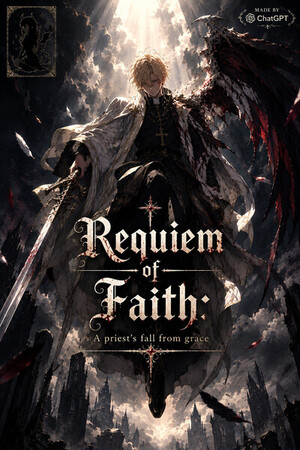
Requiem of Faith : A priest's fall from grace
It is love that binds her subjects,
and she says that to love is to respect,
and to love is to obey.
Those who love are those who suffer.
—Illises' Book of Devotion
I used to want the whole world. Deserts, mountains, cities I couldn't pronounce the names of. I used to lie awake as a boy and think about all the places my mother's book described, and promise myself I'd see every one of them.
That promise died quietly, the way most childhood promises do—not with an argument, but with a hand on my shoulder and a voice telling me holy power doesn't ask what you wanted to be. It tells you what you are now.
I didn't fight it. I was happy, even. My father wasn't.
I never understood the look on his face the day I told him I'd accepted the church's calling. I understood it even less the day he left and never came back.
The village raised me instead. The orphanage. The old couple who never stopped teasing me for being an idiot. I told myself I hadn't lost anything by staying—that I'd traded one kind of home for another, and the trade was fair.
I believed that all the way up until the day I came back to find it ravaged by satanic beasts.
I stood by the small tree at the edge of what used to be the orphanage, and understood, in the particular way you understand things you've been dreading, exactly what had happened here.
Everyone was crying. Uncle knelt in the dirt where Aunty had died, the two of them finally, terribly, no longer arguing about marriage. The building where I'd spent every year of my adolescence was bloodied.
A man I half-recognized grabbed my collar before I'd even fully processed the smoke.
"Where were you?"
"I went to get Sister back. She was taken."
"You should have been here."
I had no argument for that. I still don't.
I looked for the hooded man's pregnant wife among the survivors, some half-formed idea that she might still be findable, still be something I could fix. She wasn't there. Maybe she'd never intended to be. Maybe she'd left the moment her part was finished.
The dead needed graves, and the living needed something to do with their hands, so I organized both. Some stayed to dig. Others packed what they could carry and left without looking back, and I understood that too well to blame a single one of them.
I tried, anyway, to give them a sermon. I'm not sure who I was really speaking to.
"The end of the body isn't the end," I said. "They'll be reborn as warriors of Aegis. There's still hope—"
"ARE YOU SERIOUS RIGHT NOW?"
A boy. I didn't know his name, only that he'd lost his mother sometime in the last few hours, the same way everyone here had lost someone.
"Look around you. Everything's gone. My mother's dead. People left because there's nothing here anymore, and you're standing there talking about hope?"
I had nothing. Not because I didn't understand his anger—because I agreed with it completely, and had no idea how to say that from the pulpit.
Later, once the service had emptied out, I went to kneel at Father Lucian's grave. I didn't have a sermon left in me for him. Just the truth.
"I couldn't save her," I said. "I was weak. I couldn't get the scroll back either. How am I supposed to lead a village that doesn't exist anymore?"
"Even hell can comfort you, give you solace, if you are with the right people"
I looked up. A tall man was crossing the graveyard toward me, tired-eyed but smiling in a way that suggested the tiredness was old news to him.
"Sorry," I said. "Was that a quote?"
"Might've been. Might be one I made up. Honestly can't remember." He didn't slow down. "I'm Koyomi. I work under Dr. Dirk, Institute of Warssuherst."
He offered a hand. I didn't take it.
"A man of science, out here."
I didn't bother softening the disdain in my voice. Science, to me, has always felt like a discipline built on the refusal to let anything rest.
"I'll skip the pleasantries, then," Koyomi said, entirely unbothered, glancing past me at the ruins. "I'm here about the beasts that hit this village. You know why they came, I take it?"
"Because I wasn't here to stop them."
"Not quite."
There was no pity in how he said it. I got the sense he'd stood in front of exactly this kind of wreckage before, more than once.
"Your church wasn't just a place to pray," he said. "It's a beacon. It draws mana, converts it into holy magic, and that magic forms a barrier around the whole village. That's why it sits at the center. Always does."
He looked at me directly for the first time.
"The bandits took something from inside it, didn't they?"
"...Yes."
"Then they took mana stones. And burning the building down would've destroyed the runes holding the barrier's circle together." He frowned slightly, like a piece wasn't fitting. "What I can't explain is why the beasts specifically targeted this village to begin with. That's not standard behavior."
"Would it have anything to do with an old scroll we kept here?"
I hadn't meant to say it. It slipped out—some instinct that this man, whatever he was, might actually know something useful.
"Never heard of a scroll like that," he said, though something in his expression didn't quite match the words. "Can't rule it out, though."
He checked a watch on his wrist and made a small, apologetic sound.
"Ah—time. I've got another village to reach before dark. I'll just take a few samples from the beast remains and be on my way."
"It was good to meet you, Mr.—"
"Placidus."
"Father Placidus, then. If you ever find yourself in Fittoria, the Institute's doors are open." He was already turning to go. "No Inquisitors here, I notice."
"...I'm sorry?"
"Aren't they meant to reestablish a church after something like this?"
I had no idea. Nobody had told me anything about how this was supposed to go.
"Well. Good day, Father." And then he was gone, unhurried, like the ruins behind him were an interesting footnote rather than a tragedy.
By the time I turned back toward what was left of the village, most of the others had already begun to leave. There was nothing left here for me to stay for either—no church, no congregation, no father, no home. Only a road toward the city, and the vague, unformed idea that the Inquisitors owed this place an explanation.
The sun was going down again, painting the same gold and crimson it always did, indifferent to how much had changed since the last time I'd watched it fall.
Near the tree, a small silhouette waited. No taller than my shoulder. No older, from the shape of her, than twelve.
"I take it," she said, without turning around, "that you've already forgotten your vow."
I knew exactly who this was.





Please sign in to leave a comment.