Chapter 7:
Curve 7. The Secret Society of the Pythagorean Order and the Pentagram Symbolism
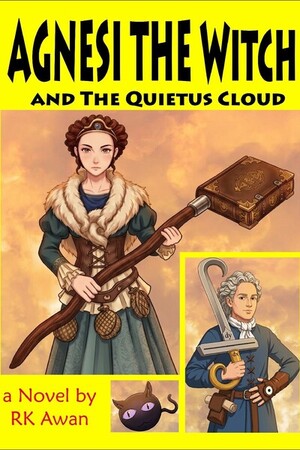
Agnesi the Witch and the Quietus Cloud
What Nuvolo Ardito Figliuoli said was true: the Pythagorean Order, the group that contributed to the discovery of Aecte and Aecte Arts, was indeed a secret society.
In response to Nuvolo's question, Agnesi Maria Caetana explained the group's previously hidden history. "It all started with Pythagoras, the Magister Matheseos, who founded the group," Agnesi said.
Agnesi then took a sip of a mixture of cold water and pomegranates from her Vin Cotto. Then the girl continued her explanation, "Pythagoras founded the group by creating certain rules that were binding for anyone who wanted to become a member of the group. Candidates for membership could be introduced by someone who was already a member of the Pythagorean Order, or they could come to the Order themselves after hearing about Pythagoras's reputation and that of the Order."
Nuvolo asked, “What kind of specific rules are those, Miss Agnesi?"
Agnesi replied, "I can say that, in general, the rules are: the Oath of Secrecy, the initiation and strict hierarchy, the communal and exclusive lifestyle that the group members must adhere to, and the special symbols that they must carry."
Nuvolo gave Agnesi the instruction, "Miss Agnesi, please elaborate on the points you have mentioned."
"Okay," Agnesi replied spontaneously, "first, the Oath of Secrecy. Members of the Pythagorean Order swore an oath that bound them not to divulge their teachings to the exoterikoi. Exoterikoi were people who were not part of their group. These teachings included, among others, philosophical-mystical knowledge, physikoi or natural sciences, mathematics, and of course knowledge and experiments on Aecte and Aecte Arts."
Nuvolo commented and asked, “That’s right, Miss Agnesi. Do you know how the oath is worded?”
Agnesi replied, “The oath I remember from the source named Carmen Auerum, or Golden Verses, is something like this: By the Tetraktys transmitted to our souls—the eternally flowing source of nature.”
Nuvolo commented and asked, "That's right, Miss Agnesi. We can't discuss what the Tetraktys is at this point. Now please elaborate on the second point you mentioned, namely the existence of initiation and a strict hierarchy."
Agnesi answered without hesitation, "As a secret society, of course not just anyone can be accepted as a full member of the Pythagorean Order. Prospective members must go through a probation period. During this period, they must undergo emotional stability and personality tests."
Nuvolo praised her and asked, “That’s a good explanation, Miss Agnesi. What will the prospective member face next?”
Agnesi replied, “They had to go through a silent period that lasted for years. Some sources say this period lasted two, three, or five years.”
Nuvolo commented, "Well, what is the silent period related to?"
Agnesi immediately grasped the direction of Nuvolo's question by answering, "That would be related to the division of factions or classes within their internal circles, among fellow members of the Pythagorean Order. There were two factions within the secret society, namely the Akustikoi and the Mathematikoi."
Nuvolo commented and instructed, "That's right. Let Miss Caetana describe what the two groups are like."
Agnesi spontaneously answered, "Akustikoi were intended for members who were only allowed to hear or accept the dogma of Pythagoras' teachings. While Mathematikoi can be said to have been a circle within the Pythagorean Order, it was intended for people who were considered to have fully obtained the secret sciences and who discussed and developed those secrets. Later, it was discovered that one of these secret sciences concerned Aecte and Aecte Arts."
"Exactly, Miss Caetana. Before you ask whether you need to discuss the connection between the two factions and the current Magoi rankings, I would like you to first explain the communal and exclusive lifestyle that the members of the group must adhere to, as well as the special symbols they must carry," Nuvolo commented as if he knew what Agnesi was thinking.
Agnesi answered without thinking for long, "Speaking about the lifestyle of the members of the Pythagorean Order, they live in a communal environment that I think could be described as a beehive or an anthill."
Spontaneously, Nuvolo asked, “Oh, bees or ants?”
Agnesi immediately explained her thoughts, "The Pythagoreans lived together in closed, monastery-like communities and shared possessions. I think of it as bees and ants living together in a closed environment and sharing their food. Furthermore, the existence of the Akustikoi and Mathematikoi reminds me of the division of roles in an ant colony, although the context is arguably different."
Nuvolo commented and asked, “I think the Pythagoreans as bees and ants is an apt analogy, Miss Caetana. Is there anything else you would like to say about the communal life of the Pythagorean Order?”
Agnesi replied, "The Pythagorean Order enforced strict dietary rules for its members. They ate foods that differed from those commonly eaten in Hellenika culture; for example, they abstained from meat and legumes."
Agnesi referred back to her conversation about Pythagorean vegetarianism: “We also discussed contemporary views on whether a vegetarian diet affects Aecte levels and Aecte Arts skills. I think Mr. Figliuoli would suggest I discuss the special symbols they carry, correct?”
Nuvolo answered briefly, “Yes.”
Agnesi continued, explaining what she had learned spontaneously: "The Pythagorean Order has special identifying marks that allowed its members to recognize one another when they were outside their community. One of these marks is the pentagram, or five-pointed star. The pentagram itself, for the Pythagorean Order, is a symbol of health and harmony."
Nuvolo made a request: “Miss Agnesi, please explain further about the Pentagram as a symbol of health and harmony.”
“The Pythagoreans called the pentagram 'Hugieia,' meaning 'health.' The pentagram, as a symbol of health, not only represented physical health but also encompassed wholeness or soundness in the sense of wholeness, well-being, and perfection. The Pythagoreans also used the word 'Hugiaine,' meaning 'Be healthy!' as a greeting among fellow members,” Agnesi answered fluently.
Nuvolo commented and made a request, “Yes, Miss Agnesi. Then try talking about the pentagram as a symbol of harmony with the last part of Miss Agnesi’s sentence mentioning aether, because we will be talking about aether next.”
Agnesi thought for about three seconds before answering Nuvolo's question, then said, "Very well, Mr. Figliuoli. The pentagram is formed from a regular pentagon, which contains the golden ratio, a proportion considered by the Pythagorean Order to be the most harmonious. The pentagram's lines are unbroken from the starting point back to the starting point, and they interlock, which can symbolize unity and balance."
Agnesi then took a sip of a mixture of cold water and pomegranates from her Vin Cotto. The girl then continued her explanation, "Because the pentagram has five lines, the Pythagorean Order associated it with the number five, which represents the five elements: the four classical elements of water, earth, air, and fire, and one other element, aether."
After uttering her final sentence, Agnesi stopped talking. Nuvolo then commented and praised, “There you have it, aether. Miss Agnesi can plan her sentences around mentioning aether at the end.”
“Thank you,” said Agnesi in response to her private tutor’s praise.
Nuvolo said, “Now, let’s talk about how the Pythagorean secrets, including the Pythagorean Order’s experiments on Aecte and Aecte Arts, were revealed to the public.”





Please sign in to leave a comment.