Chapter 10:
Curve 10. The Research and the Rummage of Aecte and Aecte Arts; Anagnorisma, the Infant of the Magoi ID and Weapon
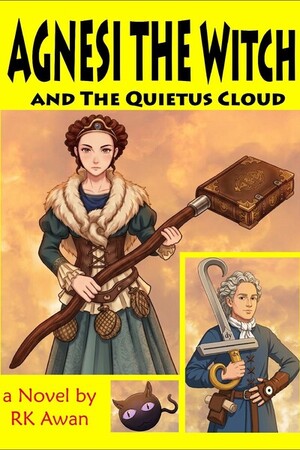
Agnesi the Witch and the Quietus Cloud
Agnesi Maria Caetana responded to Nuvolo Ardito Figliuoli's question with a lengthy reply, "Well, I will discuss what happened after the members of the Pythagorean Order were reinstated by the rulers and citizens of the polis. In the early days, the Pythagorean Order gained a large number of new members, and these new members, of course, obeyed the conditions of membership."
Nuvolo commented, “That's right, Miss Caetana.”
Agnesi continued, explaining, "This strengthened the position of the Pythagorean Order. As a result, research into Aecte and Aecte Arts developed even more rapidly. In terms of quality and quantity, the research progress resembled an exponential curve."
Nuvolo commented, "That's how history goes. Then, Miss Caetana?"
Agnesi replied, "After that, the Pythagorean Order eventually developed into various branches, various schools of thought. Some groups say that to be a Pythagorean, one must adhere rigidly to all Pythagorean teachings and ideas. Others say the main essence of Pythagoreanism is learning, and in the process of learning we can sometimes discover new things and we also have to learn and think about how we should respond to these new things."
Nuvolo commented at length, “That’s it. That’s right, Miss Caetana. One of those new things is something we’ve already discussed, namely, how vegetarianism influenced Aecte and Aecte Arts. Ultimately, over the next hundreds of years, Pythagoreanism evolved into many different forms. Schisms occurred in various eras. Each group could claim to be the closest to the first Pythagorean Order, whether literally, essentially, or in any other way.”
Agnesi responded to Nuvolo's comments by saying, "In the end, the various Pythagorean groups came to be called 'Pythagoreanic.' And the term "Pythagoreanic" became a generic term for "Magoi who developed Aecte and Aecte Arts," regardless of the Magoi's background or affiliation."
Nuvolo nodded his head, indicating that there was absolutely no mistake in Agnesi's explanation. Nuvolo then asked, "Is there anything else Miss Agnesi would like to say regarding the development of Aecte and Aecte Arts?"
Agnesi replied without thinking, "As I said before, Mr. Figliuoli, research on Aecte and Aecte Arts has increased exponentially in both quality and quantity. This, of course, makes some of the research seem erratic, haphazard, without rationalization, and without proper calculation."
Nuvolo said, “I agree with that. Sometimes there's something cult-like about the research process of Aecte and Aecte Arts.”
Agnesi expressed her opinion, “We can call that research 'the rummage.' But of course there is also the research that deserves to be called 'the research,' research that is actually research.”
“Right,” Nuvolo commented briefly.
Agnesi continued, explaining, "Ultimately, Pythagorean research led to many things that are used or have become standards in the world today. One of these is the division of the Magoi into three broad classes: Akustikoi, Epodoi, and Mathematikoi. These three classes were inspired by two classes within the original Pythagorean Order."
"That's right," Nuvolo answered briefly.
Agnesi continued her discussion, "Initially, Magoi were divided into two groups, similar to the division of groups in the original Pythagorean Order community, namely Akustikoi and Mathematikoi. Akustikoi were Magoi whose magic was inaccurate, while Mathematikoi were Magoi who could perform magic or Aecte Arts without chanting. However, thanks to various studies, it was discovered that there were people who could be included in the Epodoi group."
Nuvolo commented at length, "One example of an Epodoi is me. I should say that I can create an Aecte manifestation, for example, in the form of fire or earth, shaped like a tube or cone, and so on. At eight years old, Miss Caetana is still considered an Epodoi, but I am sure that Miss Caetana can reach the level of Mathematikoi in no time."
Suddenly, the maid beside Agnesi commented, "I agree. Miss Agnesi is indeed talented and always studies and practices diligently."
The maid's words made Nuvolo look at her. However, Nuvolo chose not to respond to the maid, instead speaking directly to Agnesi, "Alright, Miss Caetana, speaking of the research findings on Aecte and Aecte Arts that humanity has conducted, is there anything else you would like to share based on what you remember?"
"Yes, Mr. Figliuoli," Agnesi replied spontaneously, "I want to talk about 'anagnorisma.'"
The "anagnorisma" that Agnesi refers to is a tool that was in use in the modern world at that time. The name of the tool comes from a combination of two Hellenic words, namely 'anagnorisis' and 'gnorisma.' The meaning of the word "anagnorisis" is "recognition, recognition of identity, recognition of truth, disclosure, or recognition of something previously unknown." Meanwhile, "gnorisma" means "distinguishing mark, sign, token, or identifying characteristic."
So, it can be concluded that the term "anagnorisma" refers to a unique tool owned by a person that can be used as an identifier. It's important to note that an anagnorisma includes more than just the owner's name, along with other personal details such as date and place of birth, father's and mother's names, and so on.
Since one of the meanings of 'anagnorisis' is recognition of truth and the revelation or recognition of something previously unknown, this tool is clearly not an identity-recognition and recording tool that simply records a person's profile. It relates to something unique that is also found in the world: a person's Aecte and Aecte Arts.
An anagnorisma is a tool that has another name, 'right triangle windmill. ' This is because the shape of an anagnorisma is a combination of a right triangle in the middle and three squares attached to each of the three sides of the right triangle. This shape is the same as the shape that is none other than the geometric shape of Euclid's 47th Proposition. In mathematics, another name for Euclid's 47th Proposition is none other than the 'Pythagorean Theorem.'
The anagnorisma tool is inspired by the pentagram symbol used by members of the original Pythagorean Order. The reason the shape was chosen not as a pentagram but as Euclid's 47th Proposition, or the Pythagorean Theorem, is the result of hundreds of years of Pythagorean experimentation. This shape has proven effective in "translating" the Aecte and Aecte Arts of each individual owner of the tool.
What does it mean that "anagnorisma can translate one's power"? It can transform into a tool or weapon that suits each person's Aecte and Aecte Arts. For example, someone who diligently trains and has high Aecte and archery skills can transform their anagnorisma into a bow. Someone who practices sword fighting can transform their anagnorisma into a sword.
Anagnorismas adapt to each individual's strength. For example, if a person lacks sufficient strength to possess more than one anagnorismas, only one will function, leaving the others as mere decorations. In this case, only the functional one can change shape and aid the person in creating various Aecte Arts or magical manifestations.
Various studies have shown that an anagnorisma functions better if the umbilical cord that connected the baby to its mother in the womb is kept inside the anagnorisma after the baby is born. This is why babies' umbilical cords are carefully protected, including those of Pietro Fortunato Catana and Anna Maria Caetana, who placed the umbilical cords of Agnesi and her sister in a special place.
Anagnorisma itself is only granted once per person. By default, it is given to someone who has reached the age of fifteen. If the weapon or tool resulting from the evolution of the anagnorisma is damaged or destroyed, the person can request a new one.
The majority of Magoi in the world today can only have one anagnorisma, and most of them attain it by the age of fifteen. However, outliers do exist. There are those who attain an anagnorisma before the age of fifteen, as well as those who possess more than one.
Nuvolo had once stated to his private protégé, “Miss Caetana, you will likely be one of the outliers. I think you will have more than two anagnorismas, and you will have one of them before you turn fifteen.”





Please sign in to leave a comment.