Chapter 11:
Chapter 11: Silicon Evolution
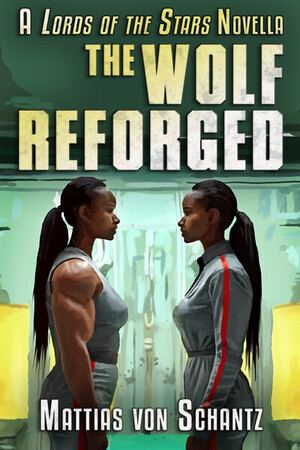
The Wolf Reforged
May 12, 2182 AD, Sunguard Headquarters, Europa, Jupiter, Solaris system
Sitting down at a small, round glass table beside the large windows overlooking the icy plains below, she casually nibbled on the still-warm Danish she had just bought. The aroma of freshly ground coffee beans hung in the air around her like a cozy cloud.
Gazing out the windows, she lifted her cup and took a deep sip of the dark, bitter liquid she craved. Outside, ships came and went as she munched on her pastry. Most were scout ships or transport vessels. Near the far edge of her vision, on Landing Field 7, a Sunguard War Cruiser had even landed, as though daring to defy Europa’s gravity while it underwent retrofitting for some future mission.
Elizabeth Mbenge had arrived at Sunguard Headquarters two hours earlier and had immediately requested a room at the billet, mostly so she could sleep and store her personal belongings. Whenever she visited Headquarters, she preferred to be out and about, observing and talking to the officers and soldiers working there, or just passing through.
These were the people who looked to her for guidance, the people to whom she had dedicated her life. She didn’t want to make decisions that affected them from a distance, so whenever she had the opportunity, she tried to mingle with them.
She had just finished her Danish when a hoarse voice behind her offered a cheerful greeting.
“Elizabeth! I didn’t know you were on Europa!”
As she turned around, a tall, muscular man in his mid-sixties, wearing a Special Agent’s uniform paired with a slightly askew gray fedora, entered the coffee shop. He had a faint limp, mirroring her own. While the growth hormones she had been injected with had accelerated her healing, and the nanobots that followed had guided the growing tissue so that no scars remained, the process wasn’t magic. She still felt the occasional spike of pain whenever she put weight on her left leg.
“Mikhail! What are you doing here?”
He pulled out a chair and sat at her table, facing her at a ninety-degree angle so that he, too, could watch the steady coming and going of the vessels outside. Careful not to spill her coffee, he set his fedora down next to her cup.
“Same as you, I’d wager,” he said, huffing a little. “Let me guess. You were pulled off Gloria on short notice for some hush-hush meeting with Solar Command today, and you have no idea what it’s all about.”
Elizabeth chuckled. “Yeah, that’s pretty much it. I don’t think it’s a coincidence that both the Special Agent in charge of Jerr and the one in charge of Gloria were brought to Headquarters on the same day. Something’s going on.”
Mikhail nodded. “Something serious, I have to assume.”
He wasn’t wrong about that, she thought. While she had only recently been given broader responsibilities on Gloria and didn’t consider herself vital to Sunguard’s operations there yet, Special Agent Johnson was in charge of a planet in the middle of a terrorist insurgency. Pulling him away from Jerr when he should have been out there fighting the JLF was not something Solar Command would do unless they believed it was absolutely necessary.
“I’ll go out on a limb and say it has something to do with Stoltz,” he continued. “Sorry about that, by the way. It can’t have been easy for you.”
“It can’t have been easy for any of us,” she corrected. “Including you. I didn’t know him that well. Clearly. But he was still a Special Agent, and what he did reflects on all of us.”
Mikhail swore. “Yeah. That scares me.”
She took another sip of her coffee. “Why is that, specifically?”
He didn’t reply. For several long seconds, he simply stared at the star-filled sky beyond the windows without saying a word. When he finally spoke, his voice was utterly serious.
“I fear this is the beginning of the end.”
“For the Special Agents?” she asked.
“No. For the Terran Federation.”
For a moment, neither of them spoke. They simply stared at one another. She knew Mikhail wouldn’t say something like that unless he meant it. They both held the same position within the Sunguard, but the other man was, without question, both older and more experienced than she was. When Mikhail spoke, she listened.
“Look,” he continued, “the Federation is not without its flaws. We are four completely distinct species, essentially held together by historical necessity and glue. And that glue is the Special Agent Corps. We’re supposed to be the mediators standing between the four races. If we fall, if the citizens no longer trust us, we can’t continue to serve in that capacity. The glue will rot away, and without it, the Terran Federation will fall as well.
“You don’t think this is apocalyptic? Think again, Elizabeth. Stoltz was a Special Agent. He could have requested a million soldiers and sent them to occupy Etar. He could have carpeted Kelar with space bombs. He could have ordered War Cruisers to lay down GDAPC fire on the streets of Jerr. He had that authority. We should count ourselves lucky he used it only to get high, not to commit mass atrocities.”
“If he had, Solar Command would have countermanded him. So would we.”
“Right,” Mikhail said, his face ashen. “But what do you think the fallout from that would have been? The damage to the trust between the four races? To their trust in us? In the Special Agents and in the Terran Federation?”
“So that’s what you think this meeting is about? Finding a way to save face?”
He shook his head. “No. Solar Command isn’t some PR firm. They’re not just trying to make us look good. Whatever we’re here for, it’s something real. They’re good people. I trust High Admiral O’Sullivan with my life.”
She glanced at the clock on the wall. “Well, we’re due in the War Room in ten minutes. I guess we’ll know soon enough.”
“Really?” he said, raising an eyebrow and smiling faintly across the table. “I haven’t been given an appointment with them yet. I was only asked to stand by for one. I guess we weren’t called here for the same meeting, after all.”
She shrugged. “Maybe not. Who knows? Let’s compare notes afterward.”
“Of course,” Mikhail said as he rose from his chair, picked up his fedora, and placed it back on his graying head. “We’ll stay in touch.”
He left her wondering what the future held for her beloved Federation. Ten minutes later, when she stepped through the wide, ornamented doors of the War Room and walked to stand in the center of the enormous mosaic of the Sunguard emblem that covered its polished floor, facing the admirals of Solar Command, the knot that had formed in her stomach left her feeling slightly queasy. Whether that simply was because she was nervous about meeting the highest leadership of the Sunguard or because of the grim predictions Mikhail had just shared with her, she did not know.
“Welcome, Special Agent Mbenge,” High Admiral O’Sullivan, Supreme Commander of the Sunguard, said, opening the meeting. “It is a pleasure to have you here. Let me begin by congratulating you on your successful apprehension of former Special Agent Stoltz and the rescue of the hostage he took. Despite the awful circumstances, you saved lives that day. You showed the citizens of the Terran Federation what it truly means to be a Special Agent.”
“Thank you, ma’am. But I must point out that the hostage survived through sheer luck. I missed my intended shot. She and Stoltz could have died. The emergency response team deserves more credit than I do.”
High Admiral O’Sullivan studied her for a moment.
“They have my sincere gratitude. But weighing the Sunguard doctrines against one another is never easy, yet you performed exemplarily. You completed your mission without anyone, civilian or hostile, losing their life. That is all anyone can expect of you.
“With that said, the Sunguard is now facing a problem that we believe you are uniquely qualified to help us solve. Admiral Umansky, would you care to explain?”
The small, red-haired woman leaned forward over the desk behind which the twelve admirals sat. She looked at Elizabeth Mbenge with steel in her eyes.
“The Special Agent program has failed. Despite what High Admiral O’Sullivan just said—and I mean no disrespect here, Special Agent Mbenge—the events surrounding Eric Stoltz’s downfall prove that we cannot trust the Special Agents to always have the best interests of the citizens of the Terran Federation at heart.
“For more than a century, we have sent our Special Agents on missions no one else could perform. We have given them the finest training and the best resources available, sparing no expense. To support them and allow them to operate independently across interstellar distances throughout the worlds of the Terran Federation without having to defer to bureaucracy, we have entrusted them with immense, almost unchecked authority.
“That level of authority demanded a level of trust we should never have placed in you.”
Special Agent Mbenge met Command Admiral Umansky’s gaze.
“With all due respect, ma’am, I disagree. Eric Stoltz failed, absolutely. That means, by extension, that the Special Agent program failed, too. I agree with that. But the idea, the very concept of a Special Agent, did not fail.”
She thought of what Mikhail had just told her. The Terran Federation simply could not afford to lose the Special Agents. The consequences could be world-ending.
“I would argue that we are still needed. We perform an essential service that no one else can provide.”
Jacob Tsai, a soft-spoken admiral in his early eighties, cleared his throat.
“You are absolutely right, Special Agent Mbenge,” he said, gesturing toward the other admirals seated beside him. “All of us agree with that. Unfortunately, that leaves us in something of a bind. We have seen with our own eyes how dangerous it can be to entrust a man with the authority we gave Eric Stoltz. He gambled, he succumbed to drug abuse, he became indebted to the criminal underworld, and we condemn him for all of it. But while the specific things he did are beyond excuse, in general, this is the human condition. Who among us can honestly say we have never done anything wrong? We all fail, one way or another. It is only a question of scale.”
“And if that is true,” he continued, “then there is no one among us whom we can truly trust with the immense power and authority of a Sunguard Special Agent. Not even you, Special Agent Mbenge. Stoltz did not begin as a villain. For decades, he served the people of the Terran Federation faithfully. But things happened. Something small snowballed into a disaster.
“Do not take this the wrong way, Special Agent, but who is to say something similar will not happen to you tomorrow?”
She had no answer to that, at least not an honest one. She was only thirty-six years old, but she had already seen enough to know Command Admiral Tsai was right. Even if most of them never fell the way Stoltz had, every one of them possessed the capacity to do so.
“I understand what you are saying, Admiral. What is your solution?”
“In the wake of the Stoltz crisis, Sunguard Research and Development has approached Solar Command with an interesting proposal. Are you familiar with the work of Dr. Tarfel tot mascham, Special Agent?”
Mbenge thought for a moment.
“The name sounds familiar, but I am afraid I cannot place it. What is her field of research?”
“She is a computer scientist,” Tsai explained. “More specifically, she has made a name for herself in the field of biomimetic robotics—biotics, for short. For the past thirty years, she has been one of our leading scientists working to improve our intelligent computers. She has mainly been working on shrinking the size of the self-replicating computer chips from which they are built. That is, their biotic cells.
“As you know, an intelligent computer is essentially a replica of a human brain built from artificial neurons. Terran brains, to be specific, as this technology was invented before we met the Etarians. When the first biotic brains were constructed, the scientists working on them realized that building one from scratch was practically impossible. The sheer number of neurons and synaptic connections in a human brain was simply too great. Worse still, even the slightest error in the immense codebase required to guide their growth would produce an intelligent computer suffering from what was, for all practical purposes, brain damage.
“So those early scientists decided not to reinvent the wheel. The code required to grow a human-level intelligence already existed within every human cell. Rather than writing millions upon millions of lines of code by hand from scratch and hoping they got everything right, they created a translation layer, a piece of software that extracted the relevant portions of the human genome and translated them into the corresponding biotic code.
“The details are not especially relevant to our discussion today, but I understand it was not as simple as just translating base pairs into ones and zeros. Biotic cells are microchips executing sequential, Turing-complete machine code, whereas biological chromosomes effectively execute their instructions in parallel through complex interactions between activated and inhibited genes. I am sure Dr. tot mascham can explain in more depth if you are interested.”
“The point, though, is that the machine intelligences they grew were, for all practical purposes, artificial human minds. Artificial life. Just like biological humans, our intelligent computers possess genuine emotions, creativity, free will, and everything else that makes us who we are. They are conscious persons. Some of us who are people of faith, myself included, would even say they have souls. They may be made of biotic microchips instead of biological cells, but they are still alive.
“There is one crucial difference between them and us, though. Because their code is digital rather than chemically encoded in deoxyribonucleic acid, as our Terran genes are, modifying the code that guides the growth of a biotic brain is comparatively trivial next to gene-editing a biological human. That made it easy for us to suppress certain aspects of the human brain that we neither needed nor wanted in our intelligent computers, such as jealousy, greed, and prejudice. It also allowed us to add entirely new regions to their brains that have no biological counterpart, such as communications and math cortices, giving them mental capabilities no human could ever possess.
“Now let me be clear. Suppressing these darker instincts was not a process scientists invented out of thin air. The human brain already has that same capacity. Children do not care whether the person they are talking to is rich or poor. They care nothing about race. They simply see people. All those early scientists did was preserve that worldview as the intelligent computers’ brains matured.
“Combined with the speed at which an electronic brain operates, along with the resilience of a solid-state biotic cell compared to the soft, water-filled biological cells that make up our own bodies, it is easy to see why the invention of the biotic intelligent computer revolutionized our society. For a century, they have been an integral part of the Terran Federation. Time and again, they have proven that they can be trusted in ways no biological human ever can. Without greed, they are essentially incorruptible. Being made of silicon, iron, copper, and titanium, they cannot become addicted to chemicals or be afflicted by disease. Created separately from biological humanity, grown in vats instead of being born into a culture or species, they take no sides. They see no distinction between the four races. To an intelligent computer, they are all simply human. They do not care whether you are rich or poor, famous or unknown, because such things hold no interest for them.
“Now imagine, as Dr. tot mascham has done, that instead of growing only an artificial brain based on translated human genes, we grow an entire body. It is, of course, an immensely more complicated undertaking, but she has assured us that she has successfully shrunk the size of a biotic cell to the point where it is now feasible. This biotic being would look human. It would behave like a human. It would feel like a human and think like a human. It would be conscious. It would possess free will. It would truly be human, even though it would not be biological. It would be a biot, with all the advantages that technology offers—near immortality, extraordinary resilience, incredible speed, and, most importantly, a genetic incapacity for corruption.
“It would be the Sunguard’s harbinger of justice, the vanguard of humanity, and fear incarnate to the enemies of the Terran Federation.”
Author's Note
The story you're reading is one of many set in the Lords of the Stars universe I've been creating over the past 30 years, where familiar characters and places reappear, and new favorites await discovery. Check out my profile to explore more stories from this universe.
While The Wolf Reforged is entirely standalone and can be read without any prior knowledge, I think you'll also enjoy Scorched Earth, Wonders From Beyond the Sky, and A Game of Wolf and Mouse which are prequels to this story, and Twilight Duty, Guardian of the Wolf, and Conscience of Steel, which are sequels.
Visit the official Lords of the Stars blog for more information about this hard sci-fi universe: https://lordsofthestars.wordpress.com
If you enjoyed this chapter, please consider giving it a like.





Please sign in to leave a comment.