Chapter 7:
Rampage part 2
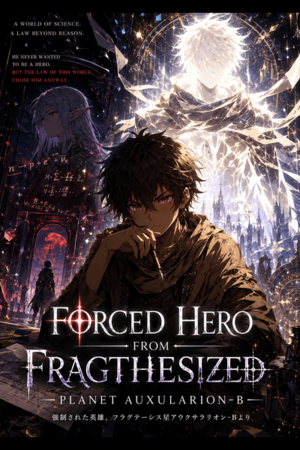
Forced hero from fragthesized planet Auxularion-B
"Cih, what a bother," Alut muttered.
He tried to sense the mana, pondering what could move the atoms.
Ah, microgravitation.
He thought again.
Microgravitation just to ignite a fire? Ah, that's not efficient.
He tried to manipulate mana decay so it would decay into finneon, but he discarded the idea. He thought that way was inefficient as well.
So he tried to condense his mana above the group of Biastonar. In this world, magic was an organismic phenomenon arising from the interaction of three fundamental particles: mana (or virtual Manastron) interacting with fineon, which then interacted with lunon. And he was well aware of that.
He had once heard of a rare phenomenon: someone had been able to activate magic while asleep. Anyone who heard the story usually laughed, treating it like an absurd comedy, but it was a historical fact.
Yet that case had only occurred once; it never happened again. From that anomaly, he understood how to maximize magic. Rather than calculating the final magic effect, he chose to calculate its activation process to trigger it.
He focused on sensing the mana inside his head, seeking a combination of particle interactions to trigger with it.
Use Tendor bosons to create a vacuum area, then wait for afro and scilio quarks to appear, he thought. However, scilio and afro quarks only manifest in a vacuum with high energy. Will condensing my mana be enough to trigger those two quarks?
Well, he would never know if he didn't try.
Nothing seemed to happen above the Biastonar group as he watched, but deep down, his mind knew his plan had succeeded.
One second—
Two seconds—
Three seconds.
Pitch-black dust materialized above the group of Biastonar.
He grinned broadly. His eyes opened wide, raw satisfaction beaming from his expression.
"Eat that, you beasts!" Alut screamed, then laughed loudly.
Several Biastonar were blasted far away as the pitch-black dust detonated. Others died instantly from the explosion. Indeed, that pitch-black dust was Rimanium—the fourth rarest metal in alchemy. Synthesizing it was extremely difficult, and anyone who created it usually died right after succeeding.
Naturally, the cause of death was the material's volatile behavior. As for why Alut was still alive after creating it? Simply because he maintained his distance from the material.
Just as he anticipated, the explosions never stopped. Portions of the Rimanium condensed into pitch-black stone, only to detonate again a second later.
I can stop it before all the Biastonar die, Alut thought.
He thought about naming that magic, so that if it had a name, he could calculate all the particle interactions in its process more easily. He remembered a character from a story—though that character couldn't create an infinite explosion, they shared a similar concept: fire causing explosions, and explosions laced with poison.
"<Wisanggeni!>" Alut shouted.
The air above the Biastonars turned dark as the pitch-black dust materialized. Before it could solidify into stone, the dust-form Rimanium exploded in rapid succession.
It crossed his mind to try darkness magic. He knew what darkness magic truly was: a spell to attack a target through their shadow. To produce this effect, two particles had to interact: mana and Fragtheson.
Because Fragtheson could modify reality, it could alter small-scale reality—like barrier magic—or fundamental reality, such as physical laws. Normally, without interacting with mana, Fragtheson was simply the particle responsible for fragthesization (modifying visible fragthesis). But to activate darkness magic, Fragtheson was used to rewrite a small part of fundamental reality: the physical definition of shadows.
"<Indrajit Sparsh!>" Alut shouted as he unsheathed his dull sword.
Nothing visibly happened to his blade.
Suddenly, a Biastonar's second shadow teleported three meters in front of him. His eyes gleamed and his mouth curved into a wide smile, clearly betraying a mind exhilarated by the thrill of battle.
The one Biastonar's head was severed the moment he slashed its shadow across the neck. Its green blood spurted downward, only to evaporate completely in a single second. He looked at the second shadows of all the remaining Biastonars. It was too overwhelming for him to kill every single one alone.
So he decided to multiply his body. If there were enough of him, he could end this rampage in an instant. He already knew which particle activated the body multiplication effect: Fragtheson, once again.
"<Candrabirawa!>" he shouted.
His body multiplied until his clones equaled the total number of Biastonars.
"<Indrajit Sparsh!>" all of his clones roared in unison.
Every single Biastonar's head separated from its shoulders as all of Alut's clones slashed their second shadows at the neck simultaneously.
"Did you create that?" one of Alut's clones asked the original Alut, pointing at the detonating pitch-black dust.
"Yep, you got it," the original Alut answered. "And now we're going to deactivate it."
"How?" another clone asked.
"By creating a false Sucrologue star," the original Alut replied.
The first clone thought the idea made sense. However, another clone considered it impossible and absurd. He knew a Sucrologue star could only form in a bulk void. He understood the difference between a simple vacuum area and a bulk void—a bulk void was a region with spatial fluctuations. In fact, their calendar used those spatial fluctuations as its spatio-temporal system. One Lumerus year actually meant the completion of one cycle passing through the fluctuated space, returning to the previous informational distance relative to the solar system.
Another clone, holding his sword against his own spine, demanded accountability from the original Alut. He didn't want Alut to leave the area in such a damaged state. It was only natural—dare to act, dare to take responsibility.
"How are you going to take responsibility for this?" the clone asked, staring sharply at the original Alut.
The original Alut was at a loss on how to take responsibility. If he could delete elements as easily as he created them, it would be simple. Normally, dematerialization magic could erase an object. However, Rimanium was a special case—if it received dematerialization magic, its structure would become eternal. Attempting to dematerialize it with magic was not only useless, but would actually make it far more dangerous.
In desperation, Alut simply imagined the element vanishing completely.
"That's useless," the clone mocked.
Yet, somehow, the impossible happened—the material disappeared. Even though the magic should have turned it into an infinite explosion, it vanished without a trace.
Another clone looked on in astonishment. What kind of magic had the original Alut used to make that work? He asked the original Alut to explain the physical anomaly.
"How?" The clone tilted his head. "Can you explain that?"
Alut was equally bewildered. He tried to search for a logical reason behind the event, but it was physically impossible. None of his physical hypotheses—whether based on magic, pure heat energy, or vacuum areas—could explain it. No matter how much he pondered, nothing in his understanding of physics could account for the phenomenon.
"I don't know how that happened," Alut replied.
"So... why did it work?" the clone pressed.
"You did it, yet you can't explain it?" another clone mocked.
"I really don't kno—"
"What happened here?" a voice called out. "I heard an explosion, so I came to check it out."
Alut recognized the voice immediately—it was Dukali. Turning toward the source, his guess was confirmed. He saw Dukali ten meters away, with his second shadow positioned five meters in front of him. Dukali was still running behind his own second shadow, which teleported another five meters forward the moment Dukali reached its previous position.
Upon reaching his second shadow, Dukali looked at the scattered corpses of the Biastonars, then turned his gaze toward Alut. At first, he didn't fully process what he was seeing. He looked closer, and finally realized what was going on.
He could see Alut—but not just one. He was looking at a crowd of Aluts.
"What is this?" Dukali asked in shock. "Did you use <Candrabirawa> magic?"
"Of course," the original Alut replied.
"Not only that, he used <Wisanggeni> magic too," one of the clones chimed in.
"<Wisanggeni> magic? What is that?" Dukali tilted his head in confusion.
He had never heard of such a spell. It didn't exist in any standard records of magical knowledge.
"We used <Indrajit sparsh> magic as well," another clone added.
Dukali naturally recognized that one. <Indrajit sparsh> was a spell that redefined shadows so they could physically affect the objects casting them. However, that still didn't explain what <Wisanggeni> was.
"Can you explain what <Wisanggeni> magic is?" Dukali asked.
"Ah, I see," the original Alut replied. He then turned to Dukali with a quick question of his own. "Do you know about Rimanium?"
Of course, Dukali knew what Rimanium was—the most dangerous material in existence. Even laypeople knew about it. He thought about it again, the concept echoing in his mind as he tried to connect those thoughts to the magic he had just witnessed.
"Do you mean that magic is based on that dangerous material?" Dukali asked, his tone dead serious.
"That's correct," one of Alut's clones answered calmly.
"Now, let's head back to the palace," Dukali said, pointing toward the gate. "After that, you must explain your new magic."
Alut knew that once they reached the palace, everything would become complicated: he would have to explain the rampage, the mysterious man wearing arctic clothes and a wolf mask, and the <Wisanggeni> magic. But he was ready for it.
"Okay, I will explain all the information His Majesty needs," Alut replied. "You don't need to remind me."
He looked at all of his clones, and they nodded in unison. Sensing his mana, he controlled it to interact with the Fragtheson particles. By redefining their existence within his mind, all of his clones vanished instantly.
"So, let we ente—"
"Just walk. Don't waste time," Alut interrupted.
Alut walked up to Dukali and grabbed his right shoulder. He sensed his mana and directed it to interact with the Tendor bosons located inside the throne room. He knew the throne room was far from their current position—nearly two kilometers away. However, he knew the microscopic realm completely ignored physical distance, no matter how far.
Observing the current situation inside the throne room through his Promactum eyeglasses, he locked onto the coordinates.
"Are you trying to teleport us?" Dukali asked.
"Of course," Alut replied. "Now, time to teleport!"
In an instant, their vision shifted directly into the throne room.
"Did you succeed in stopping the rampage?" King Danara asked."Of course, Your Majesty," Alut replied.
"Where did the rampage originate from?" King Danara asked further.
Alut was grateful he didn't have to explain how he had stopped the rampage to King Danara, as he had no idea how the King would react. Based on his speculation, the rampage had originated from the eastern forest—the Parankava Forest.
"In my speculation, it originated from the Parankava Forest," Alut reported.
"You know what your duty is, right?" King Danara asked.
Internally, Alut sighed, but he had no choice but to accept. He would have to investigate that forest tomorrow.
"Alright, I will check it tomorrow," Alut sighed.

Please sign in to leave a comment.