Chapter 3:
Chapter III
SAGARA THE HEEDLESS
I had no answer. Vasu whispered: "The chamber beneath us is not merely ceremonial."
"What does that mean?"
"The bells are activating something."
"What? What is it?"
"I don't know."
"Why are you telling me to leave?"
"Because whatever is beneath that hatch has been dormant for a very long time."
Harun watched my face. "You hear it too, don't you?"
My blood chilled. "You can hear him?"
"No."
His eyes moved toward my tunic. "I can see that you are carrying something."
I took a step back. "Stop looking at me."
"I have no desire to touch you."
"Then stop staring."
"I am staring because you have brought an old thing into this village."
Vasu went very still. "Ask him how long the temple has stood."
I did.
Harun's face changed. "Longer than the village."
"How long?"
"Perhaps six hundred years."
"Who built it?"
"The people who lived here before us."
"Why?"
He hesitated. "To keep something asleep."
Vasu said nothing.
"What is it?"
"We don't know."
"What reason do you have to wake it?"
"We aren't."
Bell sounded. The hatch beneath the altar opened by itself. A cold air rushed up from below. Every candle went out. A gust moved through the temple. The villagers began chanting.
Mira's face changed. She was afraid now. The stone beneath my boots began pulsing.
Vasu's voice shook. "The cult believes the thing below can sever them from the wheel."
"And can it?"
"I don't know."
"You're lying."
"I am afraid."
I had never heard Vasu say those words.
The hatch widened. Something moved below. Harun began reciting faster. The villagers joined him.
Then a hand emerged. Human. Old. Its fingers curled around the edge of the hatch.
Mira screamed. The hand pulled it in. A woman's face appeared beneath the altar.
Mira cried out. "Mother!"
She ran. I caught her wrist.
The face smiled. Its eyes were all black.
Vasu screamed against my ribs. "Don't let her touch it."
I dragged Mira backward. The thing below climbed higher. It was too thin. Its limbs bent at impossible angles. Its skin looked wet despite the dry stone.
Harun fell to his knees. "This isn't what you promised."
The creature looked at him. Its head tilted. Then it smiled again.
People began screaming. The temple became a maelstrom of bodies. Some fled. Some prayed. Some stood frozen.
Harun remained on his knees. I caught his sleeve as I passed. "Move!"
He looked at me. "What did we summon?"
"I don't know."
"You carry one of the old ones."
I stopped. "What?"
His eyes were on my tunic. "That thing recognized you."
I hauled him up. "Then maybe you should come with us."
"Why?"
The temple rumbled. "Because you're still alive."
He stared at me. Then he ran.
We made it halfway across the village before the temple came down. Rock and stone crashed on the road. Dust devoured the buildings. The bells died. For a few seconds there was nothing.
Then something sounded beneath the rubble. A single bell.
Mira tucked her head against my side. Harun stared at the ruins. "Is it dead?"
Vasu answered. "No."
Harun closed his eyes. "Then what do we do?"
"Leave," said Vasu.
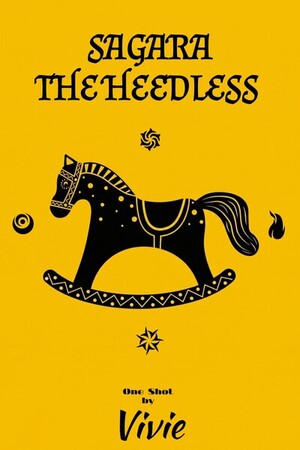
I studied the wooden horse under my fingers. "And the villagers?"
"They're already leaving."
"What about the thing under the temple?"
"That's not our problem."
I turned to the villagers who were collecting in the road. Mira still held my hand. "You dragged me halfway across the world to save a king."
"Yes."
"And now you're telling me not to help these people?"
"They can't be saved by us."
"You don't know that."
"I know exactly how this ends."
"How?"
Vasu's voice grew quiet. "With someone deciding that because the world is broken, they are therefore entitled to break everyone inside it."
I turned back to the ruins. Some of the villagers were already running away. Mira's fingers tightened around mine. I thought of the ravine. The stone. The dark. The feeling of finding myself still breathing after opening my eyes on the other side of reason.
"Then I'm staying."
Vasu went silent. "Once," I said, "I am not carrying your burden."
I looked down at Mira. "I'm carrying mine."
Vasu sighed. "That is an exceptionally inconvenient distinction."
"I know."
"And incredibly dangerous."
"I know."
There was a pause. "I am proud of you."
I stopped walking. The words hit harder than I expected.
Vasu quickly amended, "Do not get used to it."
I laughed, despite myself. Then the ruins moved. We ran.
***
We did not stop until the village was little more than a smudge of smoke behind us. Harun ran with us. He did not say much. Mira did not leave my side. At dawn we halted by a dry stream. The survivors broke up what food they had. Nobody thanked me. I was glad. Gratitude would have made everything sadder.
Mira sat beside me. "Are you going to the capital?"
"Yes."
"Why?"
"Vasu needs to warn the king."
She looked at my tunic. "Is that Vasu?"
"Yes."
"Is it a horse?"
"Apparently."
"Can I see it?"
"No."
"Why?"
"It's rude."
Vasu spoke against my ribs. "She is starting to understand me."
Mira laughed. For the first time I saw Vasu's wooden body shift beneath my tunic. Not much. But just enough. That was something like amusement.
I looked down. "You cared about her."
"No."
"That was a quick answer."
"I care about objectives."
"You told me to leave because the creature under the temple was dangerous."
"Correct."
"You stayed because I did."
"I was already committed to the road."
"You could have abandoned me."
Vasu said nothing. I let the silence linger.
That evening, after the survivors had made camp, Vasu finally spoke. "I owe you an accounting of what I am."
I tossed another dry twig into the fire. "That sounds ominous."
"It is."
Three thousand years ago the Devas did not live in some divine exile. They walked among mortals. "I had a twin," said Vasu. "A brother."
Its voice grew quieter. "The original Sagara."
I looked down at the wooden horse. "An old prophecy said that our permanent union—that is, the two of us becoming one vessel—would poison the cosmic wheel and stop its turning."
"And the gods believed it."
"They feared it."
"There is a difference."
"Not when fear wears a crown."
Vasu continued. "The stewards watched us rather than tending the levers and gears of the world. Then they decided it was easier to manage a small tragedy than an uncertain prophecy. They killed him."
"Yes."
"They didn't ask if the prophecy was true."
"No."
The fire crackled. "The world kept on falling exactly as it always had. Guilt is an ugly poison for gods to swallow. It doesn't soften them. It makes them desperate to offload the weight onto someone else."
"What did they do to you?"
"They bound my essence into timber so that no weapon could grant me the oblivion they granted my brother."
"And then?"
"They cast me out."
"For what purpose?"
"To warn whatever desperate monarch holds a throne when the wheel begins to fail."
"And you've been doing that for three thousand years?"
"Yes."
"How many kings?"
"I stopped counting."
"How many bearers?"
"One hundred, perhaps."
I looked at it. "And you used all of them?"
"Yes."
There was no shame in the answer. That was almost more frightening. "Then why is his name carved on you?"
"I don't know."
"You don't know?"
"I would desperately wish it to be destiny. That would comfort me more than anything I have craved in three millennia."
Its voice thinned. "But I have learned never to trust the stories I wish to be true."
I touched the letters carved into the wood. SAGARA. "What about me?"
"I don't know."
"Do you think I'm him?"
"No."
The answer came too quickly. Then, "I think you are yourself."
I looked at the fire. Mira was asleep on the other side of the camp. Harun sat awake, watching the dark. "What did the creature under the temple want?"
"I don't know."
"You keep saying that."
"Because it's true."
"And the cult?"
"They are still a threat."
"Are they?"
"Yes."
"Even though we stopped them?"
"We stopped one ritual."
"That's not what I asked."
Vasu was silent. Eventually it said, "They believe the world is a prison."
This belief was more dangerous than the ritual. I understood why it spoke about Kelhua in the tunnels with such bitterness. It wasn't just a political issue. It was a philosophy. And philosophies were far more difficult to eradicate than mere rituals.
We reached the capital three nights later. From the last ridge I saw its perimeter torches, scattered across the horizon like dirty gold. For the first time since my carriage ride to the edge of the ravine, I allowed myself to imagine a future where a king's coin jingled in my pockets.
The capital was more disappointing than I expected. Smaller breasted and greasier than I had imagined. The alleyways were choked with carts, beggars and competing priests of half a dozen dying cults. Tanned leather, rancid oil and unwashed humanity clung to the air. Even here I could smell the rot Vasu had described. It didn't require three thousand years of memory to detect decay. Only a functioning nose.
It took most of a day, a well-placed bribe and a trembling palace steward to secure us an audience. When we entered the throne room I noticed several things at once. The King did not look at me. He was an aging monarch with parchment skin and rings of exhaustion around his eyes. His entire being was focused upon Vasu.
I pulled the wooden horse from my tunic and placed it on a velvet cushion before the dais. Vasu spoke. Its voice shifted. It became patient. Calculated. Warm. It radiated the authority it had never once wasted on me in the dark. It spoke of the turning wheel. It explained that cosmic cycles chose their instruments rather than the other way around. It told the King that there was never any accident in whose hands a vital warning ultimately rested.
No accident.
The King's knuckles whitened around the carved arms of his throne. I stood in the shadows. I had heard that sound before. Not an identical sentiment. The same construction. The same instrument, honed to a different edge, offered to another desperate man.
I said nothing. I took the heavy pouch of gold the King's treasurer shoved into my hands. More wealth than my entire district likely generated in a decade.
I ate alone that evening in a side chamber cluttered with looted treasures. I found myself obsessing over the phrase. No accident. When I finally picked Vasu up from the table I said, "You told the King there was no accident in whose hands held your warning."
Silence.
"You told me the same thing about my name."
More silence.
"Word for word."
Vasu said nothing.
"So illuminate me. Was I chosen by fate, or was I merely convenient?"
"The second."
The answer came so quietly I almost wished it hadn't. "I required a vehicle," said Vasu. "You were desperate enough to embrace the burden without interrogating the mechanics."
I stared at it. "I've played this variation in countless cycles. Different names. Different thrones. Different fools."
The wood suddenly seemed very light in my hand. "A comforted bearer marches faster and complains less than a terrified captive."
"The village wasn't useful to you."
"Not entirely."
"The Serpent wasn't useful."
"No."
"You saved me there."
"I needed you alive."
"That's not saving."
"No."
The wooden horse hovered between us. I studied the crude black eyes. "For what it's worth," I said, "my original intention was to trade you."
Vasu didn't move. "The moment we reached the first major market I intended to sell you to the highest bidder. I didn't know what would happen to you afterward. I didn't care."
I turned the horse over in my palm. "I omitted the question because it would have delayed my escape."
Vasu was silent. "My calculation wasn't fundamentally different from yours. You required a carrier who wouldn't ask inconvenient questions. I required a relic that wouldn't demand emotional accountability."
I traced the crooked wooden leg. "I merely discovered the truth of my transaction before you explained yours."
Three thousand years seemed to settle into the room. "Then perhaps we are equals," said Vasu.
"No."
It waited. "I know what I did."
The answer was almost inaudible. "I didn't always."
I looked at it. "What does the King get?"
"A warning."
"And then?"
"He acts."
"And if he fails?"
"I find another king."
"And another bearer."
"Yes."
"And another?"
"Yes."
I set Vasu on the table. "The Serpent asked if I knew the difference between being guided and being hauled."
"I remember."
"I think I know now."
Vasu was silent. "I am not offering absolution," I said. "An act does not require forgiveness to be understood. Those are entirely distinct forms of mercy."
The wooden horse did not move. "You will carry your burden into another cycle, another court, another bearer. Whether I bless it or curse it makes no difference."
I pushed the gold pouch toward myself. "I have my own imperatives now."
Vasu's voice was very small. "I have carried this existence for three millennia. A hundred aliases. A hundred bearers. A hundred courts where I eventually wearied out my welcome."
It paused. "I never remained long enough afterward to discover if any of them cursed my name."
I said nothing. "It is simpler not to know."
"I know."
"You are the first who remained long enough to condemn me."
"I am not condemning you."
"That is somehow worse."
I almost smiled. "Then perhaps we are both learning."
Vasu was silent for a very long time. "Will you take me with you?"
The question surprised me. "No."
"I expected that."
"Did you?"
"No."
That was the first completely truthful thing it had said all evening.
I left before the palace fully awoke the following morning. I secured enough gold to ensure my independence and left the remainder stacked on the velvet cushion for whoever unfortunate soul inherited the room. There was no ceremony. No proclamation. No heroic song. The guards barely acknowledged me as I slipped through a postern gate and joined the morning crowd.
There was no ancestral home waiting for my return. I had buried that particular ghost at the bottom of the Great Ravine, along with the terrified boy who used to flinch at shadows. I did not chase after the systemic decay Vasu had catalogued. That was its cross. Not mine.
I turned the other way. Away from the mountains. Away from the capital. Toward territories no royal cartographer had been bothered to sketch. On the second day, with gold pressed reassuringly against my back, I understood why. Those places had no established glory. No throne waiting for me. No god demanding tribute. No prophecy dictating my role before I even knew my shape.
For the first time, I had a reason to travel somewhere because I chose the road.
I think of Vasu occasionally during the long, solitary watches of the night. Not often. But sometimes. I remember the peculiar emptiness beneath my ribs where its stubborn shape had once lain. I remember the Serpent. Mira's hand in mine. The ruined temple. The King's white knuckles. The phrase no accident.
I still don't know if Vasu cared for me. Perhaps that is something it could not answer, even to itself. Maybe the affection was real and the manipulation was real. Maybe those things were never as separate as either of us wanted them to be.
I harbor no expectation of our paths crossing again. Vasu had three thousand years and a hundred borrowed names. I had a murdered mother, a tyrant's discarded blade, and a stranger identical to myself languishing at the bottom of a chasm no mortal was engineered to survive. Both of us, in our own desperate machinations, had merely been running from.
For one brief, improbable stretch of road I had ceased being the solitary soul who got caught. I am nobody's son now. Nor am I anyone's convenient instrument. Merely a man walking into a frontier that has never heard of gods or cosmic cycles, carrying enough wealth to build anew and just enough hard-earned wisdom to spend it wisely.
Perhaps the world will continue to rot without me. Perhaps Vasu will fall. Perhaps the wheel will turn until it grinds itself to dust. For once I have no intention of finding out. Let the wheel grind its teeth without me.




Please sign in to leave a comment.