Chapter 2:
Chapter 2: Fog Has a Court
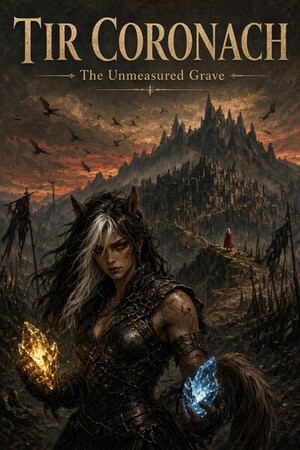
Tir Coronach: The Unmeasured Grave
Rhiannon felt it when the boat’s keel scraped stone instead of water. Mélusine’s oar dipped once more in the black sea, then struck something solid, and the fog rose around them like pale curtains pulled upward by unseen hands. The air changed with it – thick, sweet, and strange. It smelled of apples left too long in a cellar, of wet silk folded in a chest, of cold glass touched by moonlight. It tasted like a feast abandoned for a century and only now remembered.
Ynys Afallon revealed itself slowly, as if deciding whether they deserved to see it.
The fog thinned enough to show a stretch of wet stone ahead – dark slabs fitted together with a mason’s care, slick with moisture and faintly luminous under the lanterns that burned blue along the shore. The lanterns hung from iron posts shaped like twisted branches, each one crowned with a flame that did not flicker. The light was steady, unnatural, and cold.
Beyond the landing, the city waited.
Rhiannon had expected a village, perhaps a cluster of huts or a lonely keep. Instead, Ynys Afallon rose from the fog like a half-remembered dream. Stone towers leaned at angles that should have toppled them long ago, yet they stood firm. Bridges arched between rooftops, some whole, some broken halfway across, ending in mist. Houses of slate and timber clung to the hillside, their windows glowing faintly with blue or violet light. Narrow streets wound upward like veins, paved with stones worn smooth by centuries of feet.
And everywhere, the fog moved – not drifting, not blowing, but shifting with purpose, curling around corners, slipping through alleys, rising and falling like breath.
Rhiannon’s ears flicked forward. The city felt alive.
Figures stood along the landing, waiting.
They were guards, but not human. Their bodies were tall and narrow, shaped like men carved from river-stone. Their skin was gray and smooth, their faces long and expressionless. Their eyes glowed faintly – blue, like the lanterns. Each held a spear of black metal, the tips shaped like leaves. They did not speak. They did not move. They watched.
Barghest stepped off the boat first. Her spear-butt struck the stone with a heavy thud. The guards did not react. They simply shifted their attention to her, their glowing eyes narrowing slightly, as if measuring her weight.
“That’s new,” Barghest muttered.
“They are old,” Baobhan Sith said, lifting her skirts as she stepped onto the landing. “Older than Morgana. Older than the court. They remember the island before it had a name.”
Her voice held reverence, almost worship.
Rhiannon followed, bare feet touching the cold stone. The mark on her collarbone pulsed once, then quieted. Her tail brushed the ground, damp with fog. Her ears twitched at every sound – the drip of water from the lantern posts, the distant creak of a bridge shifting in the wind, the soft hum of the fog itself.
Mélusine stepped beside her. “Keep your head up,” she said quietly. “The city likes confidence.”
Rhiannon did not know whether that was advice or warning.
They climbed the stairs that rose from the landing. It was not a quay but a ceremonial path – broad steps carved with patterns of apples, rivers, and crowns. The carvings were worn, but the shapes remained. At the top, stained-glass windows towered over them, set into the front of a great hall. The glass glowed blue and violet, casting cold light across the stone. The images within the glass were strange – women with white hair, rivers flowing upward, apples falling into crowns. One panel showed a figure in black and blue, her hair long and white, her eyes cold.
Rhiannon recognized Morgana’s likeness before she saw the queen herself.
The guards followed them up the stairs, silent as fog. Their speaks clicked softly against the stone. They formed a line at the top, flanking the entrance to the hall.
Baobhan smiled at them as if greeting old friends. “They know her,” she whispered. “They know her better than any of us.”
Rhiannon’s ears stayed forward. Unclipped. Alert.
The doors to the hall stood open, tall enough for giants, carved with spirals and rivers and the shape of a crown broken into seven pieces.
Mélusine stepped forward first. Barghest followed, spear in hand. Baobhan glided after them, her red gown trailing like spilled wine.
Rhiannon hesitated at the threshold.
The city behind her breathed fog. The hall before her breathed fire.
She stepped inside.
The hall of Ynys Afallon swallowed them whole.
Warm air drifted from the great hearth at the far end, carrying the scent of smoke, fruit, and something older – something like a memory left too long in a sealed room. The ceiling arched high overhead, lost in shadow. Stone pillars lined the walls, carved with rivers, crowns, and the shapes of apples falling into bowls. The banners hanging between them were blue and black, embroided with silver thread that caught the firelight and threw it back in cold glimmers.
Rhiannon stepped inside, ears forward, tail low. The stone beneath her feet was smooth. The hall felt ancient, but not abandoned. It felt like a story that had lived too long and refused to leave.
A long table ran the length of the floor. No one sat at it, yet places were set with care: cups polished to a shine, knives laid straight, plates arranged with quiet precision. A bowl of fruit sat near the head of the table – apples and pears collapsing softly into themselves, still lovely despite their ruin. The air around them smelled faintly of sweetness and rot.
Mélusine walked ahead, her cyan armor glowing faintly in the firelight. Barghest followed, spear in hand, her mismatched eyes scanning every corner of the hall. Baobhan Sith drifted along behind them.
Rhiannon’s ears twitched. She felt watched, though she saw no one.
Then she saw Morgana.
The queen stood at the far ened of the hall, near the great hearth. She did not need the dais behind her. Her presence did the standing. Her gown was black and cyan, the midriff bare as a deliberate choice, a sash of bright water-blue wrapped around her waist and trailing like a river that had learned obedience. Her hair was white, straight as a drawn line. A black ribbon tied at the back of her head fanned out like a verdict. A crown of dark points rested lightly on her brow. Her eyes were winter-glass – clear, cold, and sharp.
She looked at Rhiannon the way a craftsman looks at a tool that has arrived on time.
“You stand,” Morgana said. “Good. Kneeling makes a mess of the stone.”
Her voice carried easily through the hall, smooth and cold as river ice. It was not permission. It was not praise. It was simply a fact.
Rhiannon did not kneel. Her tail flicked once against her calf before she forced it still. Salt still itched in the scrapes on her forearm. Her ears felt too exposed, too aware, like doors left unlatched in a house that disliked drafts.
Mélusine bowed her head slightly. Barghest did not bow at all. Baobhan Sith dropped into a graceful curtsy, her smile radiant with devotion.
“My queen,” Baobhan breathed. “Your hall is as glorious as ever.”
Morgana did not acknowledge the praise. She looked only at Rhiannon.
“Rhiannon,” she said, as if reading from a list. “Of the green yards. Of the long hair. Of the house that writes daughter into columns.”
She did not say Haus Sinnmark. She did not need to. The bruise of it settled in the air.
“You will not need their bit here,” Morgana continued. “I have my own.”
A small table stood beside her. Upon it lay gifts.
A cloak the color of wet slate. A knife too pretty for real work. A loaf of bread still steaming. And, set apart from the rest, a length of dark iron shaped for a mouth. A bit. Not Sinnmark’s make – finer, engraved with a line of tiny apples so small they could be missed by anyone who was kind.
Boabhan Sith made a soft sound of delight, almost a gasp.
“She noticed,” Baobhan whispered, eyes shining. “I love when she notices.”
Barghest tapped her spear-butt once against the stone. A warning. A boundary.
Mélusine said nothing. Her gold eyes flicked from Morgana to Rhiannon to the iron bit, filing each detail away.
Rhiannon left the bit where it lay.
“I didn’t ask to be fetched,” she said.
“No one ever does,” Morgana replied. For a heartbeat, her voice echoed Baobhan’s tone – only sharper, dressed in authority instead of devotion. “Sit. Or do not sit. The hall will not collapse either way. The country might. That is a different architecture.”
Rhiannon sat because standing forever lead to kneeling. The chair was carved with patterns she did not recognize. The cup before her was empty yet looked expensive.
Morgana did not sit opposite of her. She walked the length of the table as she spoke, the blue sash trailing behind her like a tame river.
“You heard of the Grail,” she said. “Everyone has. They say cup. They say feast. They say the dead keep to their length of earth because a pretty bowl told them to.”
Her mouth did not smile.
“It broke at Camlann. Not a crack. A shattering. The hoop that held the house together came apart in Arthur’s hands, and the pieces went looking for blood that already knew her.”
She place three fingers on the table.
“The sons.”
She spoke their names like a healer naming old wounds that had never set properly.
“Amr. Buried under a spring in the west. His grave refuses to keep a measure – six feet, twelve, a hall if you stand there when the earth remembers its argument with a father. Arthur put him in that ground. The first sliver slept in the argument.”
She paused. Not for breath. For the hall to absorb the sentence.
“Llacheu. The fair one. Bright as a hymn. He carried his piece into a lake that does not return bodies. Other knights wear his deeds now. Singers are hungry. The drowned do not write.”
Barghest’s blood eye stayed fixed on the far doors, listening for danger beyond the story.
“Gwydre ran with the boar until the hunt and the prince could not be told apart. That sliver wants legs.”
“Duran.” Morgana’s voice thinned, like wire drawn tight. “The crows learned his name. They keep it. Walk the Field after rain and you will hear them working. They sound like paper.”
Borre went into a wound that borrowed a man’s outline. Some wounds wait. His does.”
She stopped at the head of the table. The stained glass cast a violet bar across her throat.
“Mordred,” she said last, and the name fell heavy, like a stone dropped into deep water.
No one moved.
“She lived,” Morgana said. “That is the part the court sands down to traitor and failed heir, the way a smith files a burr and calls the blade finished. The Field does not file. She stood on the ridge in red and watched the cup finish dying. A piece of the hoop is in her. She is not a tomb. She is not a lake. She is a woman on a hill who has not come down.”
She gestured to the three women.
“I have spent the sending. Mélusine will escort. Barghest will hold what must be held. Baobhan will open doors with a smile when a spear would only make them stubborn.”
Baobhan curtsied, radiant with devotion. “Your will is a lantern, my queen.”
Mélusine’s mouth tightened. “I will tell her when the island is using her.”
“You always do,” Morgana said. “It changes very little.”
Rhiannon’s ears had flattened without her noticing. She forced them forward again. The bit on the table caught the stained-glass light and looked almost like jewelry.
“You didn’t name everyone,” she said.
Morgana waited.
“Arthur had daughters.”
Rhiannon did not know how she knew it. Yard gossip. A half-heard hymn. The shape of omission sitting on the table like a fourth cup.
“You didn’t mention them.”
For the first time, Morgana’s face shifted. Not a flinch. A closing – like shutters drawn over a window that still had a view.
“No,” Morgana said. “I did not.”
That was all.
Baobhan’s smile sharpened, intrigued. Barghest studied Rhiannon with new weight. Mélusine filed the sentence away for later use.
A map hung on the far wall like a wound pretending to be parchment.
Rhiannon stood, causing the chair to scrap loudly on the floor. No one said anything. Rhiannon approached it slowly. The hall behind her hummed with quiet – Barghest’s steady breathing, Mélusine’s armor ticking faintly, Baobhan’s soft sighs of devotion. Morgana walked over to stand next to her beside the map, her white hair catching violet light, her crown casting long shadows across the stone table beneath it.
The table was carved with rivers, hills, and coastlines, but most of it was blank – white fog etched into white stone. Only a few places had names, and even those looked uncertain, as if the letters might shift when you blinked.
“The mainland forgets its own names,” Morgana said. “It remembers wounds better than roads,”
Rhiannon leaned closer. Ynys Afallon was carved clearly – its coastline, its towers, its fog-lanterns. But beyond the island, the world dissolved into white.
“Is this all you have?” she asked.
“It is all anyone has,” Morgana replied. “The fog is not weather. It is memory.”
Baobhan touched the table with reverence. “It listens to her.”
Mélusine’s gold eyes narrowed. “It tolerates her.”
Morgana ignored them. She pointed to a notch in the stone near the edge of the carved coastline.
“Inverhorn. You will begin there.”
Rhiannon frowned. “Why?”
“Because the land still remembers that name. And because the first wound is closest to it.”
“Amr,” Rhiannon said.
“Yes. The spring in the west. The grave that refuses to keep its measure.”
Morgana moved her hand across the table, pointing to places where the fog thinned just enough to show a hint of shape.
“The lake that keeps Llacheu. The hunt-path that swallowed Gwydre. The Field where Duran’s name is paper in the mouth of crows. The wound that borrowed Borre’s outline.”
Her hand hovered over a blank stretch of stone.
“And the hill where Mordred stands.”
Rhiannon felt the hall tighten around that name.
“You want me to take the slivers,” she said.
“I want you to retrieve what the land refuses to give back,” Morgana said. “Not because you are chosen. Because you are empty.”
Rhiannon stiffened. “Empty?”
“You have no king in your head. No voice. No crown whispering through bone.”
Rhiannon’s tail flicked. “I’m not a cup.”
“No,” Morgana said. “You are not.”
She turned to the three women.
“Mélusine: escort.”
Mélusine bowed. “I will keep her moving.”
“Barghest: gate.”
Barghest nodded. “I will hold her when the land tries to take her.”
“Baobhan: welcome.”
Baobhan’s smile bloomed. “I will make the wounds listen.”
Rhiannon swallowed. “And me?”
“You will walk. You will listen. You will take.”
“And if I refuse?”
“Then the fog will keep you.”
Rhiannon looked at the map again. The blank space felt hungry.
Morgana gestured toward the corridor. “Sleep under this roof. Eat what is given. Tomorrow the fog will decide whether you may leave.”
Rhiannon followed Mélusine down the hall. She paused and looked at Morgana and Baobhan and said, nodding to the bit still on the table, “I’m not wearing that.” Without waiting for a reply, she continued to follow Mélusine with Barghest taking the rear. Baobhan waited a few seconds before following.
They walked through the hall, past the long table with its collapsing fruit, past the stained-glass windows that cast cold violet light, past the silent guards whose blue eyes watched everything.
Mélusine led Rhiannon down a corridor lined with doors. She opened one.
Her room was small but clean. A bed too soft after salt-stone. A ewer of water. A window only showing white. A folded cloak lay on the chair. A knife rested on the sill. Bread sat on a plate, still warm.
Rhiannon stepped inside.
Mélusine lingered at the door. “Sleep,” she said. “Tomorrow will be heavy.”
Barghest stood at the end of the corridor, a silent sentinel.
Baobhan’s laugh drifted from somewhere deeper in the hall, bright and sharp.
Rhiannon sat on the floor. The bed felt too much like a claim. She ate the bread because hunger was not a principle. She left the cloak folded. She left the knife untouched. Her tail ached where the binding had been. Her ears tracked every footstep outside.






Please sign in to leave a comment.