Chapter 1:
The Salvage
SCARWORK
The porter put the broken ward on Ansel's examination table.
Ansel pulled his results out from underneath it.
"Sorry," the porter said. "Thought you were finished."
"I am."
The porter nodded and went back for the rest.
There were six tables in the hall, each fitted with a shallow brass basin and a ring of white ceramic. Five had been cleared. At Ansel's, a clerk was waiting for the ink to dry beside the words Below requirement.
The broken ward had come from the fourth table. Ansel had heard it go — a flat crack, then white pieces skating across the floor, then an instructor moving faster than anyone had moved all morning. The girl who had been testing was walked out with her hands wrapped in somebody's coat. Nobody had said anything about it since.
Someone had wrapped the pieces in a towel, which was an expensive way to carry sharp ceramic and a poor way to carry anything that might still be charged. A brown stain was spreading through one corner.
Ansel moved his hand away.
The clerk sanded the form. "You may request a second assessment tomorrow."
"Would it be different?"
"I can't tell you that."
She had let him try three times. On the last attempt he had shut his eyes, which was not permitted, and for four seconds the small barrier inside his basin had held. Then the working loosened inside him, its parts slipping apart faster than he could gather them.
The barrier had gone out.
Twelve seconds were required.
Ansel looked at the form again. His written result occupied a small box near the top. Someone had underlined Distinction.
"Would I have to pay?"
"For the second assessment? No."
"For another night."
The clerk's hand paused over the sand tray.
"I'll ask."
She took his form through a door behind the examination benches.
Ansel sat down. The chair was low enough that his knees came above its seat. He tucked his feet underneath it and tried to decide whether another attempt would be persistence or merely a costly way to receive the same information.
Outside, students were crossing the courtyard. A young woman walked between two friends. A pale fish was swimming around her wrist; it passed through her sleeve, emerged at her elbow, and broke into a scattering of silver droplets when she laughed.
Ansel watched until she was gone.
The towel on the table gave a soft tick. He leaned closer.
A crack had opened in the brown corner. Through it, he could see a strip of copper bowed away from the ceramic beneath. The towel smelled of hot wool.
"Excuse me," he called after the porter.
The man had reached the doors with a second load balanced against his chest.
Ansel stood, caught his knee beneath the table, and sat down again rather sharply.
The porter looked back.
"The cloth," Ansel said. "Under that. It's—could you bring the tray?"
"What tray?"
"The metal one."
He pointed. The porter glanced at the towel, understood, and set his load down.
Together they slid the broken ward onto a tin tray. The underside of the cloth had begun to char.
"Was told it was discharged," the porter said.
"It probably was. Copper holds the heat."
The man studied the stain.
"Good catch."
Ansel almost explained that the smell had been obvious. He stopped himself in time.
The porter left him the tray.
The clerk came back with a man Ansel had last seen delivering the welcome address. He recognized him at once: narrow, silver-haired, robes comfortable enough to work in, though Ansel doubted they saw much work.
"The Provost signs the exceptions," the clerk said, and stepped aside.
The Provost did not look at Ansel. He looked at the tray.
"Who carried this up?"
"The porter, sir."
"In a cloth."
"Yes, sir."
He turned one of the fragments with a fingertip, wiped the fingertip on a handkerchief, and put the handkerchief away.
Only then did he unfold Ansel's assessment form.
"Varrow?"
Ansel got to his feet, cautiously this time.
"Yes, sir."
"You worked in a repair shop before coming here."
"For four years."
"What sort of work?"
"Household pieces. Heating plates, lifting brackets. Shop wards, sometimes, if they were small. I mostly took them apart for Master Bren. He did the—well, I did some of the repairs, toward the end."
"He did the - "Ansel stopped.
"I did some of the repairs. Towards the end."
The Provost waited.
"Four years," Ansel finished.
"And you applied through the written examination."
"Yes."
"That route gives us students our ordinary admissions would miss. It also means we occasionally arrive at a result like this."
He tapped the box with Distinction in it, once.
Ansel kept his eyes on the paper. The Provost had not said unfortunate. Somehow that made it harder to argue with him.
"The discipline courses require you to sustain a working while an instructor corrects it," the Provost said. "You cannot yet do that safely."
"Could I learn?"
"To improve? Certainly. To meet the requirement this term?"
He let the question stand until it stopped being one.
"I would advise you to make other arrangements."
There it was.
Ansel pressed his thumb against the rough patch of skin on the back of his left hand.
The Provost glanced again at the tray.
"However. Magister Haddon has a vacancy."
The clerk was sent down for him. It took a while.
Haddon came up carrying a cup with no handle and the expression of a man who had been interrupted at something. He set the cup on the clerk's desk, read Ansel's results, and turned the paper over to check whether anything had been written on the back.
"Four years?"
"Yes."
"Can you keep an inventory?"
"Yes."
"Accurately?"
Ansel hesitated.
"If I know what the pieces are."
Haddon looked up.
He was broad through the shoulders, with grey in his beard and a pale groove across the bridge of his nose where spectacles usually rested.
"That will do for a beginning."
He picked the cup back up.
"The position's in the Salvage. Board, a bed in the lower residence, eight coppers a week after deductions. You lose a tool, you pay for the tool. You break something on purpose, you pay for that too, and then you leave."
"The hours?"
"Start at the morning bell. Finish when I say. You can sit the common lectures if your shifts are covered."
"Discipline instruction?"
"No."
Haddon drank.
"After a year you can sit for a technical certificate."
"Does the certificate require another capacity assessment?"
"No," Haddon said. "It requires you to know when something is safe."
The Provost placed a second form beside the first.
Ansel read it twice.
Eight coppers was less than he had earned in his last year at the shop. There would be no money to send anywhere, and very little to save. On the other hand, the bed was included. So were meals. At home, neither had ever appeared on a bill, which had made it difficult to know when he had paid enough for them.
He could return. Master Bren had said so.
There'll always be something for you to do.
Ansel had been grateful when he heard it. He was grateful now.
He wanted, with an intensity that embarrassed him, to have somewhere else to go.
"Would I have access to the library?"
"The common collection," the Provost said.
"And the practical manuals?"
"Those in the common collection."
Ansel was already working out how long it would take to read the common collection.
Haddon took his cup off the desk.
"You can read mine if you wash first."
Ansel looked down at his hands. He had scrubbed them that morning until the old burns stung. There was still black beneath three nails.
"After work," Haddon added. "You'll be filthy."
The clerk turned the employment form toward Ansel.
He signed before he could think of a more dignified option.
Haddon made him carry the tray.
They crossed a gallery where the windows stood open onto the courtyard. Somewhere overhead, a bell was ringing without being struck. The sound followed them through the archway, clean and deep.
He was still here.
Then Haddon opened a narrow door beside a painted screen, and they went down a staircase that smelled of wet stone.
The tray was awkward. Ansel had to turn sideways at each landing to keep its rim from scraping the wall.
"Why's it called the Salvage?" he asked.
"Because Recovery and Materials Assessment wouldn't fit on the door."
At the bottom, Haddon shifted his cup to his other hand and lifted a latch.
The door bore a neat brass plate.
RECOVERY AND MATERIALS ASSESSMENT
Ansel looked at him.
"Had that made after I said it."
Beyond lay a long room crowded with benches.
Ansel stopped in the doorway.
There were cracked lamp housings, bundles of stripped wire, glass tubes packed in sand, and a stack of blackened ceramic plates sorted by size. Three articulated brass fingers flexed slowly inside a jar. Above a sink, a little stone face dribbled water from its mouth into a bucket.
At the far end of the room, somebody had arranged the pieces of a shattered blue bowl on a cloth. Fish had been painted around its rim. One still moved, circling the same short section of water until it reached a break and had to turn back.
Ansel smiled before he remembered to look serious.
"Don't touch the bowl," Haddon said.
"Is it valuable?"
"No. It bites."
A woman at the next bench raised a bandaged finger without looking up.
Haddon led him to an empty space beneath a high window.
"Tray here. Coat there. Anything you bring in gets a label. Anything you take out gets entered in the book. If you don't know whether it's charged, you treat it as charged."
Ansel set the tray down.
"Where do the discharges go?"
Haddon pointed at a groove cut along the rear edge of the bench. It joined a covered channel in the wall.
"Sump. You don't open those channels, and you don't pour anything into them unless I've told you to."
"What if—"
"You come and find me."
Haddon opened a cupboard and handed him an apron.
It was heavy leather, patched beneath one pocket. Someone had scratched a name into the inside, then crossed it out.
Ansel pulled it over his head.
"You'll start with separation," Haddon said. "Metal, ceramic, reusable fittings. Leave bonded pieces together. The white bin is for material cleared to melt. Nothing goes in it without my mark."
He put a pair of gloves on the bench.
They had all their fingers.
Ansel turned them over once before putting them on.
Haddon watched him, then nodded toward the tray.
"I'll be back."
The work was familiar enough to settle him.
He removed the towel with tongs and laid it in a sand bucket. The ward had been built from curved ceramic segments joined beneath a copper rim. Three segments had shattered. Two remained whole, though their glaze had darkened near the edges.
The copper was good quality. He could tell before lifting it.
At the shop, Master Bren had saved even the short scraps, beating them flat and soldering them together where a customer would not see. Here a length sufficient for half a heating plate had been twisted around the broken ward merely to hold it during transport.
Ansel unwound it carefully.
At least the porter had not thrown that away.
He sorted the loose fittings by thread and checked each ceramic fragment before placing it in the tray. One had a maker's stamp on its underside: a small tower above three dots.
Another carried something beneath the glaze.
He tilted it toward the window.
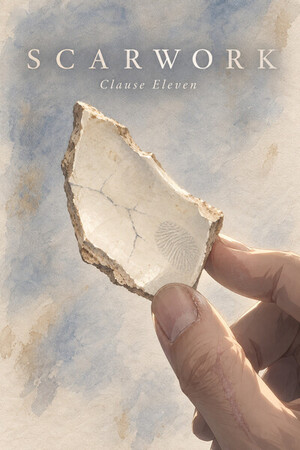
A fine grey line ran from the broken edge into the white surface. It branched twice and faded near a copper contact.
Ansel rubbed it with his gloved thumb.
Nothing changed.
He had seen marks like it before, usually in old heating stones after they cracked. He had once spent most of an afternoon trying to clean one off, until Master Bren asked whether he intended to polish the thing all the way through.
This was clearer.
He turned the fragment over. For a moment the line seemed to remain where it had been, hanging in the thickness of the ceramic rather than lying on either face. He blinked and it was gone.
He turned it back.
There.
He brought a second fragment alongside it. Two branches ended at the break, almost meeting. He shifted the pieces until the ordinary fractured edges fitted together.
The grey lines joined.
"Hm," he said, and went looking for a third.
By the time Haddon returned, Ansel had reconstructed most of one side of the ring.
"I said separation."
"Yes. I needed to see where the contacts—there's something wrong with the strip."
Haddon set his cup down.
"Which strip?"
Ansel pointed to a thin copper tongue projecting from the outer edge.
"That's the release," Haddon said.
"I thought so."
"If the ring takes too much load, that opens before the ceramic does. Keeps the fragments from being thrown."
"Yes, but this—"
He stopped.
Haddon had taken his spectacles out of his pocket and was turning them over by one arm. He did not put them on. He seemed prepared to go on turning them for some time.
Ansel tried again.
"The damage runs toward the ring."
Haddon bent over the pieces.
"The strip's scorched."
"I know."
"Which is what I'd expect."
"Yes, but—"
Ansel touched the grey branching line. It began at the copper tongue and thickened as it passed into the ceramic. He could follow it through two breaks and halfway around the ring.
He had no word for why that meant direction. A shaving curls toward the blade. Something had travelled here, and met resistance.
Haddon picked up the copper strip with the tongs.
"What makes you think it ran inward?"
Ansel looked from the strip to the fragments.
He could hear the stone face dripping into its bucket.
"I'm not sure how to show you."
Haddon lowered the strip.
"Then don't put it on the label yet."
Ansel put his hand flat on the bench, which was what he did when he wanted to keep talking and knew it would not help.
"I could work it out."
"Possibly."
"I just need—"
"Varrow."
Ansel shut his mouth.
"You've been here less than an hour. You don't have to finish the room today."
Haddon slid a shallow wooden box across the bench.
"Put it aside. Record what you can account for. If you still have a question tomorrow, we'll look."
He moved on to the next bench, where the woman with the bandaged finger wanted him to listen to something knocking inside a kettle.
Ansel stood still for a moment.
Then he took off his gloves and found a pencil.
Assessment ward, fourth table. Three segments broken. Release scorched.
He could account for those.
He placed the fragments in the box, keeping the reconstructed section together. Last came the two whole pieces.
As he lifted one, a grey thread caught the light beneath its glaze.
Ansel lowered it beside the broken ring. The thread continued the thicker line. It curved through the intact ceramic, narrowing toward the outer edge.
He turned the piece over.
There was no crack. He ran a nail across it, then examined it close to the window.
Nothing.
At the next bench, Haddon told the kettle to stop that. The knocking continued.
Ansel looked at the box, at the white bin beneath the bench, and at the unbroken piece in his hand.
He fetched the pencil again.
Across the smooth glaze, he drew a short line where he thought the fracture would be.
Beneath it, carefully, he wrote:
Check before melting.








Please sign in to leave a comment.