Chapter 3:
EPISODE 3 — "The Kid Who Learned to Apologize First"
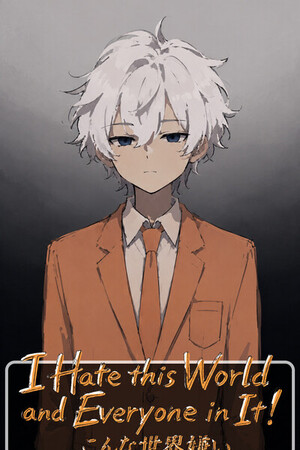
I Hate this World and Everyone in It! — こんな世界嫌い
[NARRATOR: There is a particular defense a person builds when apology becomes cheaper than confrontation — the habit of saying sorry before anyone has even finished deciding to be angry. Not out of guilt. Out of arithmetic. A person who apologizes first never has to find out how bad the alternative could have been. This is not a story about a single moment where everything breaks. This is a story about a hundred small moments, stacked one on top of another, until a fifteen-year-old human has learned to flinch before the hand is even raised.]
PART ONE: SHIROYAMA HIGH SCHOOL — MORNING, THIRD WEEK
The classroom had the particular hum of a Friday morning — restless energy barely contained beneath the surface of thirty students who could already feel the weekend approaching. Kibaro sat through it the way he sat through most things now, present in body, elsewhere in every way that mattered. "Hey," Souta said, dropping into the seat beside him with none of his usual chaos, something quieter in his voice for once. "You look kind of out of it today."
"Just didn't sleep great," Kibaro said, and the smile arrived on schedule, easy and unbothered. "Nothing serious."
[KIBARO'S INTERNAL MONOLOGUE: I didn't sleep at all. That's not the same thing, but it's close enough for the answer you need, and the answer you need is always shorter than the truth.]
"You've said that like three times this week," Souta said, and there was no accusation in it, just the plain observation of someone who, despite everything, kept noticing. "You know you can just say if something's wrong, right? I'm not gonna, like, make it weird." Kibaro felt something small and unfamiliar catch in his heart — not quite hope, not quite anything he had a name for, just a brief, dangerous softening before the practiced part of him clamped back down over it.
[KIBARO'S INTERNAL MONOLOGUE: Don't. Whatever that was, don't. You know exactly how this goes. You let someone in an inch, they ask a question you can't answer without the whole thing unraveling, and then they either pity you or they leave. Neither one is worth the inch.]
"Nothing's wrong," Kibaro said, voice warm, final, a door closing so gently the person on the other side of it barely felt the latch click. "Seriously. I'm good." Souta studied him a moment longer, then let it go with the particular grace of a human who hadn't yet learned that some doors close because they're meant to stay closed. "Alright," he said. "Just — you know where to find me."
[NARRATOR: He did not, in fact, know where to find Souta in any way that mattered. He knew where Souta sat in homeroom. He did not know how to hand a single true thing to another person without flinching, and no amount of proximity was going to teach him that on its own.]
PART TWO: THE HALLWAY — MIDDAY
Between third and fourth period, moving through the crowded hallway with his bag slung over one shoulder, Kibaro rounded a corner too quickly and collided with another student — a teenager from a different class, taller, confident, someone Kibaro didn't recognize and had no particular reason to. The collision wasn't hard. A shoulder against a shoulder, nothing more, the kind of accidental contact that happens a dozen times a day in any crowded school hallway.
"Sorry," Kibaro said instantly, before the other kid had even fully turned around, before there was any indication of anger or irritation at all. "That was my fault, sorry." The kid blinked, mildly confused by the speed of it. "It's fine, seriously," he said, already walking on, barely registering the interaction as anything worth remembering.
[NARRATOR: The boy forgot the moment within seconds. Kibaro did not. He never did.]
[KIBARO'S INTERNAL MONOLOGUE: Sorry before the sentence is even finished. Sorry before the hand comes up. That's not politeness. I used to think it was, when I was younger, back when I still believed being polite enough might actually change something. It isn't politeness. It's a reflex built by three years of learning that the apology is always cheaper than whatever comes after someone decides you didn't apologize fast enough.]
He kept walking, the smile already sliding back into place, and no one around him had any reason to think anything unusual had happened at all.
PART THREE: MS. SENA'S OFFICE — AFTERNOON
He wasn't summoned this time. He simply found himself standing outside her office near the end of the day, bag over his shoulder, telling himself he was only passing by on the way to the stairwell, though the stairwell was in the opposite direction and they both would have known that if either of them had said so out loud.
Ms. Sena looked up from a stack of papers, surprised, then quickly not surprised at all. "Kibaro," she said. "Come in, if you want." He hovered in the doorway a moment, weighing the cost of the inch he was about to give away. "I don't need anything," he said. "I just—" He stopped, recalibrated, found a smaller, safer sentence to finish with. "I was just walking by."
"Okay," Ms. Sena said simply, not pushing, gesturing instead to the chair across from her desk with the kind of casual invitation that asked nothing and demanded nothing. "You're welcome to sit for a minute anyway, if you want. I've got paperwork either way."
[KIBARO'S INTERNAL MONOLOGUE: She's not going to ask me anything. I can see it in how she's already looking back down at her folder, giving me the exact amount of space to decide what happens next. That's new. Most people like her use silence like a hook. She's using it like a door left open, not a trap set to catch me in it.]
He sat, after a moment, in the chair across from her desk, and neither of them spoke for a while, the office filled only with the sound of her pen and the distant noise of students filing out of the building for the weekend. "Ms. Sena," Kibaro said eventually, voice smaller than he meant it to be, smaller than he usually allowed it to get in front of anyone. "Do you ever get tired of people saying sorry?"
Ms. Sena's pen stilled. She looked up carefully, giving the question the weight it deserved without making that weight obvious. "Depends on the person," she said. "Sometimes sorry is just good manners. Sometimes it's something else." "Something else like what," Kibaro asked, and it came out quieter than he intended, the mask slipping half an inch before he caught it and pulled it back.
"Like a habit someone built because saying sorry felt safer than not saying it," Ms. Sena said gently. "I've met a few students like that over the years. It usually means somewhere, at some point, sorry was the fastest way to make something bad stop."
[KIBARO'S INTERNAL MONOLOGUE: She's not guessing. She knows. Not the details — she can't know the details, no one wrote the details down anywhere that matters — but she knows the shape of it, the way you'd recognize a scar even without knowing exactly what made it.]
"I should get going," Kibaro said abruptly, standing, the smile snapping back into place like a mechanism resetting itself. "Thanks for letting me sit, though. Really." "Anytime," Ms. Sena said, and didn't try to stop him, didn't chase the moment further than he was willing to let it go, which was, in its own quiet way, the exact right thing to do. "Door's open, Kibaro. Whenever." He left before the softness in his heart could turn into anything he'd have to explain later.
PART FOUR: THE HOUSE — EVENING
The house was tense the moment he stepped through the side door — he could feel it before he even saw either adult, the particular charge in the air that told him, with the accuracy of years of practice, that tonight would require more caution than most. "You left your shoes in the hallway again," his aunt said, not looking up from the counter, voice already sharpened at the edges.
"Sorry," Kibaro said immediately, already moving to fix it, already smaller in his own posture than he'd been an hour earlier in Ms. Sena's office. "I'll move them." "You always say sorry," his uncle said from the living room, not looking over, voice flat with something between irritation and boredom. "Doesn't fix anything. Just do it right the first time."
"Sorry," Kibaro said again, the word arriving before he'd even fully processed the correction, an apology for the crime of having apologized incorrectly.
[KIBARO'S INTERNAL MONOLOGUE: There's no right amount. I used to think if I found the exact right amount of sorry, the exact right tone, the exact right speed, I could make the air in this house go still. I know better now. There isn't a right amount. There's just less bad and more bad, and tonight, apparently, is leaning toward more.]
He moved the shoes, finished his chores without being asked, ate dinner in silence, and retreated to his room the moment it was socially permissible to do so, each step measured, quiet, careful — the same careful he'd carried through this house for three years, refined now into something almost invisible.
PART FIVE: KIBARO'S ROOM — NIGHT
Alone, door closed, Kibaro sat on the edge of his bed and let his shoulders drop for the first time since walking through the side door hours earlier, the small, private collapse he only ever allowed himself once the house had gone fully quiet. "Do you ever get tired of people saying sorry," he repeated to himself, quietly, turning Ms. Sena's answer over the way he'd once turned over the hair clip in the shoebox beneath the floorboard. "Something else, she said. Something else like what."
[KIBARO'S INTERNAL MONOLOGUE: I know what. I've always known what. I just haven't said it out loud, not even to myself, not in words that clean. Sorry was the thing I learned to say so the yelling would stop faster. Sorry was the thing that sometimes, on the worse nights, meant the hand didn't come down as hard. I built a whole personality out of getting ahead of other people's anger, and I got so good at it that I forgot there was ever a version of me who didn't flinch first.]
He lay back against his pillow, staring at the ceiling, and thought — not for the first time, though with a clarity that felt newly uncomfortable — about the difference between the kid who apologized to a stranger in a hallway for a shoulder that barely touched him, and the teenager underneath that performance, who had learned the habit somewhere much older, much darker, much closer to home than any hallway would ever be.
"I'm not sorry," he said quietly, to the dark, testing the sentence the way he'd once tested his own name in this same silence. "I don't actually think I did anything wrong. I just say it because it's faster."
[NARRATOR: It was a small sentence. It would not undo three years of reflex built into his shoulders, his voice, the automatic incline of his head whenever a door opened too fast or a voice rose too sharp. But it was the first time he had said the true version out loud instead of the practiced one, and even the smallest true things, once spoken, have a way of refusing to be fully unsaid again.]
Outside his window, the sky had gone fully dark, no stars visible tonight beneath a thin covering of cloud, and Kibaro closed his eyes against it, already bracing, out of habit, for whatever tomorrow would require an apology for.
[NARRATOR: Tomorrow, Souta would ask again if he was okay, and Kibaro would say yes, and mean it exactly as little as he always did. Tomorrow, Ms. Sena's door would stay open, patient, unclaimed. But tonight there was only this — a teenager, a dark room, a sentence he had never let himself say before, and the long, uncertain distance still standing between apologizing on reflex and someday not needing to apologize at all.]
TO BE CONTINUED...






Please sign in to leave a comment.