Chapter 18:
The Driver Chooses the Door
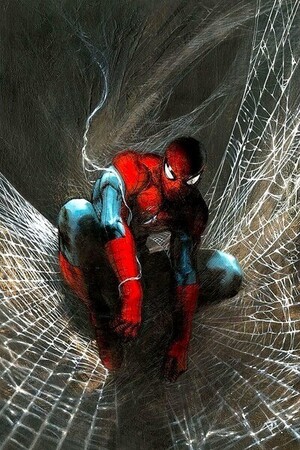
Spider-Man: Template System
New chapter is on the board.
Suit up. Queens is not getting quieter.
✦
The ambulance doors stood open, but the driver stayed on the curb.
An EMT had checked his pulse and the burn on the back of his wrist. She wanted him inside for another look. He could see his truck from here: rear doors bowed outward, a black rim around the seam, white material burned onto the metal. The cab door hung open on the traffic side. He had come out that way when the masked man told him to move.
He could not remember deciding to open it.
His phone buzzed again. The neighbor had sent a photograph of his daughter at the kitchen table, tying one shoe while the other lay under a chair. A math worksheet covered half the table. She had refused breakfast because she was angry that he had left her there before dawn. Angry was a fact he could hold without shaking.
He typed, Is she going to school with you?
Yes, the neighbor wrote. I'll walk her to the gate. Please tell me what's happening.
He looked at the truck, then at the police tape. Not in a text, he decided. Not yet.
"Sir?" The EMT waited beside him. "I can check that wrist under the light."
"I will. In a minute."
She did not argue. She moved the ambulance blanket from the step so he could sit if his knees gave out.
A detective came through the line of patrol cars with a second officer carrying an empty property envelope. She stopped short of the curb instead of standing over him.
"Mara Ruiz," she said, showing her badge. "Are you the driver?"
"I was." His voice sounded borrowed. "The truck's still mine to explain, I guess."
"Only what you know. The truck is being checked before anyone goes near it."
"A man already went near it."
The detective glanced at the scorched seam. "He's gone. I'm asking what you can tell me."
He wanted to ask where the masked man had gone. He wanted to ask whether the three men on the pavement could still reach a phone. Instead he said, "My daughter is with a neighbor. She'll be at school soon. Somebody used her to get me into that seat."
Ruiz's expression did not become a promise. "Do you have a way to reach the neighbor?"
"Yes. I just did."
"I can request a unit to check the school entrance. I can't say a patrol car will be there in the next five minutes."
"I'm not asking you for five minutes. I'm asking you not to put her name in that." He pointed at the envelope in the officer's hand.
The officer lowered it. Ruiz looked at him rather than at the paper.
"That envelope is for things recovered from the truck," she said. "Your daughter's safety contact can be handled separately. I will need enough information to ask for the check. I can't guarantee her name never appears in any record."
"I know records exist." He heard how sharp he sounded. He could not make himself soften it. "I don't want a copy of her name traveling with whatever was in the back of my truck."
"That's a boundary I can keep for this intake."
The answer was smaller than safety. It was also the first answer anyone had given him that he could test.
"And the masked man?" he asked.
"What about him?"
"Don't give him her number. Or mine. He helped me. I know that. But I don't want him calling to see if we're all right. If there's more to say, you call me through the precinct."
The detective nodded once. "I'm not using him as your contact."
He took a breath. His wrist stung where the hot cab latch had brushed it. The masked man had told him to ask for police protection. That was advice, not authority over what happened next. The difference mattered more now that the sirens were quiet.
"I can tell you about the truck," he said. "Where I drove, where I stopped, what got damaged. I can't tell you who arranged it. I never saw a name I trusted."
"Then we'll start with those three things."
Ruiz asked the other officer to take the safety request to dispatch and gave him the neighbor's phone number on a separate sheet. The driver said his daughter's name to the officer in a voice too low for the men by the trucks to hear. He watched the sheet go into the officer's own folder, not the empty envelope. It still had to travel somewhere. He was choosing the route he could see.
His work phone lit up next. DISPATCH: Vehicle out of service? Confirm by 8 or replacement shift assigned.
He had started at four. If he lost the truck, he lost the rest of the paid run. If he ignored dispatch, someone might send another driver to collect it while the rear doors were still black with heat.
Vehicle held by police, he wrote. Do not send replacement to service road. I cannot complete route.
The reply came almost at once. Shift reassigned. Clock out time pending.
He showed Ruiz the screen. "That's going to be a problem when I ask for a day's pay."
"I can document when we took control of the vehicle," she said. "I can't make your employer pay you."
"You've got a lot of can't."
"Yes. I'll tell you the ones that matter before you sign anything."
She turned when a technician waved from the truck. The device at the rear latch had been stabilized. The technician pointed to the cab and then gave a thumbs-up. Ruiz asked whether the side door and ground around it were clear for a witness walk-through. He answered yes, provided nobody touched the rear seam.
"You don't have to go back," Ruiz told the driver.
He looked at the open cab door. From the curb it seemed farther away than the two lanes between them. He could stay here and give a route from memory. Then the dent near the step would become a sentence someone else chose.
"I want to show you the side door," he said. "Not the back. I got out through the side."
"All right. We go where you choose. No touching until the photographer finishes."
The EMT checked his wrist under the ambulance light first. A shallow burn, clean dressing, no reason to keep him there unless the shaking returned or he felt faint. He took the printed care sheet because it was the only piece of paper that morning he was glad to receive.
Ruiz waited. She did not wave him faster.
They walked behind the tape. The truck smelled like hot plastic and wet road. The driver stopped at the side door, careful not to cross a line of small numbered markers on the pavement.
"There," he said. "The latch burned me. I pushed the door with my shoulder. It caught on the curb side for a second."
The photographer took an image of the door and its lower hinge. Ruiz asked him to step back while she checked the scraped paint. The driver could see the mark without anyone narrating it for him.
"Was that scrape there before today?" she asked.
"No. There's an older dent below it. I hit a loading post last month. This one is fresh."
She repeated the distinction and wrote it on the vehicle sheet. Fresh scrape above, older dent below. He corrected her when she called it the passenger door. On this truck, the wheel was on the left; the door he used was the driver's door on the traffic side. She crossed out passenger and wrote driver. He felt foolishly steadier for having caught one word.
"Where did you start?" she asked.
He gave the dispatch yard and the route printed on his trip sheet: out by the river, under the BQE, then a scheduled stop near a storage entrance. He had made one turn off the route after a call told him the entrance was blocked. He did not know whether it had been blocked. He had not checked. The phone number on the screen was not a name.
"Can I see the trip sheet?"
"It's in the cab. Left pocket of the sun visor."
Ruiz called the technician back. The photographer recorded the visor before the technician took down the folded sheet with gloves. The driver watched it go into the property envelope. He asked Ruiz to read the route line aloud before the flap closed. She did. It matched what he remembered, except that the handwritten turn was not on the printed directions.
"I wrote that after the call," he said. "I don't know who called."
"We'll record it that way."
The officer at the far end of the lane called out for help with a camera position. Ruiz did not leave the driver standing alone at the door. She asked the photographer to remain and waited until Ortega came over. The scene could take care of its own urgency for one minute.
"Do you want to tell us what they said about your daughter?" Ruiz asked.
The driver looked at the black seam of the rear doors. A small explosion. That was how the officers described it. In his memory it had filled the cab.
"Not in this statement," he said. "Not until somebody sees her outside the school and tells me she's there with the neighbor. I gave your officer the number."
"I can write that you are withholding the rest pending a safety check. It won't erase what you told me at the ambulance."
"I know. Don't put her name with this envelope."
"I won't put it on the vehicle inventory. The safety request stays separate. If later statements need it, we'll tell you why before we ask again."
That was still a lot of faith to place in a woman he'd met after the danger had happened. He looked at the trip sheet behind clear plastic. His employer would know he had handed it over. His name would be on a property receipt. The men from the truck might learn it too. He had already lost the paid hours. Keeping quiet would not give them back.
"Write what I can sign now," he said.
Ruiz used a clipboard on the hood of her car. She wrote his route, the unscheduled turn after an unidentified call, the stopped truck, the fresh scrape, the burned latch and his exit through the driver's door. She did not write that he had seen a bomber or recognized a buyer. She left the rear cargo description to the technicians who could actually inspect it.
When she read the page back, he stopped her at one line. It said the truck had been blocked at the storage entrance. "I was told it was blocked," he said. "I didn't see it."
Ruiz changed the sentence. He signed beneath the correction, using his work name. It was not anonymity. It was also not his daughter's name.
Ortega came back from dispatch. "A unit is headed to the school. They have the neighbor's description. No confirmation yet."
The driver looked at his phone. His daughter had sent one message from the neighbor's number: Are you picking me up later or is she?
He wanted to answer with a time he could keep. He typed, I don't know yet. I'll call before school ends. The reply was a single annoyed okay. It made him miss her with a force he hadn't felt while she was on the phone crying.
"I'll finish the rest when somebody confirms she's there," he told Ruiz.
"We'll mark this as partial. You can wait at the station or somewhere else we can reach you."
"The station. I want the call where I can hear it."
Ruiz gave him the property receipt for the trip sheet and the number of the report. He folded them behind the EMT's care sheet. Three papers, three different kinds of help, none enough on its own.
As they left the truck, the photographer asked whether the white residue on the door belonged in the same frame as the burn. Ruiz said to photograph both, label locations separately and let the technician identify the material later. The driver knew only that one strand had held the rear doors shut and another had caught his belt near the road. He did not know who made the material or where it came from. He did not need to guess to describe the damage he could still see.
At the car, Ruiz opened the rear door for him, then stepped aside so he could decide whether to get in. It was not a patrol-car cage; she had offered a ride to the station, not an arrest. He sat in front instead. She did not correct him.
From the passenger seat he could see the service road receding through the windshield. The masked man had pulled him out and then vanished. The detective had brought him back and let him point to a hinge. Neither could tell him what the men at the rear had planned. His daughter was going to school with an unfinished math worksheet. He was going to miss the shift he had needed.
He had chosen a door, a route back and a limited page with his name on it. The rest of the account could wait for a call from the school. Ruiz started the engine without asking him to make the unfinished part sound complete.
✦
✦
✦
Want more after the credits?
Patreon is already ahead with early chapters, previews, and extra story updates.
www.patreon.com/c/capeafterhours





Please sign in to leave a comment.