Chapter 1:
Chapter 1
The Apothecary at the End of the Road
The road had long since disappeared.
Only a narrow trail remained, winding between ancient trees and disappearing beneath a veil of mist. His horse had given up hours ago, forcing the young man to continue on foot, his boots heavy with mud and his coat damp from the cold rain.
He had traveled too far.
Farther than any sensible man would go for a bottle of medicine.
But his uncle was dying.
And there was only one thing that could save him—a rare medicinal potion said to be brewed somewhere beyond the northern forests.
The young man tightened his grip around the crumpled piece of paper in his hand. The name written upon it was almost impossible to read now.
The Apothecary at the End of the Road.
He had heard countless stories about the place.
Some called its keeper a witch.
Others claimed she could cure illnesses that physicians had long declared hopeless.
None of the stories agreed on what truly waited at the end of the road.
He continued walking.
Then, through the mist, a faint golden light appeared between the trees.
A house.
Its windows glowed softly against the darkness, and thin smoke curled from its chimney.
For the first time in days, hope stirred in his exhausted chest.
He approached the wooden door and raised his trembling hand.
Before he could knock—
it opened.
An old woman stood before him.
The young man said nothing.
He reached beneath his coat and unfolded the crumpled piece of paper he had guarded throughout the journey.
The paper was stained with rain and dirt, but the name of the illness was still visible.
The Blackrot.
He held it toward the old woman.
The moment she saw the words, her expression hardened.
“You came all this way for that?”
“My uncle is dying,” he answered. “They said this is the only medicine that might save him.”
The old woman stared at him for a long moment.
Then her eyes shifted toward the room behind her.
The traveler followed her gaze.
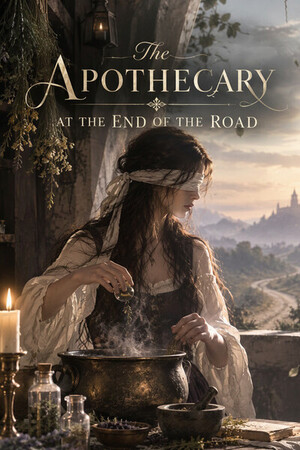
A young woman stood beside a wooden table covered with glass bottles, dried herbs, and strange instruments.
She wore a dark blindfold across her eyes.
She seemed almost unaware of their conversation.
Almost.
“Can you make it?” the traveler asked.
The old woman slowly folded the paper.
“She can.”
Hope flickered in his eyes.
“But whether you should take it…”
The old woman left the sentence unfinished.
A faint sound came from inside the room.
Drip.
The young woman had begun pouring something into a small glass vial.
The traveler watched as her hand trembled.
Only slightly.
Then she stopped.
“Leave,” the old woman said.
His brow furrowed. “What?”
“Take your money. Take your horse. Forget you ever found this place.”
“I can't. My uncle is dying, he has days left.”
The old woman turned away, returning the crumpled paper to him.
“Then spend those days beside him. There is nothing for you here.”
“There has to be.”
His voice broke as he stepped forward.
“I've crossed mountains. I've slept in forests. I've walked for days without knowing where this road would end. I wouldn't have come this far if there were another choice.”
The old woman said nothing.
The traveler clenched the paper in his trembling hand. “Please.”
The word lingered in the quiet room.
Then a quiet voice came from behind them.
“Let him stay.”
The old woman froze.
The blindfolded young woman stood beside the table, her fingers resting gently against a glass vial. The girl turned her covered eyes toward her. “He came this far for someone he loves.”
The traveler looked at her.
She couldn't see him.
And yet, somehow, it felt as though she had.
The old woman looked at the traveler one last time.
“Three days.”
The traveler exhaled shakily.
“Thank you.”
But the young woman only lowered her head.
“Don't thank me yet.”
Her fingers tightened around the vial.
“You haven't seen what it takes to make the medicine.”
The old woman stepped aside.
The traveler hesitated for only a moment before entering.
The air inside was thick with unfamiliar scents—bitter herbs, dried flowers, and something faintly metallic that he could not identify.
His eyes wandered across the room, hundreds of bottles covered the shelves.
Some were neatly arranged in rows, filled with liquids of different shades—amber, violet, deep green, and colors he had never seen before. Others were scattered carelessly across the wooden tables, some half-empty, others containing strange leaves, roots, and fragments of things he could not name.
Several glass bottles lay abandoned on the floor.
Some were cracked.
Others were shattered completely.
He stepped carefully between them.
“What is all this?” he asked.
“Medicine,” the young woman answered.
Her voice came from somewhere behind him.
He turned.
She was standing beside a long wooden table, her blindfold still covering her eyes.
“You make all of these?”
“Yes.”
He picked up a small bottle filled with a pale silver liquid.
“What does this one do?”
“Don't touch it.”
He immediately placed it back.
The young woman tilted her head slightly.
“Some things here are not meant to be handled.”
The traveler glanced around again.
There were bottles everywhere.
Some appeared ancient, covered in dust. Others looked freshly prepared. A few contained liquids so dark that they seemed to swallow the candlelight around them.
“How do you know which is which?”
“I don't.”
He looked at her, confused.
She reached toward the table and effortlessly picked up a particular vial among dozens.
"You want to know what they are?”
The traveler nodded.
She picked up a small bottle filled with dark green liquid.
“This is Serpent's Mercy.”
She turned the bottle between her fingers. “For poison. It can draw venom from the blood before it reaches the heart.”
She returned it and reached for another, this one filled with pale gold. “Sunroot's Grace. For illness. It restores a body that has forgotten how to heal itself.”
The traveler stared at the countless bottles surrounding them.
“And that one?”
The girl followed his voice and picked up a blue vial. “Dreamer's Veil. For the mind.”
“For madness?”
“For memories,” she corrected. “Sometimes those are worse.”
She placed it down.
Her fingers moved across several more bottles. “Widow's Tear. For curses.”
“Emberheart. For wounds that refuse to close. Moonwater. For sleeplessness. Thorn's Breath. For pain. Graveflower. For fevers that have already begun taking the life from a person.”
The traveler glanced around the room.
“And all of these work?”
“Most of them.”
“Most?”
She smiled faintly. “Nothing works every time.”
He noticed one final bottle sitting alone on the highest shelf.
Unlike the others, it was covered in dust.
Its liquid shimmered faintly beneath the candlelight. “What about that one?”
The young woman immediately lowered her hand.
“Nothing.”
“Nothing?”
She turned away from it. “That is Heart's Folly.”
The traveler waited.
She didn't explain.
“What does it cure? Heart? or does it make a heart stop to beat?”
A long silence followed.
Finally, she answered softly.
“The strongest potion in this room.”
Her voice became almost a whisper. “A love potion.”
“It doesn't look very dangerous.”
A faint smile crossed her lips.
“Neither does love.”
The words made him silent.
She continued, her voice strangely distant.
“Poison can kill the body. Illness can weaken it. A curse can follow a person for generations. Even a broken mind can sometimes be healed.”
Her fingers brushed against the bottles beside her.
“But love…”
She paused.
“Love can make a person willingly walk toward all of them.”
The traveler stared at her.
“That's why it's the most powerful?”
She slowly turned her blindfolded face toward him.
“ because every other potion changes something inside the body.”
Her hand hovered near the bottle but never touched it.
“Heart's Folly changes what a person believes they want.”
She lowered her hand. It doesn't force the heart to beat. It teaches the heart what to beat for.”
The traveler glanced at the bottle again.
“And you can make it?”
“I can.”
“Then why don't you?”
For the first time, her voice lost its calmness. “Because every potion has a remedy.”
She looked toward the dusty bottle. “But there is no medicine for a love that was never truly yours.”
The room fell silent.
The traveler didn't know why those words unsettled him.
“Is that why you fear it?”
For a long moment, she didn't answer.
Then she whispered: “I don't fear being loved.”
Her fingers trembled.
“I fear becoming someone who cannot live without it.”
She stepped away from the bottle.
“People think love is about finding someone who completes you.”
A bitter smile touched her lips.
“But if someone becomes your whole world…” She paused. “What happens when they leave?”
The traveler had no answer.
The young woman faced the window, her blindfold hiding whatever lived behind her eyes.
“That is why I never touch Heart's Folly.”
“Because you don't believe in love?”
“No.”
Her voice was almost too quiet to hear.
“Because I believe in it too much.”
The traveler stood perfectly still.
And for reasons he could not explain, those words frightened him more than any curse in the apothecary.
The traveler glanced toward the doorway, the old woman was already gone. He hadn't even noticed when she left.
Only the faint creak of the wooden floor remained, followed by the quiet closing of the door somewhere behind them.
He turned back to the blindfolded woman.
There was no time to waste.
“My uncle,” he said quickly. “The illness he suffers from—it's called the Blackrot.”
The woman's hand stopped.
For the first time since he entered the apothecary, she showed a reaction.
“Blackrot?”
“Yes.”
His voice carried desperation now.
“The physicians tried everything. Herbs, tonics, even medicines brought by traders from across the sea. Nothing worked. His veins have begun turning dark, and every day he grows weaker.”
The young woman said nothing.
The traveler stepped closer. “They told me there was no cure.”
His fingers tightened around the crumpled paper.
“But I heard of this place. They said there was someone here who could make medicine for illnesses ordinary physicians couldn't treat.”
“Who told you about me?”
“A physician.”
She hesitated. “What was his name?” He should not have sent you here.”
“Why?”
She turned her blindfolded face toward him.
“Because the Blackrot is not an illness.”
The traveler froze. “What?”
Her voice dropped to a whisper.
“It is something that happens to a person.”
He stared at her.
“What does that mean?”
She remained silent for a moment.
“Tell me everything about the day your uncle first encountered it.”
The traveler swallowed.
“My uncle was a trader. He traveled from kingdom to kingdom, carrying spices, silk, medicine—anything that could be sold.”
He glanced at the dark bottles surrounding them.
“Three months ago, he was returning from the eastern provinces when he encountered someone on the road.”
“Someone?”
“A mage.”
The young woman became still.
“Not an ordinary mage,” he continued. “My uncle said the man was powerful. More powerful than anyone he had ever seen.”
“What happened?”
“He doesn't remember everything.”
The traveler lowered his voice.
“He only remembers the road becoming strangely quiet. No birds. No insects. Even the wind stopped.”
The young woman slowly turned toward him.
“He tried to pass the mage, but he couldn't.”
The traveler tightened his grip on the paper. “My uncle said the mage looked at him as though he already knew him.”
“What did the mage do?”
“I don't know.”
His voice trembled.
“My uncle wouldn't tell me. He only said he felt something enter his body.”
The young woman’s fingers tightened around the vial.
“And then?”
“He ran.”
“From the mage?”
“Yes.”
The traveler looked down.
“He abandoned his goods. His horse. Everything. He just ran until he couldn't feel his legs anymore.”
“And the Blackrot appeared afterward?”
He nodded.
“Three days later.”
Silence filled the apothecary.
The young woman slowly reached for another bottle.
But before her fingers touched it, she stopped.
“Then your uncle wasn't cursed by the mage.”
The traveler looked at her.
“He was marked.”
She was silent for a long moment.
Then she lowered her head.
“Every year,” she said quietly, “more than a hundred people disappear.”
The traveler’s face tightened.
“Travelers. Traders. Farmers. Children. Sometimes entire families.” Her fingers slowly traced the rim of a glass bottle. “They vanish from roads, from villages, from their own homes. No bodies are found. No ransom is demanded. No explanation is ever given.”
Her voice became softer.
“They are simply… taken.”
The traveler swallowed. “And you think the mage did this?”
“I didn't know.”
There was something almost bitter in the way she said it.
“I thought they were runaways. Bandits. Perhaps people who had fallen victim to something ordinary and cruel.” She paused. “I never imagined a mage was behind it.”
The traveler remembered his uncle running through the forest, leaving everything behind just to escape.
The traveler remained silent, still trying to make sense of everything she had told him.
“So… can you make something for him?”
The woman turned toward the shelves behind her.
“I can try, I've never treated someone with the Blackrot before.”
His heart sank.
“But you know what it is.”
“I know enough to know that it won't be easy.”
He stepped closer. “Then please.”
She reached for an empty glass vial and examined it beneath the dim light.
“Give me two days.”
He stared at her.
“Two days?”
“I'll prepare it for you.”
He hesitated. “And after that?”
“You take it to your uncle.”
“Will it cure him?”
She didn't answer immediately.
Instead, she turned toward the rows of bottles behind her.
“I said I'll prepare the medicine.”
“That isn't what I asked.”
“I know.”
The room fell quiet.
Then she added softly,
“I don't make promises about things I haven't seen.”
The traveler looked at her for a long moment. “Two days, then.”
She nodded.
“Two days.”
The traveler stood there for another moment, as if he wanted to say something else. But after everything he had heard, there was nothing he could think of.
He gave a quiet nod. “Thank you.”
She didn't answer.
He turned and walked toward the door.
After only a few steps, he stopped, for some reason, he glanced back.
The blindfolded woman was still standing beside the table, her hand resting near the empty vial. She looked strangely calm, as though the conversation they had just had meant nothing.
Their eyes could not meet beneath the blindfold, yet somehow he felt as though she was looking directly at him.
He quickly looked away.
He opened the door and stepped outside.
The cold air hit his face, he took a breath, then another.
He had come looking for medicine, now he had two days to return home before his uncle ran out of time.
He tightened his grip on the reins and hurried down the road.
Behind him, the old apothecary slowly disappeared into the mist.
And for reasons he couldn't explain, he found himself thinking about the woman he had left behind.
One day before he was due to return to the apothecary, the traveler found himself in the middle of a crowded festival market.
The streets were filled with music, laughter, and the smell of roasted meat and sweet pastries. Merchants called out from their stalls, trying to draw people toward their goods.
For the first time in days, he allowed himself to slow down.
He stopped beside a stall filled with dried fruits and small cakes.
His uncle used to like these.
He picked up a small packet and turned it over in his hand.
“Maybe he'll like this,” he murmured.
He was about to pay when the noise around him began to change.
The music stopped.
Then someone shouted, “Move!”
People began stepping away from the middle of the street.
A line of armed men was approaching.
They wore dark uniforms and carried swords at their sides. Several walked ahead of a large wooden carriage.
People hurried out of their way.
“What happened?” someone whispered.
“They caught spies.”
“No, traitors.”
“I heard they were working against the crown.”
Milo stepped closer to the edge of the street.
The soldiers marched past without looking at the crowd.
Then he saw the carriage.
It looked less like a wagon and more like a moving prison.
Iron bars covered its windows.
Inside were women. Dozens of them.
Some were sitting on the floor. Others were pressed against the bars, frightened and confused. A few were crying quietly. One woman held a child against her chest.
He stared.
Their clothes were dirty. Some had bruises on their faces. One woman reached through the bars as the carriage passed.
“Please!”
A soldier immediately pushed her hand back inside.
He was about to turn away when something caught his attention.
A movement behind the iron bars.
One of the women had stepped closer to the window.
She was young.
Her face was pale, her hair disheveled, and there was a faint bruise along her cheek. She kept her head lowered as the carriage moved through the crowd.
The traveler barely looked at her, then she lifted her face.
He froze.
From the apothecary.
The blindfolded lady.
The one who had spoken to him about the Blackrot.
“No…”
He stepped forward.
It couldn't be her.
The carriage continued moving.
“Wait!”
He pushed through the crowd.
“Wait!”
Someone grabbed his shoulder. “Don't be stupid!”
He pulled away.
“That woman—”
The carriage was already several steps ahead.
He tried to get closer, but the soldiers blocked the road.
“Move aside!” he shouted.
One of them raised his hand toward the sword at his waist.
“Back away.”
He stopped.
Behind the bars, the young woman suddenly looked toward him.
Her lips parted as if she wanted to say something.
But the carriage moved on.
Milo followed the carriage as it left the festival and passed through the city gates.
He suddenly stopped.
“What the hell am I doing?”
He cursed under his breath.
Milo followed the carriage and stopped before the massive gates of the Empire.
His steps slowed.
Beyond the gates stood the imperial court, where prisoners were brought to be judged.
“So that's where they're taking them…”
The soldiers dragged the captives from the carriage and led them inside.
He knew he should leave.
Instead, he followed.


Please sign in to leave a comment.