Chapter 30:
As in the Gold Mosaic of a Wall
The Empire of the Waning Moon
The throne room was arranged for a small council meeting. Valens sat the throne, but did not wear the Crown of Aurelian. He had been coronated during his first reign, but had not found time to arrange a new coronation ceremony, or even to work out whether one was needed. In any case, when an an emperor was raised, he could be crowned by the Ecumenical Patriarch of Aureliopolis, a vicar acting on the Patriarch’s delegated authority, or if he was being appointed a co-emperor by a monarch already crowned, the incumbent ruler could crown his co-emperor.
The Patriarch had left for the Church Council in Dionysia, and his appointed vicar had been with Alexios when he fled the city. A coronation could not take place, even if time could be made for one. And this council had been called so Petrus could come clean about the full extent of his schemes gone awry, and why there was now no time to be lost.
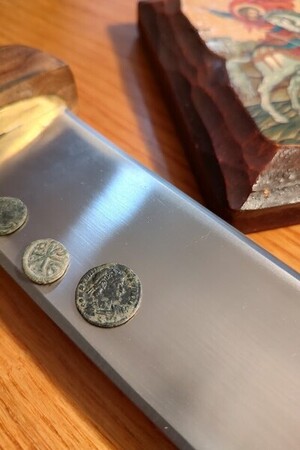
High Prefect Petrus sat across from the emperor, beside the unfinished icon Rufio had been writing when he was attacked, still on its easel. This served as a place for Valens to fix his eyes, when he was communicating telepathically with the iconographer or with Atia. They were now in a city in some inland part of the Hattusan Peninsula. This was the body of land directly across the Strait of Aureliopolis, and a potentially dangerous power base unto itself, should Alexios try to retake the capital. They sat with Alexios and the provincial governor whose mansion had been made his temporary headquarters, ready to relay any terms Valens saw fit to extend.
Hadrian sat beside Petrus, and on the other side of the icon, Princess Thekla, who had been found hiding in the cathedral sacristy, also had a seat. Her guard Sigrid stood close behind her, having refused to leave her side since the day of the coup. Also assembled were the former Prefect of the Guard, Arios, and the new holder of that office under Valens: Aethelstan, Thegn of Wigshire, who had slain Herakleos the Stylite.
Petrus rose, and laid out the full extent of his machinations. “When Alexios took power, and elevated me to the office of High Prefect, I began devising a plan to get Valens back into the city, under the pretense of using his skills as a monster-hunter to deal with Chrysos. It was always my intent to use this as the first step to placing him back on the throne, but two opportunities arose: one giving me a means enact his restoration, the other to ensure he could crush the Empire’s external enemies with relative ease, once he was restored.
“The former came when Alexios cracked down on the hooliganery and racketeering being enacted by the chariot teams. I knew that killing Chrysos would elevate Valens to a popular figurehead, and if the people of the city began to suspect this was the same Valens who had ruled them sixty years ago, the whole thing would be seen as providential, the rightful monarch returning to restore order and dominion over Nature. To amplify this, I suggested beforehand to Alexios, subtly, that Valens ought to be rewarded with a triumph through the streets of the city. From there, getting both the teams to support him against Alexios would be easy. That I could count on the Sixti, too, for support was a given. My mistake was trying to leverage the Nikaphoreans, the very men I had needed to cast down from power to make this all possible, for their ability to reach people with little love for the emperor nor the teams, and for their… less natural capabilities, ones acquired through dealings with the Bolthoi barbarians. In hindsight, trying to control zealots with coercion was an open invitation for them to martyr themselves to undermine me. I knew that Nikaphoros the Elder had championed the ideas he did for personal gain, and falsely assumed those who came after him were just as insincere.
“In any case, it was in my efforts to uncover those Nikaphoreans still in the city that led to the second opportunity. While I believe the issue of Chrysos was not engineered by them, but merely the result of spells Euphemios’ servants had used to control the monster fading over time, they did recognize a problem it was causing, limiting the capital’s ability to communicate with the rest of the Empire, and decide to compound it. Aside from the one Shadowman, which they quietly fed victims to grow into a Leupin and spawn more Shadowmen, they also asked the Bolthoi for some manner of winged monster, one or several to linger outside the city and intercept carrier pigeons. Aside from undermining the regime that opposed them, they sought sensitive information to selectively pass on either to their bishops-in-exile in Rhatia, or to the Bolthoi– careful, of course, not to compromise the bishops’ integrity by letting them know about the dealings with the pagans in the north.
“As Alexios was already eager to arrange an Ecumenical Council to cement the Nikaphoreans’ designation as heretics and normalize relations with the Church in the West, I offered to arrange one in a city near the border with the Aleani– Dionysia, provincial capital of Lyria. I made sure the Nikaphoreans here in Aureliopolis found out about it, and, well, seeing as the Nikaphoreans in Rhatia are making every effort to get close to the King of the Aleani, I was confident they would find out separately.”
Hadrian’s eyes widened, as he worked out where this was headed. “So, you got two separate groups of Nikaphoreans to launch… two separate invasions of Lyria?”
Petrus nodded. “Your brother, the governor, has been sending me an abundance of redundant messages regarding a Bolthoi army advancing through the province. Atia’s son was already on the hunt for the Shadow-spawned monsters they used as scouts, and alerted him before they had crossed the border. He is pulling people and supplies into the best-fortified handful of cities, and his own forces have been shored up by the provincial armies of the neighboring provinces.”
“And the Nikaphoreans in Rhatia have sent…”
“I have an emissary in Rhatia with whom I am telepathically linked. He arrived in the Western Patriarch’s court in Urba Rhatia, not long before that cleric left for Dionysia, then moved on to Catonium, where the King of the Aleani had his court. He has informed me only today that, at the Nikaphorean bishops’ urgings, he is launching his own invasion of Lyria. His army is gathering and preparing to cross the Lyrian Sea as we speak. Dionysia is about to be set on by two invasions, from barbarian cultures who have never met each other on the field of battle. Most likely, they’ll each assume the other to be mercenaries brought in by the Empire, and if not, neither will eager to share the spoils of conquest. In the meantime, we raise an army of our own to relieve the province, and both barbarian armies should be weakened enough by the time it arrives that we can crush both easily.”
“You used the entire leadership of the Church as bait.”
“Because they both so badly want to take Dionysia while the Council is in session, we know both armies will be rushing headlong for the same city. And because the governor knows at least one of them is coming, and has time to consolidate his forces and prepare, actually taking the city will be a difficult enough prospect that neither the Khan of the Bolthoi nor the King of the Aleani will want to commit to encircling it for a siege, until he’s certain doing so won’t expose him to attack by the the other. They will fight outside the walls, and whoever wins that battle will settle in for a protracted siege. We can sweep them away well before they crack the city, if we start gathering our forces now. At least, that was my plan, but…”
“It makes things more complicated,” Arios said, “that we only control half an Empire. We’re in a good position to attract eager new recruits, but can’t do so from anywhere east of Aureliopolis while Alexios is just across the strait, raising his own army. We have those units of the standing Imperial Army stationed in and around the capital, but most of the Palace Guard is dead or with Alexios. The provincial governors have their own standing armies, but Lyria has already called on all its neighbors for help, meaning very few of those troops will be available to us, unless any governors in the east decide they want to fight their way through Alexios to join up with us. Can we take the Aleani and the Bolthoi on, even weakened, with an army only half the size the Empire is capable of mustering, composed mostly of militiamen and green recruits?”
To everyone’s surprise, Princess Thekla weighed in. “You can. I’ve gone over the numbers with my brother before, for a scenario where the Bolthoi attacked while all the resources of the east were committed against the Haxamanids. If we assume that the two weakened barbarian armies would be about equal to our best guess of the Bolthoi’s full strength, your chances of winning in the field will be even or better, if you commit everything. You could maybe leave the private men-at-arms of the noble families behind, but every city garrison would need to be gathered, every militia raised, for every fighter who wasn’t absolutely necessary to maintain law and order. I know it is in my brother’s best interests to convince you to do this, so he could march back into Aureliopolis unopposed, but I genuinely fail to see a way to avoid disaster otherwise.”
“There’s the other matter,” Valens said, “the Haxamanids, and the Hojuzites. Our old enemy in the east is being kept busy by this new threat, for now, but what happens when the Haxamanid capital falls? Will Alexios push west to regain the whole Empire, only for a second horde of Shadow-aligned barbarians to sweep in behind him?”
Petrus slammed a fist against the arm of his seat. “Hojuzites or no Hojuzites, the Hypatioi will not let any of us live, if they win a civil war against us a second time! We have plenty of priests; a few bishops can be replaced. The solution may be to abandon my original plan, leave Lyria for the barbarians to fight over, and crush Alexios immediately. If we end it quickly, we might still be strong enough at the end of this civil war to repel any attack by the Hojuzites. Lyria is only one province, and the mountain passes between it and the rest of the Empire are defensible enough.”
Valens glowed darkly. “They’ll slaughter everyone in Dionysia. My grandson is there, Petrus.”
“And are you forgetting,” the princess added, “that you would see our Church decapitated, even as you turn to fight a religious enemy in the east? Any good will your House has built up with the common people would be lost in an instant; your armies would think that the King on High had abandoned the Empire, and after such a godless course of action, they would probably be right.”
Though he had not addressed them directly, and they had not yet weighed in, Valens had shown Atia and Rufio all of these deliberations, and now Rufio’s voice came to him. “What if you committed everything you had in the west, against the Aleani and the Bolthoi, and I convinced Alexios to do the same in the east, against the Hojuzites?”
Valens repeated his words aloud, addressing the icon to show the others that he was speaking for Rufio.
“Well,” Arios said, “if Alexios is willing to do that, then that solves the external problems. If you both succeed. If one of your or the other dies in battle, then at least the Empire avoids a civil war after the fact. There’s always the chance you both fail, and the Empire is doomed, but allowing a civil war to happen while any of these threats go unaddressed may doom it in any case. If you can do it, Rufio, it might be our best chance.”
“Tell him, as well,” Valens said, “that if we are both still alive when our campaigns are over, I am willing to honor his power-sharing proposal.”
He watched through Rufio’s eyes, as the young iconographer-turned-monster-hunter explained the plan to Alexios.
“Your majesty,” he concluded, “Valens is risking his life and his tenuous grasp on power, to save the Empire. That’s all he ever wanted; the plan to usurp you was never his. He saw the Empire under threat, and wanted to help by leading its defense, but he never insisted on doing so from the very top. Saint Alexios is both your namesake and his patron; he faced a monster far beyond himself, for the sake of his people, and an emperor’s wrath for the sake of his faith. If each of you can stay your wrath against the other, than much, much less is being asked of either of you.”
Alexios cradled his head pensively. “Can he see me through your eyes, right now? Hear me through your ears?”
“He can.”
“Valens. Truly, my quarrel is not with you. Sharing my court in Aureliopolis with you would be a small price to pay, for having it back. But you must understand that there is a man I cannot share it with, the very man who will invariably be responsible for managing it in our absence, should we be gone leading armies on the Empire’s frontiers. I will agree to this plan, crush the Hojuzites against the walls of the Haxamanid capital even as you crush the Aleani and the Bolthoi against the walls of Dionysia, but I must give you a warning. Effective only upon my return to Aureliopolis, I hereby strip your nephew of the office of High Prefect, and banish him from the city. He may still govern in my absence, but if he has not vacated Aureliopolis by the time I return, or ever comes back to it thereafter, I will read up on the creative modes of execution used in the Great Arena of Urba Rhatia under the pagan emperors, so that I might devise for him an exquisitely painful and humiliating send-off from this world.”
Valens turned to address Petrus. “Rufio did it. Alexios will agree to this plan, although of course you cannot remain High Prefect afterward. In fact, it would be very bad for you if you were still in the city when he returned.”
Petrus nodded solemnly. “Something had to give. Though I fear to leave you alone in the palace with Alexios, vulnerable to his and Antoninos’ intrigues without my help. I think this whole arrangement would be more stable if you split control of the Empire geographically, like when at its height it was split between two emperors, before the Western Emperors in Urba Rhatia lost their lands to the barbarians.”
Valens stroked his beard. “...How is the Aleani king raising his army?”
“A levy, a man from each Aleani household in Rhatia.”
“No ethnic Rhatians?”
“A few retainers or mercenaries, maybe, but exempting non-Aleani from conscription is part of how he maintains control. That, and allowing the patricians to keep convening the Western Senate. Giving the Rhatians enough self-rule that it doesn’t feel completely farcical for him to style himself King of the Aleani in Rhatia rather than simply King of Rhatia.”
Valens turned his attention back to Rufio. “And our hostages would remain in place, as a guarantee of this agreement?”
“Of course,” Alexios replied, once Rufio had recited his message aloud, “Truth be told, I would feel safer going into battle with Princess Atia and Sir Lucius riding beside me. Does my sister still have that barbarian guard of hers?”
“Sigrid? She hasn’t left her side.”
“Then she should be safe enough with you. Are we agreed?”
“I’m prepared to give you an extra concession, even. You can have your court to yourself, maintain sole rule of most of the provinces. I’ll be setting up my own capital in the west.”
“Where?”
“Urba Rhatia.”





Please sign in to leave a comment.