Chapter 38:
Epilogue: Flowers for Valemont
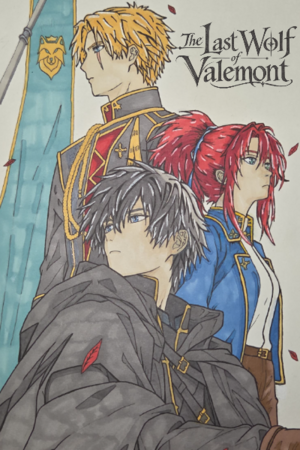
The Last Wolf of Valemont
Three months after the revolution, the capital had become noisy again.
Hammers struck timber where roofs were being repaired, carts rattled through streets crowded with pedestrians, and somebody near the eastern market had spent most of the morning shouting that his pears were cheaper than another merchant's two stalls down.
The other seller disagreed.
I had missed that more than I expected.
Scaffolding still covered parts of the palace district, and several buildings near the gates had been marked for demolition rather than repair. People walked around the damage now instead of stopping to stare at it. Children had started using one broken section of a wall as somewhere to sit.
I liked seeing them there. It made the damage feel less permanent.
A boy ran into me near the old eastern square while looking over his shoulder at his sister. He bounced off my cloak, landed on the road and stared at me as though I had deliberately arranged the collision.
“Are you all right?”
He looked at his muddy palm.
“I fell.”
I crouched and wiped his hand with the corner of my handkerchief.
There was no blood.
He inspected it twice before getting back to his feet.
His sister reached us a moment later, apologised on his behalf and took his hand before leading him towards the bakery.
The door opened as they passed, and warm air rolled into the street, scented with the smell of fresh bread. I stopped, only for a moment, then kept walking and bought flowers from a stall across the square instead.
The woman arranging them didn’t ask where I was going. Most people carrying flowers towards the palace district were going to the same place, and I had been here often enough that she recognised me anyway.
“Blue again, Isabelle?”
“And white.”
She tied them together with a narrow strip of ribbon and refused the extra coin I tried to give her.
After the second attempt, I let her win.
The memorial stood where the southern edge of the palace courtyard had once met the public square.
Part of the damaged outer wall had been left standing behind it, not enough to dominate the street, just enough that nobody could pretend the stone had always looked that way.
Rafael had objected to every proposal involving a statue of himself, and eventually the council had listened. King Rafael Valois had been crowned six weeks ago.
I still occasionally forgot the first word.
The former Emperor had been caught before dawn after taking one of the foundation passages, while Rafael’s brother surrendered before noon. Both were alive, stripped of their titles and waiting for trial.
Rafael looked much the same with a crown, as he had while stealing mobilisation plans for us. He was tired more often now, and there always seemed to be another stack of papers waiting when the last one disappeared.
Father had begun attending the new council twice a week. He came home from those meetings looking exhausted, but he kept going back anyway.
The memorial did not list victories.
It listed people.
Revolutionaries. Civilians. Imperial Knights.
That decision had caused arguments until Rafael pointed out that many of those knights had only been following orders, and their families had lost someone too.
I moved past the larger stones until I reached the one I knew.
Gideon. Marek. Tessa.
Leon Valemont.
The surname still caught me sometimes.
For years it had existed in official records beside words like traitor and conspirator. Now those records had been opened, orders compared, testimony taken, and the old judgement formally withdrawn.
House Valemont had been restored to the founding register, along with the silver wolf beneath the crown.
Leon had not lived long enough to see his name become safe again.
But other people had made sure it would be remembered.
Stories about Carnage had spread through the capital faster than repairs. In one version, Leon had taken the Western Gate alone. In another, he had fought thirty Imperial Knights on the palace steps without being touched.
A man in a tavern had informed me with complete confidence that Leon Valemont carried three children from a burning building while killing six knights.
It had been one child.
I corrected him before realising that explaining how I knew would lead to several questions.
“What was he really like?” the man had asked.
I still didn’t have a useful answer.
Numbers were easier for people: enemies defeated, gates taken, knights who surrendered when they recognised him. Historians could put those things into neat columns and argue over which parts deserved to be remembered.
I remembered him looking offended by bread.
I remembered the window, and the expression on his face when he discovered that I had told Marek and Tessa about it.
I remembered him scanning every room for exits while insisting he was perfectly relaxed, and how difficult he could make something as simple as accepting help.
I remembered that silence usually meant something had reached him more deeply than anger did.
Those parts were not appearing in the speeches.
I was glad.
I placed the flowers beneath the names and adjusted the ribbon when the wind caught it.
Marek would have complained that I had paid for something designed to die within a week. Tessa would have told him that was a remarkable objection from someone who had once spent half his pay on a coat because it had better pockets.
Gideon would have pretended that he hadn’t heard either of them.
Leon would have claimed there were more useful places to stand than in front of a stone, then stayed longer than everyone else anyway.
I laughed once.
It hurt, but not in the way it had three months ago.
I sat on the low wall opposite the memorial, and the square continued around me.
Workers carried timber towards a row of damaged shops. Two children chased each other between stacks of stone until a mason called for them to move. A merchant was arguing with a city guard about the new rules for loading carts.
Nobody lowered their voice because the dead were nearby.
I liked that.
Leon would have too.
He had wanted this.
Not the monument, but the rest of it.
They would talk about revenge, battles and the man he killed in the palace courtyard because those things sounded important enough to survive in history.
I looked at his name again.
Children would probably hear a cleaner version in school. Knights would argue about his fights. Someone would eventually write a terrible play and make him deliver speeches he would have mocked.
I knew the man who argued about windows. The man who knew six escape routes from the guild but needed me to show him where to find breakfast. The man who stood beneath a tree at Valemont and remembered sweets, servants and being eight before he remembered the fire.
I had known him for months.
It somehow felt longer.
There were still questions I had never asked because there had always been another day to ask them.
More about his mother, his father and Elara.
What he wanted the eastern garden wall to look like once it had been repaired.
Whether he would have admitted my knives were a ‘perfectly reasonable’ number.
The bakery door opened again across the square. This time I let the smell reach me without walking away.
For a moment, I could see him in the market exactly as he had been that day: bread in his hand, staring at it with that same uncertain expression.
I had laughed at him, and he looked annoyed.
Then he had taken another bite.
The memory stayed warm even after the door closed.
I rested my fingertips against the edge of the stone. It was cold beneath them, but the square was not.
People kept moving. Somebody laughed near the fountain. A cart wheel struck a loose paving stone, and somewhere behind me a shopkeeper called out to a customer.
Life continued whether anyone was ready for it or not.
I looked at his name one more time.
“I wish I could have spoken to him, just one more time.”








Please sign in to leave a comment.