Chapter 13:
Chapter 13: The Fifth Chair
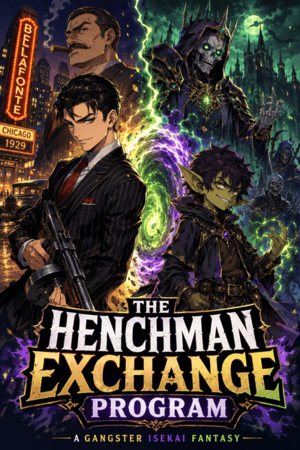
The Henchman Exchange Program
Frankie
The convoy was ahead of schedule.
I was proud of that until I opened the wagons.
We had repaired the south road, got the checkpoints working, and stopped three different officials from charging the same cart for the privilege of passing through the same mud. Freight moved twice as fast now.
Including the wrong freight.
A rider reached the tavern before noon.
“The paladin has taken the bridge.”
I stood.
“Of course he has.”
Brannik put down the cartridge he was examining. Hobb reached for his hammer. Mara took the convoy ledger. Nobody asked whether they were coming.
Good crew.
I checked the Colt before we left. Al better not make me use it in front of them.
* * *
Aldric had dropped a tree across the road without hurting the horses.
He’d also disarmed three guards and broken something inside a black iron box that now smoked beside the bridge.
The guards were tied to a wheel. The wagoner sat on a stone with his hands over his ears.
Al stood beside the last wagon.
“This stops now,” I said.
“Yes,” he agreed. “It does.”
“I gave my word these roads were safe.”
“Open it.”
“You don’t get to tell me—”
“Frankie.”
He had never used my name like that.
I looked at the wagon.
It had a canvas cover, ventilation slits, and my seal on the manifest.
Mara checked the ledger.
“Crown textiles. Workshop allotment. Six skilled hands.”
Six skilled hands.
I unhooked the cover.
There were six people inside.
* * *
They had been chained by the ankles to an iron bar. The wagon floor was wet. One man had a cough deep enough to sound like machinery failing.
An elven woman sat nearest the door. Her gray hair had been cut short with something that wasn’t meant to cut hair. Her fingers were swollen around the knuckles.
She looked at my coat.
“That seam is under intolerable strain.”
I stared at her.
“What?”
“Your shoulder. Whoever repaired it used the wrong tension.”
“An orc threw me into a sideboard.”
“That explains the damage. It does not excuse the repair.”
Behind me, Mara made a noise that might have been a laugh if the wagon hadn’t smelled like a cellar where somebody was dying.
“Name?” I asked.
“Liora Vey.”
“What are you in for?”
“Standards.”
The wagoner looked up.
“She refused the master’s ceremonial commission.”
“He wanted nine collars,” Liora said. “On one garment.”
“That was the offense?”
“That was the beginning.”
She lifted a strip of black cloth from beside her. Light moved in it the wrong way, like something trying to breathe through deep water.
“This was the material.”
Brannik reached out, then stopped short of touching it.
“Soulcloth.”
“Poorly stabilized,” she said. “And he wanted me to put my name on it.”
I looked at Aldric.
“What’s soulcloth?”
“Ask the people who made it,” he said.
The coughing man looked away.
That was answer enough for the moment.
“Break the chains,” I told Hobb.
The head guard jerked against his rope.
“The governor signed their transfer!”
I looked down at my signature on the manifest.
* * *
We unloaded the people first.
Mara gave them water. Aldric treated the coughing man, then sat on the bridge parapet with his eyes closed and his hands shaking. He’d gone gray.
Apparently God let you run up a tab too.
Brannik isolated the cloth inside the broken iron box. Liora told him which edges not to touch. He listened without arguing.
That told me plenty about her qualifications.
The guard kept saying he had orders. So had I. I found that irritating.
“You made this easier,” Aldric said when we were alone.
“I didn’t know what was in the wagons.”
“You knew what the roads served.”
“They serve farmers too.”
“Yes.”
He looked at the six people sitting in the grass.
“Both.”
I wanted to tell him about the farmers again.
Son of a bitch.
“What would you have done?” I asked. “Left the roads broken?”
“Changed whom they served.”
“And every guard along them kills somebody while we change it.”
“That is a danger. It is not a permanent answer.”
The wagoner stood behind us holding his cap.
“Will I still be paid?”
Finally. Something I could settle with money.
“Yeah,” I said. “You brought the shipment.”
I looked at the empty chains.
“We changed the destination.”
The wagoner tucked his cap under one arm.
“Shall I still take the northern road tomorrow?”
“What’s tomorrow?”
“Another allotment. From the hill villages.”
He might have been asking about flour.
I took the dispatch book from him. Six journeys completed since we’d repaired the bridge. Before that, the same run took most of a week. Now they could do it in two days.
I’d paid a bonus for that.
“Give me every manifest.”
The wagoner went to fetch them.
Al sat beside the coughing man, holding water to his mouth. He didn’t look up to see whether I understood yet.
That helped less than it should have.
I’d been counting full wagons. Taking pride in how little time they spent standing still. Somewhere in my office there was a neat column showing how much better I’d made all this.
I wanted to tear the book in half.
Would’ve made a fine display. Still wouldn’t tell me who was in the other wagons.
I waited for the papers.
* * *
Azrath heard my request through the fortress steward that afternoon.
Six artisans transferred to the town’s reconstruction effort. Independent contracts. Freedom to refuse work. Costs deducted from my share of the next tribute.
The steward read the terms three times.
“You are paying to diminish your control.”
“I’m paying to get work worth paying for.”
The Boss approved.
He sent back a note in his own hand.
Your methods continue to amuse me, Francesco. Show me what your freedom produces.
Below that, he had answered my report about the timber.
You recovered three wagons without spending a soldier. The brother survived a disagreeable afternoon. I wish more of my governors understood proportion.
I read that part twice. The bridge crew had work. Corven had gone home. Al was the only man still treating the whole thing like a crime.
The Boss understood what a governor had to do.
I put the note away before anyone saw how pleased I was.
Six people were free, and I’d managed it with the Boss’s blessing. Good day’s work.
Except for my signature on the other paper. That one was still in my pocket.
I took it out when the office was empty.
The F had a little sweep beneath it. My mother had made me practice that until it looked respectable.
I’d signed for the new bridge and Mara’s wages with the same careful sweep. And for a wagon full of people chained to a bar.
I flattened the paper on the desk. Tomorrow I would inspect every convoy. Make them write names instead of allotments. I started a list. By the third instruction, my breathing had settled.
There. Something I could fix.
I did not put leaving the Boss on the list.
At the tavern, Mara asked each of the six where they wanted to go. Two had family nearby. One wanted a place in the church until his lungs improved. We arranged carts and rooms.
The coughing man asked for his release in writing.
I told him it had already been signed.
“For me to keep,” he said.
I brought him his own copy. Mara read every word aloud while he followed the shape of the seal with a finger.
“What happens if I can’t work?”
“You get better.”
“And if I don’t?”
There was always sitting work. Counting deliveries. Keeping an eye on the cellar.
I was about to say so when he coughed again.
He wasn’t asking me for a job. He wanted to know if I’d put him back in the wagon.
“The paper doesn’t change,” I said.
He looked down at it.
“You still paid for me.”
“I paid to end an arrangement. It ain’t a loan.”
He folded the document carefully and tucked it beneath his shirt, where sweat would probably ruin it before the season changed.
Mara found him an oilskin sleeve.
Liora watched from the other side of the room. She had said little since leaving the wagon. Now she asked whether he would need medicine, and when Mara said yes, she described an herb that helped the lungs without making the patient sleep through his own meals.
Nobody had paid her to notice that.
I liked her. Probably gonna be expensive.
Liora requested a bath, clean clothes, and an explanation of my lapels, in that order.
I considered her remarkably reasonable.
* * *
She examined my suit as though conducting an autopsy.
“Take it off.”
Mara looked up from the desk.
“The jacket,” Liora said. “I have suffered enough today.”
I took it off.
She turned it inside out and ran a finger along the lining, pausing at the pockets and shoulder padding. The little stitches under the collar held her interest.
“Who made this?”
“A man in Chicago who charged too much.”
“Apparently he did not.”
She wanted to know why the trousers had a crease, why the waistcoat ended where it did, how the pocket watch sat, and why the jacket needed room under one arm.
I showed her the holster.
“Of course.” She caught my cuff.
“That mark. Where did you acquire it?”
I turned my wrist.
“The trip over.”
She studied the pale curve without touching it.
“A binding left in place.”
“Can you follow it back?”
The question came out too fast. Mara looked up.
“It is still caught in the spell that made it,” Liora said. “I can see where the thread enters the knot. That does not tell me where it comes out.”
“If you find out, you’ll tell me?”
“Yes.”
I pulled my sleeve down and nodded toward the jacket.
“Can you make another?”
“Yes.”
“Something that stops swords?”
“I can make you a suit. Once I understand the garment, we may discuss ruining it with your profession.”
Brannik grunted from the corner. Approval, I thought.
She named a price.
I tried to negotiate. She handed the jacket back.
I accepted the price.
“There are conditions,” she said.
“I figured.”
“No royal ceremonial work. No soulcloth. No claiming that because you purchased my release you purchased the use of my hands.”
I held up the contract.
“You can quit.”
“And if I refuse a commission?”
“Then I complain about you being difficult, and we discuss the next one.”
She considered that.
“Acceptable.”
Hobb dragged another chair to the table.
We were running out of space.
It seemed like a good problem to have.
* * *
Aldric stopped by after dusk.
He looked at the empty chains Hobb had left beside the door, then at Liora measuring a sleeve.
“They are free?”
“Ask them.”
He did. Didn’t take my word for it. Smart. Annoying, but smart.
When he returned, he set my convoy manifest on the desk.
“You should keep this.”
“To remind me?”
“To show anyone who asks how it happened.”
I folded it once.
“You could leave him,” Aldric said. “You need not wait until every alternative is gone.”
“He agreed to the release.”
“Of people he imprisoned.”
“Al.”
He waited for the rest.
I didn’t have any.
Then he left.
I put the manifest in the top drawer instead of burning it.
I shut the drawer, then checked it was shut.
* * *
Mara knocked after everyone else had gone to bed.
The door stood open a finger’s width. It usually did.
“Liora wants to know whether you sleep in the waistcoat.”
“Only when life goes badly.”
She came in carrying the repaired jacket.
I sat on the edge of the bed, the lamp still lit. I’d left the seal downstairs. Anybody needing a governor could come back tomorrow.
Mara hung the jacket on the chair.
Then she touched the door.
“You never lock it.”
“Wouldn’t want to inconvenience a burglar.”
She waited.
I rubbed the back of my neck.
“Got shut in a meat locker once. Kid stuff. Some older boys thought it was funny.”
“How long?”
“Long enough.”
The smell came back if I let it. Cold iron. Old blood. My own breath getting louder because nobody outside could hear it.
I didn’t let it.
“So the lamp stays,” she said.
“And the door.”
She nodded.
She didn’t ask what happened to the boys or tell me the door was open, like I was too stupid to see it. I appreciated that.
She poured me a cup of water from the washstand. I took it from her.
“Sit a while.”
She drew the chair beside the bed and smoothed her skirts. Then she told me about Della arguing with Rosella over how to wash tablecloths. I told her both women were terrifying and we oughta surrender the laundry before anyone got hurt.
She laughed quietly.
For the first time all night, I forgot to watch the door.
She left the door exactly as she had found it.


Please sign in to leave a comment.