Chapter 10:
Chapter 10 - Ursa
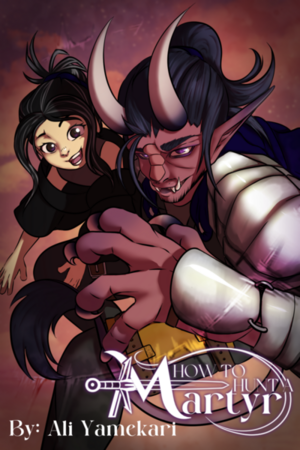
How To Hunt A Martyr
The moor took no interest in them, which came as a relief.
For the first two days it simply went on. Heather rolled away in every direction, purple deepening to brown along the ridges, broken here and there by outcrops of gray stone slick with lichen. The sky sat enormous and low. By the second morning Ursula had stopped looking for landmarks, since there weren't any. She looked at smaller things instead: a clump of bog asphodel gone yellow against the black peat, the bright green skin of moss on the north side of every rock, the little brown birds that burst out of the grass at her feet and flung themselves away in a panic of wings. Seth walked a few paces ahead with the pack on his back and the helmet on his head. Every so often he stopped and stood perfectly still, his face turned toward the horizon, and then went on again without saying why.
They kept to low ground, in the hollows between ridges, and he would not let her walk along a skyline at all. When she asked, he said a person on a ridge could be seen for five miles, and that was all the reason he gave.
The fog came on the first morning, rising out of the hollows like breath. It swallowed the heather ten paces out, then five, until the whole world was a soft gray room with the two of them walking through it and no walls at all. Sound came strangely. A curlew cried somewhere to the left and seemed to be crying from everywhere. Water beaded on her cloak and on the wool of the fox pelt and hung from the end of her nose, and she could hear Seth's armor creak a little ahead of her, the only thing in the world she could be sure of. He put a gloved hand on her shoulder once when the ground fell away without warning, and kept it there until the slope leveled out. The sun burned the fog off around noon, all at once, and the moor stood revealed around them, glittering and wet and enormous, as if it had been there all along and had only been waiting to be looked at.
The rain came on the second day, driving in sideways from the west. It found every gap. It ran down the back of her neck and into her boots, and the grease from the little tin did nothing at all against it. They took shelter under an overhang of peat bank where a stream had cut into the hillside, a low black lip of earth that smelled of soil and old leaves, and Seth took out his dagger and cut turves from the bank, thick brown bricks of them, and stacked them into a little hearth. They caught slowly. The smoke was thick and sweet and a little sour, and it made her eyes run, but the heat was real. She hung her wool socks on a stick to dry and held her hands over the glow, and the rain hammered on the earth above their heads like a hundred fingers.
"I'm naming the rain," she announced.
"Are you."
"Dennis."
He considered that. "Dennis is very persistent."
"He's got a lot to say."
"He does." The helmet tilted toward the downpour, and she could have sworn the gesture was respect.
She named a lone rowan tree in the middle of a wide brown flat, hung with berries as red as spilled paint, and called it Mildred. She named a sheep's skull, bleached white and grinning in the heather, Gregory, and put a small stone in his eye socket in case he wanted to look at something. She named a stream Tuesday. Every name got the same answer, a small sound in his throat and a slightly different tilt of the head, and by the third day she had begun to keep count of them, as other people counted coins.
At night he named the stars.
She hadn't asked. On the first clear evening he simply sat down on the far side of the peat fire and tipped his head back. "That one's the Ploughman," he said. She looked where he was looking, and after a moment she found it: a crooked line of six bright points with a fainter seventh trailing behind like a dropped tool. The next night he named another. The Lantern, the Two Sisters, the Ferryman, who stood alone on the northern edge of the sky with a single red star for his lamp. He said them plainly, one at a time, and never explained where he had learned them. She did not ask. It was one of the small things she had stopped asking about.
She noticed something else in those days, too, though it took her until the third night to put it into words. She had never once seen him sleep. He lay down sometimes, on his back with his hands folded on his breastplate, and the helmet turned up toward the sky. Whenever she woke in the night, and she woke often, he was sitting up again with his eyes on the dark, exactly as he had been the last time she looked.
On the evening of the third day they came to the stones.
They stood on a low rise where the moor swelled up out of a shallow valley, twelve gray pillars in a ring, and at first she took them for a group of people standing very still. They were taller than Seth, most of them, rough-shouldered and leaning at odd angles, crusted with pale lichen the color of old bone. The tallest stood a little apart from the rest on the western side, and it had a hole worn clean through it near the top, so that the last of the sunset came through it in a single burning coin and lay across the grass at her feet.
"Old," she said.
"Older than the kingdom." He walked into the ring and laid his glove flat against one of the pillars, as he had against the gelding's neck, and stood there a moment. "Nobody knows who put them here. Nobody has for a long time."
"Do they do anything?"
"Stand." That was all he offered. But he made camp inside the ring, and she noticed that he had put his back against the tall stone before he sat down.
There was no fog that night, and no wind, and the sky was so clear that the whole ring seemed to float in it. The peat fire smoked and glowed. She lay on her side with the fur pulled up to her chin and looked at the tallest stone, and at the hole through it, and at the Ferryman's red lamp burning in the gap.
"Seth."
"Yes."
"Did you ever see him? The Demon King."
The fire popped. For a long moment she thought he wasn't going to answer, and she had already started preparing to be told it didn't matter.
"I saw him work," he said.
She held very still.
"Once." His voice was low and even, the voice he used for facts. "It was loud. That's the first thing. Fire and breaking, mostly. Walls coming down, the ground opening. When he wanted an army to move, it moved, and he never had to raise his voice to make it. That was all he did." A pause, and she thought his hands tightened on his knees. "Burn things and command things. Nothing else. I watched him for a long time, and I never once saw him do anything gentle."
"Not even a little?"
"Not once." He turned his head toward her, and the firelight ran along the dented curve of the helmet. "What you did in that square, I've never seen anyone do it. Not him. Not anyone. He'd have set the beast on fire to make it stop. That was his idea of quiet."
She thought about that. It should have been a comfort. She was not sure why it wasn't.
"Am I like him?" she asked.
"No."
He said it at once, almost before she had finished the question, hard and flat and without so much as a breath in between. It was the fastest answer she had ever heard him give.
"You don't even know," she said.
"I know." The word came out rough. "Go to sleep."
She did not, not for a long while. She lay and watched the Ferryman drift out of the hole in the stone, and thought about a man who could say he had seen the Demon King work and never say when, or where, or how close he had stood. She thought about how quickly he'd said no. Somewhere in the middle of it, she fell asleep, and when she woke in the gray before dawn he was sitting exactly as he had been, with his back against the tallest stone and his face toward the dark.
They left the ring at first light and walked south. The moor was quiet. By midmorning it had stopped feeling like a thing they were crossing and started feeling like a place they lived.
She saw the flash at noon.
It was a small thing, a spark of light from a distant ridge, gone before she was sure she had seen it. She said nothing, and for a few steps she told herself it was a puddle catching the sun. Then it came again, higher up and farther to the east, a tiny bright wink like a dropped coin, and a third one flickered a mile beyond that.
"Seth."
"I see them." He had stopped. He was standing quite still, with his head tilted, exactly as he stood when he listened for something, and she understood that he had seen the first flash too, and had said nothing, and had let her find it herself. "Get down."
She dropped into the heather. He crouched beside her and looked for a long time along the line of ridges, and though she couldn't see his face she could see the tension in the set of his shoulders, gathering and holding.
A horse came over the shoulder of the far hill. Then another. They came in a loose line, at an easy canter, twelve or fifteen riders in white cloaks that streamed out behind them like torn clouds, and at their head someone carried a long pole with a banner snapping from its tip. Ursula couldn't make out the design at that distance. She could make out the color, deep blue, and something gold in the middle of it, a single bright circle that flared each time the wind lifted the cloth.
"Who is it?" she whispered.
"The crown." He didn't take his eyes off them. "That's the crown's banner. Gold sun on blue."
Her stomach dropped. "How did they find us? We've been out here four days."
"Four days across open moor, with no roads and no towns." His voice was very quiet. "That isn't hunting. Somebody's leading them." He turned his head toward her. "The square. What you did. Someone felt it, and they've followed it here."
"I didn't leave any trail. I didn't leave anything."
"You did. You rang like a bell."
She stared at him, and then at the riders. They had reached the bottom of the valley and were spreading out in a wide, patient fan across the heather. In the middle of the line she saw a thin figure in gray who rode a little apart from the others, holding something out in front of him in both hands. Something round and glass, caged in brass, with a light inside it.
"We can't outrun horses," Seth said. "So we choose the ground." He stood, and hauled her up beside him, and turned them both north. "Back to the stones."
They went back at a run. It was the hardest she had ever run in her life, harder than the market square, harder than the forest with the chain dragging at her ankle. Seth took her wrist and didn't let go, and half the time he simply lifted her over the ground, and the heather tore at her boots. The riders were pacing them. She could hear them now, the drumming of hooves rolling across the hills like distant thunder, and once a horn sounded, a single high note that seemed to come from everywhere at once.
They reached the ring in the late afternoon. The sun had dropped low enough to turn the whole moor gold and red, and the stones threw long, blue shadows across the grass. Seth pushed her toward the tallest pillar, the one with the hole worn through it, and set her back against it.
He pulled the pack off his shoulders and dropped it at her feet. Then he crouched in front of her, so that the helmet was level with her face, and put both gloved hands on her shoulders.
"Listen to me. If this goes wrong, you run." His voice was low and steady, and it left no room. "You don't wait. You don't look back, and you don't come for me. You go down the far side of the hill and you keep going until dark, and you hide in the heather. Do you understand?"
"You're going to win."
"Run, Ursa." His tone switched
She stared at him. He had never shortened it before. It came out of him rough and quick, as if he had been carrying it a long time and had only now set it down, and something in her chest turned over and stayed turned.
"Say you understand."
"I understand," she lied.
His hand came up as though he meant to touch her face, and stopped. Then he stood, and turned around, and walked out of the ring.
She crouched behind the stone with her cheek against its cold, rough skin and watched through the gap between two pillars. The riders came over the rise in a line, then wheeled, and halted in a wide half circle a hundred paces out, white cloaks fluttering, horses stamping and blowing. There were fourteen of them. She counted twice. They wore deep blue tabards under the cloaks, each stitched on the chest with the same gold sun, and their helmets were plain and rounded, without plumes. In front of them, on a heavy bay horse, rode a broad, gray-bearded man with a nose that had been broken flat a long time ago and never quite reset. He sat the horse as though he had been born on it and no longer noticed.
The thin man in gray sat his horse a little to one side. He carried the brass-caged globe balanced in both palms, and the smoke inside it glowed violet and roiled slowly against the glass. As Ursula watched, the smoke leaned. It bent like a reed in a current, and pointed straight at the tall stone where she was hiding.
She stopped breathing.
"In the name of the queen!" The gray-bearded man's voice was a parade-ground roar, worn hoarse with use. "You are ordered to surrender the child and submit to the crown's judgment! Do it now, and the crown will hold your life!"
Seth stood alone in the grass between the stones and the riders. He did not answer. She saw him roll his shoulders once, slowly, as he had done in the cave, and then he did something she had not seen him do since the night she first met him. He took off his gloves.
He dropped them in the grass, one at a time. His hands came out black-clawed and huge in the red light, the knuckles knotted, and a ripple went along the line of riders, a murmur and the creak of leather as horses shifted.
"Demon," someone said, quite clearly.
"Take him alive," the captain said. "Alive. That's the order. Bring him breathing."
The first three came at a gallop.
They came in a wedge with their lances leveled and their white cloaks streaming, and Ursula shut her eyes. She heard the drumming grow louder and then break, a single scream of metal, and a cry, and when she forced herself to look he had not moved from where he stood. The lead rider was in the air. Seth had stepped inside the reach of the lance and caught the shaft in one fist and pulled, and the man came out of his saddle and hit the heather ten feet away with his helmet turned the wrong way around on his shoulders. He did not get up. The lance was in Seth's hand, spinning end over end.
He drove it through the second rider before the man could wheel. It went in under the breastplate and came out of his back, and the rider rode on three strides with the shaft standing out of him, then folded slowly over his saddle bow and slid to the ground. The third swung a sword. Seth took the blow on his forearm plate, and sparks flew, and his other hand closed on the man's throat.
One, Ursula counted. Two. Three. Counting was what she did. She could not stop.
The rest came in after them, and he met them.
She saw it in pieces. A helmet caving in under a black fist. A man reaching for his sword and finding his arm gone at the elbow, staring at the place where it had been. A body flung sideways into another, both horses screaming and bolting. A claw opening a man from hip to ribs, and the man sitting down in the heather with a look of great surprise. It was fast and terrible and quieter than she had expected, no roaring, no shouting, only the wet, hard sounds of it and the horses' cries and the captain's voice still calling over everything. "Alive! Alive, damn you!"
Four. Five. Six.
He never touched a horse. Even now she noticed it, even with the numbers running through her head. The animals wheeled and shrieked, and each time one came too close he turned aside, ducked under a neck, caught a bridle and pushed the great head away with a low sound, and once he laid a hand flat on a plunging mare's shoulder and she stood trembling and let him. It was only the men. It was only ever the men.
Seven. Eight. Nine.
She stopped counting, and wished she had stopped at three.
Nine of the fourteen lay in the trampled heather among their loose horses, and the five who were left had pulled up in a ragged knot with their swords out and their faces gone white. Nobody charged. The captain sat his bay at the back with his mouth set in a thin line and the whole slaughter reflected in his flat gray eyes, and he did not raise his voice again. "Spread out," he said quietly. "Flank him. Brannock."
One of the five slid down from his saddle and went around the ring on foot, crouching, keeping the stones between himself and the fight. She saw him because she was watching everything, because she had not run. She had meant to. She had told Seth she understood. She had crouched behind the tallest stone with her heels dug in and her whole body screaming at her to go down the far side of the hill, and every time she tried to make her legs turn she saw a white cloak going down in the grass and could not. The crossbowman came up on the far side of the ring. He stepped into the gap between two pillars. He brought the crossbow to his shoulder, and the bolt pointed at the middle of Seth's back.
Seth had his face toward the riders. He couldn't see him. Ursula could see the man's finger tightening.
She did not decide anything.
She was on her feet with her hand thrust out before she had even opened her mouth, palm forward, fingers spread, and the cold came up out of her chest like a held breath let go.
The air turned to water.
It happened all at once. A soft violet ripple swept out from her palm in a widening ring, and wherever it touched, the world slowed. The wind stopped. Grass stopped bending. The bolt, which had left the crossbow with a flat slap, hung in the air ten feet from Seth's spine, spinning slowly, as though it had been dropped into deep water, and then it drifted sideways, and tumbled, and fell harmlessly into the heather.
The whole ring had gone silent.
Then she felt it, the burn in her right hand, a cold so bright that it hurt, as far from fire as anything could be. She looked down. The lines were there in the daylight, in front of everyone. They ran out from the center of her palm across the whole of her hand, pale violet fires that glowed against her skin and branched to the ends of every finger and up the inside of her wrist, and the light of them was bright enough to throw shadows on the stone.
Seth had turned around.
He was looking at her hand. She watched him take in the branching light and the shimmering ripple still fading in the air, and she saw the fight go out of him all at once, as if a string had been cut. He stood among the bodies with his bare, clawed hands hanging open at his sides, staring at the pale lines that ran across her palm and up her wrist, and what showed in the strip of his eyes was horror. Anger would have been easier. It was the flat, sickened horror of recognition, as though something he had buried a long time ago had just walked up out of the ground and stood in front of him wearing her hand.
He knew what it was. She understood that with total certainty. He knew exactly what it was, and it was worse than anything he had imagined. She could read it on his face.
"There," said the thin man in gray.
He was off his horse. He was standing in the grass with the brass globe held high, and the smoke inside it had flared into a blinding violet, straining at the glass toward Ursula's outstretched hand. His face was young and drawn, and there was awe in it, and fear, and something that looked very like hunger.
"That's her," he said. "That's the working. And the mark, Captain, look at the mark. It's exactly as the records describe."
He said a single word. She didn't understand it and would not have been able to repeat it afterward. It sounded like a stone dropped down a well. Pale cords of light burst out of the globe, out of the air itself, and lashed around Seth's arms and legs and body, and where they touched, silver runes flared in the shape of chains. He staggered. He tried to lift an arm and the cords tightened, and the whole huge frame of him went down on both knees in the grass, fighting every inch, the muscles standing out under the plate.
"Seth!"
She started forward. Hands seized her from behind. She kicked, and screamed, and a rider hauled her up off the ground by the collar of her cloak, and she felt cold steel press flat against her throat.
"Easy," the captain said.
He had ridden up beside her. Up close, his face was a landscape of old scars, gray eyes as flat as pond ice, and there was no cruelty in it. That was the worst part. He looked like someone who had done a great many things he did not like and would go on doing them.
"Orders are to bring you breathing, girl," he said. "Both of you. Nobody said anything about unhurt." He turned his head. "Demon. You can kneel where you are, or the child pays for the difference. Choose."
Seth did not fight the cords again. He was looking at her, not at the captain and not at the knife, and there was nothing in his face that she could read. Then he lowered his hands to the grass and bent his head.
"There," said the captain softly. "That's the sensible thing."
Her right hand had gone out of light. She looked down at it, and it was only a hand again, small and dirty, shaking so hard she could not stop it. The mage was watching it. His eyes had not left it once.
"The bands," he said, without turning. "Before anything else. Both of them."
They were kept in a leather satchel on his saddle, and he brought them out one at a time and laid them across his palm like something precious. Narrow rings of dull gray metal, no wider than her thumb, etched from edge to edge with runes so fine they looked like hairs. He knelt in front of Seth first, and two riders wrenched Seth's arms behind him, and the gray bands closed around each wrist with a small, precise click.
Seth's whole body jerked. It was a slight movement, but she felt it through the ground. His head dropped, and for a moment she thought he had fainted. Then it came up again, slowly, as if it weighed a great deal, and a low sound came out of him, a sound she had never heard him make, half a growl and half something else.
"It passes," the mage said, almost kindly. "Or it doesn't. Sleep, if you can."
Then he came to her.
The rider holding her pulled her arms behind her back. She felt the bands close, and the cold went into her wrists like a blade of well water, so cold it burned. She gasped. Then it spread. It climbed her arms and slid down through her chest and belly, and where it went the light in her chest went quiet, one lamp after another, like a house being closed up for the night. She reached for the cold place, the place where the magic lived, the way she might reach for a stair in the dark. There was nothing there. Nothing at all.
A weight came up through her like water rising in a well. Her arms went slack. Her head sagged. She felt her knees go, and the rider caught her, and she heard someone say from a great distance, "She's out already." She wasn't out. She was awake, in a thick, warm, terrible way, unable to lift her head or find the words she wanted, and she understood that she couldn't have raised a hand to save herself if the whole sky had fallen.
They searched the pack on the ridge, in the last of the light.
The nine were laid out in the heather under their own white cloaks. Nobody had spoken of them. The five who were left moved among the dead and the loose horses with the flat, careful hands of men who had seen worse and were trying not to look, and a couple of them had cuts they had not yet noticed. Two riders knelt over the pack with a lantern. Oat cakes. The cheese in its wax. A coil of cord, the tin of grease, the dagger, the strip of blue cloth, everything laid out in a neat row on a spread cloak. Seth knelt in the middle of the ring with the silver cords pulsing along his arms and the gray bands dull on his wrists, and every so often his helmeted head sank and jerked up again, sank and jerked up, and she watched him fight it, and lose, and hate it.
At the bottom of the pack, one of the riders found a bundle wrapped in sacking.
He turned it over, frowning, and pulled the cloth away, and the light of the lantern fell on the cracked pauldron. Ursula had watched Seth wrap it four days ago and hadn't asked. It lay in the rider's hands, an old, pitted curve of steel with a chain of rust along one edge, and the rider made a small disappointed sound, as if he had expected gold.
"Captain," he said. "Just old plate."
The captain came over. He took the pauldron, and tilted it toward the lantern to look at the surface, the scratches and the salt-bloom of rust, and held it for a moment in silence. Then he ran his thumb along the outer curve, where the metal had been rubbed smooth by years of wear, and stopped.
Ursula saw the moment he found it. She couldn't have said how. It was in the set of his shoulders, in his thumb going still, in the lantern light shivering slightly where his hand shook.
There was something under the wear. She could see it from where she sat, when he turned the plate: a shape scratched into the steel so long ago and rubbed so nearly away that it looked like a trick of the light. A ring of oak leaves. A star at the center of it.
The captain's face went the color of candle wax.
He did not say anything. Nine men lay dead in the grass behind him, and he stood in the lantern light and stared at a piece of old armor. He turned his head very slowly and looked at Seth, at the dented helmet and the bowed head and the kneeling shape in the middle of the stones. Then he looked back down at the pauldron in his hands, and he wrapped it again in its sacking with fingers that were not quite steady, and held it against his chest as though it might break.
"Ride ahead," he said to the nearest man, and his voice had gone rough and strange. He drew the rider aside and spoke to him for a long moment in a tone too low for Ursula to catch, and she heard only the end of it. "...to the queen. Only to the queen. Nobody else."
The rider was gone into the dark inside a minute. His hoofbeats faded west across the moor.
"What was that?" Ursula whispered, or tried to. Her tongue was heavy. The words came out thick.
Nobody answered her. She looked at Seth, and his head was bowed, and she could see nothing at all through the visor. She thought he had heard, though.
They marched through the night.
The wagon was a day away, the mage said, waiting at a drovers' road on the edge of the moor with an escort of spearmen, and there was no sense in staying where a fight had been. The nine were tied across their own saddles and led behind on tethers. A rider took Ursula up in front of him, a hard-faced man with a gray-streaked mustache who held her upright by her collar when she slid, and did not say a word. Seth walked. The rune-cords held him at a plodding pace, six paces behind the captain's horse, the mage riding at his shoulder with the globe held out. Twice he stumbled. The second time he went to his knees in the heather, and a guard leveled a spear at his throat, and Seth lifted his head and looked at the man through the visor until the spear began to shake and the man stepped back.
She watched him the whole way, over the rider's arm, in the thick, warm dark of the drowsiness. He did not look back at her once.
The night was cold and clear and endless. Stars turned overhead. She found the Ploughman, and the Two Sisters, and the Ferryman low in the north with his single red lamp. She named them silently, in his order, one at a time, but the names kept sliding away from her, and she could not hold them. Somewhere near dawn she slept, and did not dream.
The wagon was waiting exactly where the mage had said, on the edge of a drovers' road under a white morning sky, with twenty spearmen drawn up around it in two lines. It was a big, black, iron-barred box on wheels, bolted to a wagon bed and drawn by six heavy horses. It was not like the cage in the market town. It was bigger and better made, and every bar was etched along its length with fine silver lines, and down the middle of it ran a second wall of iron lattice, so that the box was divided into two halves with a narrow, barred gap between them.
They put Seth in the larger half. It took six men, with the cords holding him and the spears leveled. They chained his wrists behind his back to a ring in the floor and his ankles to another. When the last lock clicked shut the cords unwound from his arms, and he slumped against the bars with his head down, breathing slowly.
"When these come off," Seth said, into the silence. His voice was very low. It was the first thing he had said since the ridge. "I'll kill every man here."
The captain regarded him without expression. "Then we'll see they don't come off."
They put Ursula in the other half. She did not resist, because she could not. The rider lifted her in, and set her on the straw with her arms wrenched behind her and her wrists chained to a ring, and her ankles shackled, and she sat there with her head hanging and her lip between her teeth. The lattice was a hand's breadth from her left shoulder. Through it she could see Seth, big and dark and slumped against the far bars with his helmeted head turned away.
"Seth?"
He did not move.
"Seth. I'm sorry. I'm sorry I hid it."
Nothing. Not so much as a shift of the shoulders. She swallowed. The bands were cold around her wrists, and the drowsiness pressed down on her like a hand, and she thought that if she could only find the words, the right words, he would turn around.
She could not find them.
"Nobody speaks to the girl," the captain said to the guards, from somewhere above her. "Nobody touches her. Not a bruise. If she goes to the capital marked, you'll answer for it."
There was a murmur. A young soldier near the wagon, red-faced, spat between the bars at Seth's side, and Ursula saw the captain's hand close on the man's collar and haul him off his feet and out of sight. A moment later she heard a sound like a fist meeting a face, and after that nobody spat at anything.
They rode three days toward the capital.
She slept through most of the first one. The drowsiness came in waves. It washed her under and let her up, and each time she surfaced she reached for the place in her chest where the light lived and found it dark, like reaching for a stair that was not there. She woke to the creak of wheels and the sway of the wagon and the sight of the sky through the bars, white and vast, and to the sight of Seth's broad back on the other side of the lattice. He did not turn. Sometimes his head drooped, and she watched it sink, and jerk up, and sink again, and knew from the way his shoulders locked that he hated every one of those moments.
They fed them at noon. One bowl of gruel each, thin and gray and barely warm, a heel of bread as hard as a roof tile, and water from a dipper. Two guards unlocked one wrist chain from her, the left one. Ursula bent over the bowl like an animal. Her hand shook so badly that half the gruel ran down her chin. Across the lattice, Seth refused the food without a sound and did not look at her once. When the count was up, the guards locked her wrist again.
The mage rode beside the wagon most of that afternoon, with the globe wrapped in a gray cloth in his lap and a small book open on his knee. He watched her through the bars, openly, without embarrassment. Toward evening he drew his horse up close.
"Does it help?" he asked. His voice was quiet and eager, a young voice, hoarse with excitement. "The bands. Is the cold quieter? Can you feel anything at all?"
She said nothing.
"You needn't be afraid of me." He smiled, and it made his face look younger, and she liked it less than the fear. "I only want to understand it. It's been a years since anyone saw a mark like that. Perhaps more." He waited. "Do you hear things? When you use it? The old accounts say..."
"Enough, Brannock," the captain said, from farther up the line.
The mage sighed, and drew back, and made a note.
The moor let them go slowly. The heather gave way to grass, the grass to hedges, the hedges to fields of stubble gold under a white autumn sky. Villages came, and passed, low thatched places with smoke going up from every roof. Word had run ahead of them. She understood that on the second afternoon, when the wagon rolled through a little market town and every doorway held a face. People lined the road. They stood in silence, mostly, women with babies on their hips and old men leaning on sticks and children peering between their parents' legs, and she watched their eyes go to the big black shape on the far side of the lattice, and then to her, and then away.
"Is that him?" she heard a woman whisper. "The one from the prayers?"
A boy threw a rotten pear. It burst against the bars beside Seth's head and spattered the straw, and a soldier turned in his saddle and barked at the crowd, and a mother snatched the boy back by the collar. Seth did not move.
At a crossroads beyond the town stood a little stone shrine, a wooden roof over a rough-carved figure in armor with a sword held point-down before it. Someone had laid fresh cornflowers at the base. As the wagon passed, an old man knelt in the dust before it with his cap in his hands and his lips moving, and Ursula saw Seth's helmet turn to follow him. It turned as far as it could. It stayed there, pointed back at the shrine, long after the shrine had dropped out of sight behind the hedge.
Then, very slowly, it turned the other way, and looked at her.
She opened her mouth. He turned his head away.
On the third night, the wagon drew up in a farmer's field.
The soldiers made camp a good thirty paces off, in a ring of small fires. The mage went off to write. The captain sat alone at one of the fires with a bundle wrapped in sacking across his knees, not eating, looking at the flames. Ursula lay on her side on the straw with her arms chained behind her and the lattice a hand's breadth from her face, and watched a moth batter itself against a lantern.
She had said very little to him in three days, and none of it had been answered.
"Seth."
His back was to her. The helmet was bowed. She could hear his breathing, slow and uneven, the breath of someone who wanted very much to sleep and would not allow it.
"You said no." Her voice came out small and thick with the bands' weight. "In the stones. I asked if I was like him. The Demon King. You said no."
The moth ticked against the glass.
"You said it so fast." She swallowed. "Was that true?"
Nothing. Not so much as a shift of the shoulders. Somewhere out in the field an owl called, long and low. She lay and looked at the broad, dark, silent shape of him and thought about a hand held up against a crossbow bolt, and pale lines running across her palm, and the look on his face in the ring. He knew what it was. He had known the moment he saw it. He had decided, in the space of one breath, not to tell her, and not to look at her, and not to speak to her again.
She understood, then, that he was not angry. She would have known what to do with anger.
She turned her face into the straw, and she did not cry, because the bands had taken even that.
The city rose out of the plain on the fourth morning.
She was awake when it came into view, because the whole caravan had slowed, and the soldiers had begun to straighten in their saddles, and something in the air had changed. The road climbed a long, shallow hill. At the top the trees fell back, and the country dropped away in front of them all at once, and she pulled herself upright against the bars to see.
It was enormous. She had not known that anything made by people could be so large. A wide brown river curved across the plain like a slow bright snake, and along its northern bank rose a wall of white limestone, mile upon mile of it, dazzling in the sun, crowned with towers whose copper roofs had weathered to the green of old coins. Behind the wall the city climbed, house upon crowded house, roof upon red-tiled roof, up a long, steep hill toward a great palace of pale stone that crowned the summit with spires and gilded domes. Smoke rose from ten thousand chimneys. The sun caught the gold on the highest tower and set it burning, and from all across the city came the sound of bells, a great tumbling, overlapping chorus of them, near and far, deep and high, so many that the air itself seemed to tremble with the noise.
Four bridges crossed the river, arched and shop-lined, thronged with carts and people. Boats moved on the water, small and bright as beetles. Everything about it was crowded and glorious and alive.
Nobody in the caravan said a word. The rider beside her wagon had taken off his helmet and held it against his chest.
"The capital," the mage said. He sounded almost reverent. "Look at it, Captain. In all my years, I never..."
"Quiet," the captain said, and rode on.
The road ran down to the river and across the great southern bridge, and the crowds began there. They were packed shoulder to shoulder along the parapets, hundreds of them, and then thousands, filling the road and the steps and the rooftops on either side, and they stood in a strange, tense hush. The bells had changed. Somewhere in the middle of the tumult a single deep bell had begun to toll, a slow, heavy note at long intervals, and the smaller bells had fallen silent beneath it. Ursula felt it through the floor of the wagon and through the soles of her boots.
"They're ringing for him," a guard murmured, to no one. "They've rung it since the rider came."
The crowd was murmuring too. She could hear it swelling around the wagon like surf. It took her a moment to make out the words, and when she did she wished she hadn't. It was the prayer. She had heard it murmured in a hundred markets and a dozen churches, and she knew it as well as her own name. They were saying it all together in a low, urgent, rolling whisper, thousands of voices at once. May his spirit keep us. May his sword keep them at bay.
Something flew out of the crowd and struck the bars beside Seth's head. A cabbage, half rotten. Then another, and a fistful of mud, and a stone that rang off the iron. A woman screamed something at him, a name, a curse, Ursula couldn't tell. A little boy near the front stood on a barrel with a wooden sword held over his head, roaring, and the people around him laughed, and clapped, and cheered.
A stone struck her on the mouth.
She had not seen it coming. Her head snapped sideways and something hot ran down her chin, and with her arms chained behind her she could not so much as lift a hand to wipe it. Then shields came up. Four riders had closed in on her side of the wagon, shields raised, and the crowd's missiles began to ring off the wood instead of her. The captain rode at the head of the column and did not turn his head. Nobody spoke of the blood.
Ursula pressed her split lip against her shoulder and looked at Seth. He didn't flinch from any of it. He sat with his back against the iron, and the cabbage leaves slid down his breastplate and left green streaks on the steel, and his head was very slightly bowed.
The gate stood at the end of the bridge.
It was so big that she had to tilt her head back to see the top of it. An arch of white stone forty feet high, its doors of black oak studded with iron, flung wide. Above it, standing over the whole road with its shadow falling across the bridge like a hand, was the statue.
She knew what it was before she looked. It was the hero, the same figure that stood in the little shrine and outside the last town, but here it was three times the height of the arch, carved out of a gray-white stone that gleamed like frost in the sun. It raised no sword in triumph and pointed at nothing. The figure stood with its head bowed and its hands folded on the pommel of a great sword whose point rested against the ground, as if at a graveside. The face was turned down toward the road. It was young and calm and very, very sad, and somebody had carved that sadness into it so well that she felt her own throat close.
The crowd fell to its knees as the wagon came under it. Thousands of people at once, with a sound like a wind through a field of grain. Mothers held babies up toward the statue's feet. Old men wept. The great bell tolled once more, and the prayer rose all around them in a single voice.
She looked at Seth.
He had lifted his head. He was looking up at the statue, straight up, through the bars and past the crowd and the flying stones, and the helmet was tilted all the way back. He did not move. He did not seem to breathe. The shadow of the great stone figure fell across the wagon and across him, and the light left his face, and he sat and looked at it as the wagon rolled slowly forward, and did not look away until the arch had swallowed them both.
She saw his hands. They had curled shut behind his back around the chains, and the knuckles were pale through the black skin.
The dark of the gate closed over the wagon like water. Cool stone. The clatter of hooves and wheels, loud and hollow in the tunnel. The murmur of the prayer fading behind them. Then the light again, and the city opened around them, white walls and red roofs and crowded streets rising up the hill toward the palace in the distance, and the great bells tolling on.
Then she heard it.
It came from somewhere far ahead and above, from the top of the hill, from the pale spires of the palace. It was a single note, low and pure and endlessly sustained, and it belonged to none of the bells. She had learned every bell in the city by now. This one was deeper, clean as a struck glass, and it went on and on without fading, and she felt it come up through the floor of the wagon and through the bars and through every bone in her body until her teeth hummed.
Her right hand woke.
She felt the cold first, the sharp bright cold, and then the light. It came up through the drowsiness like a swimmer breaking the surface. It spread under the skin of her palm like frost on a window and branched to every fingertip, and behind her back, where the chain held her, violet light bled between her fingers and threw her shadow strangely across the straw. The runes on her bands flickered like candles in a draft. The note rose a little, as though it had heard her, and the lines in her palm rose with it, brightening, pulling, straining toward the top of the hill like a needle toward the north.
For the first time in days, she was fully awake.
"Seth," she said.
He had gone rigid. Every chain in the wagon shivered as his whole body strained toward the sound, and the gray bands on his wrists flared and dimmed, and flared, and she heard a low, rough noise come out of him, a sound of pure effort. He was staring up the long white street toward the palace, toward the note.
"Seth. What is that? What does it mean?"
He did not answer. He did not so much as turn his head.
She stared at the back of his helmet, and the violet light rippled across the iron between them, and she thought, with a clarity that hurt, that he had heard every word. He had heard her, and he was not going to say a thing.
Behind them, with a long groan of oak and iron, the great gates of the city began to close.
She looked forward in an anguish. She knew not what was coming, she was hardly worried about the outcome. What really brought her fear in this moment was the thought that the one person who had cared for her, even in such a short span, might never see her as anything but a Monster again.




Please sign in to leave a comment.