Chapter 1:
Act 1: Ontario and the Wall, Chapter 1: The White Spill Over Cajon
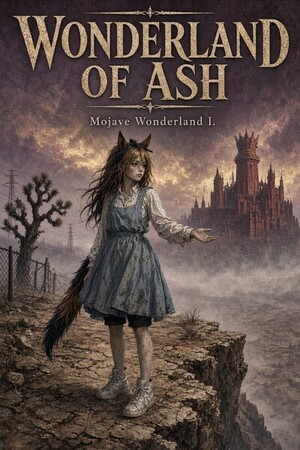
Mojave Wonderland 1: Wonderland of Ash
The smell came first, and it did not belong to San Bernardino County.
Ontario smelled of diesel exhaust, warm creosote from the Southern Pacific switchyards, dairy dust blowing in off the Chino basin, and the sour, sun-baked asphalt of Haven Avenue. It was an honest, industrial stink—dry heat and logistics corridors where fifty-three-foot dry vans groaned under the weight of imported plastics.
The air spilling down out of the Cajon Pass on the last Tuesday of September smelled of wet slate, cold river clover, and old, damp lime.
Alice stood by the chain-link fence behind the distribution center where she took her twenty-minute breaks. She was eighteen, thin-shouldered, and tired in a way that sleep never quite repaired. Her work blouse—stiff white cotton with small, stubborn ruffles along the collar that her mother had insisted looked presentable—was already grayed at the cuffs from handling packing manifests. Over it she wore a faded, dusk-blue pinafore apron, its hem stained with forklift grease and desert caliche, tucked pragmatically into the waist of dark canvas work shorts.
She took a slow drag from a lukewarm carton of sweetened iced tea and looked north.
The San Gabriel and San Bernardino ranges usually stood like jagged, sunburned cardboard against the smog, their chaparral slopes brown as cardboard until November. Today, the ridge had vanished.
A wall of white—dense, curded, and impossibly tall—was pouring over the summit. It did not drift like marine layer coming inland from Long Beach. It did not thin as it hit the thermal heat of the valley floor. It tumbled. It poured down the granite flutes of the pass like an unbroken spillway of skim milk, burying the rail cuts, swallowing the high-voltage transmission towers, and sliding southward over the foothill tracts of Rancho Cucamonga.
"Freak front," a driver named Sal had muttered an hour ago while signing his bill of lading. "Radio says visibility on the 15 is down to fifty feet past Devore. Highway Patrol is turning rigs around at Kenwood."
Alice hadn’t answered him. Answering required picking a register, and since noon, her head had felt like a three-channel television where every dial had been wrenched half an inch out of tune.
Channel One: Alice Pleasance Liddell. Born at San Antonio Community Hospital, eighteen years, two months, five days. Social Security card in a battered canvas wallet in her pocket. Shift ends at five. Need to buy eggs and two cans of evaporated milk on the walk back to the duplex on Fourth Street.
Channel Two: A sudden drop in cabin pressure, freezing cold and smelling of ozone and wet grass after dark. The roar of seventy thousand voices filtered through leagues of interstellar dust. Not a roar of blood, but of radio waves:
“...Two thousand meters... suspended under a low sky at Fuchū. Gravitational pull heavy on the turn... seventy-three millimeters of water across the dark plane. The silk does not tear when the stars align at the gate...”
And buried beneath the cold static, a name that was not human—Neo Universe—pulsing in the deep marrow of her femurs like an unmapped pulsar.
Channel Three: A long wooden hall paneled with dark, rotting mahogany. A glass table with three legs. A voice, small and perfectly dry, reciting: “Speak roughly to your little boy, and beat him when he sneezes...”
Alice pressed the heel of her hand hard against the center of her forehead. Her skin was cold. Clammy.
Above her temples, nestled beneath the tangled, dark golden chestnut-bay curls that fell across her shoulders, her scalp was on fire. Not an ache—a burrowing, foreign itch, right against the cranial suture where bone met muscle. Twice that afternoon she had reached up to scratch it, only to feel two hard, cartilaginous nubs pulsing under her skin, sensitive to the vibration of the idling refrigerated trailers three hundred yards away.
She let out a slow breath. Her lungs felt too big for her ribs.
Clack.
Alice blinked, looking down at her feet.
She wore standard eight-inch work boots, scuffed to the raw leather at the steel toes, laced tight over thick wool socks. But when she shifted her weight from left heel to right ball, the sound that rang against the broken asphalt was not the dull, rubbery thud of a Vibram sole.
It was the cold, ringing strike of iron.
She lifted her right foot. Embedded flush into the lugged rubber tread—seamlessly, as if the mold at the vulcanizing plant had been cut by a blacksmith rather than an engineer—was a dull, curved crescent of forged steel. A horseshoe. It caught the flat, diseased light of the approaching fog and gleamed gray.
"Don't look at it," Alice whispered to herself. Her voice sounded strange—thicker in the back of the palate, the vowels rounding out with an odd, equine resonance before snapping back to flat Inland English. "You're dehydrated. It's ninety-four degrees and you skipped breakfast."
A siren began to wail up near Foothill Boulevard. High, wavering, choked off almost immediately by the density of the air.
The white spill had reached the railyards.
It wasn't wind-driven. It moved at the speed of a walking man, blanketing the rows of shipping containers, turning the bright orange cranes into shadowy ribcages. Where the fog touched the chain-link fence at the rear of the lot, the galvanized zinc didn't frost over; it simply lost its luster, softening into something that looked less like industrial wire and more like calcified briars.
And then, out of the drainage ditch that ran parallel to the spur line, someone climbed up onto the gravel berm.
Alice froze.
It was a girl. Small—no older than nine or ten—wearing an oversized, sun-faded dusty-pink t-shirt that hung nearly to her knees, frayed cutoff denim shorts, and high-top sneakers that were at least two sizes too large. The shoes were caked in dry, chalky Mojave dirt, the laces knotted into frantic, double-looped messes.
Set against her tousled, sun-bleached bay-gold hair, dead center in her bangs, grew a stark and sudden shock of pure white hair—like natural poliosis. Untinted and sharp-edged among the disheveled locks, the pale cluster formed the unmistakable irregular silhouette of a thoroughbred's star marking, resting entirely within her hair.
And rising through the matted curls at the top of her skull were two alert, velvet-furred horse ears, swiveling back and forth against the deadened hum of the valley.
Tied around the base of her right ear was a scrap of dirty white ribbon, fluttering limp in the dead air. Behind her, swishing with a quiet, pendulum cadence against the scuffed backs of her knees, was a full, dust-softened bay tail with black tips that swept the gravel like a broom.
The child didn't look at the warehouses. She didn't look at the warning signs bolted to the fence. She was staring straight north, into the white maw rolling down from the pass.
"Hey," Alice called out. Her voice snagged in her throat. She stepped away from the break-room door, her hand catching the chain link. "Hey! Kid! Don't go up on the berm. The switch engines—"
The child didn't turn around. She took three stumbling, loose-limbed strides across the ballast rock. Her oversized sneakers made an unmistakable sound against the crushed granite: crunch-tink, crunch-tink.
Iron striking stone under rubber soles.
"Wait," Alice said, louder now.
The child broke into a jog. It wasn't a child's run; it was a rhythmic, long-striding trot, her knees coming up high, her shoulders staying level, her head down. She slipped through a gap where the fence had been cut by copper scavengers months ago, ducking beneath the jagged wire without slowing down.
Ahead of her, thirty yards out across the frontage road, the white wall waited. It stood thirty feet high now, sheer as quarry marble, smelling of wet leaves and copper pennies.
"Stop!"
Alice didn't think about her time card. She didn't think about her foreman, or the two cans of evaporated milk, or the fact that she had forty dollars in checking and half a tank of gas in the Civic parked behind the break room.
She hit the rusted push-bar of the access gate with her shoulder. The latch gave way with a scream of sheared zinc.
Her boots struck the gravel.
Clack-crunch. Clack-crunch.
The iron in her soles bit into the earth with terrifying, effortless traction. With each step, her balance felt impossibly wider, lower, more anchored than it had ever been in her life. The ache at the top of her skull tore open—not with pain, but with a cold, rushing pop, like a seal breaking in an altitude chamber.
Two ears—long, dark golden-bay, tipped in ink-black velvet—punched upward through her hair, twitching instantly toward the high whine of the mountain wind. Behind her, dragging with heavy, reassuring warmth against her calves, a thick, dark tail fell free from the split seam of her pinafore, its black points sweeping the dirt.
A jolt of pure panic seized Alice's chest, but when she tried to scream, the sound that scraped out of her throat was a harsh, shuddering whuff—the blown-air snort of a thoroughbred sighting the starting barrier.
No, Channel One fought back, clawing for purchase. My name is Alice Liddell. I live in Ontario. I was born here.
Then Channel Two breathed across the nape of her neck—weightless, serene, whispering with the faint, terrifying hush of solar wind:
“...The barrier is already light... the coordinates have snapped into place. Ground is dense... sixteen hundred meters of caliche... the constellation does not stop at the fence...”
“Which way, which way?” Channel Three chimed, sing-song and mocking from the ditch. “The Queen will be furious if the child is late!”
"Shut up," Alice wheezed, her knuckles white as she gathered the folds of her blue pinafore in one hand so she wouldn't trip. "Shut up, both of you."
The little girl was ten yards from the mist.
She wasn't running fast, but she wasn't hesitating. She moved like something pulled on a string, her small bay tail swinging like weather, her ears flattened back against the whistling suction of the white front.
"Kid!" Alice sprinted across the two-lane frontage road. Her legs were eating up the pavement in strides three feet longer than any human girl had a right to take. The wind off the pass was freezing now, smelling of old salt and crushed wild mustard. "Grab my hand!"
Alice lunged, her fingers reaching for the faded cotton of the girl's pink shirt.
Her fingertips brushed the threadbare hem.
The child stepped across the white line of the asphalt shoulder.
And the fog took them both.
The sound of Ontario died instantly.
The diesel rumble, the distant drone of the 10 freeway, the high whine of sirens—wiped away as cleanly as chalk from a wet slate.
There was only the hiss of falling grit.
Alice hit the ground hard, her knees skidding into coarse, alkaline sand. Her breath rasped in her throat, cold and thin, tasting like battery acid and crushed chalk. She scrambled to her hands and knees, her ears swiveling frantically—left, right, backward.
Sound didn't travel right here. A scrape of gravel three feet away sounded like it was happening inside a galvanized trash can five miles distant.
"Kid?" Alice choked out.
Two feet to her left, sitting flat on the caliche with her legs splayed out in front of her, was the girl.
The child wasn't crying. Her small, freckled face was pale, smeared with white alkali dust around her mouth and nose. Her large, dark eyes stared blankly into the swirling soup of white around them, unblinking. Her horse ears drooped slightly, pointing toward the ground in deep, numbing exhaustion.
Underneath her right ear, the dirty white ribbon hung limp.
"Are you hurt?" Alice crawled over, her fingers trembling as she grabbed the girl's small, thin shoulders. The child's skin was icy, but her heart was hammering against her ribs like a trapped bird—far too fast, a rapid-fire equine pulse that Alice could feel through the cotton of the shirt. "Can you talk? What's your name?"
The girl looked at Alice. Her eyes flicked upward—first to Alice's black-tipped ears, then down to the blue pinafore, then to Alice's face.
The diffuse light caught the pure white shock of hair set squarely in her bangs, burning clean and pale against the gray dust like a fallen star. Her freckled nose and face were completely clear beneath it. She didn't speak—her throat only worked once, producing a low, questioning nicker, soft as a pigeon in a barn rafter, before she swallowed dryly. She lifted a dirt-caked hand and pointed past Alice's shoulder.
Alice turned.
The frontage road was gone. The chain-link fence was gone. The warehouse roofs were gone.
Behind them lay a barren, gently sloping wash of white caliche and cracked mud, bordered by the ghostly, skeletal silhouettes of dead Joshua trees emerging from the fog like crooked fingers.
And directly in front of them, carved into the caliche bank where an irrigation ditch should have been, stood a weathered concrete culvert pipe.
Above the dark, circular opening of the pipe, someone had driven an iron survey stake into the dirt. Nailed to the stake was a battered square of sheet metal, rusted red at the corners, with letters stenciled in faded black spray paint:
RANK ONE. NO REFUNDS.
THE LONGER YOU STAY, THE MORE TRUE IT BECOMES.
Alice stared at the metal plate.
A sudden, deep shudder ran through the muscles of her thighs, settling into her calves with an unnatural, coiled weight. She looked down at her hands. Her skin was still human—pale, knuckled, scraped at the palms from the gravel fall, her fingernails lined only with the ordinary grease of the distribution center. But when she took a breath, the air in her chest settled differently, anchored by the long, dark bay tail resting heavy against her calves and the ears twitching atop her head.
Beside her, the child leaned her forehead against Alice's ribs, burying her small, freckled face into the damp blue apron. She didn't let go.
Alice wrapped one arm tight around the girl's narrow shoulders, her jaw clenching until her teeth set with grim resolve.
"All right," Alice whispered into the white silence. Her horse ears pinned back against her hair, tuning out the third channel, locking down the first. "All right. We don't go back. We go through."






Please sign in to leave a comment.