Chapter 1:
Prologue: The Cry of the Sky
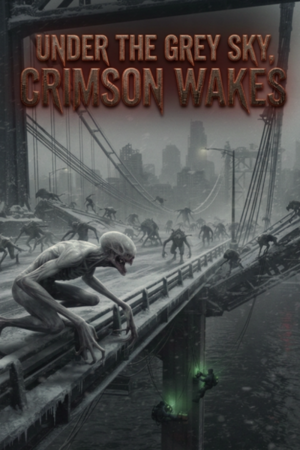
Under the Grey Sky, Crimson Wakes
Nobody agreed on how the world had ended.
That was the first lesson every child learned in Caldera, before the alphabet of warning lights, before the names of the seven barrier gates, before the rule that said a white body was never dead until its head lay apart from its spine.
The old records called the beginning 2030. Some histories gave the day and hour. Others claimed the calendars had already been corrupted, that the date had been chosen afterward because frightened people needed a number to nail the end of the world to. Two and a half centuries had worn certainty smooth. Servers had failed. Paper had burned. Witnesses had contradicted themselves and then died. Their children remembered the contradictions better than the facts.
But every version began with the same sound.
The Cry of the Sky.
It came on an ordinary day, according to the stories. Trains moved through cities. Aircraft crossed oceans. Children complained about lessons. People stood in markets arguing over fruit and fuel and money. Then something spoke from above the weather.
Not thunder. Not an alarm. Not a voice in any human language.
A single vast note rolled through the atmosphere, low enough to shake windows and deep enough to be felt inside teeth. Some recordings described it as metal tearing across the whole curve of the Earth. Others called it the anger of a living sky. A Vaeli scroll named it the wound announcing itself.
Then people died.
Half the human population, some accounts said. Seven in ten, said others. There was no census afterward, no functioning authority able to count the bodies. They fell at tables, at steering wheels, in surgical theaters, in submarines and command bunkers. They died together, as if an unseen hand had passed over the world and pressed down.
The survivors had only hours to mourn.
By nightfall, the dead were changing.
Skin paled until it looked dusted with snow. Limbs lengthened. Joints learned new directions. The first creatures crawled because they had not yet remembered how to stand; the oldest surviving film showed white figures moving on four elongated limbs through a hospital corridor while the emergency lights flashed red. By the second day they were hunting. By the end of the week, they were learning.
Shelters rose everywhere. Stadiums became camps. Metro tunnels became cities. Warships took civilians aboard. Mountain bunkers sealed their doors. Every one of those refuges vanished from the later record.
Every one except Antarctica.
The stations on the ice were never meant to hold a civilization. They had laboratories, machine shops, fuel, radios, runways, desalination systems, and people accustomed to fixing things while death waited outside. Those things proved more valuable than armies. Ships came south while ships still could. Aircraft landed with scorched engines and empty tanks. Engineers from the old United States built the first linked defenses around the largest refugee settlement. They called the city Caldera because it had been remade inside catastrophe, though there was no volcano beneath it. Later generations called it the city that built the Barrier.
The Barrier was never truly a wall. Children imagined one because a wall was easier to understand. In reality it was a chain of sea forts, buried sensors, drone fields, pressure mines, false beacons, fortified passes and electromagnetic storms wrapped around the survivable approaches to the continent. It was machinery, distance and terror cooperating.
For a time, the people behind it still watched the old world from orbit.
Then the satellites died.
Not one by one. Not from age. The surviving logs said entire constellations went blind within eleven minutes. Some burned through the atmosphere. Some simply stopped answering. Caldera's founders launched replacements, and something destroyed those too.
Afterward came the meteors.
They fell without prediction through a sky the radar could no longer read. Most struck the ice or vanished into the Southern Ocean. Several hit the refugee zones. One erased a settlement whose name now existed only on a memorial wall beneath Caldera's eastern district. Old people still claimed the meteors had changed direction as they fell.
No proof survived.
Proof was a luxury. Survival became law.
The settlements hardened into states. Caldera held the central Barrier command. Neon Tokyo sealed itself inside networks and glass towers. Vael found impossible writings beneath ancient layers of blue ice and withdrew behind weather and secrecy. The Crown of Rime forgot enough technology to turn maintenance into nobility and reactors into thrones. Far below the eastern ice, the Russian deep-state prepared for a return to the outer world and spoke of ruling whatever could be rebuilt. To the west, the Chilean-descended state of Meridian lost district after district to the white things until its remaining citizens fled north toward Caldera, leaving a drowned and vine-strangled city behind.
Beyond the Barrier, the creatures still came.
Sometimes they reached its outer sensors and disappeared. No wreckage. No bodies. No retreat tracks. Command argued that they entered the sea and found passages beneath the ice. Others believed the Barrier itself took them. Nobody knew.
The children of Caldera grew up under cloud.
The sky above Antarctica was usually grey: pearl grey, iron grey, the green-grey of an old bruise. On rare days it became white enough to erase the horizon. The histories said the sky had once been blue across most of the world. A blue so deep people had ignored it.
Kevin Morcant had never believed that last part.
He could believe in the Cry. He could believe in dead satellites and learning corpses. He could believe in meteors that turned in flight because the ice held stranger things than that.
But he could not understand how anyone had looked up into a blue sky and failed to stop.
He had wanted to see one since he was six years old.
At twenty-one, he wore his dark hair grown long enough to bundle at the back of his head, a small private refusal of military neatness beneath the field hood.
Standing in a ruined grocery while a white creature unfolded itself over a bleeding man, Kevin understood that he probably never would.



Please sign in to leave a comment.