Chapter 11:
Chapter Ten: Beneath the Museum
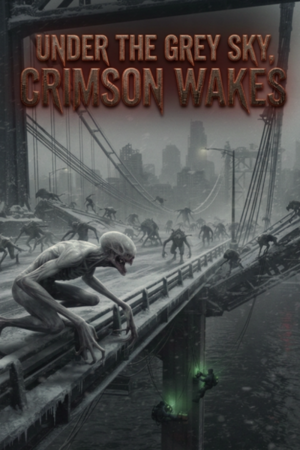
Under the Grey Sky, Crimson Wakes
Kevin disliked museums because they arranged disasters after the danger had passed.
A rifle behind glass became history. A burned child's coat became testimony. A section of Barrier armor with claw marks became proof of courage rather than proof someone had needed better armor.
The Caldera Museum of Continuity occupied the oldest surviving station complex beneath the central city. Its upper galleries were polished and public: models of the first Barrier towers, fragments of dead satellites, reconstructed rooms from 2030 and the blackened nose of an aircraft that had delivered two hundred refugees on half an engine.
Below the public floors lay twenty kilometers of storage, service tunnels and sealed archives.
Five people had vanished there in twelve days.
The first two were maintenance workers. Their equipment remained arranged beside an open service panel, meals untouched, no blood. The third was a courier whose route tracker showed him entering a wall at walking speed and continuing eleven meters through solid foundation before the signal stopped. The fourth and fifth were museum apprentices searching for a missing crate from Archive Seven.
One apprentice returned.
His name was Tomas Vale. BSI kept him in a sound-dampened clinic because ordinary conversation triggered seizures. Kevin interviewed him using written questions and image boards.
Tomas could not draw the creature that took him. Every attempt began as a narrow white torso and ended in spirals covering the page. He circled images of mouths, radios and schoolchildren. When asked whether the creature spoke, he wrote:
NOT SPEAK. BORROW.
Beneath that:
WORDS ARE ROPE.
Verra entered the clinic alone to use presence mapping. Tomas felt human, injured and terrified. Something else clung to the outer edge of his signature like a pale fingerprint. When she asked him to think of the missing apprentices, the foreign impression tightened.
Tomas whispered four words before the seizure began.
"It asked my name."
He then answered in a voice that was not his own.
"Liora below. Bring Rose."
The clinic lights failed. By the time emergency power returned, Tomas had bitten through his tongue and every monitor contained the same three descending tones heard at Black Bridge.
Director Veyne argued to postpone field entry until Tomas stabilized. Ruth Calder arrived at BSI Central with Liora's journal, struck a security officer with her cane and refused to leave until someone searched beneath the museum.
"My daughter has been missing for five days," she told Veyne. "If your procedure needs a sixth, select one of your own children."
Veyne approved the mission.
BSI assigned a six-person team.
Kevin led. Verra handled anomalous detection. Alex attended under field-observer restrictions with no live beam access and an implant limiter Dr. Lorne could disable remotely. Two containment officers, Tamsin Cole and Rafi Sen, carried heavy adaptive carbines. Silas Rook joined as Strategic Continuity liaison despite Kevin's written objection.
Before descending, the team crossed the public Gallery of First Days.
School groups normally filled it. The disappearances had closed the museum, leaving exhibits running for empty rooms. A projection of the pre-Cry Earth rotated beneath a blue sky. Children could touch continents and summon oceans, forests and cities that no longer answered.
Alex paused beneath the sky projection.
Blue light filled the dome with a color too rich to seem natural. Kevin had spoken of wanting to see such a sky since childhood. Standing inside the simulation, Alex understood the longing and distrusted it. Beauty this complete felt like propaganda.
A blue echo moved among the exhibits.
Liora Calder crossed the gallery five days earlier carrying a document tube. She stopped at a display of meteor fragments, removed one fragment from its magnetic stand and held it beside a black stone rubbing. The patterns aligned.
Alex followed the echo.
The fragment remained in its case now. Its label said it had fallen during the second Antarctic meteor event, six years after the Cry.
"Open this," he told the curator on duty.
Silas Rook said, "Our warrant concerns the lower archives."
"The missing apprentice handled it before disappearing."
Rook's face became careful. "How do you know?"
"Blue."
The case opened under museum authority. The meteor fragment was lighter than stone and warmer than the gallery. On one side, hairline channels formed part of the inverted-tree design.
Verra sensed nothing magical. Kevin's scanner identified no radiation or active field. When Alex brought his training socket near, phantom fingers closed painfully.
Blue showed Liora whispering to someone outside the echo's frame:
The tablet wasn't found under Caldera. It fell here.
Then the memory ended.
Rook ordered the fragment sealed for Strategic Continuity.
Ruth Calder's voice came from the staircase. "Touch it and I will introduce your hand to a conservation hammer."
Their guides waited below.
Elias Calder was a thin man in his sixties with a grey beard trimmed close and an archivist's habit of touching objects only by their edges. His wife, Ruth, was shorter, broad-faced and wrapped in a red museum coat covered with pockets. Both wore old-fashioned spectacles despite easy corrective surgery.
"Digital lenses revise what they think you want," Ruth said when Alex asked. "Glass has the decency to remain wrong consistently."
Elias carried a locked case against his chest.
Kevin nodded toward it. "Equipment?"
"Personal," Elias said.
Ruth answered more directly. "Our daughter's field journal."
Their daughter, Liora Calder, was one of the missing apprentices.
The crate she and her colleague had sought contained excavation records from beneath the earliest Caldera foundations. Not valuable to thieves. Not dangerous by official inventory. The Calders had spent their careers cataloging it.
"Liora believed one object had been removed before the crate entered museum custody," Elias said as they descended. "A stone tablet photographed during the first construction period. Every image is corrupted in the same place."
"What was on it?" Verra asked.
"Four figures around a tree," Ruth said. "Or a machine mistaken for a tree. Liora thought the original survey team found architecture beneath the station and buried the record."
Silas Rook walked behind them. "The first construction period produced many misidentified geological structures."
Ruth looked back. "You intelligence people use misidentified the way priests use mystery."
Rook smiled. "I am a continuity liaison."
"And I am nineteen."
The first storage level smelled of dust and preserved cloth.
Alex walked behind Kevin and the Calders, trying not to look for colors. Looking summoned nothing reliably; refusing to look made every flicker feel important. Shelves held evacuation signs, broken tools, domestic objects and sealed cases of paper. Emergency strips lit as the team passed.
Alex saw blue.
A man in old station coveralls walked through a locked door to their left. His body was translucent, edges trailing. He carried a steel box.
Alex stopped.
The others continued two steps before Kevin noticed.
"What?"
Alex pointed. "Someone went through that door."
Elias checked it. "This room has been sealed since the upper flood."
"Not now. Before."
The blue figure repeated the motion. It did not acknowledge Alex. An echo, not a ghost. The man placed his palm on a wall panel, waited, then vanished through the locked door.
Alex approached carefully. The blue man's coveralls bore an obsolete station patch: an eagle over a half-built Barrier. His steel box carried the number 4-17.
Elias Calder stopped breathing for a moment.
"What number?"
"Four-seventeen."
Ruth opened the locked case her husband carried and removed Liora's field journal. Several pages had been marked with red thread. On one, Liora had copied an inventory line from the museum's founding catalog:
4-17 — lithic panel, unknown script, root/figure motif. Removed by Continuity order. Destination unlisted.
"The missing tablet," Ruth said.
Silas Rook took one step closer. "That inventory was classified after contamination concerns."
"You said the structure was geological," Elias replied.
"Both may be true."
"Only if stone has begun catching political diseases."
Alex kept watching the echo. The man in coveralls seemed frightened. He looked behind him each time before touching the panel. On the third repetition, Alex noticed another blue shape reflected in the glass of an empty display case—a hooded figure standing where no one stood in the real room.
The Quiet Man from the camera. No torch. No pale procession. His hood carried a narrow metal clasp shaped like a closed door.
"He was being followed," Alex said.
Kevin scanned the room. "By our hooded subject?"
"I think so. Blue doesn't explain. It only repeats what the place kept."
"Places don't keep memories," Rook said.
Alex glanced at him. "Your orphanage sensor disagrees."
Rook's jaw tightened.
"Blue?" Verra asked.
Alex nodded.
Dr. Lorne's voice came through his earpiece from remote medical support. "Duration?"
"Four seconds. Repeating."
"Pain?"
"One."
"Do not pursue without baseline scan."
Kevin examined the wall panel. "Observer restrictions mean you observe while we open it."
Ruth produced a museum key. The lock reported no authorized entry for eighty-six years.
Inside, flood residue covered the floor in grey ridges. The shelves were empty. Alex followed the blue figure to the back wall, where it knelt and touched a drainage grate.
Kevin lifted the grate.
A shaft descended beneath the archive.
No museum plan showed it.
They rigged lines and went down.
The shaft opened into a pre-collapse transit tunnel. Rails ran beneath shallow black water. Caldera's official history said the earliest station possessed no underground transit, yet tiled signs on the wall displayed district names that had never existed.
BLUE EAST.
ORCHARD TERMINAL.
GATE OF NAMES.
The letters were English. The architecture was not. Stone arches rose behind printed concrete, older surfaces incorporated into newer construction. Their proportions made distance difficult to judge. A doorway that appeared three meters high remained the same size after they walked toward it.
Verra's presence sense returned only their group.
"No people," she said. "No white signatures either."
Rafi Sen tapped one wall. "Something moved ahead."
A sound traveled through the tunnel.
A word.
"Liora."
Elias ran before Kevin could stop him.
Ruth cursed and followed. The team moved after them through knee-deep water.
The voice came again.
"Elias. Ruth. Come."
Not a recording. The pronunciation improved after each word.
They reached an abandoned platform where museum crates lay broken across the tiles. Archive Seven markings covered the nearest. Inside, old survey books had been shredded and arranged in spirals.
The tunnel widened around the station into architecture accumulated in violent layers. Modern power cables crossed pre-collapse ceramic conduits. Behind those lay carved stone channels polished by water that had not flowed for centuries. Museum labels had been fixed to several walls during an abandoned survey: UNASSIGNED FOUNDATION FEATURE, PROBABLE NATURAL CAVITY, NO PUBLIC ACCESS.
Ruth removed one label. Beneath it, an eye had been carved into the stone.
"Liora photographed this," she said. "The image vanished from the archive while she was still writing the report."
Silas Rook examined the carving without touching. "Early settlers reused symbols."
"The carving is beneath the poured foundation," Elias said. "It predates the settlement."
"Then someone carved it before Caldera."
"That is the definition of predates."
Kevin moved between them before the argument became a substitute for fear. "We establish route marks every twenty meters. Physical paint and cable, not network beacons. Rafi, rear watch. Tamsin, ceiling and ducts. Nobody follows a voice out of sight. Nobody answers if a voice uses their name."
"Why?" Ruth asked.
"Because Tomas Vale wrote that words are rope. Until we know what that means, we don't provide more rope."
They advanced past a ticket hall whose gates had been built for bodies much taller than humans. Each turn carried them farther from the museum and deeper into something that had once been incorporated, concealed and forgotten.
Alex's blue echoes increased.
He saw first-generation refugees hauling cables. Then figures in unfamiliar long coats moving in the opposite direction through the same space. Then a child drawing four circles in dust while adults argued over sealing the tunnel. None reacted to the others. Different times occupied the platform like transparent crowds.
The echoes caused pressure behind his eyes but lacked the violence of purple. He could look away. The difficulty was deciding which fragment mattered.
A blue woman placed a lantern beneath a bench.
Alex checked. Nothing.
A blue soldier fired into a wall.
They found no impact.
A blue maintenance worker avoided one tile.
Kevin marked it, and Tamsin discovered a pressure shaft beneath.
The past was not instruction. It was evidence without context.
Liora's red scarf hung from a signpost.
Ruth took it with both hands.
Alex saw blue.
Liora Calder appeared beside the crate, a slim young woman with her mother's face and her father's careful hands. She argued with another apprentice whose features blurred. She held a black rubbing sheet against a stone fragment.
The echo shifted.
A pale hand emerged from beneath the platform edge.
Liora turned.
Blue dissolved.
Alex staggered.
Elias caught his good arm. "Did you see where they took her?"
"Below the platform. She was alive when the echo ended."
Ruth gripped Liora's scarf until her knuckles blanched. "Then she is alive now."
Kevin's expression softened without becoming false. "An echo is not a current signal."
"I know what an archive is, Officer Morcant." Ruth wrapped the scarf around her wrist. "I also know my daughter. She annotates when afraid. She tied a museum catalog knot at the end."
Verra examined the fabric. Near the torn edge, three threads had been knotted together.
"What does it mean?"
"Hidden access," Elias said. "She left direction for us."
Ruth pointed beneath the platform.
Alex felt a blue trace descending through the tile.
"Below us," he said.
The platform erupted.
Creatures came through the tile in a coordinated burst.
They were smaller than the bridge whites, narrow enough to move within service ducts. Their arms divided below the elbow into two blade-thin forelimbs, each ending in grasping knobs rather than claws. Their heads carried inflated throat sacs that pulsed before sound.
"Elias," one said in Liora's voice.
Tamsin Cole fired. Her rounds took the speaker through both knees and chest. It folded, then pulled itself forward on its divided arms.
"Name," another said.
"Give. Name."
Kevin's beam removed the first head.
Rafi fired into the second, severing one pair of limbs. It continued on the remaining pair.
More poured from the broken platform. Not dozens at first—six, then ten, then enough to make counting useless. Their throat sacs produced fragments gathered from the missing people.
"Cold."
"Mother."
"Open the door."
"It asked my name."
Alex raised his weapon, conventional only, and saw red outlines moving before the bodies. He fired where one would place its head. The creature entered the shot and fell.
Red made immediate violence legible.
Blue flickered through the platform, showing Liora pulled into the dark.
Purple appeared behind Ruth Calder.
A branch of possibility, thin as lightning.
Alex looked at it.
The world opened.

Please sign in to leave a comment.