Chapter 0:
THE DAWN OF ANDHRA-VERS
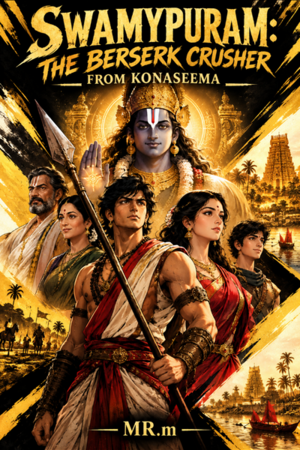
SWAMYPURAM: THE BERSERK CRUSHER FROM KONASEEMA
THE DAWN OF ANDHRA-VERS
MANY AGES. MANY HEROES. ONE LAND.
Officially launching with:
SWAMYPURAM: THE BERSERK CRUSHER FROM KONASEEMA
---
THE GRAND REVEAL
The clouds parted.
Beneath the boundless blue sky, a magnificent futuristic metropolis stretched toward the distant horizon.
Colossal skyscrapers pierced the heavens, their gleaming glass facades reflecting the brilliance of the sun. Towering structures rose above vast avenues, while elevated highways wound between enormous buildings like silver rivers suspended in the air.
Beyond them stood high-tech airports, their immense terminals and runways forming part of a sprawling network that connected the great metropolis to the wider world.
Everywhere, the signs of a magnificent modern civilization stood proudly beneath the open sky.
Then—
The earth trembled.
A deep rumble surged through the ground.
The foundations of the metropolis shook. The towering buildings swayed, their enormous silhouettes trembling against the heavens. The highways groaned beneath the sudden disturbance, and the entire city seemed to hold its breath.
A crack appeared in the earth.
Then another.
The ground split apart.
And from beneath the modern world, something ancient began to awaken.
The futuristic buildings started disappearing.
One by one, their towering forms sank into the depths, swallowed by an unseen force. Their gleaming surfaces vanished beneath the trembling earth, and the magnificent structures of the modern age gave way to the forgotten grandeur of another civilization.
Ancient fortresses emerged from beneath the ground.
Massive stone ramparts rose toward the heavens, their formidable walls extending across the landscape. Towering gateways appeared, adorned with intricate carvings and majestic architectural details. Behind their fortified enclosures, royal palaces and magnificent courtyards returned to the world.
Then came the temples.
Their colossal gopurams ascended toward the heavens, crowned with elaborate sculptures of gods, goddesses, celestial beings, legendary warriors, and sacred figures.
Stone pillars emerged from the earth, carved with extraordinary craftsmanship. Their surfaces bore intricate patterns, floral designs, and images of divine beings whose stories had endured through countless generations.
The ancient streets unfolded between them.
Traditional houses appeared in long rows, their sloping tiled roofs and weathered walls forming entire neighborhoods. Wooden doorways, pillared verandas, spacious courtyards, and ancient pathways reappeared as though the hands of time had reversed their work.
The city continued to rise.
Beyond its imposing fortifications, the coastline began to change.
The forgotten ports of ancient Andhra emerged from beneath the sands.
Old harbors returned to the shore, their stone platforms and ancient landing places extending toward the sea. The sands that had concealed them for centuries parted, revealing the remnants of a vanished maritime world.
Then, from those very sands, ancient ships appeared.
Their enormous wooden hulls emerged beside the harbors and upon the waters. Tall masts rose against the horizon, while broad sails caught the ocean breeze.
The vessels rested upon the waves as though they had merely been waiting for the return of their age.
The scene shifted.
A vast panorama unfolded before the heavens.
The ancient metropolis stretched across the landscape, surrounded by imposing fortresses, magnificent temples, traditional houses, and sprawling streets. Beyond the city, the ancient ports stood beside the boundless ocean, where the ships of a forgotten age waited upon the shimmering waters.
Then the light changed.
A golden radiance descended from the heavens.
The sky began to glow.
A mysterious golden energy swept across the ancient world, illuminating every structure in its path. The mighty fortresses shone beneath its celestial brilliance. The towering temple gopurams glittered as though touched by the rays of a divine sunrise.
The golden light spread across the streets.
It illuminated the tiled rooftops, the palace courtyards, the ancient gateways, and the magnificent stone architecture of the temples.
Beyond the city, the harbors and ships gleamed beneath the same radiant glow.
The entire ancient metropolis was transformed into a sea of gold.
Then, the energy began to rise.
From every corner of the ancient world, the golden radiance gathered above the city. Streams of brilliant light ascended from the earth, converging in the vastness of the sky.
Higher and higher they climbed.
The countless rays of golden energy spiraled toward a single point, growing brighter as they converged.
The heavens themselves seemed to tremble beneath their brilliance.
Then the light condensed.
A magnificent golden radiance formed above the ancient metropolis, illuminating the clouds and casting its glow across the entire landscape.
Within that celestial brilliance, something began to appear.
Letters.
One by one, golden letters emerged from the light, suspended in the heavens. Their brilliance intensified with every passing moment until the entire title stood revealed.
ANDHRA—VERS
The letters blazed like molten gold.
Beneath them, the ancient metropolis stood in magnificent silence. Its fortresses, temples, streets, and harbors glimmered under the radiance of a forgotten age returned to the world.
For one breathless moment, the golden title illuminated the heavens.
Then—
A drop of blood fell from above.
It struck the title.
A thin crimson trail flowed across the shining golden letters, its vivid color cutting through the celestial brilliance.
The ancient world remained beneath the golden sky.
And above it, the name of a forgotten world shone in gold and blood.
---
WELCOME TO ANDHRA-VERS
A historical fiction universe inspired by the early eras of Andhra's past, its forgotten histories, sacred traditions, and the heroes who shaped its legendary landscape.
MANY AGES. MANY HEROES. ONE LAND.
Across the centuries, kingdoms shall rise and fall.
Empires shall emerge from the dust of forgotten lands. Kings shall march beneath magnificent banners, and mighty armies shall shake the earth beneath their footsteps.
Royal courts shall witness ambition, loyalty, betrayal, and sacrifice. Warriors shall defend their homelands, generals shall command vast armies, and rival dynasties shall struggle for supremacy.
Yet beyond the grandeur of imperial thrones and the thunder of victorious armies, the lives of countless people shall shape the destiny of the land.
Behind every crown lies a responsibility.
Behind every victory lies a sacrifice.
And behind every forgotten kingdom lies a story waiting to be told.
From the traditional divine origins of Andhra to the rise of its ancient dynasties, ANDHRA-VERS brings together different ages, generations of heroes, and the enduring heritage of a remarkable land.
Its journey begins with a sacred tradition.
---
I. ANDHRA VALLABHA
TRADITIONAL CHRONOLOGY: 1000–800 BCE
THE TRADITIONAL FIRST EMPEROR OF THE ANDHRAS
Before the banners of great dynasties rose above the Deccan, before mighty emperors carved their names into stone, and before the chronicles of ancient kingdoms passed from one generation to another, there existed a sacred tradition concerning the divine origins of Andhra.
According to traditional accounts, Andhra Vallabha was none other than Lord Vishnu Himself, who descended into the mortal world in a divine avatar to defeat the mighty demon Nishumbha.
The demon's ambition knew no boundaries.
The heavenly realm had fallen beneath his dominion. The gods had been defeated, and the celestial world had been brought under the authority of a conqueror whose hunger for power continued to grow.
But the heavens were not enough.
Beyond the celestial realms lay the vast lands of the mortal world. Across the northern regions, mighty Janapadas stood beneath the authority of their rulers. Nishumbha had conquered every North Indian Janapada of that age.
His armies had crossed kingdoms and subdued their rulers.
His victories had carried his dominion across the northern lands.
Now, his gaze turned toward the sacred land of Andhra.
The demon intended to extend his conquest into a land destined to become the home of mighty rulers, sacred temples, and an enduring civilization.
But his ambition would be challenged by a divine presence.
Lord Vishnu descended as Andhra Vallabha.
The divine emperor rose against Nishumbha, and the fate of the sacred land became bound to the outcome of their legendary conflict.
The war between the demon and the divine emperor forms the heart of this traditional account: a struggle between the ambition to conquer and the divine purpose of protection.
Through this great war, Andhra Vallabha defeated Nishumbha and established the traditional borders of Andhradesam, corresponding broadly to present-day Andhra Pradesh and Telangana, around the land's sacred temples.
Thus begins the opening saga of ANDHRA-VERS.
A story of divine power.
A story of imperial destiny.
A story of sacred geography and the legendary origins of the Andhras.
THE SACRED TEMPLES OF TRILINGA DESAM
The sacred geography of Andhra occupies a central place in the traditional account of Andhra Vallabha.
Across the land stand three revered temples, their sanctity connecting the people, their traditions, and the divine heritage of the region.
1. MALLIKARJUNA SWAMY TEMPLE — SRISAILAM
Location: Nandyal district, Andhra Pradesh
Among the sacred mountains of Andhra stands Srisailam, home to the revered shrine of Lord Mallikarjuna Swamy.
The rugged beauty of the Nallamala hills surrounds this sacred region. Dense forests stretch across the mountainous landscape, while the sacred temple rises amid the natural grandeur of the hills.
Within its hallowed precincts, generations of devotees have offered their prayers to Lord Mallikarjuna.
Its sanctity has endured across centuries, making Srisailam one of the most revered spiritual destinations in the region.
2. BHIMESWARA SWAMY TEMPLE — DRAKSHARAMAM
At Draksharamam stands the sacred temple of Lord Bhimeswara Swamy.
Its ancient stone architecture, imposing pillars, sculpted details, and sacred atmosphere reflect the deep spiritual heritage of the region.
The temple's architectural grandeur bears witness to generations of devotion and craftsmanship.
Within its sacred precincts, the traditions of worship have continued across generations, preserving the spiritual identity associated with this revered shrine.
3. KALESHWARA MUKTESWARA SWAMY TEMPLE — KALESHWARAM
At Kaleshwaram stands the sacred shrine of Lord Kaleshwara Mukteswara Swamy.
Its divine presence forms another important part of the traditional sacred geography associated with the land of the Andhras.
Together, these three sacred shrines occupy a special place in the traditional understanding of the region's spiritual identity.
According to tradition, these three sacred temples gave the land its revered name:
TRILINGA DESAM
The traditional account also connects the name Telugu to Trilinga, linking the identity of the language and its people to the sacred heritage of the land.
Thus, the story of Andhra's origins is intertwined with the spiritual traditions of its temples.
The land is remembered not only through the rise of rulers and the clash of armies, but also through sacred mountains, ancient shrines, devotional practices, and the traditions passed from one generation to the next.
LITERARY INSPIRATIONS
The story of Andhra Vallabha draws inspiration from Telugu literary works and traditional accounts that preserve references to the sacred and cultural heritage associated with him.
These works form part of the literary foundation behind this creative exploration of Andhra's legendary past.
1. Vallabhabhyudayam (Srikakula Mahatmyam) — Kodandarama Kavi
A literary work associated with traditional accounts of Andhra Vallabha and the sacred heritage of Srikakulam.
2. Amuktamalyada — Emperor Sri Krishnadevaraya
A celebrated Telugu literary work by the illustrious emperor Sri Krishnadevaraya, whose contribution to Telugu literature remains an important part of the region's cultural legacy.
According to tradition, Sri Krishnadevaraya wrote Amuktamalyada at the command of Andhra Maha Vishnu Himself and offered it to Lord Venkateshwara of Tirupati.
3. Andhra Nayaka Satakam — Kasula Purushottama Kavi
A Telugu devotional literary work included among the inspirations for this exploration of Andhra's traditional heritage.
4. Kridabhiramam — Traditionally Associated with the Legendary Poet Srinatha
This Telugu literary work contains references to traditions and festivals associated with Andhra Vallabha, providing another literary connection to the cultural memory surrounding him.
5. Andhra Kaumudi — A Telugu Grammar Text
A work included among the literary sources and inspirations behind this exploration of Telugu language and heritage.
Drawing inspiration from these works and traditional accounts, I am creating a historical fiction epic centered on the great war between the demon Nishumbha and Andhra Vallabha.
The divine emperor, the demon's ambition, the sacred land of Andhra, and the legendary conflict between them form the foundation of this opening saga.
It is a story shaped through deep respect, devotion, and imagination—a creative retelling of sacred traditions through the grandeur of an epic narrative.
A NOTE TO MY READERS
Some readers may wonder whether the avatar of Andhra Vallabha is entirely my own invention.
For those who wish to explore the traditional accounts themselves, I humbly encourage you to read the literary works mentioned above, especially if translations are available.
You may also visit the Srikakulam Andhra Maha Vishnu Temple, situated on the banks of the sacred Krishna River in Srikakulam village, Ghantasala Mandal, Krishna district, Andhra Pradesh.
There, you can explore the temple's Sthalapurana and learn more about the traditions associated with Lord Andhra Maha Vishnu.
According to tradition, Andhra Vallabha was the first emperor of Andhra and none other than Lord Vishnu Himself, revered as Andhra Maha Vishnu.
These sacred accounts and literary traditions are an important part of the inspiration behind this story.
ANOTHER NOTE TO MY READERS
This epic is my own creative interpretation, inspired by the traditional stories, sacred heritage, and devotional accounts associated with Lord Andhra Maha Vishnu.
While the story draws inspiration from ancient traditions and literary works, its wars, characters, relationships, and many dramatic events are brought to life through my own imagination and storytelling.
The divine figures and sacred traditions that inspire this narrative deserve respect. At the same time, the fictional events and dramatic elements belong to my creative vision.
I warmly invite readers to visit the sacred temple of Lord Andhra Maha Vishnu, explore its Sthalapurana, and discover the ancient texts and traditions that inspired this work.
This is my offering of imagination, respect, and bhakti—a sacred tradition retold in the form of a grand epic for the readers of our age.
---
II. ANDHRA JANAPADA AND ASSAKA MAHAJANAPADA
600–300 BCE
THE AGE OF RIVAL KINGDOMS
Long before the rise of the great Andhra empires, the ancient Deccan was a land of emerging powers, expanding settlements, and rival political ambitions.
Across its fertile valleys and rugged landscapes, early kingdoms and Janapadas developed their own identities, rulers, customs, and aspirations.
Among the powers explored in this saga are Andhra Janapada and Assaka Mahajanapada.
Their rivalry forms the foundation of this epic chapter of ANDHRA-VERS.
Two political worlds stand at the heart of the narrative, each with its own ambitions, leaders, and vision of power.
Territories become objects of desire.
Alliances are tested.
The decisions of rulers shape the destinies of their people.
The struggle between Andhra Janapada and Assaka Mahajanapada will unfold as an epic tale of rivalry, ambition, and the early political world of the Deccan.
Through this saga, ANDHRA-VERS will explore an age when the foundations of regional power were still taking shape.
---
III. ANDHRA IN THE AGE OF MEGASTHENES
LATE 4TH–EARLY 3RD CENTURY BCE
THE AGE OF ANCIENT DIPLOMACY AND LOST CHRONICLES
An age of powerful rulers and distant kingdoms.
An age when ambassadors traveled between royal courts, carrying news of foreign lands and the political ambitions of mighty empires.
Among the visitors whose names survived the passage of centuries was Megasthenes, the Greek ambassador whose writings described aspects of ancient India.
His work, Indica, became one of the ancient world's accounts of the Indian subcontinent. Though the original text has been lost, fragments and quotations preserved by later writers continue to offer glimpses into the world he described.
Yet those surviving fragments leave many questions unanswered.
What did the political world of Andhra look like during this age?
What rulers governed its territories?
What alliances shaped its politics?
What kingdoms stood along its rivers and ancient routes?
In this saga, the lost writings associated with Megasthenes become a creative gateway into the political landscape of ancient Andhra.
Through historical imagination and epic storytelling, the narrative will explore the rulers, political structures, and conflicts of the age in which Megasthenes visited the Indian subcontinent.
The story will reconstruct a world whose many details remain beyond the reach of surviving records, bringing its imagined courts, rulers, and political struggles to life.
The Megasthenes Age of Andhra will be a journey into the ancient political world of the region, inspired by the fragments of history and the possibilities that remain hidden within the past.
---
IV. THE RISE AND EXPANSION OF THE ANDHRA SATAVAHANAS
c. 1ST CENTURY BCE–3RD CENTURY CE
THE GREAT IMPERIAL SAGA
Among the most ambitious chapters of ANDHRA-VERS is the rise and expansion of the Andhra Satavahanas.
This saga will be one of the longest and most extensive parts of the entire universe.
Across generations, the Satavahana rulers shaped the destiny of a vast Deccan empire. Their reigns, ambitions, military campaigns, political decisions, and struggles for power will form a sweeping historical narrative.
The empire's story stretches across centuries, through changing political circumstances and the ambitions of successive rulers.
Its royal courts, military expeditions, trade networks, and relationships with neighboring powers provide the foundation for a saga of imperial transformation.
The story will follow the dynasty through five major seasons, each centered on a different emperor and a distinct stage in the empire's development.
The reign dates below are approximate. The chronology of the early Satavahana rulers, in particular, remains debated among historians.
SEASON 1: EMPEROR SIMUKA
c. 230 BCE
THE BIRTH OF A TRUE ANDHRA EMPIRE
Every great empire begins somewhere.
Before the imperial banners stretch across distant territories, before royal treasuries fill with the wealth of prosperous lands, and before the name of a dynasty echoes through the centuries, there must be a ruler willing to challenge the world before him.
This season follows Emperor Simuka, whose story marks the beginning of the Satavahana imperial saga.
Just two years after the passing of Emperor Ashoka the Great, Simuka carved an empire out of the mighty Mauryan Empire.
The first capital of the Andhra Satavahanas was Kotilingala.
Kotilingala — The First Capital
Located on the banks of the Godavari River in modern-day Telangana, Kotilingala was the initial seat of power where the dynasty's founder, Simuka, established his rule.
His earliest coins were found at Kotilingala and nowhere else.
His journey will explore the rise of a new political power, the foundations of imperial authority, and the struggle to establish a dynasty whose influence would extend across the Deccan.
The birth of a true Andhra empire begins with Simuka.
SEASON 2: EMPEROR KRISHNA — KANHA
c. 207 BCE
THE PROTECTOR OF THE EMPIRE
An empire born through ambition must survive through strength, loyalty, and leadership.
The second season follows Emperor Krishna, also referred to as Kanha in Prakrit.
As the brother of Simuka, Krishna inherits a kingdom whose future depends upon the stability of its foundations.
The young empire faces the challenges of preserving its authority and securing the legacy of its founding ruler.
Krishna's story explores the responsibilities of imperial power and the difficult task of protecting a growing realm.
He is remembered in this saga as:
THE PROTECTOR OF THE EMPIRE.
SEASON 3: EMPEROR SATAKARNI I
c. 189 BCE
DAKSHINAPATHA PATI — THE EMPIRE BUILDER
The empire's ambitions reach beyond the boundaries established by its founders.
At the center of the third season stands Emperor Satakarni I, presented in this saga as the son of Emperor Simuka.
His reign becomes the stage for a new phase of imperial expansion.
Through political ambition, military campaigns, and the consolidation of royal authority, Satakarni I will be portrayed as a ruler determined to extend the influence of his dynasty.
His story explores the transformation of a growing kingdom into a formidable imperial power.
The title associated with his saga captures that ambition:
DAKSHINAPATHA PATI — LORD OF THE SOUTH.
The empire builder takes his place upon the stage of history.
SEASON 4: EMPEROR GAUTAMIPUTRA SATAKARNI
c. 1ST–2ND CENTURY CE
THE ZENITH OF AN EMPIRE
The fourth season enters one of the most celebrated chapters of the Satavahana story.
At its center stands Emperor Gautamiputra Satakarni, one of the most prominent rulers of the dynasty.
His name is associated with a period of renewed imperial strength and military success.
The season will follow his struggle to restore and expand the authority of the Satavahana realm, bringing the emperor's campaigns and political achievements to life.
His story will also explore the rival powers of the age, including the Sakas, and the challenges that confronted the empire.
Among the celebrated titles associated with him is:
SHAKA-YAVANA-PAHLAVA-NISUDANA
The title means:
THE DESTROYER OF THE SHAKAS, YAVANAS, AND PAHLAVAS.
The fourth season will portray the height of imperial ambition and the struggle of a powerful emperor to secure his dynasty's place in the history of the Deccan.
SEASON 5: EMPEROR YAJNA SRI SATAKARNI
c. 152–181 CE
THE LAST GREAT MARITIME EMPEROR
Several decades after the height of Gautamiputra Satakarni's reign, another important ruler emerged to lead the Andhra Satavahana dynasty.
Emperor Yajna Sri Satakarni, whose reign is generally dated to approximately 152–181 CE, stands at the center of the fifth season.
He is celebrated as the last truly great emperor of the Andhra Satavahanas.
His reign provides an opportunity to explore the empire's maritime connections and the commercial networks that linked the Deccan with distant lands.
Among the most distinctive features associated with Yajna Sri Satakarni are his coins bearing images of ships.
Those ships provide a striking visual symbol for this season.
Their presence on imperial coinage evokes the maritime trade that connected the Satavahana realm with the wider Indian Ocean world.
Through this final major chapter of the Satavahana saga, the story will explore the empire's commercial strength, its maritime connections, and the challenges facing a dynasty that had ruled for generations.
The sails of the empire's ships will rise against the horizon as the Satavahana story approaches its later chapters.
---
V. THE ANDHRA IKSHVAKU EMPIRE
c. 3RD–4TH CENTURY CE
APPROXIMATELY 225–340 CE
THE RISE OF A NEW IMPERIAL POWER
The decline of one great dynasty opens the way for another.
As the political landscape of the Deccan changes, a new ruling house rises to establish its authority.
The Andhra Ikshvakus enter the story of ANDHRA-VERS as the central figures of another imperial saga.
Their rise, achievements, military leadership, and royal legacy will be explored through three seasons, each offering a different perspective on the dynasty and the people who served it.
SEASON 1: EMPEROR VASISHTHIPUTRA CHAMTAMULA AND GENERAL AṆIKKI
c. 3RD CENTURY CE
THE RISE OF THE ANDHRA IKSHVAKU EMPIRE
At the center of the first season stand Emperor Vasishthiputra Chamtamula and General Aṇikki.
One commands the authority of the throne.
The other stands among the military leaders whose service helps shape the empire's strength.
Together, their stories form the foundation of this season's narrative.
The rise of the Andhra Ikshvaku Empire will be portrayed through the challenges of establishing royal authority, securing the realm, and building the foundations of a new imperial power.
The emperor's ambitions and the general's military leadership will unfold against the changing political landscape of ancient Andhra.
This is the story of a new empire's beginning.
SEASON 2: GANDI — THE FATHER OF GENERAL ELIŚRĪ
THE SECRET PROTECTOR OF THE EMPIRE
Gandi, the son of Aṇikki and the father of the legendary General Eliśrī, takes center stage in this season.
He was the secret protector of the empire during the reign of Emperor Virapurushadatta.
While the second emperor, Virapurushadatta, was busy overseeing the golden age of Buddhism in Andhra and building monuments, it was Eliśrī's grandfather, the aged Aṇikki, and his son Gandi who helped maintain the military security that allowed the empire to flourish.
Their story explores the military leadership and quiet dedication behind the empire's stability.
SEASON 3: EMPEROR VASISHTHIPUTRA EHUVALA CHAMTAMULA
c. 274–297 CE
THE ZENITH OF THE EMPIRE
The third season follows Emperor Vasishthiputra Ehuvala Chamtamula, the OG of this era, whose reign stands at the heart of the Ikshvaku imperial story.
The empire has grown beyond its earliest foundations.
Its royal authority, political ambitions, and cultural achievements provide the setting for a narrative about imperial power at its height.
The season will explore the emperor's reign and the world surrounding his court, bringing the zenith of the Andhra Ikshvaku Empire to life.
It is a story of imperial achievement, royal responsibility, and the forces that shape the destiny of a powerful dynasty.
SEASON 4: GENERAL ELIŚRĪ
3RD CENTURY CE
THE SHIELD AND SWORD OF THE EMPEROR
Not every great historical story belongs to an emperor.
Some belong to the warriors who stand beside the throne, command the armies, and carry the burden of defending the empire.
This season follows General Eliśrī, the commander-in-chief, or Mahasenapati, of Emperor Ehuvala Chamtamula.
He is also presented as the grandson of General Aṇikki.
Through this connection, the season links two generations of military leadership and explores the legacy of service that passes from one generation to the next.
As the emperor's commander-in-chief, Eliśrī stands at the center of the empire's military story.
His narrative will explore the responsibilities of command, the dangers of warfare, and the loyalty demanded of a general entrusted with the defense of his sovereign.
The emperor may sit upon the throne, but the safety of the realm can depend upon the men who stand between the kingdom and its enemies.
GENERAL ELIŚRĪ WAS KNOWN AS THE SHIELD AND SWORD OF THE EMPEROR.
HIS LEGACY
He founded the ancient town of Yeleswaram, also spelled Eleswaram, located right across the Krishna River from the Ikshvaku capital of Vijayapuri.
Today, this historic site sits on the banks of the Nagarjuna Sagar reservoir.
The Temple
It was in this newly developed area that he built the famous Sarvadevalaya, a Shiva temple, during the eleventh regnal year of King Ehuvala Chamtamula.
---
VI. THE WARRING STATES ERA AND SUCCESSOR KINGDOMS OF ANDHRA
c. 3RD–5TH CENTURY CE
THE AGE OF RIVAL KINGDOMS
When a great empire fades, its former territories do not simply fall silent.
New rulers rise.
Old alliances fracture.
Regional powers compete for influence, and the political landscape becomes a stage upon which multiple kingdoms pursue their own ambitions.
The centuries following the decline of the Satavahana and Ikshvaku powers provide the setting for another major chapter of ANDHRA-VERS.
This is the Warring States Era and the Age of Successor Kingdoms in Andhra.
The first season will explore the rivalries and political struggles involving four important ruling houses:
- The Brihatpalayanas: Their territories extended across areas to the north of Andhra and throughout Telangana.
- The Ananda Gotrikas: Their power was centered in the southern regions of Andhra.
- The Salankayanas: They controlled the coastal Andhra region, including important ports and trading centers.
- The Vishnukundinas: Rising to power from their capital, Indrapalanagaram, they established the foundation of their political authority.
The site is identified with modern-day Tummalagudem in the Yadadri Bhuvanagiri district of Telangana. It served as the foundation of their political authority when they began ruling the western and central regions of the Deccan.
Their competing ambitions and shifting political relationships will form the foundation of a sweeping narrative about a region undergoing significant political change.
The story will move between royal courts, military strongholds, contested territories, and the lives of those caught between rival powers.
Every kingdom will have its own rulers, interests, and ambitions.
Every alliance will carry the possibility of betrayal.
Every campaign will have consequences that reach far beyond the battlefield.
Through these rival kingdoms, ANDHRA-VERS will explore a turbulent age in which the political future of Andhra remained in motion.
SEASON 1: THE WARRING KINGDOMS ERA OF ANDHRA
c. 3RD–5TH CENTURY CE
THE STRUGGLE FOR ANDHRA
The first season of this era will focus on the Brihatpalayanas, Ananda Gotrikas, Salankayanas, and Vishnukundinas.
Their political worlds will collide as competing dynasties struggle to establish and preserve their authority.
The season will portray the tensions of a fragmented political landscape, where royal ambition, military strength, and the pursuit of regional supremacy shape the fate of kingdoms.
It is an age of changing powers and uncertain destinies.
SEASON 2: SWAMYPURAM: THE BERSERK CRUSHER FROM KONASEEMA
c. 4TH–5TH CENTURY CE
THE JOURNEY OF VENKAT RAMANAYYA
At the center of the second season stands Venkat Ramanayya, the hero of:
SWAMYPURAM: THE BERSERK CRUSHER FROM KONASEEMA
His story unfolds during the rise of the Vishnukundina Empire and the reign of Govinda Varma I, within the broader age of political transformation in Andhra.
While the great kingdoms struggle for political power, the journey of Venkat Ramanayya brings another dimension to the age.
His story offers a closer look at the people whose lives unfold beyond the royal courts and imperial battlefields.
The rise of kingdoms and the ambitions of rulers form the larger historical landscape, but the heart of this season belongs to Ramanayya and the challenges he must face.
His journey becomes part of the wider story of a changing Andhra, where the destinies of individuals and kingdoms meet.
Through SWAMYPURAM, readers will enter the world of Venkat Ramanayya and experience one hero's journey within the turbulent age of rival powers and emerging empires.
This is the story that officially launches ANDHRA-VERS.
---
VII. THE RISE OF THE VISHNUKUNDINAS
c. 5TH–7TH CENTURY CE
APPROXIMATELY 420–624 CE
THE AGE OF IMPERIAL EXPANSION
The political landscape of Andhra continues to change.
From the struggles of the successor kingdoms emerges another powerful dynasty.
The Vishnukundinas rise to prominence, opening a new chapter in the history of the region.
Their imperial ambitions, military campaigns, and royal achievements form the foundation of the final major saga in this current outline of ANDHRA-VERS.
Their history stretches across generations of rulers, each inheriting the legacy of those who came before.
The dynasty's rise and expansion will provide the setting for stories of imperial ambition, military campaigns, political alliances, and the responsibilities of royal authority.
Two seasons will focus on two emperors whose stories offer different perspectives on the dynasty's development.
SEASON 1: EMPEROR MADHAVA VARMA II
c. 440–460 CE
THE EMPIRE BUILDER
The first season follows Emperor Madhava Varma II, whose story centers on the expansion of Vishnukundina power.
The emperor's conquests provide the foundation for an epic narrative of imperial ambition and political transformation.
His campaigns will carry the story across the lands where royal authority is contested and new territories become part of an expanding realm.
The season will explore the challenges of building an empire, the responsibilities of leadership, and the consequences of military expansion.
At its heart stands the vision of a ruler determined to establish a lasting imperial legacy.
MADHAVA VARMA II (JANASRAYA) — THE EMPIRE BUILDER.
SEASON 2: EMPEROR MADHAVA VARMA IV
c. 573–621 CE
The second season turns to Emperor Madhava Varma IV, known by the title Janasraya.
His story will explore another chapter in the history of the Vishnukundina dynasty.
The emperor's reign offers an opportunity to portray the political world of a later generation, shaped by the legacy of earlier rulers and the challenges of maintaining royal authority.
The dynasty has already witnessed the ambitions of powerful emperors and the expansion of its influence.
Now, a later ruler inherits that history.
Through his story, the Vishnukundina saga will continue beyond the age of imperial expansion, exploring the responsibilities and ambitions of an emperor who must govern a realm shaped by generations of political and military struggle.
The name Janasraya marks the beginning of this final season in the current ANDHRA-VERS outline.
---
THE GRAND VISION OF ANDHRA-VERS
From the traditional divine origins of Andhra Vallabha to the rise of the Satavahanas, from the imperial achievements of the Andhra Ikshvakus to the struggles of the successor kingdoms, and from the journey of Venkat Ramanayya to the rise of the Vishnukundinas, ANDHRA-VERS is envisioned as a vast historical fiction universe.
Its stories will travel across different ages.
Its heroes will come from different kingdoms and generations.
Its world will be shaped by sacred traditions, royal ambitions, military struggles, political rivalries, and the lives of people whose stories deserve to be imagined and remembered.
Some sagas will draw their foundations from traditional accounts.
Others will explore historical figures and dynasties through creative reconstruction.
Every story will have its own characters, conflicts, and dramatic journey, while remaining connected to the larger vision of the universe.
The banners of one dynasty may fall, but another shall rise.
The fate of a kingdom may change, yet its people will continue their journey through the centuries.
And long after the names of individual rulers have faded from memory, the stories of their age will remain.
This is the world I have dreamed of building.
And with the story of Venkat Ramanayya, the hero of SWAMYPURAM: THE BERSERK CRUSHER FROM KONASEEMA, that dream is officially taking its first step into the world.
ANDHRA-VERS IS OFFICIALLY LAUNCHED!
---
A TRIBUTE TO A GREAT TELUGU LITERARY LEGEND
Every creative journey begins with inspiration.
For me, one of the greatest sources of inspiration is the legendary Telugu writer Viswanatha Satyanarayana gaaru, revered as The Telugu Kavi Samrat—the Emperor of Telugu Poetry.
His literary legacy stands as a magnificent contribution to Telugu literature and culture.
His works remind me of the extraordinary possibilities of storytelling rooted in our own language, history, imagination, and cultural heritage.
With the deepest respect for this great literary legend, I hope to pursue my own creative journey and bring stories inspired by Andhra's past to readers of our generation.
After many decades, I am setting out on a journey inspired by the literary spirit of those who came before me.
I do not claim to equal the greatness of the masters whose works have inspired me.
Instead, I wish to honor their legacy in my own way: by creating stories that draw from the cultural and historical heritage of Andhra and presenting them through the imagination and storytelling of a new age, in my own anime-style writing.
To the great Viswanatha Satyanarayana gaaru, the Telugu Kavi Samrat, I offer my deepest respect on this platform, Honeyfeed.
---
AN OFFERING TO LORD VENKATESHWARA
Above every ambition, every dream, and every story stands the divine presence to whom I dedicate this creative journey.
Lord Venkateshwara.
Every story in ANDHRA-VERS, every character brought to life, every kingdom imagined, every battle written, and every world created is offered to my Supreme Lord, Venkateshwara.
Whatever imagination has been granted to me, whatever stories I am able to create, and whatever path this creative journey may take, I offer them all at His divine feet.
This universe is my work of imagination, but its dedication belongs to Him.
With devotion in my heart and respect for the sacred heritage that inspired me, I begin this journey.
---
THE JOURNEY BEGINS
From forgotten kingdoms to magnificent empires.
From the sacred traditions of ancient Andhra to the struggles of its historical rulers.
From the clash of rival armies to the journeys of extraordinary heroes.
The world of ANDHRA-VERS awaits.
I am truly happy to share this dream project with all of you. It has been one of my long-held ambitions to create a universe that brings together the stories, traditions, and historical imagination of Andhra.
I hope you enjoy the stories of ANDHRA-VERS as this journey unfolds.
If you like the concept, please leave a like and share your thoughts. Your support and feedback will mean a great deal to me as I begin building this universe.
MANY AGES. MANY HEROES. ONE LAND.
WELCOME TO ANDHRA-VERS.
Mr.m




Please sign in to leave a comment.