Chapter 6:
Chapter 6: The Golden Dust, Cleaning Duty, and the Sunset Alley
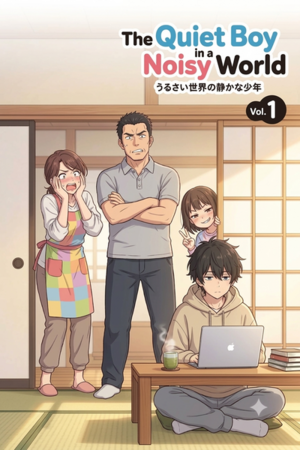
The Quiet Boy in a Noisy World
The fifth and sixth periods of a Japanese high school afternoon always feel like a sluggish, half-asleep tunnel.The sunlight filtering through the window frames had lost its midday bite, dissolving into drowsy specks of golden dust that settled across the wooden desks and floorboards. At the front of the room, the history teacher's chalk scraped rhythmically against the blackboard—tap-tap-tap, scriitch... his flat, monotonous cadence drifting through the air like a hypnotic lullaby.Two rows to my left, Daiki's head slumped forward every two minutes. Battling heavy waves of sleep, he would jerk upright with a start, rub his bleary eyes, and then, as the chalk resumed its drone, his forehead would inevitably sink back toward his desk.In the seat directly ahead, Kento idly traced aimless ink lines across the margins of his notebook, his eyes tracking the second hand of the circular wall clock.I remained completely stationary in my corner by the window.My lecture notes were already complete, organized in neat, concise handwriting. When you listen to capture the fundamental logic of a subject rather than mechanically transcribing a teacher's every word, you never have to clutter pages. Three precise bullet points were more than enough to crystallize the essence of a forty-minute lecture.Ding-dong-dang-dong.Three-twenty in the afternoon.The long bell signaling the end of homeroom echoed through the building, drawing a collective, audible sigh of relief from the entire room. True freedom, however, remained a few paces out of reach—blocked by the most non-negotiable tradition of Japanese school life: Souji (cleaning duty)."Alright, everyone! Our group has the classroom and the rear corridor today," the class representative called out.Daiki rubbed his eyes, pushed himself up from his chair, and immediately pressed a hand against his lower back. "Ugh... I think that cold yakisoba pan from lunch pinched a nerve in my spine. Can I just take the light work and clap the blackboard erasers outside?""Your spine turns into boiled noodles only when there's actual labor involved, Daiki," Kento scoffed, pulling two long wooden brooms from the utility locker and tossing one toward him. "Catch. If you leave dust in the corners today, I'm telling your crush that you haven't changed your socks since yesterday."Terrified by the threat, Daiki caught the broom instantly.Without uttering a word, I walked to the corner sink, filled a plastic bucket with cold water, and wrung out a coarse cotton rag (zoukin) until it was damp and firm between my palms.For many students, this fifteen-minute cleaning interval feels like an annoying penalty, but to me, it served as a grounding physical reset. As you slide the cloth rhythmically along the grain of the wooden boards, the tension gathered along your lumbar from hours of sitting naturally stretches away. The earthy scent of damp wood, the cool shock against your skin, and the steady, unbroken cadence of your hands—with proper focus, even wiping a floor becomes a quiet form of meditation.Within fifteen minutes, the desks were shifted back into immaculate rows. The classroom stood clean, airy, and still.Three forty-five in the afternoon.The moment I stepped past the school's entrance, a fresh wave of noise rolled through the courtyards.The late afternoon of a high school belongs entirely to Bukatsu (extracurricular clubs). From the dirt field drifted the sharp crack of baseball bats, the rhythmic thud of soccer balls, and the piercing trill of coaches' whistles. Above, through the open windows of the gymnasium, rubber soles squeaked violently against hardwood, while distant, dissonant scales from trumpets and saxophones leaked from the music room.Everyone was attached to a collective. Everyone was sweating, shouting, and actively laboring to advertise the vibrant energy of their youth.At the shoe lockers (getabako), I slipped out of my indoor slippers and laced up my plain black leather school shoes.Kento and Daiki were heading toward the stairs."Ren, are you honestly heading straight home?" Daiki asked. "We were thinking of hitting the arcade by the station to check out that new fighting cabinet.""No," I replied, tightening the shoulder strap of my school bag. "My club is already determined.""Your club?" Kento chuckled. "Right, the official Kitaku-bu (Go-Home Club). Where the singular founding rule is: abandon society and retreat directly to your futon.""It isn't running out of laziness," I said quietly, turning on my heel. "It's called conserving bandwidth by maintaining a safe perimeter from the herd. See you tomorrow."I walked through the heavy, wrought-iron main gates.Autumn twilights in Kyoto carry a depth found nowhere else in the world.The sun was dipping behind the western ridges, bleeding the sky from pale blue into a bruised gradient of burnt orange and deep twilight purple. Crows called out from the tiled eaves of two-story wooden merchant houses (machiya) lining the narrow alleys. Golden ginkgo leaves drifted down on the chilly breeze, dancing across the asphalt beneath my shoes.The crisp, clean air cooled my face.Steering clear of the crowded commercial thoroughfare leading to the station, I turned down a quiet, flagstone alleyway.The mechanical roar of modern traffic faded away. In its place remained only the subtle creek of wooden gates, the trickling of clean water through stone gutters, and the comforting aroma of evening dashi simmering from unseen kitchens.Just around the bend, sheltered beneath an ancient Japanese maple, stood the shop.Hanging from its weathered wooden lintel was an indigo cotton curtain (noren), dyed with the stark white kanji: 古本 (Furuhon—Secondhand Books).There was no glowing neon sign, no sleek glass display cases. Outside sat two weathered wooden crates packed with dusty, hundred-yen paperbacks arranged in neat rows.Lifting the heavy cotton curtain with one hand, I stepped across the threshold.Ting... ting...A small brass bell mounted above the frame gave a soft, delicate ring.Inside, the atmosphere felt as though time had quietly unhooked its gears fifty years ago and never bothered to resume. From the floorboards to the low ceiling, weathered mahogany shelves sagged beneath the weight of antique bindings, yellowed parchment, and forgotten literature. The air was rich with the scent of dried glue, aged paper fibers, and a subtle trace of sandalwood incense—a blend that instantly uncoiled the nervous system.Behind the low counter sat an elderly proprietor, wire-rimmed spectacles resting on the bridge of his nose. He offered a brief, passing glance over the rim of his evening newspaper, uttering no theatrical "Irasshaimase," asking no intrusive questions about what I sought.It was the rare kind of sanctuary where a person was permitted to simply disappear.I made my way down the narrow corridor between the stacks, my fingertips lightly brushing the spines of vintage volumes by Tanizaki and Akutagawa.Then, from the dimmest, rearmost corner of the aisle, a silhouette shifted.Someone was seated upon a low wooden stool.The same dark navy-blue sailor uniform, long sleeves draping over half of her palms, and straight brown hair falling neatly to her shoulders. Resting open across her lap was a heavy, yellowed vintage art catalog.The first-year girl from the library.As the slight creak of the floorboards under my shoes broke the stillness, she slowly lifted her gaze.The warm, amber glow of the shop's bare incandescent bulb washed across her features.There was no surprise in her eyes. She did not hurriedly snap the catalog shut, nor did she retreat into awkward, defensive pleasantries.She simply took the small canvas tote bag resting beside her stool and pulled it an inch closer to her side—a silent, unhurried gesture that cleared just enough standing room for me in the narrow aisle.Above the door, the small brass bell hung completely silent.Outside, Kyoto's dusk was slowly surrendering to the deep ink of night, but within that quiet wooden corner... two separate lives shared the exact same silence without needing to utter a single word.Author's Note:> Thank you for reading. If you enjoyed this chapter, feel free to continue following along.>





Please sign in to leave a comment.