Chapter 3:
Pending
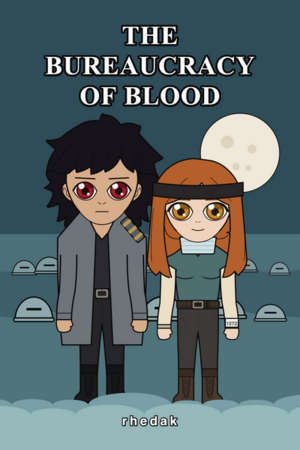
The Bureaucracy of Blood
Because Progon liked to remember how things used to be done, the bed was the modern kind, with a spring mattress and a reading lamp, and the shape of a coffin. Dritan lay in it with the curtains drawn against the day and his coat on the chair, and for some time he did not look at the coat.
Then he did. He got up and eased the paper from the pocket, and carried it back to bed and unfolded it under the lamp. A telephone number, in pencil, in a driver’s careful hand. No name.
It was late, in the way the district meant it, the sun climbing behind the curtains and the whole city going to sleep. To ring a stranger now was to be either a fool or in trouble. He lay with the phone on his chest for a quarter of an hour. Then he dialed.
It rang six times. “Vera.” A woman’s voice, flat with sleep. “Whoever this is, it’s late.”
“Fatmir gave me this number.”
A pause. A lamp clicked on at the other end. “Did he,” she said. “What for?”
“I want to join the Blood Guard.”
“They all do, at this hour. Name?”
“Dritan.”
“Just Dritan?”
“Just Dritan.”
He heard a noice as if she had sat up. Most of them managed on one name. The Guard was a good job for people like them, she said, safe and better paid, but you walked their streets and felt nothing, and they tested for that, and the testing was brutal. Fatmir couldn’t do it himself. Sleep on it, and ring the next night.
The line went dead.
He lay in the shape of the bed and looked at the lid that was not there. Next year, or the one after.
The next night she put him down for tryouts at a disused tram depot by the river bridge. Fatmir left him at the corner. His clothes and his pallor read as sheltered, his hair still cut by a man who came to the house, and under the bulbs his eyes were the same dark red as the rest. He wrote his true bloodline on the form, because a false line got checked. Agron named him Softie. Nobody asked what his father did. Grigor, told only that the nights were a favor, held the line. They stood in the afternoon sun a minute longer each week, and he blistered and peeled. Friendships were marked down, a recruit who leaned on another being one who might lean on a donor, so he sat one seat along from Agron.
In the second month an examiner with a folder sat each of them alone in a bare room and asked the same question. The man ahead of Dritan came out carrying his bag and was gone by the next night; word went round that he had said yes, a donor’s hands. “Is there any donor you remember?” she asked when Dritan’s turn came. “Any one of them.”
One two seven two. “No,” Dritan said.
She wrote something down. It came out smooth.
In the sixth month she called him into the office behind the ticket cage. She had his form in front of her.
“The line for bloodline,” she said. “I never read it. Upstairs did, at headquarters, this evening. They read what you wrote and rang your father.” She turned the folder round. Across the front, in blue, a stamp: PENDING REVIEW. “You pass on paper. Everything. Technically anyone can sign up. Ours start at the bottom. Yours wouldn’t. But Upstairs can’t refuse a Fisniket and won’t overrule his father, so it’s pending.”
“For how long?”
“A week. A decade. I’ve seen both.” She looked at him. “You could go home, Dritan Fisniket. People do.”
“No,” Dritan said.
***
At dawn his father stood in the hall under the lamp, still holding the telephone receiver, and did not wait for the door to close.
“A tram depot,” Progon said. “Training to stand guard over livestock beside drivers’ sons. Not one of ours has ever done a thing so shameful. Do you understand what you will lose? The clan. Your allowance. Your place at this table.”
“I don’t think I’ll notice,” Dritan said.
Progon set the receiver down very carefully.
Later Kamona stopped in the doorway of his room. “Is there someone?” she asked.
“No.”
She looked at him as long as she had at the table. “I see,” she said, and went.
***
The file stayed on Vera’s desk. Pending candidates could train; nothing in the regulations said otherwise, and Vera did not like being told things by Upstairs. Every year she stamped the folder again, over the last, because the stamp had to be current, until the word was a blue block you could barely read.
Recruits who had come after him were advanced past him. At home Dritan’s place at the table moved down the board and then was not laid at all. The allowance stopped and so did the tutors, and the Retainers meant for him went to Grigor. Kamona sent plates up to his room and said nothing about them. Dritan kept running, because running was allowed. In time the peeling stopped and he tanned.
The night Agron was posted north, he sat down opposite Dritan at the depot’s long table.
“They say your father could end this with one call,” he said. “Pull you home.”
“He could.”
“And?”
“No.”
Agron looked at him for a while. “You never once sat next to me,” he said.
“No.”
“I noticed. So did they.” He grinned. “Good for you, Softie.”
The next night he went north as a plain guard. By the ninth stamp Dritan had stopped telling himself next year.
On the night he came of age his father sent for him to the study, which was never a good sign. Kamona sat by the window. Progon stood with his back to the room, and then, for the first time in years, he turned and looked at his son.
“You have gone the color of a field hand,” he said. He turned back to the fire. “Until tonight my word held that file. From tonight only the clan’s word could hold it, and I will not give it.” “Let him do what he wants,” he said, to his wife. “He’ll come back in a few decades, when the novelty has worn off.” Kamona did not turn from the window. “You will do it without the clan,” Progon said, “and without my name on any form. If I could revoke your bloodline, I would.”
“I know,” Dritan said.
Three nights it took Upstairs to find a pen. Then the review was concluded, and Vera told him so with the folder shut, not looking up.
She took a coat from the bottom drawer, gray, folded, and put it on the desk, with a badge on top and a pair of boots beside it. It was the gray of the coat he had once watched for three breaths across a round room, waiting for it to turn. On the left shoulder, already sewn, were bars. The thread had gone dull in the drawer.
“Those were ready,” he said.
“Since Upstairs read your form.” Vera did not smile. “Agron left word for this day. He says he’ll salute you when he must and not before.”
He picked up the coat.
“Congratulations, Commander,” she said. “You start next month.”











Please sign in to leave a comment.